THE CHRONOLOGICAL
BING CROSBY ON TELEVISION
Compiled by Lionel Pairpoint, Malcolm Macfarlane and Greg Van Beek
The International Club Crosby is placing this superb book detailing Bing’s television career onto the Internet for use by fans and researchers alike. This is an updated version of the original book published by the club in 2003. Paper copies of the original, containing over 70 photographs, are still available.
Foreword
‘A tea-chest, a biscuit-box, cardboard, darning-needles, hat-boxes,
cycle-lamp lenses, discarded electric motors, piano-wire, glue, string and
sealing wax to a total value of 12/6d plus several hundreds of flashlight
batteries wired together
to provide a 2,000 volt power source.’
This heterogeneous collection comprised the prototype of a system that
would eventually provide the most astonishing advance in the field of ‘in-home’
entertainment since primitive man pounded on a hollow log for the amusement of
his family. An infinitely more sophisticated component of that early
apparatus can now be found in billions of homes around the globe - possibly in
every room, including the bathroom! Just take a moment to consider this
remarkable prophecy from ‘Lightning’, a popular science magazine of the 1890’s:
‘Before the next century shall expire, the grandsons of the present
generation will see one another across the Atlantic and the great ceremonial
events of the world, as they pass before the eye of the camera, will be
executed at the same instant before mankind.’
When John Logie Baird transmitted the murky image of a Maltese cross, a
distance of three metres, across his attic room, it is possible that he would
have cherished the same vision. But could he really have conceived ‘live’
pictures from the surface of the planets or the tracking of our every move in
Woolworth’s? He died in 1946 when his invention was still something of a
‘freak show’, to be enjoyed by the relatively affluent. So, he knew
nothing of Video Cassette Recorders, WWF Wrestling, Play Stations, the Cartoon
Network, Digital Versatile Discs, Jerry Springer, ‘Reality’ Television or
Buffy, The Vampire Slayer.
Nowadays, bookcases groan under the weight of hefty tomes that have been
written on the subject. Among them, there will be ‘Guides’, ‘Handbooks’,
‘Who’s Who’s’, ‘Companions’ etc., etc. You may even discover, ‘The Golden
Age Of Television’ and ‘The Encyclopaedia Of Television’, somewhere
in there. Please take notice that the volume you are reading makes no claim to
either of these prefixes. ‘Golden Age’s’ will vary from generation to
generation and there is likely to be a publication waiting, on some editorial
slipway, eager to be launched, entitled, ‘The Golden Age of Popular Music - The
1990’s’!
Furthermore, the dictionary advises that an ‘encyclopaedia’ will
contain, ‘information on many subjects or on many aspects of one
subject’. Hopefully, this publication will be offering information on
only one aspect of one subject. It is concerned with Bing Crosby’s
appearances on television and the compilers’ aim has been to assist in the
dating, cataloguing and identification of those foggy videos and/or woolly
audio tapes that may form a cherished part of the many collections of his work.
Whereas, he was not exactly dragged, kicking and screaming, into the
medium, his entry into television was hesitant, to say the least. His
early quotes on the subject are well documented:
‘No entertainer who’s in everyone’s home once a week can survive very
long. If a new motion picture of mine were released each week for fifty-two
weeks - I soon wouldn’t have many friends coming to the theatre to see me’ or, ‘The chef can’t stir too
many soup kettles. Television is murder but radio just takes a few hours
a week, all I have to do is stand up at the mike and sing.’
The last sentence from these quotations may help to explain his
philosophy in the matter. It was no secret that Bing preferred the unseen
informality of radio as opposed to getting ‘decked out’ for television and
admirers of the Crosby style might have been perfectly content to see him
‘stand up at the mike and sing’. Indeed, the first two programmes that flew
under the banner of ‘The Bing Crosby Show’, in 1954, for General Electric were,
essentially, radio with pictures. Both were filmed for TV transmission
and it is highly probable that the musical content owed much to the extensive
taped library of songs built up from his radio shows. For example, his
opening song in the first of these TV ventures was ‘Y’All Come’ and this was
identical to the version used on his radio programme in November 1953, in
addition to being the very same version that was mastered for commercial
release.
Setting aside re-runs of his old movies, an item advertised as Bing’s
television debut, was also a filmed contribution. Probably shot during a
transcription session for ‘Philco Radio Time’, his rendition of ‘Silent Night’
with the Bob Mitchell Boys’ Choir, used as an epilogue to NBC’s ‘A Christmas
Carol’ enjoyed the distinction of being seen on television before it was heard
on radio.
It should be remembered that in the
late 40’s and early 50’s, TV broadcasts were either performed live in front of
television cameras or filmed in advance with motion picture cameras. The
only way to preserve a live broadcast was by means of a somewhat primitive
process known as ‘kinescope’. This was merely a high-flown description for the
simple process of placing a motion picture camera in front of a studio
television monitor in order to preserve the image and sound for
posterity. As can be imagined this technique was vastly inferior to
‘live’ or even filmed transmissions.
Well aware of the advantages, not to mention, convenience, that the use
of magnetic tape had brought to his radio series, Bing would have shown a keen
interest in the research going on at the laboratories of Bing Crosby
Enterprises in Beverly Hills, Cal. It was here that John Mullin and Wayne
Johnson demonstrated the first video recorder on 11th November 1952. Bing
Crosby Enterprises also showed the first colour video in 1953, though neither
was developed commercially.
For the next ten years, Bing honoured the declaration of principles that
he had set out for himself regarding over-exposure on television. During
this time, there were never more than two of his own specials per
annum. Naturally, there were guest shots, ‘walk-ons’ and sundry
interviews but in 1964 he agreed to appear in a weekly ‘sitcom’ series for ABC
when another of those early quotes might have returned to haunt him.
‘There’s no question in my mind as to what TV format would be best for
me. I’m investigating the possibility
of a filmed half-hour show, employing motion picture
techniques. . . Anybody who goes into television should
be sparing in how much they do’.
All 28 episodes of ‘The Bing Crosby Show’ were reeled off in the space
of 31 weeks, a process inherent to sponsored broadcasting. The regime was particularly
punishing and most un-Binglike. He was commuting to Hollywood from his
Hillsborough home, filming five shows in three weeks then taking two weeks off.
At this time he was suffering from recurrent, painful attacks of bursitis and
he wrote to Kathryn, ‘The work isn’t too difficult but it’s constant
and all other activities and interests must be excluded. We work straight
through from 8 am to 7 pm every day. By the time I bathe and dress for
dinner, it’s 9 o’clock and I collapse into bed at 10.’
He was cast as ‘Bing Collins’, a character who,
coincidentally, shared the same initials, enabling him to use his own
handkerchiefs, shirts and cufflinks should he so desire! The
characterisation was a true alter ego, corresponding with everyone’s image of
the real Bing Crosby. Urbane, amiable, witty, a master of the bon
mot, ready to deliver the perfect homespun bromide to difficult, teen-age
daughters and most importantly, able to burst into song every half-hour. But although his fans
may have loved it, it is reported
that ‘he hated the show and hated doing it’ and ‘it took up more of his time
than it was worth to him’. ‘Variety’ condemned it as being ‘15
years too late’. Other critics damned it with the faint praise of ‘cute’
and ‘pleasant’. Inevitably, it slid in the ratings, drawing the bitter comment
from Bing, ‘It’s a rat race! If you don’t get a rating, they dump you.’
In the same year, he began his tenure
as one of the regular emcees of the prestigious ‘Hollywood Palace’, surviving
the possible embarrassment of introducing performing chimps and plate-spinners,
to appear in more than thirty of these shows.
If one were pressed to use the tag,
‘Golden Age’, this would, undoubtedly, have been, ‘The Golden Age Of
Variety On Television’ and those brought up on ‘Café Continental’ through
‘Saturday Spectacular’, ‘Sunday Night At The London Palladium’ and ‘The
Hollywood Palace’ will surely, lament the demise of these extravaganzas. Today,
would-be producers would be stopped dead in their tracks in contemplation of
the terrifying cost of a forty-piece orchestra and a glittering parade of stars
from stage and screen and the best that we can hope for, in these first years
of the 21st century, is the annual, filmed version of the ‘Royal Variety
Command Performance’ or a one-off, ‘one-person show’ with the camera panning
around an audience of mixed celebrities enjoying a free outing.
It was in the ‘Hollywood Palace’ series
that the traditional, Crosby family Christmas show was born, continuing (with
the exception of 1969) until ‘Bing Crosby’s Merrie Olde Christmas’, screened
posthumously in 1977.
Many stars of radio, stage and film encountered difficulties in their
transition to TV. In an early appearance, Bob Hope can be seen, reading
his gags from a script and experienced actors were known to refuse parts for
fear of ‘corpsing’ before an unseen and unknown audience. Those who witnessed
Bing Crosby make his considerable mark in four of the major show business
media: vaudeville, records, radio and films, would have had no doubt that, in
spite of his initial reluctance, his easy and relaxed style would be a ‘winner’
for television. On some occasions, those same admirers may have been
disappointed, particularly in guest spots, when he was presented like some
national monument, for a dutiful audience to applaud brief snatches from
‘Pennies From Heaven’ or ‘Swinging On A Star’. On the other hand, they would
have been gratified by the genuine ‘Crosby Medley’, featured in some of his
later programmes and full versions of such numbers as ‘I Left My Heart In San
Francisco’; ‘Mame’; ‘Raindrops Keep Falling On My Head’; ‘The Men In My Little
Girl’s Life’ and ‘Bridge Over Troubled Water’ that they might never have heard
in any other context.
Bing’s peaks on TV came relatively late in his life when many others might have been considering winding down. There is no doubt, however, that public entertaining is a very difficult occupation to retire from, as evidenced from this final quotation, from his biography -‘I don’t have to work at all if I don’t want to. The reason I don’t quit is that I’ve stayed in the entertainment business so long, I’ve become a squirrel on a treadmill. I can see no end to my road, so I can’t jump off’.
Lionel Pairpoint
THE CHRONOLOGICAL BING CROSBY ON
TELEVISION
This chronology details, in order, every programme that the compilers
have been able to trace. After due consideration, a few doubtful programmes
which had been included in our original drafts, have been deleted due to lack
of evidence. For example, there was a strong claim that Bing Crosby had some involvement
with a ‘This Is Your Life’ programme honouring Laurel and Hardy. A copy
of this show has been discovered and has appeared on satellite television and
on a commercially issued video but the copy reveals no contribution by him.
Another was ‘The Bob Hope Birthday Special’ purportedly screened on 29th May
1963. Audio copies exist of an NBC radio programme,
sharing the same date, entitled ‘Happy Birthday, Bob’. Greetings are
heard from Bing, Jack Benny, Frank Sinatra, Eddie Cantor, George Burns, Jimmy
Durante, Rosemary Clooney and many others. A review of this radio show
appeared in ‘Variety’ of 5th June 1963 but a search of the television listings
from several West coast newspapers show no corresponding television show.
To facilitate reference, the programmes have been numbered consecutively
within the dates of the original broadcasts. It should be noted that Bing
Crosby’s name has been accorded priority in musical items and/or sketches, no
matter how small his contribution to such items may have been. Those
items in which he participated are indicated by an asterisk (*).
An attempt has been made to include all musical items performed by or
performed to, by other featured artistes. Details of comedy routines, sketches
and monologues by other participants and incidental music to accompany
acrobats, jugglers, magicians etc., have not been included
Some items have been deliberately
omitted. Although references may be made to them in the programme notes,
his Hollywood films and the many ‘tribute’ programmes aired after his death are
not shown. Some caution has also been shown with original filmed items, not
intentionally produced for television screening.
No special mention has been made to the commercials featured during the
programme breaks, although Bing may have been actively involved in them.
This also applies to the annual Crosby Golf Tournament, together with the
Minute Maid and Tennetts advertisements.
An endeavour has been made, in the notes, to detail some of the
commercially issued, video cassettes and/or audio versions on record or compact
disc featuring excerpts or complete shows illustrating Bing Crosby’s work on
television. However, it should be appreciated that these are only
representative examples of the material that still is, or has been
available. It is realised that there are some issues and equivalents not
shown herein but the compilers have not felt justified in including items that
have not been personally checked.
Considerable research has been undertaken and a great many authoritative
publications have been consulted to ensure that song titles are correctly
quoted. However, minor differences have been noted in works of reference
on the subject and in these cases, the compilers’ discretion has been observed.
In addition, there were tunes, obviously specially written to accompany a
situation or link, which may not have enjoyed the formality of a title by the
composer and these have been, arbitrarily, given a name with a view to
assisting identification.
Lists, alphabetically, the songs or musical items in which Bing Crosby
participated.
Details, alphabetically, the people and places concerned
in the programmes.
Index 3
Lists, alphabetically, the songs or musical items performed solely
by or for other guests during the programmes.
NOTE:
Index 1 comprises some 1250 renditions by Bing but it should be pointed
out that a large percentage of the 765 titles shown were included in medleys
and may even consist of only two or three words. By the same token, Index
3 contains almost 700 song titles, representing more than 800 renditions and in
both cases, it has not been considered practicable to note, individually, every
occasion on which a mere fragment from a song was used.
A classic example can be observed on the Hollywood Palace of
21st May 1966. A medley with Johnny Mercer
featuring no less than forty titles is timed at precisely five minutes, which
allows roughly, seven seconds for each selection, including linking dialogue!
ACKNOWLEDGEMENTS
The first published listing of Bing's
appearances on television was printed in BING magazine in 1993 and was prepared
by Malcolm Macfarlane who had drawn heavily on earlier
research initiated by our late members Bob Roberts and Eric
Griffiths. He was aided also by Frans Van der Kolff and
the late Jean-Paul Frereault at that time, as well as
gathering valuable information from various early Crosby fan club magazines. In
amalgamating Malcolm's earlier work and his subsequent amendments for this
book, considerable fresh research was carried out by Malcolm, Greg Van
Beek and the writer. Much use was made of the excellent series of
books produced by Gary Hamann (Bing Crosby In The 50s,
etc.) and of reviews taken from the show business journal,
‘Variety’. Wig Wiggins, Arne Fogel, George O'Reilly, the late
Gordon Hooper, Gwen Harvey, Charlie Campbell, Fred Romary, George Harwood,
Frank Dolson and Ron Hall added important
information.
Co-author Greg Van Beek generously
provided many of the photographs, including some previously unpublished
material, that have done so much to enhance and illustrate the text. In
addition, we are grateful to Ron Bosley, who has keenly supported
this publication and supplied further photographs from his collection. Arne
Fogel too weighed in with some rare pictures and our thanks are due to him as
well.
Our sincere appreciation is extended to
all those who have assisted with this project.
Very special thanks are due to Martin
McQuade who gave, unstintingly, of his time and efforts in reviewing
the completed manuscript, making corrections and adding many items of which we
had been unaware.
Lionel Pairpoint
THE
CHRONOLOGICAL BING CROSBY ON TELEVISION
No. 1
26th May 1948 - Hollywood Premiere of ‘The Emperor Waltz’ (KTLA-TV) (a)
Bing
is in attendance at the Hollywood Paramount and when interviewed by announcer,
George Fischer, offers the wry comment, ‘This picture was made so long ago, I’m
anxious to see how it turned out!’ (In fact, shooting on the movie had
been completed almost two years previously).
Amongst other personalities
due to attend were Lucille Ball, Eddie Cantor, Gary Cooper, Joan Crawford, Mona
Freeman, Clark Gable, Betty Grable, Rex Harrison, William Holden, Bob Hope, Van
Johnson, Alan Ladd, Hedy Lamarr, Pat O’Brien, Larry Parks, Edward G.
Robinson, Mickey Rooney, Shirley Temple, Gene Tierney and Esther Williams.
Note:
(a)
The programme was also broadcast
on radio station KFWB.
“A large turnout of
Hollywood personalities is guaranteed at the world premiere of ‘The Emperor
Waltz’ tonight at the Hollywood Paramount Theatre. Bing Crosby, arriving from
New York this morning to attend his first world premiere event. The gala
occasion is expected to draw a crowd of several thousand spectators and extra
police will be on duty to handle the overflow throng on Hollywood Bvd.”
(‘Los Angeles Times’ 26th
May 1948)
No. 2 19th December 1948 – ‘Philco Playhouse’ - ‘A Christmas Carol’
(NBC)
*Silent
Night
(a) with The Bob Mitchell Boys’ Choir
Note:
(a) A video version appeared on Warner Music Video 8536 50294 3 - ‘The Magic Of Bing Crosby’ and was also included as an extra on the Infinity Entertainment DVD “The Legendary Bing Crosby” (IEG2204) issued in 2010.
A video version was also included in the Blu-ray "Going My Way - 75th Anniversary Edition" issued by Shout Select in 2019 (No. SF 20107 2117732)
These video versions
appear to be identical to the audio version that was broadcast on Philco Radio
Time on the 22nd December 1948.
“Philco
Television
Playhouse’s presentation of ‘A Christmas Carol’ on NBC TV, Sunday Night
(19th)
was a warm, tender and wholly evocative interpretation of the Charles
Dickens
classic. As an epilogue, Bing Crosby made what was advertised as his
first
appearance on video, via films with a rendition of ‘Silent Night’ but
this
highly publicized stint was completely overshadowed by the preceding
dramatization. Film production on the Crosby number, which had the Bob
Mitchell
Boys’ Choir backing up, was disappointingly flat. There was no mention
of the
fact that this section of the show was filmed but viewers probably
guessed it
from the faded texture of the screen image. Crosby, incidentally, has
been seen
on video before this in several of his old pics.”
(‘Variety’ 22nd December
1948)
Crosby Formula To Show The Way (Headline)
“Bing Crosby, who
recently transferred his future radio and television allegiance to CBS’s
William S. Paley for a $1,000,000, is mulling a two-way programming operation
that may be the answer to radio stars going video, yet domiciling in Hollywood.
The whole problem of shifting their base of operations to New York, key
production centre of television, has become increasingly vexing to top air
personalities who, despite recognizing that sooner or later, they must embrace
TV, are nevertheless reluctant to relinquish Californian climes. With Hollywood
retaining its grip on coast to coast radio production, the LA to New York
problem has been a major factor in stymieing the pacting of big-time
personalities for television.
It
was considered inevitable that someone would evolve a formula that in one fell
swoop, would permit to simultaneous radio/TV video casting to the theme of
‘California Here I Stay’ and if Crosby pioneers the practice which would
involve taping for AM and kinescoping for TV at one and the same time, it’s
considered a certainty that it would spark a succession of star-studded
simul-casts, emanating from the coast. It would also provide the impetus for
the taping (such as Crosby, Groucho Marx etc) of major radio programming from
hereon in, a practice that has already been blessed or had already been given
the blessing of Paley, NBC prexy, Niles Trammell (until this year was strictly
verboten on both sides of the major networks).
Crosby,
it is reported is peddling his show for next season. Philco is now paying him
$25,000 a week for his taped AM program on ABC but the crooner it is
understood wants $27,500 for next season - that’s for radio alone but he wants
a simultaneous AM-TV show-casing on Columbia. This would be feasible by
training the video cameras on his program while it’s
being tape recorded (weeks in advance of airing) and kinescoping the stanza for
a date release of the transcribed TV version. Such a parlay would also permit
for separate sponsorship for the video edition with a commercial cut-in to
dovetail with the AM commercial insert.”
(‘Variety’ 9th February
1949)
“In New York, Bing had
discussions with CBS regarding a television show. While there, Bing gave all of
the shows the once over and said he’s very enthusiastic about the medium but
that it looks like a lot of work and will take more time to put together than a
radio show. He doesn’t expect to take the leap until the fall of 1950.”
(‘BINGANG’ summer, 1949)
No. 3 27th February 1951 – American Red Cross Fund Campaign (CBS)
A filmed guest
appearance with Bob Hope and Judy Garland and others. Introduced by Ed Sullivan.
Most contributions were probably, pre-recorded and the show was also broadcast
on radio at the same time. Further details unknown.
No. 4 21st June 1952 – Olympic Fund Telethon (CBS & NBC)
Featuring Dorothy Lamour, Frank
Sinatra, Bud Abbott & Lou Costello, George Burns & Gracie Allen, Dean
Martin & Jerry Lewis, Liberace, Paul Douglas, Ezio Pinza, Phil Harris and
Orchestras conducted by John Scott Trotter, Victor Young and David Rose.
*Road To Morocco
(Parody)
with Bob Hope
*I Found A
Million-Dollar Baby (In A Five & Ten Cent Store)
with Buddy Cole (Piano) & Red Nichols (Cornet)
*Doodle Doo
Doo
with Bob Hope & Ezio Pinza
*Carolina In
The
Morning
(a)
Note:
(a)
A snatch only.
“Bob Hope and Bing
Crosby’s 14½-hour telethon to raise funds for the U.S. Olympic team was a
resounding financial click, topping the $1,000,000 mark, as the mammoth benefit
checked off the CBS-TV and NBC-TV channels at 1:30 p.m. on Sunday.
It
was one of the few times in video’s career that the two major networks pooled
their facilities and resources for an entertainment-slanted show, a move
inspired by Crosby’s CBS identity and Hope’s NBC affiliation.
It
was an occasion for some major TV ‘firsts’, including the long-awaited debut of
Crosby as a video personality. He demonstrated (toupee and all, an a la the pix
Crosby, as distinct from the hat-toting, sports-attired, pipe-smoking Bingle of
the radio studio audience) that he’s a natural and a ‘sure bet’ in the
transition to TV, adding an affirmative addenda to the current wholesale
jockeying among the top bankrollers in TV to latch onto his services for the
upcoming semester.
.
. . If by 1 a.m., (two hours after the telethon got under way) the viewer was
sorely tempted to call it quits for the night, it was because the hoped for
Hope-Crosby mental gymnastics and by-play were conspicuous by their absence;
the Groaner was still holding back on the vocals (except for a ‘Road to
Helsinki’, Olympic-slanted duet, with Hope, as the curtain-raiser) and when he
finally got around to ‘Million Dollar Baby’ as his first legit song
contribution to TV, it was attended by an embarrassing mental void on the
lyrics which didn’t even inspire the Groaner to gag his way out of the fumble.
.
. . Those who stayed with it, however, were rewarded as the show gained
momentum and the Hope-Crosby dualistics hit their stride. (By the Sunday
afternoon finale, they were a TV affinity which suggested they might have been
working the video channels for years).”
(‘Variety’ 25th June 1952)
The Bob Hope-Bing Crosby
“telethon” to raise funds for the United States Olympic Fund, which probably
kept a good part of the nation up for most of Saturday night and Sunday
morning, was quite a financial feat. A total of $1,000,020
was contributed or pledged over a fourteen and one-half hour period, which is a
formidable achievement now that these marathon performances occur so frequently
on TV.
Theatrically, the
chief news of the “telethon” was that it marked the video debut of Bing Crosby.
If there ever was any doubt about it, the word is that the groaner can make the
medium his own whenever he chooses. Still youthful as ever in appearance and in
good voice, Bing’s relaxed style and easy-going ways were made to order for
home viewing. The Bing is in.
Otherwise, however,
the long show was something of a disappointment. Perhaps the “telethon” stunt
is just becoming too familiar, but much of yesterday’s program was far from
exciting and more akin to a succession of personal appearances than a real
show. Viewers must have been particularly disappointed that Bing was so sparing
with his vocal wares. During the ten hours that this department watched he did
only one complete song.
The “telethon” was staged
at El Capitan Theatre in Los Angeles and was carried by both the Columbia
Broadcasting System and the National Broadcasting Company television. From the
outset Bob and Bing made it clear that for the night they would be intent on
the business of raising the needed funds to transport the American team to
Helsinki. Accordingly, their participation consisted chiefly of reading figures
and the names of contributors, a chore in which they had the help of Dorothy
Lamour. This inevitably made for considerable repetition and, while some of
their byplay was fun, the show as a whole moved pretty slowly.
Part of the
program’s lack of pace could be attributed to the staging, which was more in
the style of radio than television. The guest artists were forced to work in
front of a microphone, which is the old-fashioned way of doing things now, and
this imposed severe limitation on the variety of acts. The emphasis
was mostly on singing and instrumental solos, with hardly any representation of
dancing or sketches.
In the early
morning hours the madcap team of Dean Martin and Jerry Lewis injected some life
into the proceedings and the studio audience really came alive. Unfortunately,
Jerry somewhat overstayed his welcome, but Bing’s attitude of superiority
toward the comedy duo was a mite surprising.
Another star making
his TV debut during the “telethon” was Phil Harris, the veteran of the Jack
Benny program. He showed to good advantage in two lively numbers and his
vitality came over very effectively on TV. Frank Fontaine and his son, Bobby,
also had an amusing comedy act during the morning portion of the show.
Bob and Bing
deserve the country’s thanks for pitching in at the last moment to assure
adequate finances for the Olympic team, and it must be
hoped that those who made pledges will keep them. With past “telethons” the
actual cash finally received was only a small part of the total pledged and
many of the “contributions” turned out to be just cheap and thoughtless bids
for free publicity. It’s probably just as well that Bob and Bing rescued the
Olympic Committee from its financial plight before the “telethon” format is
worn out.
(Jack Gould, New York Times,
June 23)
“I need no crystal ball
to tell me that television looms big in my future, as it does in the future of
any entertainer. The principal reason I haven’t had a go at it is that radio,
recordings, picture-making and the other businesses in which I’m involved take
up so much of my time and mean so many trips away from home that the time to do
it right just isn’t available. Then, too, there are a lot of things I like to
do aside from business, like golfing, and
fishing, and hunting, and if I did TV, when would I so indulge myself?
TV is here to stay, and it will be here when I get
ready to go into it. There’s a question in my mind as to what TV format would
be best for me. I’m investigating the possibility of a filmed half-hour show,
employing motion-picture techniques the way a big studio films a short subject.
But the expense would be tremendous. It might cost so much to make that it
wouldn’t be practical. I’m not sure I could find a sponsor who could get up the
large bundle of coin such a show would cost. But given the right format,
television doesn’t frighten me. I should be able to get by, doing what I’ve
done in pictures, in camp shows, and in vaudeville - - entertain.
I
do think this: anybody who goes into TV should be sparing in how much work he
does. No entertainer who’s in everyone’s home once a week can survive very
long. His welcome can’t be stretched that far. If a new motion picture of mine
were released each week for fifty-two weeks—or even for thirty-nine weeks—1
soon wouldn’t have many friends coming to the
theaters to see me. And they’d drop the flap on me at home, too. They’d weary
of my mannerisms, my voice, my face.
Three
years ago the price for my complete radio package was twenty-seven thousand
five hundred dollars a broadcast. This included my salary of seven thousand
five hundred dollars a week. For my 1951-52
radio-broadcasting season I made a package deal with
General Electric at sixteen thousand dollars a week. This same contract
stipulates that so long as I’m doing a radio show for G.E. I will not do a TV
show of my own - except for General Electric. I have no agreement on price with
G.E. but there are indications that a big show on television would be worth up
to fifty thousand per week.
In
view of this, it may be cause for wonderment on the part of some that I don’t
succumb to the lure. Naturally, I am toying with the idea - who wouldn’t at
such prices - but I’m content to take my time. After all, I’m doing reasonably
well now, and I don’t have to work at all if I don’t want to. The reason I
don’t quit is that I’ve stayed in the entertainment business so long I’ve
become a squirrel on a treadmill. I can see no end to my road, so I can’t jump
off.”
(Bing
Crosby, writing in ‘Call Me Lucky’.
Probably written during the summer of 1952)
No. 5 4th January 1953 – ‘The Colgate Comedy Hour’ (NBC)
Guest
appearance. With
Don Cherry, Marilyn Maxwell, Bob Hope and Jack Buchanan.
“Bob Hope hit his top
comedy level of the season with a sprightly hour of gags and quips on last
night’s Comedy Hour. There was plenty of help around but Hope took over from
the start and the tempo whisked from his opening monolog to the ‘Road To Bali’
scene, which brought on Bing Crosby as a surprise guest making his debut on
commercial television.
.
. . Hope reserved the closing minutes for Crosby’s entry and a long pitch for
their Paramount picture, ‘Road To Bali’, in which each
has a financial stake. By actual count ‘Bali’ was mentioned 12 times and the
Groaner walked off with a neon sign that spelled out ‘Road To
Bali’. Crosby twitted Hope for his crass commercialism in plugging the picture
but passed off his own guesting with, ‘anything to get a buck at the box
office’. It was a gratis shot by Bing but Hope promised to pay it back. For a
closer, Bing, Bob and Buchanan did a song and dance and then came on with ukes
which they didn’t have time to play.”
(‘Daily Variety’ 5th
January 1953)
No. 6 15th February 1953 - ‘Toast Of The Town’ (CBS)
Bing
was one of the advertised guests along with Gene Autry, Roberta Peters,
Jimmy
Boyd, Molly Bee, Eileen Barton and Honeychile Robinson. In fact, his
only appearance is in a sequence from the film "Going My Way".
No. 7
25th February 1953 - ‘I Married Joan’ (NBC)
Guest
appearance. Sitcom,
which ran for 4 years featuring Joan Davis and Jim Backus. Bing appeared
carrying a bag of groceries into Joan’s kitchen. The episode was entitled, ‘The
Opera’ and it was filmed in advance.
“In the Crosby self-kidding
tradition, the script took note of the Groaner’s reluctance to plunge into TV.
As he sauntered onstage, Joan Davis gasped: “You’re not . . . Oh, no, he
wouldn’t be on television. Too fat for it - Too slow.”
(‘Newsweek’ 4th January
1954)
No. 8 25th November 1953 – ‘Thanksgiving
Party in aid of the Muscular Dystrophy Foundation’ (ABC-TV)
Hosted by
Dean Martin and Jerry Lewis.
Publicity indicated that Bing was to make a guest appearance with Lucille Ball,
Desi Arnaz, Jack Benny, Rosemary Clooney, Xavier Cugat, Jimmy Durante, Frank
Sinatra, Groucho Marx, Liberace, Marilyn Monroe, Harry James, Betty Grable,
Danny Thomas, Ray Bolger, Jane Wyman, Dick Powell and others. However, it seems
that Bing and many of the guest stars listed were not on the show.
No. 9 3rd January 1954 - ‘The Bing Crosby Show For General
Electric’ (CBS) (a)
Directed
by Fred de Cordova. Written and produced by Bill Morrow. With the John
Scott Trotter Orchestra, Perry Botkin, The Cass County
Boys, Barbara
Logan, Sheree North and Jack Benny.
*Y’All
Come
(b)
*It Had To Be
You
(c) with
Buddy Cole
(Piano)
*Changing
Partners
with the Rhythmaires
*I Love
Paris
(d)
Notes:
(a) A video version of the programme was issued on Festival Films (unnumbered) - ‘Bing Crosby’s Cavalcade’ and on Video Yesteryear (number unknown). A brief video extract from the dialogue between Bing and Jack Benny was included in the ABC-TV programme ‘Bing Crosby: His Life and Legend’ which was shown on 25th May 1978 and in the Warner Music Video 50294-3-A - ‘The Magic Of Bing Crosby – Part One – Special Edition’. Brief extracts were also seen in the BBC2-TV programmes ‘Bing On Bing’ and ‘Living Famously – Bing Crosby’ shown in the UK on 25th December, 2002 and 23rd January 2003 respectively and in the KSPS-TV documentary Bing: Going My Way shown on PBS in May 2003 and subsequently issued on DVD and video. The entire show was issued on the Collectors’ Choice Music 2-DVD set “Bing Crosby: The Television Specials – Volume 1” in April, 2010 and included in the Time Life DVD set "The Best of the Bing Crosby Specials" (Disc 1), issued in 2018.
(b) A video version of this item
appeared on Warner Music Video 8536 50294 3 - ‘The Magic Of
Bing Crosby’ and on the Goodtimes Home Video ‘Bing Crosby - Hollywood’s
Greatest Entertainer’.
(There is no doubt that this is the version of the
song, issued as a commercial recording, which was also heard on the General
Electric radio programme on 22nd November 1953).
(c) A video version of this item appeared on Warner Music Video 8536 50294 3 - ‘The
Magic Of Bing Crosby’. The item was also shown as part
of the PBS presentation “The Legendary Bing
Crosby” made available to PBS stations in 2010 and subsequently issued on DVD
by Infinity Entertainment Group (No.IEG2204). Brief extracts were also used in
the Independent TV presentation ‘The South Bank Show’ shown in the UK on 26th
December 1999 and in the USA on 24th December 2000 on the Bravo channel as
‘Bravo Profiles Legendary Crooner Bing Crosby’.
(d) A video version of this item appeared in the Warner Music Video 50294-3-A -
‘The Magic Of Bing Crosby – Part One – Special
Edition’. The item was also shown as part of the PBS presentation “The
Legendary Bing Crosby” made available to PBS stations in 2010 and subsequently
issued on DVD by Infinity Entertainment Group (No.IEG2204). A video version was
included in the i-tunes album "Bing Crosby: With
All My Heart" released in January, 2011.
“Bing banged over a
whopping first show on TV for General Electric, with the New Year only three
days old as Crosby ushered in his video debut with his own series, sporadic
though they’ll be, it automatically gave an aura of shining expectancy to the
’54 outlook. For years it has been axiomatic in radio that BC can do no wrong.
On the basis of the GE Sunday night bow (in the usual Fred Waring spot on CBS
TV), it goes in spades. It can be argued that the decision to ‘go film’ instead
of live, stripped the half-hour show of a certain spontaneity element (This
reviewer, for one, would have preferred a ‘live’ Crosby). At this stage of the
game it might seem totally unnecessary and unreal for the Groaner to dandify
himself to look twenty-five again and it can be argued that the singer has yet
to achieve an on camera TV stance, more appropriate to his demeanor than
casualness. It can also be argued that there was no reason for Bing to permit
his initial showcase to fall from grace and its high qualitative level by
introducing a stripper (Sheree North). The fact remains that none of it really
mattered - for if there is a more natural, sure and at ease performer in
showbiz, he’s still being kept under wraps. Whatever the minor flaws of chapter
one on the Crosby GE TV agenda and they were apparent, they will probably be
taken care of, now that Mr. Big has finally succumbed to video’s blandishments.
What is important are the positive factors about Bing’s first show - that he’s
got himself a format without really requiring a format (which, of course, means
nothing more than a relaxed, informed, thirty minute, sequencing of songs and
the inevitable banter with a guest star - particularly when the guest is Jack
Benny). As it turned out this was one of those dream talent parlays, a visual
throwback to ex-radio semesters of the Hope-Crosby by-play, which set some kind
of a high mark in comedics, on the listening only circuit. The Benny-Crosby
interlude was a little gem in itself. It was so good that the introduction of a
third party in the person of Miss North didn’t hurt it but it didn’t help it,
either. What is important too, in the Groaner’s first time up, was the clincher
that all the surrounding Crosby show components, (John Scott Trotter’s musical
backgrounding, Ken Carpenter and more notably, Bill Morrow’s solid contribs as
writer/producer have made the AM to TV transition, with the same grace and
ease). Chalk up as a plus factor too, the directorial assist from Frederick de
Cordova who does the Burns & Allen CBS show. Bing bodes some happy video
semesters for ‘54.”
(‘Variety’ 13th January
1954)
“That old charmer, head
of the Crosby clan, finally showed his face around television. On his own show, that is. The millions who made up the vast
welcoming committee must’ve shared the same thought - he was well worth
sticking around for. One word description of his coming out party: Socko!
The
trepidation and fear of the new medium no longer can be a mental block with the
Groaner. He came off his first show, dashing and debonair, as sure of himself
as in a Decca recording studio. Only trace of nervousness was in his closing
walk-off, he seemed slightly bewildered but that extra bow is not in BC’s
makeup. He’ll do another one for General Electric in March and probably, six
next season. The first one out of the way, he’ll be
old Mr. Confidence himself.
What
Crosby and Bill Morrow put together for the grand entry was a pleasantly
persuasive dish that must have been devoured avidly by the onlookers. His
themer for so many years and dropped this season, ‘Blue Of The
Night’ brought him on as a stand-up comic, a monologist of the Bob Hope stripe.
Morrow supplied him with some breezy chatter, such as, ‘Reason I haven’t been
on TV before is that I was waiting for color. GE came up with green so, I
grabbed it’ Hope, he compared to ‘a stricken steer’. Bing need have no worries
on this score, either. He can time and punch a line with the best of them and
has the added plus of spreading his charm with the friendliness of an old
shopkeeper.
Unlike
other singers with their own shows, he warmed his pipes with only four numbers:
his current Decca sides, ‘Y’All Come’ and ‘Change Partners’, ‘It Had To Be You’, with Buddy Cole’s piano accompaniment, and ‘I Love
Paris’. To most Crosby fans that would have been the show in itself, the lush
lilt of the Crosby styling. He was given a production backup for ‘Y’All’ and
‘Paris’, with the Cass County Boys and instrumentals giving the country beat an
oatuneful background. It was impressive and warming, with Bing wearing a cowboy
hat as his only rural effect. In the ‘Paris’ number, Bing must have titillated
the distaffers when he planted a long kiss on Barbara Logan.
Jack
Benny’s guesting, along with Sheree North, a bosomy blonde, clad in a clinging
jersey, was a riotous romp with the laughs rolling in waves. Benny tried to unsell
Bing on TV, working on his nerves to unsteady him but to no avail. The fright
gripped Benny instead and he leapt on Bing’s shoulders like a femme frightened
by a mouse. It was amicable repartee that passed between them, Bing remarking
about Benny’s cosiness with a buck and how he took his lunch at the Cocoanut
Grove and was ordered out. Shot back Benny, ‘I can remember when you were
thrown out of the Grove for another reason’. That was strictly a trade gag.
The
North dance specialty created somewhat of a crisis but it gave the show a
zippy pick-up. The Dulcy type, she’s a rare find and could, conceivably, give
some competition to Marilyn Monroe or Marie Wilson. She’s the perfect foil for
the flip-lipped comic and worked the scene with Benny to most of the hilarious
highs. Morrow’s production and Frederick De Cordova’s direction were stellar.
Bing’s
in and all the way, a stroke of good fortune for GE.”
(‘Daily Variety’ 4th January 1954)
Crosby opened his first GE TV show with
switch on Jack Benny’s old vaude intro—“Here I Am.” It’s difficult to believe
that the show was produced by the same men responsible for his delightfully
informal radio airers. Benny provided the brightest spot on the program via his
attempt to persuade the imperturbable Bing that that he really suffered from
opening night nerves. Benny also introduced Sheree North, a pretty comedienne
with a sensational figure. Crosby warbled four numbers—“Ya All Come,” “I Love
Paris,” “Change Partners” and “It Had to Be You.” The last-named number, which
simply planted Crosby by pianist Buddy Cole and let him sing, was by far the
most effective. It is to be hoped that he’ll do more of the same on the rest of
the series.
(Billboard,
January 16, 1954)
“He has strong
objections to too-frequent appearances. “I’ve always felt television is just
like movies, but it’s in the home. I wouldn’t want to be in anybody’s home too
often, and you wouldn’t want to see a movie starring the same person every
week.” He feels performers should limit their TV appearances to no more than
six or seven times a year. Of his own plans, he is vague. One thing is certain,
nonetheless: He will film his second TV show in March, for Easter release.”
(‘Newsweek’ 4th January
1954)
No. 10 10th January
1954 - ‘The Christophers’ (WPIX-TV) (a)
With John
Charles Thomas, Igor Gorin and Dennis Day.
Note:
(a) ‘The Christophers’ is a religious
movement, founded by Father James Keller in 1945. Bing was also featured in other
programmes produced by The Christophers’ shown on television but as these
appear to be re-runs of films, possibly made for another purpose, they are not
included in the main listing but are merely shown as part of this note: -
28th June 1953 – ‘Films Of Faith’ (WOR-TV New York). The short film, ‘Faith, Hope and Hogan’ was included in this programme. The film featured Father Keller interviewing, Ben Hogan, Bing Crosby, Bob Hope, Phil Harris and Ralph Kiner. Perry Botkin joined the group to accompany Bing’s rendition of ‘One Little Candle’ and also a snatch of ‘Ac-Cent-Tchu-Ate The Positive’. It was included in the Time Life DVD set "The Best of the Bing Crosby Specials" (Disc 1), issued in 2018.
13th
October 1953 – (WOR-TV) This
programme included ‘You Can Change The World’, a short
film made in 1950 that was directed by Leo McCarey. Bob Hope, Jack Benny, Eddie
‘Rochester’ Anderson, Loretta Young, Irene Dunne, William Holden, Ann Blyth and
Paul Douglas were featured. Bing sang ‘Early American’.
No. 11 17th January 1954 - ‘The Colgate Comedy Hour’ (NBC)
Bing was advertised as
making the presentation to the winner of his National Pro-Am Golf Tournament
from Pebble Beach.
“Colgate Comedy Hour hit
a pretty mediocre level last Sunday (17th), over NBC TV. In a mish mash of
video and sports, it looked liked a carbon of ‘Toast Of
The Town’, without any of the latter’s class. Some names were there with
inferior material, only Frank Sinatra’s special guesting in the final quarter
of an hour lent the show some distinction. Advance publicity had played up
promise of scenes from the Bing Crosby Golf Tourney at Pebble Beach, Cal., with
El Bingo and various stars, to participate in the climax of the event and what
resulted was pretty flat. For fifteen long, dull minutes, the camera floated
round the clubhouse after the event was over, as Ben Gage picked up some golf
and baseball players as well as Dean Martin and Phil Harris (but no Crosby!),
in a few chatty inanities that seemed to please the participants, hugely. Alan
Young opened the studio part of the show with a few gags and passes at a
bagpipe. It picked up quite a bit thereafter, when Chicquita and Johnson came
on for their sure-fire class acro act and then segued back to a routine level
with a skit showing Stan Freberg, in a recording studio, disking a take-off on,
‘C’Est Si Bon’. Although this sketch had its moments, it didn’t
completely, come off. Then Young was back in a skit about buying a suit which
was corny vaudeville in Joe Laurie’s day. Sinatra looking fuller and fit had
some sneak gagging that included ribs at his own radio program and offered, a
neat solo rendition of, ‘Young At Heart’ and a somewhat overproduced blues
number with a dancing chorus.”
(‘Variety’ 20th January
1954)
No. 11a January 1954
– The Jimmy Demaret Show (color)
Bing is interviewed by
Jimmy Demaret at the Tamarisk Country Club in Palm Springs.
Note:
(a)
The interview was
included on the Collectors’ Choice Music 2-DVD set “Bing Crosby: The Television
Specials – Volume 1” issued in April, 2010 and included in the Time Life DVD
set "The Best of the Bing Crosby Specials" (Disc 1), issued in 2018.
No. 12 21st March 1954 - ‘The Jack Benny Show’ (CBS) (a)
Guest
appearance. With Bob Hope, George
Burns, Eddie ‘Rochester’ Anderson, Don Wilson, Jay Novello and the Mahlon
Merrick Orchestra.
*Honey I Will
Long For You
(b) with
Jack Benny
& George Burns
*M-O-T-H-E-R (A Word That Means
The World To
Me)
(b) with Jack Benny
& George Burns
*The Gypsy In
My
Soul
(c)
Notes:
(a) A video version was issued on Congress Video in 1987 (no catalogue number) and
also on Madacy Music Group TVC-6-1115 as part of a two-tape set of Jack Benny
Programmes. Extracts from the show were included in the Goodtimes Home Video
‘Bing Crosby - Hollywood’s Greatest Entertainer’ issued in 1991. The show was
also included on the Critic’s Choice DVD ‘Jack Benny Program Vol. 1’ numbered
CCD 001006D issued in 2003.
(b) The two songs were included in a ‘vaudeville’ sketch entitled ‘Goldie, Fields,
and Glide’. An abridged video version of the first song was included in the
Goodtimes Home Video ‘Bing Crosby - Hollywood’s Greatest Entertainer’ issued in
1991. Brief extracts were also seen in ‘Remembering Bing’, a 90-minute special
produced by WTTW, Chicago and televised by the Public Broadcasting Service on
28th November 1987.
(c) See also notes for Programme No. 26 6th November 1956.
“The show had its high
points, of sufficient laugh voltage to carry many another comedy stanza. Those three B boys - Bing, Benny and Burns - did a
song and dance turn that dripped with nostalgia of the old vaudeville days.
Decked out in blue coats, white pants and straw sailors, they sang and
soft-shoed like when they ‘killed ‘em in Scranton’. Each encored solo, with
Bing singing ‘Mother’ and Benny reciting the lyrics in mock dejection while the
others hung their heads, sadly. Burns took to hoofing for his turn after the
fashion of a latter-day Pat Rooney. All three then came out with ukuleles but
played not a note. The applause was deafening but this was TV, not vaudeville
and time of the essence. Bing, paying back for Benny’s guesting on his first TV
show, got across another song in his easy and relaxed style from a sitting
position.”
(‘Daily Variety’ 22nd March
1954)
No. 13 25th April 1954 - ‘The Bing Crosby Show For General
Electric’ (CBS)
Directed
by Les Goodwins. Produced by Bill Morrow. With the John Scott Trotter
Orchestra, Buddy Cole, Joanne Gilbert and The Wiere Brothers.
*Dear Hearts And
Gentle
People
(a)
*Young At
Heart
(b)
Singin’ In The
Rain
Joanne Gilbert
*After You’ve
Gone
(c)
with Buddy Cole (Piano)
*Secret Love
Note:
(a) A video version of this item appeared in the Warner Music Video 50294-3-A - ‘The Magic Of Bing Crosby – Part One – Special Edition’.
(b) A video version was included in the i-tunes album "Bing Sings the Sinatra Songbook" released in January 2011.
(c) An audio version was included in the CD: Some Fine Old
Chestnuts (60th Anniversary Deluxe Edition)
“Bing Crosby, obviously,
has a casual attitude toward TV. Almost before he stood up to be counted for
his second General Electric filmed foray on Sunday the 25th, over CBS, he was
delivering a whale of a plug for Decca Records. And he did it in such a manner
as to give the impression that the blurb was more important than the fact that
this was his first video outing since last January. About midway, the Groaner
came through with the second ballyhoo for his wax works when, he and pianist,
Buddy Cole, squared off on ‘After You’ve Gone’. Up
front, Crosby one-twoed on, ‘Dear Hearts And Gentle
People’ and ‘Young At Heart’ in deadening, stand-up style. After he gave Joanne
Gilbert the build-up boffo, she proceeded to give a tame treatment to, ‘Singin’
In The Rain’.
There
was a bit of needed spark in the fiddle-faddling vocals and the hoofing of the
Wiere Brothers but here’s an act that cries out for live telecasting. Crosby wound it up with, ‘Secret Love’ which with the possible
exception of the highly visual Wieres, it was probably a crackerjack, radio
show.”
(‘Variety’ 28th April 1954)
There’ll be as much
critical controversy over this second telefilm by Crosby as over his first one
with Sheree North. The issue here is clean-cut. Can Bing just stand up and sing
without any production or props and get away with it? Aside from a song by
Joanne Gilbert and some monkeyshines from the three Wiere Brothers, it was all
Crosby in front of a drop and mostly in close-up, flexing his pipes.
The
Crosby fans will be pleasantly serenaded (‘he’s singing to me’) but the
critical clan may show their claws. They might contend that it’s little more
than radio with a framed picture of Bing sitting atop the set. The Crosby camp
claims that such simplified production was the result of a study made of
hundreds of letters, most of them asking only that, ‘Bing sing’. That he does
and in as good voice as in the relaxed calm of his fatherly days.
Decked
out in a sports jacket with an emblem, he gives out with ‘Dear Hearts And Gentle People’ and ‘Young At Heart’, and all the time
with hands in pockets. Miss Gilbert then comes on to thrush, ‘Singin’ In The Rain’ with the softness of morning dew. Changing to a
business suit (‘for the first time, I’ve been left off the list of the five
worst dressers’), Crosby saunters over to a piano where Buddy Cole is benched
and with complete detachment raises his voice (‘from a bag of old chestnuts’)
and pipes ‘After You’ve Gone’. He closes out the musicale with ‘Secret Love’
and signs off with ‘good night’ and not ‘goodbye’. Bing has been quoted as
saying, ‘This is my last’.”
(‘Daily Variety’ 26th April
1954)
No. 14 15th June 1954 - Ford Automobile 50th Anniversary
Celebration
(a)
*White Christmas
Note:
(a)
A filmed contribution to this two
hour show with guitar accompaniment only, interacting
with a ‘live’ Rudy Vallee.
No. 15 17th October
1954 - ‘Toast Of The Town’ (CBS)
A filmed
guest appearance. Also featured Irving Berlin and Liberace. Introduced
by Ed Sullivan.
*White Christmas
“Ed Sullivan evidently
has a soft spot for Liberace and gave him just about half of his ‘Toast Of The
Town’ stanza on CBS-TV Sunday night (17th) . . . Otherwise, it was a first rate
session, marked by a top-notch film clip of a Sullivan interview with Bing
Crosby on the Coast. The Crosby bit was a plug for the Paramount pic ‘White
Christmas’ (which, incidentally has been getting a
hefty slice of cuffo time on both radio and TV, via Irving Berlin’s current pic
and song-plugging activities). But the Groaner was in his niftiest form as a
casual personality and his relaxed way before the cameras belied what must have
been an army of Paramount technicians to make this ultra professional looking
‘home movie’ sequence. Sullivan opened with a few remarks and Crosby carried
the ball from that point onwards, chatting amicably and delivering snatches of
Berlin tunes without accompaniment, except for one number, ‘Gee, I Wish I Was
Back In The Army’. It was a tip top trailer.”
(‘Variety’ 20th October
1954)
No. 16 3rd December 1954 - ‘Person To Person’ (CBS) (a)
Interviewed
at his Hollywood home by Edward R. Murrow, linked from New York.
Note:
(a) A video version of the
programme
was issued on Festival Films (unnumbered) - ‘Bing Crosby Surprise
Package’.
(Bing sings the first line of several of his million-selling records
and
snatches of ‘This Ole House’ and ‘Count Your Blessings (Instead Of
Sheep)’). The Crosby portion of the program was included as
an extra on the Shout Factory Blu-ray of "Going My Way" (SF
20107) issued in 2019.
A
brief glimpse of Bing standing in front of his Gold Records was also seen in
‘Bing! His Legendary Years, 1931 - 1957’ first shown on the Disney Channel on
21st November 1993 and subsequently issued on an MCA video MCAV-10846.
“With Crosby this was a
compelling Cook’s tour of his Hollywood manse. . .If
Crosby were any more relaxed he’d collapse but that didn’t impair the
efficiency of his guideposts to a variety of items, from the nineteen Decca
‘gold’ platters to the late Dixie Crosby’s Copenhagen China Collection. He
hummed ‘This Ole House’ in tongue-in-cheek manner and interlarded a dash of
‘Count Your Blessings’ in a casual style which spoke of innate showmanship - he
even had the right ‘theme’ songs for the occasion. He got in the right degree
of plugging for his upcoming ‘Country Girl’, saluted his late gagman, Barney
Dean, spotlighted his ‘real’ friends, spoke about the boys - Lindsay was the
only one present - and even got in a fast dash of his case against, ‘Oop!’ ‘Shoop!’ and ‘Sh-Boom’ which his four toughest critics, his sons,
apparently hold in higher esteem than does the Groaner. He admitted that
bringing up the four boys was his toughest job.”
(‘Variety’ 8th December
1954)
“Bing Crosby had the
crew of Edward Murrow’s, ‘Person To Person’ show really worried sick. The day
of his show, it rained and the one thing that Bing insisted upon was that,
NOTHING should be damaged or dirtied. Because the house belongs to his mother
and it’s her empire.”
(‘Hollywood Citizen News’
4th December 1954)
No. 17 6th January 1955 - ‘The Lux Video Theatre’
presents ‘Sunset Boulevard’ (CBS)
Bing appeared as a Lux
Video Theatre guest. He did not take part in the play, which starred Miriam
Hopkins as ‘Norma Desmond’.
No. 18 8th March 1955 - ‘The Red Skelton Show for CBS’ (a)
Red Skelton presented Bing
with the ‘Look’ magazine Best Actor Award for 1954 for his role in ‘The Country
Girl’. Other guests were Edmond O’Brien, Walt Disney, Alfred Hitchcock
and Jack Lemmon.
Note:
(a)
A video version of Bing receiving his award was included in the Goodtimes Home Video
‘Bing Crosby - Hollywood’s Greatest Entertainer’ issued in 1991.
No. 19 30th March 1955 - 27th Academy Awards Ceremony (NBC) (a)
Guest
appearance. Talked with Bob Hope
(MC) and presented all three Awards in the Music categories.
Note:
(a) The entire show was included in a
Festival Films video ‘27th. Academy Awards Show (1955)’.
Part
of the dialogue between Bing and Bob Hope was included in the NBC-TV programme
‘On the Road with Bing: A Special Tribute to Bing Crosby’ which was shown on
28th October 1977.
A
brief glimpse of Bing on the stage at the Awards Ceremony was also seen in
‘Bing! His Legendary Years, 1931 - 1957’ first shown on the Disney Channel on
21st November 1993 and has subsequently been issued on an MCA video MCAV-10846.
“Bing Crosby, making
three music awards, was kidded no end by Hope. But Der Bingle more than held
his own, returning quip for quip. It was one of the night’s most amusing
interludes.”
(‘Hollywood Citizen News’
31st March 1955)
No. 20
8th May 1955 – ‘Toast Of The Town’ (CBS)
Hosted by
Ed Sullivan. With Eddie Fisher, The Mariners, Eileen Barton, Wonder Boy John, Richard Hearne
and Robert L’Amouret.
During the programme, filmed
extracts from the recent Hollywood premiere of ‘Daddy Long Legs’ starring Fred
Astaire and Leslie Caron were shown. Those interviewed at the event
included Bing Crosby, Claudette Colbert, Joan Crawford, Jennifer Jones, Jane
Russell, Harry James, Betty Grable, Victor Mature, Maureen O’Hara, Clifton Webb,
Robert Cummings, Jeanne Crain and others.
No. 21 24th May 1955 - ‘The Bob Hope Show’ (NBC) (a)
Guest
appearance. With
Don Hartman and Jane Russell.
Note:
(a) The
entire show was issued on DVD by Bobontv.com, their reference number 052455. Apart from the usual Hope
monologue, the programme was composed mainly of clips from his movies (see
press report). Bing’s participation was limited to a sketch based on the
premise that he is throwing a party for Bob and Jane Russell is to be Bob’s
date. Bob, in top hat, white tie and tails, arrives at the Crosby residence.
Expecting a surprise party, he enters unannounced, only to find that the place
is deserted. After looking around the house, he finally enters the bedroom to
discover Bing, clad in pyjamas with ice pack on his head, fast asleep in bed!
On enquiring about the party, Bing says, ‘Oh, that was
last night!’ Clips from the ‘Road’ films were shown including the complete ‘Put
It There Pal’ scene from ‘Road To Utopia’. When Bob
leaves the room, he has a giant movie poster on his back (placed there by Bing
no doubt) advertising the film, ‘The Country Girl’.
The complete show was included in a video (un-numbered) issued by
Festival
Films.
“Bob Hope closed the
book on another television season with a cavalcade of clips from his Paramount
past and enough footage on his future, ‘The Seven Little Foys’ to whet audience
curiosity. . . .In the guest corner were Bing Crosby, Jane Russell and Don
Hartman, executive producer at Paramount. . . .As name attractions, Cros and
Russell were point-getters but they were used only sparingly and their material
not conducive to the holding of sides or shrieks of sheer delight. They served
mostly the purpose of dialoguing the lead-ins to the old films, most of which
had Hope in kissing scenes. . .It seemed a waste of both Crosby and Russell,
their participation being so functional to obviate any attempt at comedy. . .”
(‘Variety’ 25th May
1955)
No. 22 10th March
1956 - ‘Ford Star Jubilee’ - ‘High Tor’ (CBS) (a)
Directed by
James Neilsen. Orchestra conducted
by Joseph Lilley. With Julie Andrews, Nancy Olson, Everett Sloane, Lloyd
Corrigan and Hans Conried.
*Living One Day At A Time
Sad Is The Life Of A
Sailor’s Wife
Julie Andrews
When You’re
In
Love
Julie Andrews & Everett Sloane
*A Little Love, A Little While
When You’re
In Love
(Reprise)
Everett Sloane
*John Barleycorn
Once Upon A
Long
Ago
Julie Andrews
*Once Upon
A Long Ago
*A Little Love, A Little
While (Reprise)
Note:
(a) An augmented audio version of the programme, containing narration and songs not
heard on the broadcast was issued on the Decca LP DL8272 - ‘Bing Crosby - High
Tor’
Schwartz
sent me up the recordings of the songs for “High Tor” and I think they are
quite good. They have a lot of quality and they are in the mood of the piece. I
read the script again and I think this can be quite a nice film. I don’t know
about its commercial potentialities or whether or not audiences will understand
it completely, but that doesn’t worry me. I would rather be associated with
something like this that at least represents an effort to achieve something
lofty, than to fall into the rut of all that other bilge that is being produced
these days for TV.
I anticipate already that there will be some criticism
about this film by some of the newspaper TV columnists, etc., but if it’s done
well, and I anticipate it will be, I don’t see how we can be too vulnerable.
For the same reason, I don’t think there will be any throwing of hats in the
air or dancing in the streets over the film. Let’s just settle for it being
“nice”.
(Bing Crosby, in a letter dated 5th October 1955 to
George Rosenberg.)
“Crosby’s entry
into the 90-minute spectacular on CBS-TV’s ‘Ford Star Jubilee’, Saturday night
(10th) was hardly as rewarding as the auspicious occasion warranted. Out of
Maxwell Anderson’s ‘High Tor’ fancy, originally presented on Broadway 20 years
ago as a straight play, the network fashioned a filmusical version, the joint
effort of Arthur Schwartz and Anderson (with Schwartz also doubling as
producer)
The
songs were good, at least a couple of them way up on
the potential list of solid clicks. There was a stunning performance from Julie
Andrews, the ex-ingenue of ‘The Boy Friend’, as the ephemeral Dutch phantom
walking the ‘High Tor’ mountain for 300 years. But basically, what evolved was
a flimsy, ‘boy meets ghost, loses girl, boy loses ghost, gets girl’ vehicle
that would find it tough going as the bottom half of a theatrical double
feature. Through it all, Crosby was lost. True, his ballading was good. Crosby
and his bouncy ‘John Barleycorn’ rendition was one of the show’s high spots but
his love-making had just about as much substance as the Dutch ghosts on High
Tor. His poetic meanderings were neither fanciful nor symbolic. It just wasn’t
in the film clips for a placid and, let’s face it,
not-so-young contented guy in a comfortable jacket to project himself as an
escapist from a material world through the flights of Anderson’s dream on the
Tappan Zee.
When
he came upstage to do his songs (four in all) with all his muted charm and
affability, it was strictly Crosby and not Van Dorn, the man in love with his
mountain. For that matter the entire Dutch crew, from the captain down, had
little understanding or feeling for what Anderson was trying to say.
Strange
were many things about the production. Why, for example, Crosby wasn’t even
given a nibble at the best of the Schwartz tunes, ‘When You’re
In Love’, to which, non-singer, Everett Sloane fell heir. Or why the camera
transitions were so awkward, considering the scope that the filmization
afforded. Or why Ford permitted an invitation to a tune-out even before the
film got started with an elongated commercial that must have consumed five
minutes.
This
musical version of bank robbers scheming to buy High Tor.
. . also enlisted the services of Nancy Olsen, who, at least, had a
comprehensible role and therefore rang true to her performance. . . It remained
for Miss Andrews to really capture Anderson’s elusive fantasy on life and love.
The
film was made for CBS in 12 days. It cost about $450,000. The network reserves
the right to give it a couple more screenings, then it
reverts to Crosby and Schwartz for any possible residual values. These are
doubtful assets.”
(‘Variety’ 14th March 1956)
“Somewhere in the double
translation - from stage to tv-pix terms and from dramatic to musical comedy
form - much of what made ‘High Tor’ a Broadway success seems to have got lost.
What emerges on the home screens in this film, said to have cost upwards of
$500,000, is essentially, a listless exercise, with rather undistinguished
musical and murky philosophizing, leavened only by the stingiest pinches of
comedy.
A
strangely subdued Bing Crosby walks through his role with little conviction,
making for the most part like a straight musical comedy juvenile. His gifts of
off-hand repartee and clowning are little in evidence and his ponderous
philosophizing proves too static to register dramatically. Only in his
vocalizing does he show his accustomed style and verve. . . Miss Andrews, a
British import for Broadway’s ‘The Girl (sic)
Friend’, is too ethereal for dramatic conviction but is lovely in her Dutch
costuming and able in her warbling chores with Crosby. . . Nancy Olsen makes
the most of her standard role as the brisk modern maid. . . Editing, while
generally competent, at times, shows regrettable lapses. In one sequence, heavy
rain deluging Conreid and Corrigan, miraculously stops
when Crosby walks on the scene. At other times, playback synchronization
between Crosby’s voice and his lip movements are noticeably at variance.”
(‘Daily Variety’ 12th March
1956)
‘CBS TV’s presentation
of ‘High Tor’ has been described by Oscar Levant as a sort of sleepy hollow
legend, being both ‘sleepy’ and ‘hollow’. Whereas, this is probably too
harsh a judgment of the musical version of the Maxwell Anderson play, the
production wasn’t, exactly, a hundred per cent as successful. What
happens to have gone wrong is that the whimsy that was present in the intimacy
of the theatre, just didn’t get transposed to the
screen. The effect as a result was somewhat like trying to pretend ‘Finian’s
Rainbow’ without blarney. The story is intriguing, if somewhat
complex. Bing Crosby owns a mountain, the mountain is coveted by various
scoundrels. A ghostly ship with a ghostly Dutch crew makes its appearance.
There are romantic complications as Crosby is torn between the shapely spectre
of Julie Andrews and a real live girl, Nancy Olsen, while Everett Sloane
pitches woo as a phantom. The only trouble with all this is that it is
taken too seriously. There are some lively tunes among the six or seven
introduced in the teleplay and it should be interesting to see whether the
combination of TV and Bing Crosby boosts any of them into the hit category.’
(‘Billboard’ 24th March
1956)
No. 23 17th June 1956 - ‘The Bob Hope Sunday Spectacular’
With Les
Brown and his Band of Renown, George Sanders, Marilyn Maxwell, Betty Grable,
Jane Russell and Dorothy Lamour.
Guest
appearance.
(a)
Note:
(a)
An outtake from ‘Road To Bali’ was shown.
No. 24 15th July 1956 - ‘The Ed Sullivan Show’ (CBS)
Filmed
guest appearance to promote ‘High Society’ (a). With Harold Lang, Joan
Holloway, Shirley Yagamuchi, Wesson & Polk, Louis Armstrong and Julie
Andrews.
*Mississippi
Mud
(b)
*A-Tisket,
A-Tasket
(b)
I Could Have Danced All
Night
Julie Andrews
Show
Me
Julie Andrews
Muskrat
Ramble
Louis Armstrong
Basin Street
Blues
Louis Armstrong
The Faithful
Hussar
Louis Armstrong
Stompin’ at
the
Savoy
Louis Armstrong
Note:
(a)
Film clips were shown of ‘Well Did You Evah!’, ‘You’re Sensational’ and ‘Now
You Has Jazz’ from ‘High Society’.
(b) Unaccompanied fragments only.
“Frank Sinatra may think
that Ed Sullivan is ‘sick, sick, sick’ but he nevertheless wound up on the
latter’s CBS-TV show as a performer on Sunday night (15th). It was, of course,
via the film route, plugging the Metro pic, ‘High Society’. Sinatra was heard
doing a couple of choruses solo and one with Bing Crosby, who also appeared on
the Sullivan show in a filmed interview. The sequence
was a thinly veiled but entertaining plug for ‘High Society’ and had Crosby, in
his usual breezy manner, speaking about various facets of the pop biz and his favorite personalities.”
(‘Variety’ 18th July 1956)
No. 25 6th October 1956 - ‘Ford Star Jubilee’ - ‘You’re The
Top’ (CBS)
Made a
special appearance (filmed at Pebble Beach) in this tribute to Cole Porter. Introduces the show and later presents a clip from High Society of the 'Now You Has Jazz' number.
Directed
by Seymour Berns. Orchestra
directed by David Rose. With The Don Crichton Dancers, The
Toppers, Louis Armstrong, Dorothy
Dandridge, Sally Forrest, Dolores Gray, Peter Lind Hayes, Mary Healy, Shirley
Jones, Gordon
MacRae, George Sanders, George Chakiris and Cole Porter.
Another
Op’nin’,
Another
Show
Entire cast
Anything
Goes - dance routine
Orchestra
*Introduction to the show
Bing Crosby
You Do Something To Me Dorothy Dandridge
In The Still Of The Night Gordon MacRae & Shirley Jones
You’re The Top Mary Healy & Peter Lind Hayes
Let’s Do It, Let’s Fall In Love George Sanders & Dolores Gray
Night And Day George Chakiris
Thank You So Much, Mrs. Lowsborough-Goodby
George Sanders
C'est Magnifique George Sanders
Blow, Gabriel, Blow Louis Armstrong
My Heart Belongs To Daddy Dorothy Dandridge
Always
True To You In My Fashion
Dolores Gray
So In Love Gordon MacRae
I Hate Men Shirley Jones
Wunderbar
Gordon MacRae & Shirley Jones
Don't Fence Me In (snatch only) The Toppers
Drink, Drink, Drink (The Drinking Song)
The Toppers
I Get A Kick Out Of You
Dolores Gray
Why Can’t
You
Behave
Dolores Gray
Just One Of
Those
Things
Dolores Gray
I Love You (impressions of other singers) Gordon MacRae
Begin The Beguine
Gordon MacRae
*Introduction of 'Now You Have Jazz'
clip
Bing Crosby
Well, Did You
Evah!
Cole Porter & entire cast
Another Op’nin’,
Another
Show
Entire cast
“Cole Porter was treated
to a pleasing once-over-lightly on CBS TV’s ‘Ford Star Jubilee’ Saturday night
(6th) as the 90 minute spec series returned for the new season. . . There was
no stinting on production credits or in the assembling of talent.
. . plus a filmed insert of Bing Crosby and the composer himself joining in for
the finale. . . The filmed Crosby insert, perhaps a concession to the Ford
demands, was of dubious merit and inevitably led to the integration of one of
his film clips from his ‘High Society’ pic. But at least it was one of the more
entertaining clips backed by Satchmo and his combo.”
(‘Variety’ 10th October
1956)
No. 26 6th November 1956 - ‘See You At The Polls’ (a)
Appeared as part of a
gathering of Hollywood stars including, Jimmy Durante, Bob Hope, Peter Lawford
and Groucho Marx.
The purpose of the
programme was to remind American citizens of their right to vote.
*The Gypsy In
My
Soul
(b)
Notes:
(a)
This was an assembled programme consisting of clips from television shows and
films, produced by the American Heritage Foundation.
(b)
The item was first seen on the Jack Benny Show (Programme No. 12, 21st March
1954).
No. 27 11th November 1956 - ‘The Ed Sullivan Show’
(CBS)
Guest
appearance. With Phil Silvers,
Marcel Marceau, Julie Andrews, Louis Armstrong and Kate Smith.
Medley:
Julie Andrews
Wouldn’t It Be
Luverly
Someone To Watch Over Me
I’ll Follow My
Secret Heart
*True Love
God Bless
America
Kate Smith
“. . . The big hoop-la,
of course and a rarity in the area of ‘live’ tv, was the Bing Crosby appearance
and soloing of his ‘True Love’, with an enforced reprise, hitched to a Sullivan
wager that it’ll register second only to ‘White Christmas’ in disc clicks.
‘Love’ was done to a Bing turn but it was in the banter division, chiefly with
Phil Silvers, that the Crosby personality asserted itself as of old. Their
by-play in the show’s opening moments, set a pace for hilarity that was only
topped when Silvers, in perhaps his most stand-out non-Bilko turn on tv, turned
in a skit on ‘Ol Man River’ at a ‘Show Boat’ rehearsal that hit a peak in
comedics.”
(‘Variety’ 14th November 1956)
No. 28 22nd January 1957 - ‘The Phil Silvers Show’ - ‘Sgt.
Bilko Presents Bing Crosby’ (CBS) (a)
Guest
appearance.
*The Wreck OfThe
Hesperus (Longfellow)
Recitation
Note:
(a)
A video version of the programme was issued on Fox Video 0647 - ‘Sergeant Bilko
- Volume Two’
No. 29 27th March 1957 - 29th Academy Awards Ceremony
Guest
appearance. (Filmed contribution)
*True Love
No. 30 16th June 1957 - ‘The Ed Sullivan Show’
(CBS)
Filmed
guest appearance. With Susan
Heinkel, Page & Bray, Don Rondo, Rusty Draper, John Raitt, Inger Stevens,
Polly Bergen and Johnny Mathis. A film clip of Bing singing ‘Temptation’
was shown.
“On film, Bing Crosby
exchanged a couple of pleasant minutes of chatter with Sullivan but for an
indifferently, integrated plug on his new pic, ‘Man On
Fire’, he introduced Inger Stevens who appears with him in the picture.”
(‘Variety’ 19th June 1957)
No. 31 13th October 1957 - ‘The Edsel Show ‘ (CBS) (a)
Directed
by Seymour Berns. Written and
produced by Bill Morrow. Orchestra directed by Toots Camarata. Musical supervision by Buddy Cole with additional arrangements by
John Scott Trotter. With Rosemary Clooney, Frank Sinatra, Louis
Armstrong, Bob Hope, Lindsay Crosby, The Four Preps and Mr. Conn & Mr.
Mann.
*Now You Has
Jazz
(b) (g)
with
Louis Armstrong
Medley:
All The
Way
(g)
Frank Sinatra
Love And
Marriage
(g)
Frank Sinatra
Baby,
Won’t You
Please Come
Home
Frank Sinatra
*True Love
South Of
The
Border
(c)
Orchestra
*Mexicali
Rose
(c)
*South Of
The
Border
(c)
with
Frank
Sinatra
*Paris In
The
Spring
(c)
with
Frank Sinatra
Mademoiselle De
Paris
(c)
Orchestra
*I Love
Paris
(c)
with
Frank
Sinatra
*Sweet
Leilani
(c)
with
Frank
Sinatra
*Road To
Morocco
(c) (g) with
Frank Sinatra
& Bob Hope
I Guess I’ll Have To
Change My
Plan
Rosemary Clooney
Medley:
Boola
Boola
(g)
The Four Preps
*Collegiate
(g)
with Frank Sinatra
*The Whiffenpoof
Song
(g)
The Sweetheart Of
Sigma
Chi
Frank Sinatra
*September
Song
(d) with
Frank
Sinatra
*There’s A Long,
Long
Trail
with Frank Sinatra
In The Middle Of An
Island
Lindsay Crosby
The Birth Of
The
Blues
(e) (g) Frank
Sinatra
& Louis Armstrong
Medley:
Love Is The
Sweetest
Thing
Rosemary
Clooney
I Want To
Be
Happy
Rosemary Clooney
Where The
Blue Of The
Night
Frank Sinatra
*Goody Goody
Love Thy
Neighbour
Rosemary Clooney
*I’m An Old Cowhand (From The
Rio
Grande)
with Frank Sinatra
*Nature Boy
I’m Always
Chasing
Rainbows
Frank Sinatra
There Is
Nothing
Like A
Dame
Frank Sinatra
Somebody
Loves
Me
Rosemary Clooney
It All
Depends On
You
Frank Sinatra
*Let’s Take An Old Fashioned Walk
I’ll Walk
Alone
Rosemary Clooney
I’m Walking Behind
You
Frank Sinatra
*Swinging On A
Star
with Frank Sinatra
*Small Fry (Parody)
*I’d Climb The
Highest
Mountain
with Frank Sinatra
I’ve Got You Under
My
Skin
Frank Sinatra
Why Don’t
We Do This
More
Often?
Rosemary Clooney
*It’s Been A Long, Long Time
*Ac-Cent-Tchu-Ate The Positive
I Can’t
Give You
Anything But
Love
Frank Sinatra
*Please
I’ve Got
A Feelin’ You’re
Foolin’
Rosemary Clooney
I Get A
Kick Out Of
You
Rosemary Clooney
June
Night
Rosemary Clooney
*You Go To My
Head
(Parody)
with Frank Sinatra
Just One Of
Those
Things
Rosemary Clooney
It’s A Grand Night For
Singing
(Parody)
Frank Sinatra
‘S
Wonderful
Rosemary Clooney
*Jealous
I Got
Rhythm
Frank Sinatra
*Hound Dog
No Other
Love
Rosemary Clooney
Blues In
The
Night
Frank Sinatra
Tea For
Two
(Parody)
Rosemary Clooney
Three
Little
Words
Frank Sinatra
*My Blue Heaven
(Parody)
(f)
with Frank Sinatra & Rosemary Clooney
Three O’clock In The
Morning
Frank Sinatra
*Three Little
Fishes
with Frank Sinatra & Rosemary Clooney
On The Atcheson,
Topeka & The
Santa
Fe
Rosemary Clooney
*Sunday, Monday Or Always
Three Coins In
The
Fountain
Frank Sinatra
*Columbia, The Gem Of The Ocean (aka ‘The Red, White And
Blue’) with Rosemary Clooney
*Ma Blushin’
Rosie
with Frank Sinatra
*Side By
Side
with Frank Sinatra & Rosemary Clooney
*On The
Sunny Side Of The
Street
(g)
with Frank Sinatra, Rosemary Clooney & Louis Armstrong
Notes:
(a)
Bing arranged for this ‘live’ program to be ‘produced’ by Gonzaga University in
order that the profits could go to them in a tax efficient way. The program won
the ‘Look’ magazine TV Award for ‘Best Musical Show.’
A video version of the programme was issued on International Licensing &
Copyright ILC0094 - ‘Frank Sinatra Live At the Edsel
Show’ and on Festival Films (catalogue no. unknown) ‘Bing Crosby and
Friends Volume 1’.
The item was also shown as part of the PBS presentation “The Legendary Bing
Crosby” made available to PBS stations in 2010 and subsequently issued on DVD
by Infinity Entertainment Group (No.IEG2204). An abridged version was also
included on Questar DVD QD3175 ‘A Bing Crosby Christmas’. An abridged audio version
of the show was issued on Loota LP 4901 ‘The Edsel Show’. In addition, short
extracts were included in the A. & E. Biography Channel programme ‘Bing
Crosby: America’s Crooner’ which was first televised on 14th December 1993 and
has been repeated on several occasions since and also issued on video. Brief
extracts were also seen in the KSPS-TV documentary Bing: Going My Way
shown on PBS in May 2003 and subsequently issued on DVD and video and in the
BBC2-TV presentation ‘Bing On Bing’ transmitted in the UK on December 25, 2002.
(b)
A video version of this item appeared on Warner Music Video 8536 50294 3 - ‘The
Magic Of Bing Crosby’ and on the Goodtimes Home
Video ‘Bing Crosby - Hollywood’s Greatest Entertainer’ issued in 1991.
An abridged video version was also seen in ‘Bing! His Legendary Years, 1931 -
1957’ first shown on the Disney Channel on 21st November 1993 and subsequently
issued on an MCA video MCAV-10846.
A brief extract was used in the Independent TV presentation ‘The South Bank
Show’ shown in the UK on 26th December 1999 and in the USA on 24th December
2000 on the Bravo channel as ‘Bravo Profiles Legendary Crooner Bing Crosby’.
BCE 6 (CD) “Bing in Dixieland” (audio and video versions included in download issue)
An audio version was also issued on American Masters CD -
'Bing Crosby Rediscovered: The Soundtrack'.
(c)
Video versions of these
items were included in the Goodtimes Home Video ‘Bing Crosby - Hollywood’s
Greatest Entertainer’ issued in 1991.
The ‘Road to Morocco’ segment was also seen in ‘Bing! His Legendary Years, 1931
- 1957’ first shown on the Disney Channel on 21st November 1993 and
subsequently issued on an MCA video MCAV-10846.
(d)
This item was included in ‘Remembering Bing’, a 90-minute special produced by
WTTW, Chicago and televised by the Public Broadcasting Service on 28th November
1987.
An
abridged video version was also seen in the Goodtimes Home Video ‘Bing Crosby -
Hollywood’s Greatest Entertainer’ issued in 1991.
A
video version was included in the Public Broadcasting Service TV special ‘Frank
Sinatra - The Classic Duets’ aired in the
USA in December 2002 and March 2003. The special has subsequently been issued
on DVD and video.
An
audio version was issued on Capitol CD 72435-42771-2-2 – ‘Frank Sinatra -
Classic Duets’
(e)
An audio version of this item was included on Voice CD V-CD-1101 –
‘Frank
Sinatra – The Live Duets 1943 - 1957’
(f) A brief extract was used in the Independent TV presentation ‘The South Bank Show’ shown in the UK on 26th December 1999 and in the USA on 24th December 2000 on the Bravo channel as ‘Bravo Profiles Legendary Crooner Bing Crosby’.
(g)
Included in the Time Life DVD
set "The Best of the Bing Crosby Specials" (Disc 2), issued in 2018.
“The Edsel Show, a
special kick-off for Ford’s new line of cars on tv, was a smooth, fast ride all
the way. In fact, without even seeming to try, it shaped up as one of video’s
top musical offerings, in the same class as the Mary Martin-Ethel Merman layout
several years ago, on the ‘Ford Jubilee’ show.
This
time, it was the tandem of Bing Crosby and Frank Sinatra, two savvy pros who
were at the top of their form. For Crosby, it was his best tv
showing to date and for those who remember live radio way back when, Der Bingle
generated the same easy charm that was responsible for his long-time run on the
AM kilocycles. Sinatra, likewise, displayed a finesse
and a sureness that bespeaks his multi-faceted showbiz experience. In addition,
the one-hour stanza showcased, among others, another veteran performer, Louis
Armstrong, in some nifty routines.
But
basically, it was Crosby and Sinatra, in a freewheeling songalog and an
informal script that never got in the way of the singing. Working solo, duo and
trio (with Rosemary Clooney), they covered several dozen songs, most of them in
quickie versions. In the biggest production of a show that was marked with a
minimum of production frills, Crosby and Sinatra did a song ‘take-off’ on
‘Around The World In 80 Days’, winding up with Bob Hope entering for a short
routine on ‘We’re Off On The Road To Morocco’
Crosby’s
number with Armstrong and his combo on ‘Now You Has Jazz’ was a crackerjack
getaway. Satchmo returned again for a nifty rundown of ‘The Birth Of The Blues’ with Sinatra. Miss Clooney had one solo slot
on a show ballad midway in the show, while Lindsay Crosby, son of Bing,
delivered, ‘In The Middle Of An Island’, in fair
style, with backing from the Four Preps. In the hoofing division, Mr. Conn
& Mr. Mann, two slick tapsters were on and off fast.
For
the final quarter-hour, Crosby, Sinatra and Miss Clooney joined in a clever
medley of romantic oldies. As with the rest of the show, this routine was
handled with a breezy comedic touch that didn’t strain for laughs.
The
new Edsel cars were effectively plugged via some film clips and some asides
from Crosby and Sinatra. The latter also appeared to slide in a plug for his
upcoming show for Chesterfield on the TV network.”
(‘Variety’ 16th October
1957)
No. 32 20th December 1957 - ‘Happy Holidays with Bing &
Frank’ (ABC) (a)
Guest
appearance. Written by Bill Morrow,
produced by William Self and directed by Frank Sinatra. Orchestra directed by
Nelson Riddle, with Ralph Brewster Singers..
Mistletoe And
Holly
Frank Sinatra
*Happy
Holiday
(b)
with Frank Sinatra
*Jingle
Bells
with Frank Sinatra
Medley:
*Deck The
Halls With Boughs Of
Holly
with Frank Sinatra & Chorus
*God Rest Ye
Merry
Gentlemen
with Frank Sinatra & Chorus
*Hark! The Herald
Angels
Sing
with Frank Sinatra & Chorus
*O Come All Ye
Faithful
with Frank Sinatra & Chorus
It Came Upon A
Midnight
Clear
Frank Sinatra
*Away In A
Manger
*O Little Town Of
Bethlehem
with Frank Sinatra
*Rudolph, The
Red-Nosed Reindeer
Santa
Claus Is
Comin' To Town
Frank Sinatra
*The Christmas
Song
with Frank Sinatra
*White
Christmas
with Frank Sinatra
Notes:
(a)
Recorded 18th October 1957 at the Goldwyn Studios and originally shown in
monochrome. A colour version was re-discovered by the Sinatra family and was
shown on the TRIO channel in the US during 2001 and then issued on a DVD titled
‘Happy Holidays with Bing & Frank’ by Hart Sharp Video numbered 29567
0003-2 in 2003. The entire show was included in the Infinity Entertainment
2-DVD set “Bing Crosby: The Television Specials – Volume 2 – The Christmas
Specials” and on the Shout! Factory 7-DVD set “Frank Sinatra Concert
Collection”, both of which were released in November 2010. The entire show was also included in the Time Life DVD
set "The Best of the Bing Crosby Specials" (Disc 3), issued in 2018. An audio version
of the programme was issued on Ho-Ho-Ho Records LP 1088 - ‘A Warm &
Wonderful Christmas Eve With Bing & Frank’ and
items have subsequently been issued on many CDs, notably, Laserlight 12775
‘Christmas Sing with Frank and Bing’ and Eclipse 64914-2 ‘Christmas with Bing
and Frank’.
The programme was sponsored by Bulova Watches and Chesterfield Cigarettes.
(b)
A few bars only.
“Bing Crosby guested on
Frank Sinatra’s ABC-TV Christmas Show, last Friday (20th) and Sinatra &
Co., would have been hard put to find a more vivid contrast with the memorable
early season Edsel show. Where the latter was vibrant, this Sinatra filmed
episode was static; where the Edsel outing was spontaneous and fresh, this was
studied, pretentious and awkward. Comparison is not really invidious, since it
was the Sinatra-Crosby teaming that made the Edsel show
the great TV outing that it was. Yet, the results on this Yule edition of the
Sinatra showcase seem a summary of the failings of the entire Sinatra series on
ABC - it’s uncomfortable, Even discounting the often sloppy production, the
absence of a central theme or point of view, the fact is that Sinatra never
quite seems at his best or his easiest and the attitude affects his guests.
Sinatra himself directed this outing, his first directorial stint and in this
regard the show was commonplace, with Crosby and the Voice, first carolling
over a home bar, then, in old-English costume, in a street setting, then back
in the too posh setting of the Sinatra living room. The pair went through some
15 Christmas songs, traditional and modern but neither were in their best voice
and unlike the Edsel outing, the combination wasn’t a happy one, with the
harmony somewhat forced and at times, rather strident. Worst attribute of the
show and the facet that seems to cause the most discomfort, in the dialogue, is
Sinatra, spouting a torrent of flip expressions that, presumably, are supposed
to be sophisticated and hep but come across in a completely affected manner. He
doesn’t seem at ease and neither did Crosby who had to suffer with the same
business. It’s a case of writer, Bill Morrow, who should know better than to
try his old ‘Kraft Music Hall’ flippancies in another era and with so
completely a different type of personality as Sinatra. For all the ABC
decisions to do more live shows with Sinatra and with all the big guest star
bookings on the show, no improvement in the program or the ratings is likely
to begin until Sinatra starts acting himself. He can work all the tension he
wants into a song or even a performance but on television ya gotta be relaxed
and ya gotta be straightforward and believable or it’s
murder, as Sinatra is now experiencing it.”
(‘Variety’ 24th December
1957)
No. 33 12th January 1958 - ‘Bing Crosby And His Friends’
(CBS) (a)
Directed
by Seymour Berns. With the Buddy Cole Orchestra, John Daly, Tommy Harmon, Kathryn
Crosby, Bob Hope, Phil Harris, Buddy Lester, Red Skelton, Bob Crosby and Fred
MacMurray.
The first telecast of the
Bing Crosby Pro-Am Golf Tournament. Bing presented a live variety show and
introduced the song ‘Straight Down The Middle’.
Television coverage of this
annual event continued during the remainder of Bing’s life and for a time, after
his death. No further references to the event will be made in these listings.
*Straight Down The Middle
*Tomorrow’s My Lucky Day
Note:
(a)
A thirty-minute video excerpt was issued on Video Resources ‘Make Me Laugh -
Bing & Friends’ (Catalogue number unknown)
“Bing Crosby and Friends
put on some sort of a show yesterday afternoon. Ostensibly, a sports program,
featuring the finals of Bing’s tournament at Pebble Beach, it also contained
attempts at entertainment.
The
golf shots were confusing and meaningless, especially when every other ball
flew off into the ocean. The comedy and entertainment pieces were contrived and
superficial excepting a fairly nice slice of repartee, involving Crosby and Bob
Hope.
One
rattling piece of incongruity - During a commercial spell, brother Bob said, in
effect, that no ‘plugs’ for movies or current jobs would be allowed to come
from the guest stars, due to the charity aspect of the affair. Then Bing and
Bob did a smart about-face by giving the old pitcheroo to a new Hope movie.”
(‘Los Angeles Evening
Herald Express’ 13th January 1958)
“Apparently feeling that
straight golf, even with celebrities, is too specialized a field for the mass
audience, Crosby decided to jazz things up, shooting film clips of celebs in
comedy routines, doing a filmed fashion show and providing some other
extraneous inserts. But the technique didn’t work . . . In setting out to give
the audience apples and pears, Crosby and CBS came up with a lemon.”
(‘Variety’ 15th January
1958)
No. 34 2nd March 1958 - ‘The Bob Hope Show’ (NBC) (a)
Guest
appearance. With
Les Brown and his Band, Anita Ekberg, Natalie Wood and Robert Wagner.
Two Sleepy
People
Bob Hope and Natalie Wood
*Nothing In
Common
(b)
with Bob
Hope
Note:
(a)
The entire show was issued on DVD by bobontv.com in 2010, reference No. 030258.
(b)
A video version of this item was included in the NBC-TV programme ‘On the Road
with Bing: A Special Tribute to Bing Crosby’ which was shown on 28th October
1977.
An abridged version of this item was also included in the Goodtimes Home Video
‘Bing Crosby - Hollywood’s Greatest Entertainer’ issued in 1991.
“The ‘well-alongers’
must have taken huge delight from Crosby and Hope, a winning parlay on any
track. . . From Hope’s crackling monologue down through the curtain call bits,
it was a gay romp. What looked like a walk-on for Crosby developed into one of
those precious moments on television when the pair traded gags.
It’s a pleasure to hear these vets bandy words. The dialogue is easy, charming
and smooth. Together, they seem not to need a script. The relaxed give and take
does it for them. This was comedy on a superlative level that beat a steady
tattoo on the risibilities of the onlookers.”
(‘Variety’ 5th March 1958)
No. 35 25th September 1958 - ‘The George Jessel Show’
Guest appearance.
(The Los Angeles Times, September 25, 1958)
No. 36 30th September 1958 - ‘The Eddie Fisher Show’
Guest
appearance. Walk-on
spot with Dean Martin interrupting Eddie Fisher and Jerry Lewis.
“The big moment in the
Eddie Fisher show came when he and Jerry Lewis were clowning and Bing Crosby
and Dean Martin walked onto the stage. Not a single boo from the audience and
Eddie’s representatives vow the crowd wasn’t screened.”
(‘Los Angeles Evening
Herald Express’ 1st October 1958)
No. 37 1st October 1958 - ‘The Bing Crosby Show for
Oldsmobile’ (ABC) (a)
Directed
by Bill Colleran. Written by Bill Morrow. Musical direction by Buddy Cole. With Tom Hanson & Tad
Tadlock, Bill Hayes, Patti Page
*Well, Did You
Evah!
(Parody)
(i)
with Dean Martin, Patti Page, Bill Hayes & Florence Henderson
*Swanee
(g)
*In My Merry
Oldsmobile
(Parody)
with Patti Page, Bill Hayes & Florence Henderson
Summertime
(i)
Mahalia Jackson
Sometimes I Feel
Like A
Motherless
Child
(i)
Mahalia Jackson
Medley:
(h)
Torna A
Surriento
(i)
Dean Martin
*My Wild Irish
Rose
(i)
Oh,
Marie
Dean Martin
*Galway
Bay
(b)
with Dean
Martin
*Too-Ra-Loo-Ra-Loo-Ral
(Parody)
(c)
with Dean
Martin
Medley:
*In A
Little Spanish Town
*Swinging On A
Star
(i)
with
Dean Martin
I Only Have Eyes For
You
(Parody)
Dean Martin
Once Upon
A Time (It
Happened)
Dean Martin
*My Little
Buckaroo
(d)
with Dean
Martin
I Heard a
Love Song
in Paris (La
Seine)
Patti Page
*True
Love
(e)
with
Dean
Martin & Patti Page
*Life Is Just A
Bowl Of
Cherries
(i)
with Dean Martin & Patti Page
Here’s To
My
Lady
(f)
Orchestra
& Chorus
‘We Get Letters’
Medley:
(i)
*Mississippi Moon
Tears In
My
Ears
Patti Page
Grace
Dean Martin
*Twang, Twang,
Twang
with Dean Martin & Patti Page
*When The
Saints Go Marching
In
with Mahalia Jackson
*For My Good
Fortune
with Dean Martin & Mahalia Jackson
*Far Away
Places
*I Guess I’ll Get The
Papers (And Go
Home)
with Dean Martin & Patti Page
Well, Did
You Evah!
(Parody)
(i)
Chorus
Notes:
(a)
This was a ‘live’ show.
(b)
Dean Martin’s contribution consisted of spoken interjections only.
(c)
Dean Martin sings ‘O Sole Mio’ in counterpoint.
(d)
Dean Martin’s contribution consisted of a snatch of ‘Volare’.
(e)
A video version of this item appeared on Warner Music Video 8536 50294 3 - ‘The
Magic Of Bing Crosby’.
(f)
Incidental
accompaniment to a dance routine by Tom Hanson & Tad Tadlock.
(g)
The item was shown as part of the PBS presentation “The Legendary Bing Crosby”
made available to PBS stations in 2010 and subsequently issued on DVD by
Infinity Entertainment Group (No.IEG2204).
(h) Included as an extra on the Infinity Entertainment DVD “The Legendary Bing Crosby” (IEG2204).
(i) Included in the Time Life DVD set "The Best of the Bing Crosby Specials" (Disc 2), issued in 2018.
“A
couple more like this one and ABC-TV will get a reputation for having put
television back in show business. Without equivocation, the Bing Crosby Special
last Wednesday night (1st) was a delightful viewing experience from beginning
to end. A strictly professional enterprise from which
Oldsmobile extracted maximum mileage in a tasteful serving of some of the best
song salesmen extant. If the product itself, the ’59 Olds, can deliver
half the qualitative, freewheeling performance that Crosby & Co achieved
last week, then GM’s got itself a happy division.
Here
was the plot - Crosby, Dean Martin, Patti Page and the wonderful Mahalia
Jackson in a virtual hour songfest, either in solo, duet, trio or whatever
which way. That’s all! For background, no elaborate,
over-stuffed production but merely a simple crazy-quilt pattern of lights that
made for an ingenious bit of electronic hoop-de-doo and a stunning effect in
keeping the imaginative qualities of the show as a whole.
The
pleasures were varied and frequent, including one of Crosby’s top tv performances to date. In fact the Bingo and Dean Martin
were having themselves a merry romp throughout and even if Bill Morrow’s
scripting wasn’t always at peak form, the ease and naturalness with which the
banter was tossed off, more than compensated for this deficiency.
The
opening, ‘What A Swell Party’ (sic) set the mood and the tempo and from then on
it was pretty much of a breeze for everyone concerned. There was Crosby’s
‘Swanee’, a beautiful Mahalia Jackson rendition of ‘Summertime’, some Bing
& Dean nip-ups, both verbal and vocal, spanning a wide and tuneful range;
some Patti Page soloing and one of those inevitable Patti, Bing & Dean
three-way clambakes, in both serious and satiric vein, reaching a peak of
comicality in some ribbing of ‘We Get Letters’ and kidding around with ‘Life Is
Just A Bowl Of Cherries’ and a rock ‘n’ roll joust. Then a lively Mahalia
Jackson spiritual and a kidding-on-the-square ‘Wait For The
Reviews’ finale.”
(‘Variety’ 8th October
1958)
Bing
Crosby moved up to television's top rung last night with the first of his
programs for the American Broadcasting Company. The presentation was a musical
hour of charm, diversity, humor and taste; it was produced with enormous style
and sophistication. The Groaner, who once had doubts about TV, has conquered
another medium. This was a Crosby both old and new. Old for
his informality, light banter and wry quips. New for
his amusing admission of the passing years, the hard work that obviously went
into his TV show and the refreshing avoidance of any jokes about Bob Hope.
Mr. Crosby is now strictly modern.
(Jack
Gould, New York Times, 2nd October 1958)
No. 38 22nd November 1958 - ‘The Dean Martin Show for
Timex’ (NBC)
Guest
appearance. Produced and directed
by Jack Donohue. With the David Rose Orchestra, Phil Harris, The
Treniers and Dean Martin.
*Now You Has Jazz
(Parody)
with Dean Martin and Phil Harris
Just In
Time
Dean Martin
*Volare
(a) Dean
Martin
John
Henry
Phil Harris
Why, Oh
Why
The Treniers
R.O.C.K.
The Treniers
I’m Gonna
Sit Right
Down and Write Myself a
Letter
Dean Martin & The Treniers
Medley:
What’ll I
Do?
Dean Martin
All By
Myself
Dean Martin
All
Alone
Dean Martin
Makin’
Whoopee
Dean Martin & Phil Harris
Guys And
Dolls
Dean Martin & Phil Harris
They
Didn’t Believe
Me
Dean Martin
*Gigi
Medley:
I
Surrender
Dear
Dean Martin
Just One
More
Chance
Dean Martin
May
I?
Dean Martin
*Learn To Croon
*Please
*Thanks
June In
January
Dean Martin
*Love In
Bloom
*Love Is Just Around The
Corner
with Dean Martin
*Love Thy Neighbour
*Soon
*It’s Easy To Remember
Note:
(a)
There are spoken comments from Bing and Phil Harris and both accompany Dean
Martin for the last few lines, which include a snatch of ‘Where The Blue Of The Night’ from Bing.
“The only sustained bit
of entertainment coming out of Dean Martin’s first show of the season, occurred
in the last quarter hour when Martin and guest, Bing Crosby parlayed a medley
of evergreens into a delightful, easygoing songfest. That the tunes were Crosby
perennials helped add a neat nostalgic flavor to the segment.
But
it took Martin a long time to get on the road to nostalgia. Preceding entries
were arranged in hodge-podge manner without any particular flow or meaning.
Although the solo shots by Martin and Crosby were okay, the horseplay preceding
most of the numbers and centring, particularly, on Martin’s sobriety and/or
Crosby’s gold is tiresome stuff at this point in the game. The studied
casualness was strained and didn’t come off.”
(‘Variety’ 26th November
1958)
“There was an
outstanding medley near the wind-up, with Martin and Bing Crosby, his guest,
delivering some of Der Bingle’s hits of yesterday and a lot of viewers must
have wished this piece de resistance had been lengthier. . . They could have
used more of Crosby with Martin for the first half, when Bing was on rarely. .
. Martin’s patter was good and Bing quipped about his sons’ penchant for
marriage in Las Vegas. Martin registered with ‘Volare’, as Bing and Phil Harris
kidded him about hamming it up. . . Harris scored with a dramatic rendition of
‘John Henry’; Crosby was a smooth as syrup with ‘Gigi’; then Martin and Crosby
went into the click hits, reeling off vintagers such as, ‘Learn To Croon’, ‘I
Surrender Dear’ etc’. Martin would sing a few, then Crosby would pick it up and
then they would duet. It was a solid, terrific routine.”
(‘Daily Variety’ 24th
November 1958)
No. 39 December 1958 - USO Christmas Show (a)
Introduced
by President Eisenhower. With The
Band Of The USA, Anna Maria Alberghetti, June Allyson, Louis Armstrong, Jack
Benny, Polly Bergen, Milton Berle, Ray Bolger, George Burns, Marge & Gower
Champion, Cyd Charisse, Van Cliben, Rhonda Fleming, Benny Goodman, Eydie Gorme,
Bob Hope, Lena Horne, Betty Hutton, Danny Kaye, Frankie Laine, Tony Martin,
David Niven, Kim Novak, Gregory Peck, Walter Pidgeon, Dick Powell, Jane Powell,
Martha Raye, Jimmie Rodgers, Jane Russell, Dick Shawn, Dinah Shore, James Stewart,
Gale Storm, Danny Thomas and Miyoshi Umecki.
Around The
World
Rhonda Fleming
They Can’t
Take That
Away From
Me
Dinah Shore
It Might As
Well Be
Spring
Miyoshi Umecki
Piano
solo
Van Cliben
Lullaby Of
Broadway
Betty Hutton
It’s A Most
Unusual
Day
Jane Powell
Avalon
Benny Goodman Quintet
Ivory
Tower
Gale Storm
I’d Do
Anything
Lena Horne
*White
Christmas
(b)
I’ve Got The World On A
String
Anna Maria Alberghetti
When Your
Lover Has
Gone
Eydie Gorme
Smiles
(c)
Jimmie
Rodgers,
Tony Martin & Frankie Laine
There’s No
Tomorrow (O
Sole
Mio)
Tony Martin
Oh-Oh, I’m Falling
In Love
Again
Jimmie Rodgers
That’s My
Desire
Frankie Laine
Taking A
Chance On
Love
Martha Raye
My Honey, I
Will Pine
For
You
(d)
Jack
Benny,
George Burns & James Stewart
Come Rain Or
Come
Shine
Polly Bergen
When The
Saints Go Marching
In
Danny Kaye & Louis Armstrong
Silent
Night
(e)
Notes:
(a)
A filmed all-star
variety special for Overseas American Forces. Shown on AFRTS.
An edited thirty-minute video version (with Bing’s portion intact) was issued
on Home Video Syndications VC-210 - ‘Visions Of
Christmas’
(b)
Bing appears to sing ‘White Christmas’ by lip-synching to his 1955 recording
with the Paul Weston Orchestra and the Norman Luboff Choir.
(c)
Brief parody
(d)
See programme No.12 when a similar act, under the same banner of ‘Goldie,
Fields and Glide’ was performed. James Stewart deputises for Bing on this
occasion.
(e)
Various groups of the entertainers take part (Bing was not present).
No. 40 2nd March 1959 - ‘The Bing Crosby Show for
Oldsmobile’ (ABC) (a)
Produced and directed by
Bill Colleran. Written by Bill Morrow. With Nelson Riddle Orchestra, Tom Hanson &
Tad Tadlock, Jo Stafford, James Garner, Dean Martin, Bill Hayes & Florence Henderson, Phillip Crosby and Dennis
Crosby.
*Love Won’t Let
You Get
Away
(Parody)
(c)
(f)
with cast
*Ol’ Man
River
(b) (c) (e) (f)
I’ll Be
Seeing
You
(f)
Jo Stafford
*It’s Easy To
Remember
(d) (f)
with Dean
Martin
*Hooray For
Love
(f)
with Jo Stafford & James Garner
Any Place I Hang My Hat Is Home James Garner
Stardust / Way DownYonder
in New
Orleans
Chorus & Orchestra
*Fancy Meeting
You
Here
(c)
with Jo Stafford
*On A Slow Boat To
China
(c)
with Jo Stafford
*I Can’t Get
Started
with Jo Stafford
*Hindustan
(c)
with Jo Stafford
*It Happened In
Monterey
with Jo Stafford
*You Came A
Long Way From St.
Louis
with Jo Stafford
*Love Won’t Let
You Get
Away
with Jo Stafford
*Twilight On
The
Trail
(b)
*Love Won’t Let
You Get
Away
(Parody)
(f)
with cast
*The Jones
Boy
with Phillip Crosby and Dennis Crosby.
Notes:
(a)
An abridged version of the show was shown on the Nostalgia cable channel in the
USA in August 1995.
Phillip and
Dennis Crosby used a parody of ‘The Children’s Marching Song’ to link the
various segments.
(b)
Video versions appeared on Warner
Music Video 8536 50294 3 - ‘The Magic Of Bing Crosby’.
(c)
Audio versions of these songs were included on the Bluebird CD ‘Fancy Meeting
You Here’.
(d)
A cappella - Bing has
only a line or two.
(e) The item was shown as part of the PBS presentation “The Legendary Bing Crosby” made available to PBS stations in 2010 and subsequently issued on DVD by Infinity Entertainment Group (No.IEG2204).
(f) Included in the Time Life DVD set "The Best of the Bing Crosby Specials" (Disc 2), issued in 2018.
“Bing Crosby’s second
show of the season for Oldsmobile was a highly entertaining exercise in
cleverness. From Bill Morrow’s script through the special musical material by
Sammy Cahn and Jimmy Van Heusen to the settings by Jim Trittipo, the stanza was
sparked by a wit and an ingenuity which gave an extra edge to the line-up of
names…
Morrow’s
scripting, as usual, was keyed to the Crosby style of relaxed but completely
constructed palaver. The show also happened to be solid in the performance department,
as well. On hand were Jo Stafford who was at the top of her form in her solo of
‘I’ll Be Seeing You’ and her wind-up, 20-minute duet
with Crosby on a flock of standards. Dean Martin, unbilled and unannounced,
turned up for a gag imitation of Bing Crosby in his salad days while Garner was
ingratiating in his singing and chatter assignments.
The
Crosby twins, Phillip and Dennis, were used as prop boys, singing the intros
and shifting the Trittipo sets in a flowing transition from number to number.
Their integration into the long Stafford-Crosby duet via do-it-yourself
constructions of Chinese junks, Mexican sombreros, airplanes and the Eiffel
Tower was standout. They also joined Crosby for a pleasant workout on a hit of
a couple of years ago, ‘The Jones Boy’.”
(‘Variety’ 4th
March 1959)
A scenic designer named
James Trittipo virtually stole the Bing Crosby Show last night on Channel 7.
His impressionistic settings made of unfinished lumber were breathtaking in
their inventiveness, simplicity and humor...Otherwise the show was in the best
Crosby tradition, unhurried entertainment that was consistently pleasant.
(Jack Gould, New York
Times, 3rd March 1959)
No. 41 19th March 1959 - ‘The Dean Martin Show’ (Colour) (a)
Guest
appearance. Produced and
directed by Jack Donohue. With the David Rose Orchestra, The
Curfew Kids, Donald O’Connor, Gisele MacKenzie and Dean Martin.
Small
Fry
Dean Martin & Donald O’Connor
Back In The Old Routine Dean Martin & Donald O’Connor
*Back In The Old Routine with Dean Martin
"We kept waiting for Bing Crosby’s
“surprise” visit to last night’s “Dean Martin Show,” hoping it would add a
little life to a listless exhibition, but it was three minutes to signoff
before Bing put in his appearance, and by then it was too late.
The Bing bang proved a dud anyway—a
line of dialogue, a bit of song, some foot movements. Nothing.
Martin can be affable and amusing, but
last night, despite the presence of such potentially socko guests as Donald
O’Connor and Gisele MacKenzie, he was just tedious. Maybe, as seemed the case
last season with his buddy, Frank Sinatra, he’s just using TV these days as a
restful fill-in between movie assignments.
There were songs, dances and unfunny
sayings—and, of, yes: card tricks! —without over-all theme or coordinating
point of view. The final number, the one in which Crosby momentarily
participated, was “Back in the Old Routine,” and that pretty much summed up the
taped hour. Routine."
(Harry Harris, The Philadelphia Inquirer, March 20, 1959)
No. 42 29th September 1959 - ‘The Bing Crosby Show for
Oldsmobile’ (ABC) (a)
Written by Bill Morrow and directed
by Bill Colleran. With the Axel
Stordahl Orchestra, Jayne Turner, Bill Hayes and Florence Henderson, George
Shearing, Joe Bushkin, Paul Smith, Peggy Lee, Louis Armstrong and Frank
Sinatra.
*I’m Glad I’m Not
Young
Anymore
(Parody)
with Frank Sinatra, Peggy Lee & Louis Armstrong
*Looking At The World Through Rose-Coloured Glasses
Willow
Weep For
Me
Frank Sinatra
Baubles,
Bangles and
Beads
Peggy Lee
Piano Medley:
with George Shearing, Joe Bushkin and Paul Smith (Pianos)
*I Love A
Piano
with Frank Sinatra & Peggy Lee
Lullaby Of
Birdland
Peggy Lee with George Shearing (Piano)
The One I
Love
Belongs To Somebody
Else
Frank Sinatra with Paul Smith (Piano)
*Where The
Blue Of The
Night
with Joe Bushkin (Piano)
*I Love A
Piano
(Reprise)
with Frank Sinatra & Peggy Lee
Mack The
Knife
Louis Armstrong
*Too Neat To Be A
Beatnik
with Peggy Lee
*Basin Street
Blues
(b) with
Louis
Armstrong
*Everybody Loves My Baby
*Lazy
Bones
with Louis Armstrong
Medley:
Them
There
Eyes
Louis Armstrong
Some Of
These
Days
Peggy Lee
If I Could
Be With
You
Frank Sinatra
Lazy
River
Frank Sinatra & Peggy Lee
*(We're Gonna Be
In) High Society
with Peggy Lee
Sleepy Time Down
South
Louis Armstrong
*Now
You Has
Jazz
with Frank Sinatra, Peggy Lee & Louis Armstrong
Notes:
(a) A video version was issued on Festival Films ‘Bing Crosby and Friends Volume 2’. An abridged edition of the show was televised on the Nostalgia cable channel in the USA in October 1995. The entire show was issued on the Collectors’ Choice Music 2-DVD set “Bing Crosby: The Television Specials – Volume 1” in April 2010 and included in the Time Life DVD set "The Best of the Bing Crosby Specials" (Disc 1), issued in 2018.
(b) An abridged video version of this item was included in the ABC-TV programme
‘Bing Crosby: His Life and Legend’ which was shown on 25th May 1978. A video
clip of this item also appeared on Warner Music Video 8536 50294 3 - ‘The Magic
Of Bing Crosby’.
“Mount Bing Crosby,
Frank Sinatra, Peggy Lee, Louis Armstrong, Joe Bushkin, George Shearing and
Paul Smith in a tasteful, Bill Colleran framework and its hardly an accident
that you come up with a 60-minute layout that’s alternately, sophisticated,
smart, breezy, snazzy and solid entertainment. Which just about characterises
last Tuesday night’s, ‘Bing Crosby Show’
Crosby
bore the brunt of the show and for the most part was in fine fettle, whether
working solo or dueting with Sinatra or Miss Lee or ‘Satchmo’. With a Bill
Morrow scripting assist, Crosby and Sinatra tossed the gab ball back and forth
and this may have been the only fall from grace. It wasn’t Grade A gab tossing.
Whether
it was Satchmo’s blowing up a storm or vocalising, or Crosby, Sinatra or Miss
Lee singing, dueting or as a threesome, or yet again, a Bushkin-Shearing-Smith
grand slam in their 88 virtuosing, it came out like tv being restored to the
show biz pedestal. These Crosby outings have a habit of upgrading the medium.
There
was special song material by Sammy Cahn (who co-produced with Colleran) and
Jimmy Van Heusen; a bang up orchestral background by Axel Stordahl and an
overall decor that was elegant simplicity.
The
sequencing of the numbers gave the show a correct tempo and pacing, from the
opening, ‘I’m Glad We’re Not Young Anymore’ by the
Crosby-Sinatra-Miss Lee-Armstrong foursome to the closing medley by the
quartet. Interlaced were such highlights as Crosby’s ‘Looking At The World
Through Rose-Coloured Glasses’, his trademarked ‘When (sic) The Blue Of The Night’, his duet with Miss
Lee on ‘Too Neat To Be A Beatnik’; Sinatra’s ‘Willow Weep For Me’, ‘The One I
Love’ and ‘If I Could Be With You’; Miss Lee’s ‘Baubles, Bangles And Beads’,
‘Some Of These Days’ and ‘The One I Love’; Satchmo’s ‘Mack The Knife’; ‘Basin
Street’ and ‘Lazy River’. Dovetailed with the vocals was a fetching
terpsichoreal sequence by Jayne Turner and dancers - a capsule jazz version of
‘Cinderella’.
There
was more, too, virtually all of it rich in texture and amply rewarding for the
viewing and the listening.”
(‘Variety’ 30th September 1959)
Although some critics found the
television medium too sterile for Peggy Lee, an appearance in late 1959 proved
not only her suitability for it, but also the fact that, done well, television
could be unbeatable. The variety show, as practiced by the pros, was not yet an
also-ran forum for mediocre entertainers. At this point, the talent was first
rate, the energy enormous, and the music jazzed. The Bing Crosby Show, on which
Lee appeared, was arguably the single greatest musical-variety show that ever
aired, featuring nothing less than the Mount Rushmore of popular singing at the
end of the era when pop-jazz ruled the land.
Start with music by Sammy Cahn and
Jimmy Van Heusen. Add a roster of musicians led by the brilliant Brit, George
Shearing, and pianists Paul Smith and Joe Bushkin, a player with swing in his
blood who had worked with Billie Holiday, Tommy Dorsey, and Benny Goodman.
Finally, bring on three more musical guests accompanying Bing: Louis Armstrong,
Frank Sinatra, and Peggy Lee. The sum total? An hour of astounding talent, all
caught in a crosscurrent between the old and not really so staid, and the pulls
of the blossoming counterculture whose influences could no longer be ignored.
(Peter Richmond, The Life and Music of Miss Peggy Lee, page 267)
On an episode of
the televised Bing Crosby Show, Lee joined Crosby, Sinatra, and Louis Armstrong
for a delightful quartet, “I’m Glad We’re Not Young Anymore.” This performance
went down in history via one particularly famous photograph in which the foursome
stood arm-in-arm singing together; this illustrious picture became affectionately
known as the “Mount Rushmore” of twentieth-century American music, and for good
reason. Armstrong represented the founding voice of jazz, Crosby and Sinatra held
their own as the two pinnacle male performers in popular music and film musicals
through much of the century from the swing and post-swing eras, extending from the
1930s into the 1970s (Sinatra’s career lasted even longer), and Peggy Lee crossed
into all of the above genres, forging her own path as swing, jazz and pop diva,
songwriter, and universal artist. Witnessing the tongue-in-cheek comical performance
from which the famous photo originated has remained a rewarding endeavor for
fans of the four stars.
(Tish Oney, Peggy Lee – A Century of Song, page 152)
No. 43 19th October 1959 - ‘The Frank Sinatra Timex Show’
(ABC) (a)
Guest
appearance. Directed
by Bill Colleran. Executive producers Sammy Cahn and
Jimmy Van Heusen. With the Nelson Riddle Orchestra, Dean Martin, Mitzi
Gaynor and Jimmy Durante
*High Hopes
(Parody)
with Frank Sinatra, Dean Martin & Mitzi Gaynor
Day In, Day Out
Frank Sinatra
*Together
Wherever We
Go
(b)
with Frank
Sinatra
& Dean Martin
Hurricane
Mitzi
(c)
Mitzi
Gaynor
Talk To
Me
Frank Sinatra
*Cheek To
Cheek
with Frank Sinatra, Dean Martin & Mitzi Gaynor
Wrap Your Troubles In
Dreams
Dean Martin
Medley:
*Give Us The
Good Old
Songs
with Frank Sinatra & Dean Martin
*Down By
The Old Mill Stream
The Old
Grey
Mare
Frank Sinatra
In The Shade Of
The Old Apple
Tree
Dean Martin
That Old
Feeling
Frank Sinatra
*Down The
Old Ox Road
Ol’
Rockin’
Chair
Dean Martin
Old Devil
Moon
Frank Sinatra
You’re An
Old
Smoothie
Dean Martin
*My Old Flame
*Ol’ Man
River
with Frank Sinatra & Dean Martin
High
Hopes
Frank Sinatra & Children’s Chorus
Medley:
Just One Of
Those
Things
Frank Sinatra
Angel
Eyes
Frank Sinatra
The Lady Is A
Tramp
Frank Sinatra
Medley:
*You Gotta Start Off Each
Day With
A
Song
with Frank Sinatra & Dean Martin
Who Will
Be With You
When I’m Far
Away?
Frank Sinatra & Dean Martin
*Inka Dinka
Doo
with Frank Sinatra & Dean Martin
*Bill Bailey,
Won’t You
Please Come
Home
with Frank Sinatra, Dean Martin, Mitzi Gaynor & Jimmy
Durante
Notes:
(a) A video version of the programme was
issued on Alpha Distribution VST035 ‘The Frank Sinatra Show No. 3’, also on
Mountain Video VCM035 ‘The Frank Sinatra Show’ and on Festival Films (No
catalogue No.) ‘Bing Crosby and Friends Volume 3’.
(b) A video version was included in the Public Broadcasting Service TV special
‘Frank Sinatra – The Classic Duets’ aired in
the USA in December 2002 and March 2003. The special has subsequently been
issued on DVD and video.
An
audio version was issued on Capitol CD 72435-42771-2-2 – ‘Frank Sinatra -
Classic Duets’
(c) Non-vocal. Incidental music for
dance routine only.
“ABC-TV atoned for a
bundle of vidpix scenes on Monday night (19th) when it ushered in the first of
four Frank Sinatra specials this season, in an hour frolic that paid off with
the desired entertainment wallop. On deck for the occasion, along with Sinatra,
were Bing Crosby, Dean Martin and Mitzi Gaynor (with a special surprise
appearance by Jimmy Durante for the finale). Spice it up with those
distinctive touches that have now become par for the course where
producer-director Bill Colleran is concerned, and what does it matter if
Sinatra has been in better voice, if there’s too-gimmicky backgrounding or if
the silhouetting, shading and lighting on occasion distracted rather than
enhanced?
In
the words of the Bingo, bring forth three vagrant minstrels together and
brother, you got yourself a summit meeting. You’ve got to go a long way to find
three personalities who blend with such perfection. The trio’s closer,
providing a tantalising sneak preview of their Clayton, Jackson & Durante
filmization on the drawing board for ’60, was whammo from ‘Start Off Each Day
With A Song’ to ‘Inka Dinka Doo’ and ‘Bill Bailey’ (with, of course, the
Schnozz himself as the clincher).
Or
again, the threesome kicking around a bagful of old ASCAP standards and
clowning up the ‘Together’ number. And if Sinatra in solo was a bit off the
pedestal in his ‘Day In, Day Out’, he more than redeemed himself as he reprised
his nitery routine (backed by a small combo) as he fractured his audience with
‘Lady Is a Tramp’ and ‘Just One Of Those Things’ . . .”
(‘Variety’ 21st October
1959)
“Frank
Sinatra's first show on Channel 7 last night ranged in mood from torpor to a
state of adept showmanship that might be expected from a combination of his
talents with those of Bing Crosby, Dean Martin and Mitzi Gaynor. The trouble
was that the program had a disconnected quality about it, as if the curtain
dropped between its segments. There was no easy flowing continuity. The high
points included songs sung in night-club fashion by Mr. Sinatra, a medley by
his guests, who introduced the show, and the finale starring all hands, and,
surprise, Jimmy Durante.”
(Richard
F. Shepard, New York Times, 20th October 1959)
No. 44 29th February 1960 - ‘The Bing Crosby Show for
Oldsmobile’ (ABC) (a)
Produced and directed by
Nick Vanoff. Written by Bill Morrow, John Aylesworth and Franl Peppiatt. Orchestra directed by Vic Schoen. With Elaine
Dunne, Sandy Stewart, Perry Como, Phillip Crosby, Dennis Crosby and Lindsay
Crosby.
*Sing, Sing,
Sing
(e)
with Perry Como & the Crosby Boys
*Zing A
Little
Zong
(e)
with Perry Como
Medley:
*Lazy
with Perry Como
*Gone
Fishin’
with Perry Como
*Lazy
Afternoon
with Perry Como
*Hoop-De-Doo
(e)
with Perry Como
*Getting
To Know
You
(e)
with Perry Como, Elaine Dunne & Sandy Stewart
Medley:
Zing A
Little
Zong
(e)
Elaine Dunne & Sandy Stewart
Dream Along With Me
(I’m On My Way To A
Star)
Sandy Stewart
Where the
Blue of
the
Night
Elaine Dunne
Catch A
Falling
Star
Sandy Stewart
Swinging
On A
Star
Elaine Dunne
Hot
Diggity
Sandy Stewart
Pennies From
Heaven
Elaine Dunne
Papa Loves
Mambo
Sandy Stewart
Play A
Simple
Melody
Elaine Dunne & Sandy Stewart
*A Couple Of
Song And Dance
Men
with Perry Como, Elaine Dunne & Sandy Stewart
Bye, Bye,
Blackbird
Sandy Stewart
Medley:
(b)
*Mimi
with Perry Como
Louise
Perry Como
*Thank Heaven For
Little
Girls
*Valentine
with Perry Como
*Thank Heaven For
Little Girls
(Reprise)
with Perry Como
How Ya Gonna Keep
‘Em Down On The
Farm
Vic Schoen Orchestra
Scarlet
Ribbons
Phillip, Dennis & Lindsay Crosby
Before I
Leave This
Town
Phillip, Dennis & Lindsay Crosby
*Joshua Fit De Battle Of
Jericho
(c)
with
Phillip,
Dennis & Lindsay Crosby
Come Along With Me To
New
York
Elaine Dunne
Medley:
(b)
*Sing, Sing,
Sing
(e)
with Perry Como
*Ma Blushin’
Rosie
(e)
Dinah
(e)
Perry Como
*Ida, Sweet As
Apple
Cider
with Perry Como
*Gigi
I Could Write A
Book
Perry Como
*I Found A
Million-Dollar Baby (In A Five & Ten Cent Store)
*I Guess I’ll Have To
Change My
Plan
with Perry Como
*Wrap Your Troubles In Dreams
Dream Along With Me
(I’m On My Way To A
Star)
Perry Como
*Get
Happy
(d) with
Perry Como
*When The
Red, Red Robin Comes Bob, Bob Bobbin’ Along
Mr.
Meadowlark
Perry Como
*Bob White (Whatcha Gonna
Swing Tonight)
I Whistle A
Happy
Tune
Perry Como
*Avalon
Manhattan
Perry Como
*Chicago (That Toddlin’
Town)
*Hit The
Road To
Dreamland
with Perry Como
Show Me The
Way To Go
Home
Perry Como
*Two Sleepy
People
(Parody)
with Perry Como
Notes:
(a) Recorded 11th January 1960. An abridged version of the show was shown on the
Nostalgia cable channel in the USA in September 1995.
(b) An audio version of the medley was issued on Broadway Intermission LP BR-123
‘Crosby and Como’.
(c) A video version of this item appeared on Warner Music Video 8536 50294 3 - ‘The Magic Of Bing Crosby’ and it was also included as an extra on the Infinity Entertainment DVD “The Legendary Bing Crosby” (IEG2204). An audio version was issued on Broadway Intermission LP BR-123 ‘Crosby and Como’ and on American Masters CD - 'Bing Crosby Rediscovered: The Soundtrack'.
(d) Bing ‘scats’ only.
(e) Included in the Time Life DVD set "The Best of the Bing Crosby Specials", (Disc 2), issued in 2018.
“Pairing Perry Como with
Bing Crosby may not be change of pace casting but the two stars are masters of
the song craft and joined together for a consistently pleasing and of course,
always relaxing musical session. It was the first that they had worked together
and now, Crosby is slated to play the Como show March 16 on NBC-TV on a
home-and-home guest arrangement. It was, perhaps,
inevitable that the Como-Crosby tandem would invite a script that laid on both
performers’ easy-going, if not somnolent, style. A couple of nifty laughs were
extracted from this angle but it was accented somewhat too heavily through the
hour.
Overall,
however, the scripting team, headed by Crosby’s veteran phrasemaker, Bill
Morrow, turned out some typically smooth-riding persiflage for Der Bingle and
his guest. In their song stints, done mostly in duet, C & C delivered with
their trademarked casualness, with no effort to bowl over the viewer. The
backgrounds were minimal, with some chorus boys used as occasional transitions
as the baritone crooners worked through several long standard medleys. Included
were a collection of ‘lazy’ songs, a Maurice Chevalier wrap-up midway and a
random sample of oldies for the finale.
Also
part of the guest line-up were three of Crosby’s four sons who contributed a
couple of nifty folk songs, ‘Scarlet Ribbons’ and ‘A Fox Went A’Hunting’,
joining with their pere in a slick version of ‘Joshua Fit De Battle Of
Jericho’. They bowed off after engaging in an amusing display of way-back
hoofing.
The
guest line-up was completed by a couple of good-looking talents, singer-dancer,
Elaine Dunne and songstress, Sandy Stewart. Their intro routine via some cross
talk between Crosby and Como was slightly too cute but the girls handled their
assignments expertly.”
(‘Variety’ 2nd March 1960)
No. 45 16th March 1960 - ‘Perry Como’s Kraft Music Hall’
(NBC) (Colour)
Guest appearance. With Mitchell Ayres Orchestra, the Ray Charles Mixed
Group, Genevieve and Peter Gennaro.
*Dream Along With Me (I’m
On My Way To A
Star)
(a)
*In The Cool,
Cool, Cool Of The
Evening
(a) with
Perry
Como
*On Behalf Of The
Visiting
Firemen
(a) with
Perry
Como
*In The
Cool, Cool, Cool Of The Evening
(Reprise)
(a) with
Perry Como
Medley:
(b)
*Yes! We Have No
Bananas
with Perry Como
*The Aba Daba
Honeymoon
with Perry Como
*I'm Just Wild About Animal Crackers
Barney
Google
Perry Como
*Collegiate
with Perry Como
*C-O-N-S-T-A-N-T-I-N-O-P-L-E
with Perry Como
*Crazy
Words-Crazy Tune
(Vo-Do-De-O)
with Perry Como
*It Ain’t Gonna
Rain No
Mo’
with Perry Como
*Ice Cream (I Scream -You
Scream, We
All Scream For Ice
Cream)
with Perry Como
*Mr. Gallagher
& Mr.
Shean
with Perry Como
Medley:
Who Threw The
Overalls In Mrs. Murphy’s
Chowder?
Genevieve
*MacNamara’s
Band
with Chorus
*Too-Ra-Loo-Ra-Loo-Ral
with Perry Como
*Dear Old Donegal
It’s A Great Day For The
Irish
Chorus
Medley:
(c)
*Sing, Sing, Sing
*I Hear
Music
with Perry Como
Oh, How I Hate To
Get Up In The
Morning
Perry Como
*Ma Blushin’ Rosie
*Here Comes The Sun
Blue
Skies
Perry Como
*It’s A Lovely Day, Today
Breezin’ Along With The
Breeze
Perry Como
*Let’s Get Away
From It
All
with Perry Como
Back In
Your Own
Backyard
Perry Como
*Mountain
Greenery
(d)
with
Perry Como
*Aren’t You Glad You’re You?
with Perry Como
*When I Take My Sugar To Tea
When My Sugar Walks
Down The
Street
Perry Como
*At Sundown
My Blue
Heaven
Perry Como
*Moonlight
Bay
(e)
with
Perry Como
*Where The
Blue Of The
Night
(e)
Dream Along With Me
(I’m On My Way To A
Star)
(e)
Perry Como
*Let’s Put Out The Lights And Go To Sleep
(Parody)
(e) (f) with Perry Como
*On Behalf Of The
Visiting Firemen
(Reprise)
with Perry Como
*In The
Cool, Cool, Cool Of The Evening
(Reprise)
with Perry Como
*I Hear Music
(Reprise)
with Perry Como
Notes:
(a)
Audio versions of these items were issued on Broadway Intermission LP BR-123
‘Crosby and Como’.
(b)
An audio version of the medley was issued on Broadway Intermission LP BR-123
‘Crosby and Como’.
(c)
A video version of the medley was issued on Festival Films (unnumbered) - ‘Bing
Crosby Surprise Package’.
An audio version of the medley was issued on Broadway Intermission LP BR-123
‘Crosby and Como’.
(d)
A video version of this item was included in the ABC-TV programme ‘Bing Crosby:
His Life and Legend’ which was shown on 25th May 1978.
(e)
Extracts of these items were seen
in ‘Remembering Bing’, a 90-minute special produced by WTTW, Chicago and
televised by the Public Broadcasting Service on 28th November 1987.
(f)
Shown on ‘An Evening At Pop’s’ with Perry Como as guest, on PBS September
1988.
“The flip side of the C
& C songalog is just as good as the original. Which means that Bing Crosby
and Perry Como, in taking up last Wednesday (16th) on Kraft Music Hall, just
about where they left off a couple of weeks previous on the Bingo ABC special,
had themselves another ball as they cavorted through a mile-wide repertory.
Practically half of the full-hour showcase was strictly from duet and a more
engaging earful would be hard to come by. They ranged all over the lot, from
the ‘crazy songs’ of the ‘20’s as their forepart contribution to an up-dated
15-minute roundelay as the closer.
All
told, it was a melodic and a tasteful production,
geared for sight values and dressed up in NBC’s finest compatible hues, with an
appropriate genuflecting to St. Pat, as Crosby, Como and guest star, Genevieve
frolicked on the tinted green. Genevieve’s Gallic tempoed tunes and charm,
whether she was working solo or in concert with Crosby and/or Como, framed themselves favourably around the display. It was an infectious
kind of fun with some supplementary contributions by Peter Gennaro in the terp
department and fine choraling by the Ray Charles mixed group. Basically, this was Bank Night for C & C fans.”
(‘Variety’ 23rd March 1960)
No. 46 24th March 1960 - ‘Revlon Revue’ – ‘A Salute To Paul
Whiteman’ (CBS)
Presented
by Revlon to celebrate Whiteman’s 50th anniversary in show business and his 70th birthday.
Guest
appearance. Hosted
by Mike Wallace, with Jack Teagarden, Buster Keaton and Peggy Lee.
Basin
Street
Blues
Jack Teagarden
When Day
Is
Done
Paul Whiteman Orchestra
Pearl Bailey
Medley:
Peggy Lee
Rockin’ Chair
The Gypsy In My Soul
Georgia On My Mind
It’s So Peaceful In The Country
Hold On
Rockin’ Chair
(Reprise)
Medley:
Jeepers
Creepers
Peggy Lee and Jack Teagarden
Lazy
River
Jack Teagarden
Them There
Eyes
Peggy Lee with Jack Teagarden (Trombone)
Christmas Night In
Harlem
Peggy Lee and Jack Teagarden
*Mississippi Mud
(a)
*Happy Birthday To
You
(a)
Orchestral
Medley:
Paul Whiteman Orchestra
Tiger Rag
You’re Driving Me
Crazy
Song Of India
Rhapsody In Blue
Note:
(a)
Snatches only of these items
“Paul Whiteman, one of
the major figures in the history of pop and jazz music, rated a more swinging
tribute on his 70th birthday than he was accorded on the ‘Revlon Revue’ last
Thursday night (24). The stanza was strictly routine
and a frequently listless run-down of tunes associated with Whiteman. Bing
Crosby, one of the Rhythm Boys in the Whiteman band, during the late 1920’s,
turned up on the show, via a tape sequence, to do a fast ‘Happy Birthday’
chorus to the man who launched him on his crooning career. Like the rest of the
show, Crosby’s accolade to Whiteman was devoid of real warmth…”
(‘Variety’ 30th March 1960)
No. 47 5th October 1960 - ‘The Bing Crosby Show for
Oldsmobile’ (ABC) (a)
Produced and directed by
William O. Harbach. With Nelson Riddle Orchestra, Dennis, Phillip & Lindsay
Crosby, Carol Lawrence, Rosemary Clooney and
Johnny Mercer.
*On The
Street Where You
Live
(b) (k)
*Let’s Take An
Old-Fashioned
Walk
with Rosemary Clooney
*Lazy Bones
(Parody)
with Johnny
Mercer
*Lullaby Of
Broadway
(Parody)
with
Carol
Lawrence
Daddy
(Parody)
Dennis, Phillip & Lindsay Crosby
Song Writers Medley:
*I Want To Be
Happy
with Rosemary Clooney
Great
Day!
Rosemary Clooney
*I Found A
Million-Dollar Baby
On The Atcheson, Topeka
& The
Santa
Fe
Johnny Mercer
*That Old Black Magic
Over The
Rainbow
Rosemary Clooney with Chorus
Old Devil
Moon
Johnny Mercer
*Feudin’ And
Fightin’
with Rosemary Clooney
South
American
Way
Carol Lawrence
*I Can’t Give You
Anything
But
Love
with Carol Lawrence
I Won’t
Dance
(c)
Orchestra
Long Ago And
Far
Away
Rosemary Clooney
A Foggy
Day
Johnny Mercer & Rosemary Clooney
*Swanee
*I Want To Be
Happy
with Johnny Mercer, Rosemary Clooney & Carol Lawrence
Limehouse
Blues
Dennis, Phillip & Lindsay Crosby
*Please
(d) with
Dennis,
Phillip & Lindsay Crosby
*Mississippi
Mud
with Dennis, Phillip & Lindsay Crosby
Medley:
(e)
If I Had
My
Druthers
Rosemary Clooney
You Are My
Lucky
Star
(Parody)
Rosemary Clooney
The March Of
The Gladiators
(Parody)
Rosemary Clooney
The Man On
The Flying Trapeze
(Parody)
Rosemary Clooney
Love Is Sweeping The
Country
(Parody)
Rosemary Clooney
*The Love Nest (Parody)
How About
You?
Rosemary Clooney
*If I Had My Druthers
*Tea For
Two
(Parody)
with Rosemary Clooney
*Popeye The
Sailor Man
*I Get A
Kick Out Of You
(Parody)
with Rosemary Clooney
*You Gotta Be A Football Hero
(To
Get Along With The
Beautiful
Girls)
with Rosemary Clooney
*Aren’t You Glad You’re You?
(f)
with Rosemary Clooney
I Like The Likes
Of
You
Rosemary Clooney
*Stay As Sweet As
You
Are
(f)
*Aren’t You Glad You’re You?
(Reprise)
with Rosemary Clooney
*There Will Never
Be
Another
You
(f)
with
Rosemary Clooney
When I Was
Very
Young
(g) (k) Carol Lawrence
Old Time Radio Medley:
(h) (k)
*Where The
Blue Of The Night
*Mr. Gallagher
& Mr.
Shean
(Parody)
with Johnny Mercer
*Mr.
Meadowlark
with Johnny Mercer
*On Behalf Of The
Visiting
Firemen
with Johnny
Mercer
*Mr Gallagher And Mr Shean (Reprise) with Johnny Mercer
There Will Never Be Another
You
(k)
Rosemary Clooney
Medley:
(i)
*Pennies From
Heaven
*June In
January
(j)
*Learn To
Croon
(j)
*I’m An Old Cowhand (From The
Rio Grande)
*Tumbling Tumbleweeds
*Sweet Leilani
*Blue Hawaii
*Play A
Simple Melody
Notes:
(a) Recorded August 1960. The programme was issued on a Festival Films video as
‘Bing Crosby and Friends Volume 6’. An abridged version of the show was
televised on the Nostalgia cable channel in the USA in January 1996.
(b) An audio version was issued on Broadway Intermission BR-135 - ‘Crosbyana -
Volume 5 from Bing’s Collection’.
The
arrangement for this item includes portions of the four songs shown in italics.
A device that serves to introduce the main participants in
the show.
(c) Non vocal. Incidental music to accompany Carol Lawrence
dance routine.
(d) An abridged video version of this item was included in the ABC-TV programme ‘Bing Crosby: His Life and Legend’ which was shown on 25th May 1978.
An abridged
version of this item was also seen in ‘Bing! His Legendary Years,
1931 - 1957’ first shown on the Disney Channel on 21st November 1993
and subsequently issued on an MCA video MCAV-10846.
(e)
An audio version was issued on Broadway Intermission BR-135 - ‘Crosbyana -
Volume 5 from Bing’s Collection’. Most of the titles shown are fragmentary and
parodies. A brief glimpse of Bing and Rosemary Clooney together was also seen
in ‘Bing! His Legendary Years, 1931 - 1957’ first shown on the Disney Channel
21st November 1993 and subsequently issued on an MCA video
MCAV-10846.
(f)
Video versions of these items appeared on Warner Music Video 8536 50294 3 -
‘The Magic Of Bing Crosby’.
(g) Mainly a dance
routine by Carol Lawrence, including ‘Little Orphan Annie’ sung by Chorus.
(h) An audio version was issued on Broadway Intermission BR-135 - ‘Crosbyana -
Volume 5 from Bing’s Collection’
(i) With the aid of split screen technique, Bing duets with several versions of
himself. An audio version was issued on Broadway Intermission BR-135 -
‘Crosbyana - Volume 5 from Bing’s Collection’ (Date shown as ‘1961’). Extracts
were shown as part of the PBS presentation “The Legendary Bing Crosby” made
available to PBS stations in 2010 and subsequently issued on DVD by Infinity
Entertainment Group (No.IEG2204).
(j) Video versions of these items appeared on Warner Music Video 8536 50294 3 - ‘The Magic Of Bing Crosby’.
(k) Included in the Time Life DVD
set "The Best of the Bing Crosby Specials" (Disc 4), issued in 2018.
“Bing Crosby,
in his first special of the new season, was the front man of a neat musical
stanza, last Wednesday night (5th). Keyed by Crosby in his customary relaxed groove, the session framed an
excellent roster of supporting performers in a swinging format. The quartet of
scripters supplied a breezy continuity which didn’t get in the way of the
music, while the production mountings were imaginative without being
pretentious.
The
music was pegged to a series of flexible medleys which permitted Crosby and
company to work ensemble and solo. After Crosby’s, ‘On The
Street Where You Live’ opener, Rosemary Clooney, Johnny Mercer and Carol
Lawrence brought on in a ‘singing game’ involving a chain of cleffing
collaborations. It started with the Irving Caesar-Vincent Youmans, ‘I Wanna Be
Happy’ to Youmans-Billy Rose’s, ‘Great Day!’ to Rose-Warren’s, ‘I Found A
Million Dollar Baby’ etc. It was a clever device for running through about a
dozen great standards.
The
Crosby sons, minus Gary, contributed a bright, ‘Limehouse Blues’ and then
joined with papa on a couple of numbers, including a rock ‘n’ roll take-off on,
‘Please’. Crosby’s ‘old master’ quality was vividly, on display, in this
contrast with the younger generation’s derivative talent. Crosby also teamed
with Miss Clooney in a nifty piece of material cut from ‘Aren’t You Glad You’re
You?’ and then worked with Mercer in a nifty creation of the old days of
radio…. Miss Clooney handled one solo number, ‘There’ll Never
Be Another You’, in classy style against an appropriately formal background.
For
the wind-up, Crosby delivered a medley of his past hits, playing against two
other Crosby images, in a cleverly and precisely executed process of film
super-impositions. Nelson Riddle’s Orchestra cut the show sharply, throughout.”
(‘Variety’ 12th October
1960)
“. . . besides the three
junior Crosby’s, there will also be, three of the senior. Aided by a little
electronic chicanery, the old man appears on screen in triplicate for a brace
of numbers.”
(‘TV Guide’ 5th October 1960)
Bing Crosby’s first
special of the season, an attraction on Channel 7 last night, was a highly
tuneful outing of very considerable style and imagination. Dispensing with the
Palm Springs chatter that had grown a trifle wearing last season, the Old Groaner
concentrated this time on a variety of medleys done in different styles with
Rosemary Clooney, Johnny Mercer, Carol Lawrence and his sons, Dennis, Phillip
and Lindsay. It was unpretentious, relaxed and musically fresh. Admittedly, the
individuals in charge of the sound portion of the show were not at their most
efficient. At the outset a mixture of delightful standard numbers was all but
obscured by Nelson Riddle’s orchestra...The show’s final number involved a
triple exposure, which had three different Bing Crosby's in different costumes,
singing simultaneously. It was a real technical feat and interesting and
amusing to watch. The three Crosby sons, once the brats of video,
have come a long way, the number with their father, adapting “Please” to a Presley
rhythm was fine.
(Jack Gould, ‘New York
Times’ 6th October 1960)
No. 48 19th October 1960 - ‘Tonight’ (BBC) (a)
Interviewed
at Sunningdale Golf Course in the UK by Derek Hart. Bing whistles a few bars of ‘Where The
Blue Of The Night’.
Note:
(a)
Recorded 15th October 1960.
No. 49 20th March 1961 - ‘The Bing Crosby Show for
Oldsmobile’ (ABC) (a)
Produced and directed by
William O. Harbach. With the Nelson Riddle Orchestra, Aldo Monaco, Hugh
Lambert, Carol
Lawrence and Maurice Chevalier.
*Ridin’
High
(b) (k) with
Maurice
Chevalier & Carol Lawrence
*Without A
Song
*It’s A Good
Day
(c) with
Chorus
*In The
Cool, Cool, Cool Of The
Evening
(d) (k) with Maurice
Chevalier & Carol Lawrence
Sing, Sing,
Sing / Big Noise From
Winnetka
(e)
Orchestra
Medley:
*Once In
Love With Amy
*Ida, Sweet As
Apple
Cider
with Maurice Chevalier
*Gigi
Charmaine
Maurice Chevalier
*Candy
*Gigi (Reprise)
*(I’m) Chiquita
Banana
with Maurice Chevalier
In My
Merry
Oldsmobile
Maurice Chevalier
*Louise
with Maurice Chevalier
*Mexicali Rose
Mimi
Maurice Chevalier
*If You Knew
Susie
with Maurice Chevalier
*Evelina
with Chorus
Linda
Maurice Chevalier
*Count Your Blessings
(Instead Of Sheep) (Parody)
Margie
Maurice Chevalier
*Ma Blushin’
Rosie
with Maurice Chevalier
*Thank Heaven For
Little
Girls
with Maurice Chevalier
Anema e
Core (How
Wonderful To
Know)
(k)
Aldo Monaco
Granada
(k)
Aldo Monaco
Life Is
Just a Bowl
of
Cherries
Maurice Chevalier
*Pigalle
(k)
with Maurice Chevalier
*Alouette
(f) (k)
with Maurice Chevalier and Chorus
*The Second Time
Around
(j)
with Chorus
*Flattery (Can
Charge Your
Battery)
(g)
with
Carol Lawrence
Medley:
*Yesterdays
September
Song
Maurice Chevalier
Young At
Heart
(h)
Chorus
*I’m Glad I’m Not
Young
Anymore
with Maurice Chevalier
*I Wish I Were In
Love
Again
(i)
with
Maurice Chevalier and Chorus
Notes:
(a)
Recorded February 1961. An edited audio version of the programme was issued on
De Baron Grouch LP 47 - ‘Three Giants’. The final medley was not included.
‘Flattery’ is shown on the sleeve as ‘What Do You Think Of
Me?’
(b)
Includes a snatch of ‘In My Merry Oldsmobile’.
(c) Arrangement includes snatch of ‘Great Day!’.
(d) Arrangement includes snatch of ‘Alexander’s Ragtime Band’.
(e)
Orchestral accompaniment to Carol Lawrence dance routine.
(f)
Included as an extra on the Infinity Entertainment DVD “The Legendary Bing
Crosby” (IEG2204).
(g) Arrangement includes snatches of ‘Bill Bailey, Won’t You Please Come Home’
(sung by Bing) ‘Too Marvellous For Words’ (Bing) and
‘Cheek To Cheek’ (Carol Lawrence).
A
brief glimpse of Bing dancing with Carol Lawrence was also seen in ‘Bing! His
Legendary Years, 1931 - 1957’ first shown on the Disney Channel on 21st
November 1993 and subsequently issued on an MCA video MCAV-10846.
(h)
Fragment only.
(i) Closes with a reprise of ‘I’m Glad
I’m Not Young Anymore’.
An abridged video version of the item was included in the ABC-TV programme ‘Bing Crosby: His Life and Legend’ which was shown on 25th May 1978.
An audio version was
issued on American Masters CD - 'Bing Crosby Rediscovered: The Soundtrack'.
(j)
An audio version was issued on American Masters CD - 'Bing Crosby
Rediscovered: The Soundtrack'.
(k) Included
in the Time Life DVD set "The Best of the Bing Crosby Specials" (Disc
5) issued in 2018.
“Bing Crosby keeps
topping himself. His latest semi-annual ABC-TV romp for Oldsmobile, with Maurice
Chevalier as his singing partner and Carol Lawrence as an added starter, was a zestful, fast-hour with wit, warmth and good
humour.
Crosby
and Chevalier made a fine team, not so much in their vocal meshing as in their
wonderful reactions to each other. And since producer-director, Bill Harbach
and his three writers played the hour as a sort of ‘fun with music’ show, the
Crosby-Chevalier pairing played off, incandescently.
The
twosome got their best licks in, during a pair of medleys, one pegged on
femme names in a ‘little black book’ sequence of memorabilia which gave them a
crack at ‘Louisa’ (sic), ‘Mimi’,
‘Gigi’, ‘Ida’, ‘Candy’ and several more, done with appropriate tongue in cheek
and camaraderie. And a second, more sentimental, turn pegged to ‘I’m Glad I’m
Not Young Anymore’ and ‘I Wish I Were In Love Again’. Both were top-flight in
performance and effect.
Miss
Lawrence got her licks in, vocally and dancewise . . . And
her turn with Crosby, a cute piece of fluff titled, ‘Flattery Charges My
Battery’ was pure fun. Monaco is a Crosby discovery, an Italian tenor
with a remarkable control of his vocal nuances plus lots of lung power. Other
high points of the show were Chevalier’s solos on ‘Life Is Just A Bowl Of Cherries’ and ‘Pigalle’ (sic) and Crosby and Chevalier with a femme chorus
on the jazziest version of ‘Alouette’ yet. Nelson Riddle Orchestra backed with
verve and distinction.”
(‘Variety’ 22nd March 1961)
No. 50 3rd August 1961 - ‘Tonight’ (BBC) (a)
Another
recorded interview for this popular early evening magazine programme. (See Programme No. 48)
Note:
(a)
Recorded 2nd August 1961
No. 51 5th August 1961 - ‘The Rosemary Clooney Show’ (ATV) (a)
Guest
appearance.
*Fancy Meeting
You
Here
with Rosemary Clooney
*Fancy Meeting
You
Here
(b) with
Dave King
Notes:
(a)
This was a ‘live’ show.
(b)
Rosemary Clooney introduces Bing to Dave King resulting in this duet of the
final lines of the song.
No. 52 26th August 1961 - ‘Big Night Out Presents The Peggy Lee Show’
(ABC [UK]) (a)
Guest
appearance. With the Bob Sharples
Orchestra, The Victor Feldman Quartet, David Kossoff,
Jimmy Van Heusen and Sammy Cahn. Directed by Philip Jones.
I Love
Being Here
With
You
Peggy Lee
Moments Like
This
Peggy Lee
Mary
Ellen
Peggy Lee and David Kossoff
Fever
Peggy Lee
Till There
Was
You
Peggy Lee
Fly Me ToThe
Moon
Peggy Lee
*All Of
You
(b)
with Peggy Lee
Life Is
For Livin'
Peggy Lee
Medley:
with Jimmy Van Heusen (Piano)
Swinging
On A
Star
Sammy Cahn
Three Coins In
The
Fountain
Sammy Cahn
All The
Way
Peggy Lee
Love And
Marriage
Sammy Cahn
The Second Time Around
Peggy Lee
*Moonlight Becomes You
*But Beautiful
*High
Hopes
with Peggy Lee, Sammy Cahn & David Kossoff
Life Is
For Livin’
(Parody)
Peggy Lee
Note:
(a)
Recorded 31st July 1961. The entire show was included in the DVD "Light
Entertainment Rarities" issued by Studio Canal in November 2020.
(b)
Very brief contribution by
Bing, singing with his pipe in his mouth as he comes to life as a dummy.
“ABC TV’s ‘Big Night
Out’ which had previously suffered delusions of grandeur, not justified by the
outcome, at least lived up to its sizeable handle in this offering. The show
was built around Peggy Lee, quite an edifice in herself and its chief guest was
Bing Crosby, who’d groaned his way over from the local movie studios where he’s
making another ‘Road’ picture with Hope.
It
was Peggy Lee’s first outing on British tv and she scored with a relaxed and
polished selection of standards, sprinkled with the odd novelty. . .There
followed a neat tour of waxworks, to the accompaniment of ‘The Look Of You’ (sic), at the end of which, Bing Crosby, who was
pretending to be a dummy, took life.
A
gay interlude introduced songwriters, Sammy Cahn and Jimmy Van Heusen, who
strung along some of their past hits, such as, ‘Swing (sic) On A Star’ and ‘Second Time Around’, with
Cahn striding out with his amateur pipes. Peggy Lee gave snatches of ‘All The
Way’ and the whole thing was agreeably informal.
Crosby,
in faltering vocal form, reminisced with numbers from past ‘Road’ movies and
joined the assembled company in a final ‘High Hopes’. It was one of those
guestings when it seemed more important to be there than to bring a
contribution.”
(‘Variety’ 26th August
1961)
No. 53 10th September 1961 - ‘Sunday Night At The London
Palladium’ (ATV)
Guest
appearance. With the London
Palladium Orchestra conducted by Jack Parnell, the Tiller Girls, Yana, Bruce
Forsyth and Bob Hope.
“The big draw was its
star, Bob Hope, who was given 20 minutes of the running time and deserved 10.
He was content with a string of cracks about TV westerns, golf and Crosby, all
of which seemed vaguely familiar. . .A surprise finale brought on Bing Crosby,
in cap and apron, to sweep the stage but groan nothing. It was a good
mechanical act but others could have read the gag book, too.”
(‘Variety’ 13th September
1961)
No. 54 24th September 1961 - ‘The DuPont Show’ - ‘Happy With
The Blues’ (NBC)
With the
Paul Weston Orchestra, La Vern Baker, Joanie Sommers, Robert Strauss, Peggy
Lee, Vic Damone and Harold Arlen.
Bing narrates the story of
Harold Arlen’s song-writing career. (Voice over only)
“Take a score or more of
Harold Arlen stock tunes and entrust them to some of today’s most expert
practitioners, it’s a cinch you got yourself a show. . . Bing Crosby
(offscreen) narrated a sequence capsulising the Arlen career with accompanying
stills augmented by some brief Crosby - Judy Garland - Ethel Waters vocals.”
(‘Variety’ 27th September
1961)
No. 55 1st October 1961 - ‘The Ed Sullivan Show’ (CBS)
Filmed
guest appearance with Bob Hope.
With Phil Silvers, Nancy Dussault, John Readon, Peter Nero and the McGuire
Sisters.
Film clips of Sullivan’s
recent trip around the world include a visit to London, where he talks with Bob
Hope and Bing about their new ‘Road’ picture ‘The Road to Hong Kong.’
No. 55a 8th October 1961 DuPont Show of the week "USO - Wherever They Go (NBC)
A tribute to the USO. Many stars are featured including Bing and Bob Hope.
No. 56 29th October 1961 - ‘The World Of Bob Hope’ (NBC)
Brief appearance.
“As the first of the
‘World Of’ Specials for Purex in 1961-62, this series
looks like a promising venture into the relatively uncharted area of television
biography. The kick-off focussed on the life of Bob Hope and while the show did
not dig too deeply into the man or his environment, it was an interesting,
informal glimpse of the great entertainer. Fascinating bits of film interlaced
Hope’s career with such names as Frances Langford, Jerry Colonna, Bill Goodwin
and Dorothy Lamour etc. In the case of Bing Crosby, it was symptomatic of this
overall superficial prose that no attempt was made to depict Hope’s personal
reactions to Crosby.”
(‘Variety’ 1st November
1961)
No. 57 5th November 1961 - ‘The Time, The Place And The
Camera’ (ATV)
Interviewed. A British current affairs programme hosted by Bernard Braden.
No. 58 11th December 1961 – ‘The Bing Crosby Show’ (ABC) (a)
Directed by
Peter Croft. Choral
direction by Norman Luboff. With the Peter Knight Orchestra, The Happy
Wanderers, Sean Glenville, Ron Moody, Miles Malleson, Miriam Karlin, Marion Ryan,
Shirley Bassey, Dave King, Terry-Thomas and Bob Hope.
*Great
Day!
with Chorus
That’s
Amoré
Dave King
*Learn To Croon
Medley:
*Tea For
Two
with Marion Ryan
*When I Take My Sugar To
Tea
with Marion Ryan
A Nice Cup Of
Tea
Dave King & Marion Ryan
Java
Jive
Dave King
*A Cup Of
Coffee, A Sandwich And
You
with Dave King & Marion Ryan
*So Long! Oo-long
(How Long
You Gonna Be
Gone?)
with Dave King & Marion
Ryan
*Tea For
Two
(Reprise)
with Dave King & Marion Ryan
Bye, Bye,
Blues
(b) (c) The Happy Wanderers
*The Sheikh Of
Araby
(b) (d) with The Happy Wanderers
*My Melancholy Baby
(Parody)
(b) (e)
*My Fate Is In Your
Hands
(b) (f)
*Fings Ain’t Wot
They Used
T’Be
with Miriam Karlin
Medley:
Lucky Day
(This Is
My)
Shirley Bassey
I’m
Shooting
High
Shirley Bassey
As I Love
You
Shirley Bassey
Medley:
Make Yourself At
Home
Chorus
Where Did
You Get
That
Hat?
Chorus
*Any Old
Iron
with Chorus
*Lily Of
Laguna
*If You’re
Irish Come Into The
Parlour
with Sean Glenville & Chorus
*Knees Up
Mother
Brown
(g)
*White
Christmas
(h) with
Chorus
Notes:
(a) Recorded 12th November 1961 in the Associated-Rediffusion Television Studio 5
at Wembley, London. The entire show was included in the Infinity Entertainment
2-DVD set “Bing Crosby: The Television Specials – Volume 2 – The Christmas
Specials” released in November 2010 and included in the Time Life DVD
set "The Best of the Bing Crosby Specials" (Disc 3), issued in 2018.. An abridged version of the show was
televised on the Nostalgia cable channel in the USA in November 1995. Also the
entire show was issued on the Festival Films video ‘Bing Crosby & Friends -
Vol. 9 - Christmas Show’. Brief glimpses of Bing with Marion Ryan and Dave King
were seen in ‘Bing! His Legendary Years, 1931 - 1957’ first shown on the Disney
Channel on 21st November 1993 and subsequently issued on an MCA video
MCAV-10846.
(b) All four of these items were interpolated into what, in fact, amounted to a
lengthy sketch, concerning Bing’s arrest and trial on a charge of ‘singing in
the street without a licence’. The ‘policeman’ was played by Ron Moody and the
‘judge’ by Miles Malleson.
(c) Accordion only, providing incidental accompaniment to a dance routine by the
Happy Wanderers.
(d) Sung as accompaniment to a further dance by the Happy Wanderers.
(e) A snatch only, sung a cappella.
(f) An audio version was issued on Crosbyana Collector’s Library EP CCL-1 - ‘Bing And Phillip Crosby Sing Thanks and Other Hits’.
(g) The song is interrupted by the ‘surprise’ appearance of Bob Hope (suitably
attired) as Bing’s long-lost ‘Aunt Matilda’.
(h)
An abridged video
version appeared in the CBS-TV special ‘Bing Crosby: The Christmas Years’ which
was shown on 2nd December 1978. An extract was also shown as part of the PBS
presentation “The Legendary Bing Crosby” made available to PBS stations in 2010
and subsequently issued on DVD by Infinity Entertainment Group (No.IEG2204).
“It was a cold day on November I2th in London, and as
I had journeyed a considerable distance, I went into the TV studios foyer
early, where I was allowed to sit in the warm until it was time to enter the
studios. This part, offered me by fortune, the opportunity of seeing another
great star. As I sat there, in came about five men wrapped in heavy overcoats;
they went to the reception desk and asked to be directed to the studio where
Bing was working. The first person I recognised was the well known Radio and TV
personality Jerry Desmonde, who used to be the side kick for the late and great
comedian Sid Field. Then I took a look at another chap who was wearing a hat,
and it was the one and only Bob Hope. I did not recognise the others; as they
went down the stairs to enter the corridor leading to the studio Bob Hope
cracked ‘We look like an audition for a Gypsy band’. Well, I did not see Bob do
his part in the show; and Shirley Bassey also did her part before I had entered
the studio, due to her having an engagement at night in the South of England.
At
about 4.30 p.m., I along with a lot of other people made our way into the
studio, and I just stood and stared at the hundreds of huge lights hanging from
all angles from the studio roof, along with monitor sets, microphones, and on
the floor great tangles of cables and TV cameras. I sat myself on the front row
of seats on the studio floor and waited, and as we waited, Bing and Rosie
Clooney were to be heard singing for our entertainment from the ‘Fancy Meeting
You Here’ LP. A studio manager then came along and said a few words to the
audience, explaining about the scenes that had already been shot, and those
which we were to see being recorded. Then he introduced that great personality
Dave King, who did his best to warm up the audience. Dave did a great job, but
everyone seemed to be waiting for someone else by this time. Dave sensed this
and shouted out words to the effect of ‘Fetch that guy in from the golf
course.’ And sure enough, from behind the crowd of studio staff and TV cameras
wandered that so familiar figure, to the tune of great applause. Bing Crosby
came up to the audience and explained about the show which was running late,
and he hoped that it didn’t cause inconvenience to anyone. If Bing only knew
what his presence meant to all those in the audience, he need never have spoken
those words.
Bing
then commenced with the opening announcement of his TV show and then sang
‘Great Day’. This scene was shot twice as the tapes were not running smoothly
on the first take. From then on, the whole thing was a dream
come true; there was Bing and his guests going through one scene after
another with no trouble at all. And Bing looked so smart in a very nice suit,
and a delightful head of hair. He really looked in his forties, and most
certainly not in his late fifties. They say Como is relaxed, but you should see
Bing. He wandered about the huge studio floor as the cameras switched to
another set, doing a little soft shoe shuffle to amuse himself,
and whistling here and there. Then as the 30 second count down for the next
take commenced, he just stood there without any apparent care in the world. And
as the orchestra struck up he launched into his next song or scene as I can
only imagine Bing can.
We saw him sing duets with Marion Ryan and Dave King, do a comedy routine with Terry Thomas and one with a
girl whose name escapes me [Miriam Karlin]. She was taking the part of a
painter, and with Bing did a number called ‘Fings Ain’t What They Used To Be’. Bing then joined some real London street buskers, and
sang a song with them which leads up to another very funny scene in a law
court; Bing having been arrested by a London Policeman for singing in the
street without a licence. The Judge turns out to be a fan of Bing’s, and comments
‘Whatever has happened in Hollywood for you to have to turn to singing in the
streets?’
My
great moment came when Bing walked right up to a TV camera not many yards from
me, and announced his final number, I had never dared to dream that I would
ever hear Bing sing in person, but I have always longed to hear him sing one
number; within easy earshot of his actual voice . . .and my great moment came .
. . he did not name the number but said words to the effect that ‘Here’s one I
should know well.’ A shiver of delight ran right through me as the orchestra
and choir came in . . . and Bing’s great voice was only equalled by the great
song itself, Irving Berlin’s one and only WHITE CHRISTMAS. As long as I live I
swear I’ll never forget that precious minute or two as Bing entranced everyone
with the most famous song he has ever sung.
Bing
thanked the audience for being so kind to him; and that was that. . . I
travelled home on that Sunday night with a memory which overshadowed any other
show business event I have ever witnessed - I recall with pleasure the first
time I ever saw and heard Louis Armstrong, Jack Teagarden and Earl Hines,
Michael Holliday, Kid Ory and his Jazz Band. I shall recall this Crosby show
with pleasure, but that final number of Bing singing ‘White Christmas’ within
actual earshot, is the memory which overshadows
everything.”
(Stan White, writing in
‘Crosby Post’ December, 1961)
“This first of two Bing
Crosby specials for ABC-TV may have been thin and tired in theme and some of
its comedy but the hour managed to present some easy-going and bright musical
moments. Videotaped on London locations and at Associated Rediffusion’s Wembley
studios, with Crosby and an all-British cast, it opened and closed effectively
but sagged in the middle in sequences that had the vet crooner seeking out his
British ancestry.
Highlights
were the opener, a song-and-dance number in the traditional Crosby style aided
by comedian, Dave King and singer, Marion Ryan; a Crosby and Terry-Thomas
comedy bit in a Somerset House setting; songs of Welsh, blues-belter (and a
looker), Shirley Bassey (although marred by poor dubbing) and a wind-up pub
scene with Crosby and the Happy Wanderers, a buskers group, with a string of
songs in the Mitch Miller sing-a-long vogue. Crosby closed with ‘White
Christmas’, natch, backed by the Norman Luboff Choir.”
(‘Variety’ 13th December
1961)
“It was time last night
for Bing Crosby's occasional television special on Channel 7; this one was
taped in England and used a number of British artists in an outing that was to
prove very thin. By now it is no secret that the timbre and resonance of the
Crosby voice have altered with the passing year, and last night the strain of
the assignment imply could not be concealed. For some strange reason the
obvious way out of the difficulty, capitalizing on the Crosby suavity and
reinforcing him with a strong supporting company, was not utilized. A favorite
British comedian, Terry-Thomas, had one or two moments of fun but David King
was not employed to good advantage. The sketches were of no help either. A
young lady named Shirley Bassey, who Mr. Crosby described as a major London
hit, encountered formidable difficulty in living up to her billing. And Marion
Ryan and Miriam Karlin had somewhat similar problems.”
(Jack Gould, New York
Times, 12th December 1961)
No. 59 27th February 1962 - ‘The Bob Hope Show’ (NBC) (a)
Guest
appearance. Directed
by Jack Shea. With the David Rose Orchestra, Steve
Allen, Joan Collins, Joanie Sommers and Jack Paar.
It’s
Love
Joanie Sommers
*‘Jobs For
The Kids’
Sketch
(b)
with Bob
Hope, Steve
Allen & Jack Paar
Note:
(a)
The entire show was issued on DVD by bobontv.com in 2010, reference No. 022762.
(b)
An extract from the skit featuring Bing was included in the NBC-TV programme
‘On the Road with Bing: A Special Tribute to Bing Crosby’ which was shown on
28th October 1977.
Finale was a zany,
erratic skit with Paar, Allen, Hope and, as a surprise
‘walk-on’, Bing Crosby. They played children soliciting a job from General
David Sarnoff, the RCA (and NBC) mastermind. Sarnoff was simulated, of course.
(“Variety’ 6th March 1962)
No. 60 25th March 1962 - Shell Advertisement in UK
Bing’s version of this
advert was shown for the first time. He recorded the jingle to accompany the
film on 8th November 1961. He also appeared in many other promotions, notably
for ‘Minute Maid’. It has been considered impractical to individually list these
items.
No. 61 3rd April 1962 - ‘Picture Parade’ (BBC)
(a)
Interviewed together with
Bob Hope by Robert Robinson as a promotion for the film ‘The Road To Hong Kong’.
*Teamwork
with Bob Hope
Note:
(a)
Recorded 19th October 1961. Cecil Madden, a senior
Many congratulations on achieving such an exciting special
programme with Hope and Crosby for “Picture Parade”, and at no cost for fees.
To have them working a specially written script by (Dennis) Goodwin and singing
together in our studios was an achievement we shall long remember. I will do my
best to get the cover of the Radio Times with the special photographs when you
use it. Crosby feeling ill, and the worry of a substantial informal audience
all added to a difficult day which was splendidly surmounted by all. Well done!
No. 62 14th May 1962 - ‘The Bing Crosby Show’ (ABC)
(a)
Directed
by Stan Harris. Chorus directed by
Joseph Lilley. With the David Rose Orchestra, The Smothers Brothers, Pete
Fountain, Edie Adams, Gary Crosby and Bob Hope.
*America
with Edie Adams, Gary Crosby, Bob Hope & Chorus
Road Films Medley:
*You Lucky People
You
(b)
with Bob Hope
*Moonlight Becomes You
*Road To
Morocco
with Bob Hope
*Personality
with Bob Hope
*But
Beautiful
with Bob Hope
*Teamwork
(b)
with Bob Hope
I Need
Some Night
Life
(b)
Edie Adams
Loads of
Love
Edie Adams
*Let’s Not Be Sensible
I Got
Rhythm
Pete Fountain & his Group
*Play A
Simple
Melody
(b)
with Gary Crosby & Pete Fountain & his Group
*Camp
Karefree
b)
with Gary Crosby, Edie Adams & Bob Hope
Chicken
Fat
(b)
Gary Crosby
Chocolate
(b)
The Smothers Brothers
*Zing A Little
Zong
with Cast
Note:
(a)
Recorded April 1962. Pre-show publicity indicates that ‘Lollipops And Roses’ was to be sung by Bing and ‘A Fine Romance’ by
Bob Hope and Edie Adams, but these items were missing from the copies viewed by
the compilers. An abridged version of the show was televised on the Nostalgia
cable channel in the USA in February 1996.
A video version of the programme was issued on Video Yesteryear No. 591 - ‘The
Bing Crosby Show 14th May 1962’ and on Festival Films ‘Bing Crosby and
Friends Volume 7’.
The entire show was issued on the Collectors’ Choice Music 2-DVD set “Bing
Crosby: The Television Specials – Volume 1” in April 2010.
(b) Included in the Time Life DVD set "The Best of the Bing Crosby Specials" (Disc 4) issued in 2018.
“It’s probable
that Bing Crosby gets lots of loot for his ABC-TV specials. He’s worth it. On
Monday (14th), Crosby put together an imaginative stanza, hip and quick and he
was aided tremendously by a very funny, Bob Hope, by a charming and swinging,
Edie Adams and his look-alike, offspring, Gary Crosby. Right from the opener, a
theatrical number built around ‘America’, the flashy piece of music from ‘West
Side Story’, the hour program jumped.
The
Crosby-Hope ‘review’ of music from their old ‘Road’ pictures was to be expected
but expected or not, these two old pros made it light and easy and almost worth
all the several minutes devoted to this two-man medley. The numbers by Miss
Adams were musical pleasures. When son, Gary and his father stood there, the
younger might not have been quite so proficiently casual as his pere but he
tried and he was a fair contrapuntal match for the old man.
The
Smothers Brothers were OK towards the finale and sets by Spencer Davies were
fine, which to sum it up, means Crosby put on a good show for ABC and his
sponsors.”
(‘Variety’ 16th May 1962)
“…I was preparing to go
back to Maryland when I heard Bing was doing a television special to promote
the movie (‘Road To
Hong Kong’). I called him and said that if he wanted me, I would stay
over in Hollywood for a few days. Mr. Crosby informed me that it was too
late to write me in. When I saw his special, however, I was really
shocked to see them using large blow-ups of me and
they kept talking about me all through the show.”
(From ‘My Side Of The Road’ by Dorothy Lamour)
No. 63 24th June 1962 - ‘The Ed Sullivan Show ‘ (CBS)
Guest appearance. This was Ed Sullivan’s 14th Anniversary Show and in a change of style, he sat in the audience for most of show. Guest stars included Lucille Ball, Jerry Lewis, Steve Allen, Jack Carter, Phil Silvers, Jack Benny, Teresa Brewer, Red Buttons, Johnny Carson, Ted Mack, Will Jordan, Arthur & Katherine Murray and George Gobel.
*I Can’t Believe That You’re In Love With Me
Anniversary
Waltz
(a)
Climb Every
Mountain
Kate Smith
Smile
Medley
Teresa Brewer
Note:
(a)
Non-vocal. Incidental accompaniment to dance routine by Arthur & Katherine
Murray.
No. 64 19th July 1962
Bing is interviewed by a
KGMB-TV reporter at Honolulu Airport prior to his departure for California.
Mary Frances and Harry Crosby are also seen.
Note:
(a) The interview was included on the Collectors’ Choice Music 2-DVD set “Bing Crosby: The Television Specials – Volume 1” issued in April, 2010 and included in the Time Life DVD set "The Best of the Bing Crosby Specials" (Disc 1), issued in 2018.
No. 65 24th October 1962 - ‘The Bob Hope Show’ (NBC)
(a)
Guest
appearance. Directed
by Jack Shea. With the Les Brown Orchestra, Juliet
Prowse and Lucille Ball.
*‘Bonanza’
Sketch
with Bob Hope & Juliet Prowse
Turkey
Trot
(b) Juliet
Prowse
*I Can’t Begin To Tell You
*Put It There
Pal
with Bob Hope
Notes:
(a)
A snatch of the opening dialogue between Bing and Bob plus the entire ‘Bonanza’
sketch was included in the NBC-TV programme ‘On the Road with Bing: A Special
Tribute to Bing Crosby’ which was shown on 28th October 1977. The ‘Bonanza’
sketch, with Bing as Ben Cartwright and Bob Hope playing all three sons,
lampooned the popular TV western series, which
ran on NBC-TV from September 1959 to January 1973. The entire show was issued
on DVD by bobontv.com in 2010, reference No. 102462.
(b) Arrangement includes ‘Twelfth Street Rag’.
“Hope was the
incontrovertible star within a supporting constellation consisting of Bing
Crosby, Lucille Ball and Juliet Prowse. . .The second
skit, a take-off on ‘Bonanza’, was even better. In this one, Crosby was the
head of a vast Texan Empire and father of three sons. All of whom were played
by Hope. With Miss Prowse rung in for some sex appeal, it was a risible romp in
a madcap groove which Hope carried off with flawless timing and unruffled
aplomb. . .Crosby was featured in the finale, doing an okay solo on ‘I Can’t
Begin To Tell You’ and then duetting on ‘Put ‘er (sic) There Pal’ from their film ‘Road To Utopia’.
It was top-name and top-drawer, all the way.”
(‘Variety’ 31st October
1962)
“Bob Hope returned to
the air Wednesday night with the first of six specials. You could usually say
where there’s Hope, there’s life—but not this time. Maybe it was because it was
a filmed show—or could his writers still be on vacation? Whatever the reason,
Hope didn’t have it. It wasn’t because of his lack of talent. He had his
perennial sparring partner Bing Crosby, comedienne Lucille Ball and delicious
dancer, Juliet Prowse. But except for Bing it was almost a total loss . . . The
one bright spot of the otherwise lackluster performance was the last ten
minutes when Crosby sang and then Hope joined in for a duet on their old
palship song ‘Put It There Pal’—with new lyrics, it was refreshing indeed.
(‘Milwaukee Journal’)
No. 66 24th December 1962 - ‘The Bing Crosby Show for
Clairol’ (ABC) (Colour)
(a)
Directed by
Norman Abbott. Orchestra conducted
by Andre Previn. Chorus directed by Joseph Lilley. With The
United Nations Children’s Choir and Mary Martin.
*This Is A Lovely Way To
Spend An
Evening
with Mary Martin
Medley:
(b)
*I Like
Music
with Mary Martin
*I Hear
Music
with Mary Martin
The Song
Is
You
Mary Martin
*Cheek To
Cheek
with Mary Martin
*I Got Rhythm
*This Is A Lovely Way To
Spend An Evening
(Reprise)
with Mary Martin
*This Is A
Grand
Occasion
with Mary Martin
*I Left My Heart In
San
Francisco
(c)
‘Signs Song’
routine
Mary Martin
*Doin' The Bing (d)
But Not For Me Andre Previn (piano solo)
Coffee Break Medley:
*What’s New
Mad About The
Boy
Mary Martin
*Singin’ In The
Rain
with Mary Martin
*I Love To
Whistle
with Mary Martin
A
Wonderful
Guy
Mary Martin
*I Like The
Likes Of
You
with Mary Martin
*Only
Forever
with Mary Martin
*The Song Is Ended
*Wait Till The
Sun Shines,
Nellie
(e)
with
Mary
Martin
God Rest
Ye Merry,
Gentleman
Andre Previn Orchestra
*Little Drummer
Boy
(f)
*Some Children
See
Him
with Mary Martin
Let There
Be Peace
On
Earth
The United Nations Children’s Choir
*White Christmas (g) with Mary Martin
Notes:
(a) Recorded November 1962. This was the first ‘special’ broadcast by ABC in
colour. The entire show was included in the Infinity Entertainment 2-DVD set
“Bing Crosby: The Television Specials – Volume 2 – The Christmas Specials”
released in November 2010 and included in the Time Life DVD
set "The Best of the Bing Crosby Specials" (Disc 3), issued in 2018.
The latter DVD includes an outtake of the Coffee Medley, Mary Martin
singing, "You're Nearer" and an outtake of "White Christmas". An
abridged version of the show was televised
on the Nostalgia cable channel in the USA in December 1995.
(b)
The medley was sung with
Bing and Mary Martin, alongside Andre Previn, who was providing piano
accompaniment.
(c)
A video version of this
item appeared on Warner Music Video 8536 50294 3 - ‘The Magic Of Bing Crosby’.
Audio versions
were issued on Crosbyana Collector’s Library EP CCL-1 - ‘Bing And Phillip
Crosby Sing Thanks and Other Hits’, Limited Edition Club JGB1007 - ‘B.C. - T.V.
(Bing On The Box)’ and Universal CD
B0027588-02 "Among My Souvenirs - More Treasures from
the Crosby Archive"
(d)
Audio and video versions were
included in the iTunes album "Bing Crosby: Shall We Dance?"
(e) An abridged video
version of this item was included in the ABC-TV programme ‘Bing Crosby: His
Life and Legend’ which was shown on 25th May 1978. Part of this item also
appeared on VCI video VC4137 ‘A Bing Crosby Christmas’ and on Questar
DVD QD3175 with the same title.
An
abridged version was also seen in ‘Bing! His Legendary Years, 1931 - 1957’
first shown on the Disney Channel on 21st November 1993 and subsequently issued
on an MCA video MCAV-10846.
(f) This version was edited and included in the TV special The Nick At Nite Holiday Special shown on November 28, 2003 with Clay Aiken appearing to sing a duet with Bing.
(g) The duet is augmented, later, by Andre Previn and the United Nations Children’s
Choir for a short reprise.
“The potential of this Bing Crosby Christmas Eve
special was great, as he and guest star Mary Martin opened with ‘This Is A
Lovely Way To Spend An Evening’. Unfortunately, though, the two savvy singers
didn’t live up to the potential. The hour was an overly casual affair that
produced little of the magic expected of a Crosby-Martin parlay. The songbag was,
for the most part, made up of just a few identifying bars that dissipated the
values of the standards put on display. The full-length, special material songs
fell short, too. . . Crosby’s material song, ‘Doing The Bing’, was pegged on
his easy-going manner and was given sock production styling by the imaginative
choreographic work of Marc Breaux and Dede Wood.”
(‘Variety’ 26th December
1962)
No. 66a 30th
December 1962 ‘Once Upon A Dime’ (KTTV)
Guest appearance. The 25th Anniversary of the March of Dimes is celebrated. Producer-Director Jack Donohue. With Andre Previn, Lionel Hampton, Connie
Stevens, Juliet Prowse, Pearl Bailey and Dean Martin.
No. 67 17th
February 1963 - ‘The Dinah Shore Show’ (NBC) (Colour) (a)
Guest appearance. Directed
by Dean Whitmore. With orchestra conducted by Harry Zimmerman, Al Hirt and his
Band and Bud & Travis.
Wonderful Boy
Dinah
Shore
Spring Will Be A Little Late This Year
Dinah
Shore
*You’ll Never Get Away
with
Dinah Shore
Medley:
‘S Wonderful
Chorus
*Quizas, Quizas, Quizas
*In A Little Spanish Town
Easy To Love
Al
Hirt & his Band
Chop Suey
Al
Hirt & his Band
Serenade In Blue
Dinah
Shore with Al Hirt & his Band
*South Rampart Street
Parade
with
Dinah Shore & Al Hirt (Trumpet)
Raspberries
Bud
& Travis
La Bamba
Bud
& Travis
Medley:
(b) with
Dinah Shore
*Let’s Be Buddies
*Friends
*How About You?
*Just The Way You Are
*I’d Do Anything
*Teamwork
*Let The Rest Of The World
Go By
(c) with Dinah Shore
*‘S Wonderful (Parody)
(d) with Dinah Shore
Notes:
(a) Recorded December 1962.
(b) An audio version
of the medley was issued on Limited Edition Club JGB1007 - ‘B.C. - T.V. (Bing
On The Box)’.
The last five songs in the medley were included in the
programme ‘MWAH! The Best of the Dinah Shore Show’ broadcast by various PBS
Stations in the US in early March 2003.
(c) An audio version was issued on
Limited Edition Club JGB1007 - ‘B.C. - T.V. (Bing On The Box)’
(d) An audio
version was issued on Limited Edition Club JGB1007 - ‘B.C. - T.V. (Bing On The
Box)’ (Shown as ‘Let’s Be Going Our Way’)
“Dinah Shore’s show became a major event with the
addition of Bing Crosby to its cast. The presence of Der Bingle was not only a
valuable asset to its entertainment values but he seemed to excite every
department, as well. . . Bing’s casual air and humor-laden renditions
generated excitement. ‘In A Little Spanish Town’ and ‘Que Sas’ (sic) comprised
his first medley. Then with Miss Shore, he
sat down for a light-hearted and gay session of singing and banter. It
was an easy, graceful stint by a pair of pros. Crosby also seemed a bit thinner
than usual but didn’t let it interfere with his work. He seems ageless.”
(‘Variety’
20th February 1963)
No. 68 16th
September 1963 - ‘Come A’ Running’ (CBS)
The pilot episode was screened
for a proposed series, starring Linden Chiles and Ruth Hussey. The option was not taken up on what appears
to have been another turgid ‘doctor/nurse’ saga. It earns a place here because Bing is said to
be heard singing the intended theme song, ‘Come A’ Running’.
No. 69 7th
November 1963 - ‘The Bing Crosby Show’ (CBS) (a)
Produced and directed by
Nick Vanoff. With the Andre Previn Orchestra, The Young Americans, Caterina
Valente and Buddy Ebsen. The script is by Bill Morrow and Max Wilk. Choreography by Marc Breaux and Dee Dee Wood.
*A Doodling Song
(b) (f) with The Young Americans
*Wrap Your Troubles In
Dreams
(b) (f) with The Young Americans
Medley:
The
Young Americans
I’ve Been Ramblin’
Jamaica Farewell
Cottonfields
Michael,
Row The Boat
(f)
The
Crawdad Song
(f)
This
Land Is Your Land
(f)
*In The Summertime
with
Buddy Ebsen
Never Will I Marry Caterina Valente
Medley:
with Caterina Valente
*Never On Sunday
(f)
*Quizas, Quizas, Quizas
(f)
*Quando, Quando, Quando
*Bei Mir Bist Du Schön
*Sukiyaki
*Mademoiselle De Paris
*The Language Of Love
Zip-A-Dee-Doo-Dah
(f)
Andre
Previn (Piano)
Yankee Doodle Dandy
(f)
The
Young Americans
*Shenandoah (Across The
Wide Missouri)
(c) (f) with The Young Americans
Medley:
At The Codfish Ball
The
Young Americans
Broadway Rhythm
The
Young Americans
*You Are My Lucky Star
(d)
Easy To Love
The
Young Americans
*The Ballad Of Davy
Crockett
(e) with Buddy Ebsen & Chorus
I’ve Got You Under My Skin
Caterina
Valente
*Danke Schöen
(f)
with
Buddy Ebsen & Caterina Valente
Notes:
(a) Recorded
29th September 1963. A video version of the programme was issued on Festival
Films ‘Bing Crosby and Friends Volume 5’
(b) An
audio version was issued on Broadway Intermission LP BR-135 - ‘Crosbyana -
Volume 5 from Bing’s Collection’.
(c) An
audio version was issued on Broadway Intermission LP BR-135 - ‘Crosbyana - Volume
5 from Bing’s Collection’. (Shown as ‘Shennandoah’. Date shown as
29.9.60)
(d) An
audio version was issued on Broadway Intermission LP BR-135 - ‘Crosbyana -
Volume 5 from Bing’s Collection’. (Shown as ‘You’re My Lucky Star’ and
as being from ‘Hollywood Place [sic]’. Date shown as 1/11/66)
(e) An audio version was issued on Broadway Intermission LP BR-135 - ‘Crosbyana - Volume 5 from Bing’s Collection’. (Source and date shown as ‘Duet with Buddy Ebson [sic] - Hollywood Place [sic] 1959’).
(f) Included in the
Time Life DVD set “The Best of the Bing Crosby Specials” (Disc 4) issued in
2018.
“Always a low pressure performer, Bing
Crosby seemed to be virtually rolling on his rims in his first special of the
1963-64 season. The Old Groaner still appeared youthful but there was a
telltale trace of tiredness in some of his routines. Crosby, however, is still
a persuasive smoothie with his rococo lines supplied by scripter, Bill Morrow
and he piloted this stanza down a pleasing, if familiar groove. It was an
all-musical session spotlighting vocals by Crosby, Buddy Ebsen and a large
Coast Choral group, the Young Americans. . . Ebsen, in his ‘Beverly
Hillbillies’ role, joined with Crosby in a work-over of a charming folk-styled
tune, ‘In The Summertime’.
Continental songstress, Caterina Valente
was brought on with a weak comedy intro but she came through with an effective
rendition of ‘Never Will I Marry’ and joined with Crosby in a snappy
international medley of tunes that ranged from, ‘Never On Sunday’ through
‘Sukiyaki’ to ‘Mademoiselle De Paris’.
Second half of the show revolved around
a group of old picture and legit tunes with Crosby and the guests working solo
and in tandem on such numbers as ‘Codfish Ball’, ‘Broadway Rhythm’, ‘I’ve Got
You Under My Skin’ and ‘Davy Crockett’. The singing and hoofing were
entertaining enough despite the unimaginative staging. The show was marked by
some clever commercial concoctions. The Pepsodent plug featured some by-play
between Crosby and Jerry Colonna, who was long identified with the product via
his association with Bob Hope. In the Pontiac plug, Phil Harris turned up in a
screwball golf match with Crosby.”
(‘Variety’ 13th November
1963)
None of us, including Bing Crosby, are getting any
younger. The crooner, youthfully attired in what appeared to be a blazer, was
on the Columbia Broadcasting System last night in a special that wasn’t very
special at all. He sang a few old songs, a few new ones and traded some unfunny
musical variety-show patter with his guests – Buddy Ebsen and Caterina Valente.
Mr. Crosby still has the same quiet, relaxed manner and his sleepy-time voice,
apparently in fine condition, roved through “Dream Your Troubles Away” and
“Shenandoah”. Delicate hearts in many homes probably skipped several
beats...The program emerged as a harmless hodgepodge of folk, popular and
semiclassical music.
(‘New York Times’ 8th November 1963)
No.
69a 15th November 1963 - The Chrysler
Theatre - The House Next Door
A comedy of errors about an East Coast man who
acquires a Beverly Hills mansion for a pittance because it is located next to
one owned by a mobster. Starring Bob
Hope, Jill St. John and Kathryn Crosby.
Bing makes a short cameo appearance in the final scene as a handsome
stranger who distracts Bob’s wife (played by Kathryn).
No.
70 8th December 1963 – The Best on
Record (The Grammy Awards) (NBC)
During the evening of 11th
November, Bing was filmed being presented with a Lifetime Achievement Grammy
from the Academy of Recording Arts and Sciences by Frank Sinatra. The film was
intended to be used in an NBC special at the Grammy Awards event to be called
‘The Best on Record’, which was scheduled to be televised on 24th November but
was cancelled due to the death of President Kennedy. The show was eventually
seen on December 8. The citation read:
“For his
outstanding recordings which span more than 30 years, consistently embodying
superior musicianship, uncompromising dignity and a never-failing enthusiasm,
and have served as an inspiration to those within the industry as well as
millions of listeners the world over.”
No. 71 13th December
1963 - ‘The Bob Hope Comedy Hour’ (NBC) (a)
Co-host with Jack
Benny. With Les Brown and his Band of
Renown, Danny Thomas and Juliet Prowse.
*Do You Hear What I Hear?
(b)
Notes:
(a) In
the absence of Bob Hope who was suffering from an eye ailment, Bing introduced
the show and later the ‘Look’ magazine All-American Football team. Apart from
this and his song, the programme was padded with a comedy routine by Jack Benny
and re-runs of a couple of sketches from previous Hope shows.
Most
of Bing’s contribution was taped on 24th November 1963. The entire show was
issued on DVD in 2010 by Bobontv.com, their reference number 121363.
(b) Bing
lip-synched to his 1963 recording with the Ralph Carmichael Orchestra &
Chorus (See also Programme No. 120). A video version of this item was included
in the NBC-TV programme ‘On the Road with Bing: A Special Tribute to Bing
Crosby’ which was shown on 28th October 1977.
“With Bob Hope benched for a few weeks by an eye
ailment, Jack Benny and Bing Crosby co-quarter-backed his ‘Chrysler Comedy
Hour’, last Friday and, with the help of some choice sketches from previous
Hope programs, made it a winning outing. The show was noticeably a patchwork
of tapes and almost totally devoid of the immediacy and spontaneity that is
normally felt in a Hope broadcast. But the star’s illness, wittily dwelled upon
by Benny and Crosby, turned that into an advantage in the manner of a tribute.
The viewer found himself present, not merely as a consumer of entertainment but
as a friend of the hospitalised comic and a well-wisher.
The opening monologues took the form of
the traditional show biz roasts, with Crosby testifying that, in all his years
with Hope, the comic never up-staged or hogged a scene - ‘although Heaven
knows, he tried’.
For a finale, Crosby introduced the
‘Look’ magazine, All-American Football Team and the various Bowl Game Queens
with a lukewarm gag for each member. The segment had no appropriateness in the
program but did serve for topicality and, along with a Crosby rendition of,
‘Do You Hear What I Hear?’, helped to keep the show from seeming to be an
entire re-run.”
(‘Variety’ 18th December
1963)
No. 72 23rd
December 1963 - ‘Hollywood and The Stars - The One And Only Bing’ (NBC) (a)
First showing of this documentary. Narrated by Joseph
Cotten.
Note:
(a) A video version of the programme was
issued on Festival Films (unnumbered) - ‘Bing Crosby’s Cavalcade’
No.
73 24th December 1963 - ‘The Promise’
(Colour)
A half-hour hour programme with narration by Bing. He did not
appear on camera, nor did he sing. Father Peyton’s Family Theater Group
re-enacted events leading to the birth of Christ.
No.
74 4th January 1964 - ‘The Hollywood
Palace’ (ABC) (a)
With Les Brown & his Orchestra,
Les Salvadori (musical clowns), The Andre Tahon Puppets, The Hardy Family (acrobats),
Silvan, The Young Americans, Bobby Van, Nancy Wilson, Gary Crosby, Bob Newhart
and Mickey Rooney.
Dominique The Andre Tahon Puppets
Mickey Rooney and Bobby Van spot
The Hardy Family spot
Joshua Fit De Battle Of Jericho
Gary
Crosby
*Teamwork
with
Gary Crosby
Silvan spot (magician)
I’m Almost In Your Arms
Nancy
Wilson
Bob Newhart spot
Robert Cummings has a walk on spot to promote next week's show
Saturday
Night
The Young Americans
Green, Green
The
Young Americans
If I Had A Hammer
The
Young Americans
*Climb Ev’ry Mountain
(b) with the Young Americans
Notes:
(a) Recorded 28th
December 1963.
The Hollywood Palace was an hour-long variety show
that ran on the ABC network from January 1964 until February 1970. Instead of a
permanent host, guest hosts were used. Bing Crosby, a frequent guest host,
hosted the first and last Hollywood Palace episodes.
The series began as a mid-season replacement for ‘The
Jerry Lewis Show.’ ABC originally had high hopes for Lewis’ live, two-hour
variety series. They signed the comedian to a 5-year contract for a reported
$35 million. The network also purchased the El Capitan Theatre in Los Angeles
and re-christened it ‘The Jerry Lewis Theatre.’ After Lewis’ series failed, ABC
renamed the theatre ‘The Hollywood Palace.’ The first two seasons of The
Hollywood Palace were in black and white. The show switched to colour on 18th
September 1965 (the beginning of the third season). Collectors of this series
may notice that black and white copies of the colour episodes are in
circulation. That’s because, during the series run, ABC produced B&W 16mm
kinescope copies of the colour episodes. Many of these B&W kinescopes ended
up in the collections of 16mm film collectors. In more recent years, VHS copies
have been mastered from these B&W kinescopes. The original colour
videotapes do exist but they are not as accessible to collectors as the B&W
kinescopes.
(b) An audio version was issued on
Crosbyana Collector’s Library EP CCL-1 - ‘Bing And Phillip Crosby Sing Thanks
and Other Hits’.
A briskly paced vaudeville show was unveiled on
Saturday evening by the American Broadcasting Company to take the place of the
recent Jerry Lewis stage weight. For
popular diversion, the hour gives promise of turning out nicely.
The show bears the title of
"The Hollywood Palace" and adheres straightforwardly to the tested
formula of the two a day. Last night
there were clowns for an opener, the
main star was penciled in for next of closing and there was a song fest to
empty the studio. The producers, Nick Vanoff and William O. Harbach, displayed
their showmanship by engaging some fine acts to bridge the intervals between
headliners. Andre Tahon's puppet
company was nothing short of superb in its miniature version of the singing
nuns doing "Dominique." The Hardy family, a father and his three
engaging young daughters, were tumblers extraordinary. Silvan was truly a mystifying illusionist; it
was a pity he had to be cropped for a middle commercial.
With its chief feature, the
show took no chances: it presented Bob Newhart in his wonderful monologue on
Sir Walter Raleigh trying to convince his London superior of the uses of
tobacco. And Mickey Rooney's vitality stood him in good stead in making the
most of his rather thin sketch involving "Candid Camera." Nancy
Wilson, Gary Crosby, the Young Americans and Bing Crosby, who doubled as master
of ceremonies, completed the roster. The
musical aspects of the show, as a matter of fact, were the weakest part of the
evening.
But a good augury of the
future was the insistence of Mel Feber, the director, that the show keep
moving. It looks as if there may be some
new competition on the Ed Sullivan level of television.
(Jack Gould, New York Times, 6th January 1964)
“If I had anything to do with ‘Hollywood Palace’, the show
replacing ‘The Jerry Lewis Show’, I would have had Dean Martin as M.C., saving
Bing Crosby for the second instalment. ‘The Hollywood Palace’ tried to be ‘The
Ed Sullivan Show’ while also trying to hold on to ‘The Lawrence Welk’ audience
and high ratings - not recognising the awful truth that it is Lawrence, himself
who has this undefinable magic. No other substitute can harvest his crop of
corn and high-number rating.”
(‘Hollywood Citizen News’
8th January 1964)
No. 75 15th
February 1964 - ‘The Bing Crosby Show for Lever Brothers’ (CBS) (a)
Produced and directed by Nick
Vanoff. With John Scott Trotter and his Orchestra, Peter Gennaro. Kathryn
Crosby, Rosemary Clooney, Frank Sinatra, Dean Martin and Bob Hope.
*Pennies From
Heaven
(i)
*Something
To Do
with
Rosemary Clooney, Kathryn Crosby & Peter Gennaro
*I Believe In You
(g) (i) with Bob Hope
I Want To Be Happy
(b) Orchestra & Chorus
*Dream
(c) with Kathryn Crosby
*The Oldest Established Permanent Floating Crap Game In New York
(g) (i) with Frank Sinatra &
Dean Martin
Medley:
(h)
*Don’t Fence Me In
with
Rosemary Clooney
*I’m An Old Cowhand (From
The Rio Grande)
with
Rosemary Clooney
*She’ll Be Comin’ Round The
Mountain
with
Rosemary Clooney
*The Crawdad Song
with
Rosemary Clooney
*San Antonio Rose
with
Rosemary Clooney
*Down In The Valley
with
Rosemary Clooney
*On Top Of Old Smokey
with
Rosemary Clooney & Chorus
*You Are My Sunshine
with
Rosemary Clooney
Stranger In Paradise
(d) Orchestra & Chorus
Medley:
*A Scarf, A Stool, A Song
And Imagination
(e)
with Chorus
Imagination
Rosemary
Clooney
*I Left My Heart In San
Francisco
(e) with Chorus
Two Ladies In De Shade Of De Banana Tree
(b) Orchestra & Chorus
My Ship
Kathryn
Crosby
*Love Makes The World Go
Round
(e)
& (f) with Rosemary Clooney
*A Scarf, A Stool, A Song
And Imagination (Reprise)
with Rosemary
Clooney, Kathryn Crosby & Peter Gennaro.
Notes:
(a) Recorded
27th October 1963 & 3rd February 1964. A video version of the show was
issued by Festival Films in 2002 entitled ‘Bing Crosby & Friends - Vol. 8 -
‘All-Star’ Show’.
(It
is not difficult to believe that some portions of the show were filmed more
than three months apart. The segments featuring Frank Sinatra, Dean Martin and
Bob Hope have obviously been recorded separately.
In
addition to the vocal duet with Hope, there is a two-part sketch focusing on Bing and Bob’s
disparate and entirely fictional versions of their first meeting in which Bob
Hope plays a somewhat dishevelled caddy and Bing, an equally shabby, ‘shoeshine
boy’, who warbles a few lines from ‘Where The Blue Of The Night’. This
particular sketch with Hope was included in the Goodtimes Home Video ‘Bing
Crosby - Hollywood’s Greatest Entertainer’ issued in 1991.)
(b) Accompaniment for dance routine by Peter Gennaro.
(c) An audio version was issued on Limited Edition Club LP
JGB1007 - ‘B.C. - T.V. (Bing On The Box)’
(d) Accompaniment for dance routine by Kathryn Crosby and Peter
Gennaro.
(e) An
audio version was issued on Broadway Intermission LP BR-136 ‘Bing Crosby - From
Bing’s Personal Collection - Crosbyana Volume 6’.
(f) Rosemary
Clooney sings a few lines of ‘Hi-Lili, Hi-Lo’ contrapuntally
(g) Shown
as part of the PBS presentation “The Legendary Bing Crosby” made available to
PBS stations in 2010 and subsequently issued on DVD by Infinity Entertainment
Group (No.IEG2204).
An audio version was issued on American Masters CD - 'Bing Crosby
Rediscovered: The Soundtrack'.
(h) This medley was included in the Passport Video DVD-1560 “Rosemary Clooney – Singing At Her Best” released in 2004.
(i) Included in the Time Life DVD
set "The Best of the Bing Crosby Specials" (Disc 5) issued in 2018.
“Bing Crosby, who can somehow do no wrong in front of
the camera, ambled his way, effortlessly, through his hour Saturday night
special on CBS-TV. His tired pals, Bob Hope, Frank Sinatra and Dean Martin,
didn’t generate much excitement. It was left up to Peter Gennaro and his
dancers to add any sparkle the program had.
Bing’s wife, Kathryn, was not much of a
plus or minus in the line-up. She was there and she did, very nicely, what she
had been taught to do which was a novelty in itself. Actually, she was a
welcome change from Bing’s sons who usually show up on his TV clambakes.”
(‘Hollywood Citizen News’
18th February 1964)
“This one had billing as ‘a special’ but
therein lies a misnomer. There’s nothing special about a program, despite
illustrious show business names, which lacks both wit and wisdom. . . Mrs. Crosby
proved to be the hit of the show, being amiable and attractive. Otherwise
Crosby’s show was a disjointed effort.
While the various players gave a fair
account of themselves, mainly via the song and dance material and the quipping
clashes between Crosby and Hope, the program itself was devoid of cohesion.
It was as if each segment had been filmed on its own and then all the pieces
were put together as an afterthought, with continuity not in mind.
Crosby was strong with ‘Pennies From
Heaven’ and ‘San Francisco’ and he and spouse were fine with the ‘Dream’ combo
but for the rest, well, it was just a lost world. . . .The show was probably
okay for the fans but the advertised come-on must have left a number of people,
unhappy.”
(‘Variety’ 19th February 1964)
The Prestons, the father-and-son law team on "The
Defenders," were pre-empted last night on the Columbia Broadcasting System
to make way for Bing Crosby's special musical hour. Followers of the Saturday
night legal dramatics probably questioned the wisdom of the substitution. Mr.
Crosby’s hour boasted a number of stars including his wife, Kathryn Crosby, Bob
Hope, Frank Sinatra, Dean Martin, Rosemary Clooney, and Pete Gennaro. But not
too much originality was employed in their use, and the show followed a
predictable course. The longest sequence had Mr. Crosby and Mr. Hope exchanging
insults as usual. Otherwise, the sixty minutes primarily had Mr. Crosby and his
colleagues in random numbers, the choice of which left much to be desired in
lilt or melody. The evening’s major pleasure was Mrs. Crosby, who in song and
dance projected an attractively youthful verve.
(Jack Gould, New York Times, 16th February 1964)
No. 76 20th
June 1964 - ‘Los Expertos Contestan’ (a)
Records a Spanish-speaking
panel game show for Latin American release.
Note:
(a) Date of taping only.
Transmission details unknown.
No. 77 13th
September 1964 – ‘ABC’s Wide World of Entertainment’ (ABC)
Produced and directed by Dwight
Hemion. With Gene Barry, Inger Stevens, Kathy Nolan, Jimmy Dean, Sammy Jackson,
David Hedison, Tony Franciosa, Richard Basehart, David Janssen, Lawrence Welk,
Connie Stevens and Mickey Rooney.
*On ABC This Coming Year
with
Chorus
*Play A Simple Melody
with
Mickey Rooney, Sammy Jackson, David Hedison, Tony Franciosa & Richard
Basehart
*Style
with
Mickey Rooney & David Janssen
*The Beer Barrel Polka
with
Jimmy Dean & Lawrence Welk (Accordion)
“Crosby, last night served as host of a program
introducing the stars and shows debuting this week on ABC. It was a nice bit of
fluffery serving to show the network’s intense concentration upon strictly
light-hearted programing.”
(‘Los Angeles Herald Examiner’
14th September 1964)
“Some day, it’s to be fervently hoped, somebody’ll
come along with an effective ‘let me entertain you’ trailer on things to come –
a trailer, for example, that won’t have the opposite effect of what was
intended and induce viewers to stay away. . . When the hour was over, what was
chiefly demonstrated (and perhaps, compensated for the entire 60 minutes) was
the indestructibility of Bing Crosby.”
(‘Variety’ 16th September
1964)
“When Bing
Crosby walked into the Stadium Club at Chavez Ravine with his pal Ed Crowley
prior to an Angels baseball game, it might be assumed that he was out for an
evening of relaxation. Nope. He was working. He was on hand to close a deal
with Bill Rigney, Angel’s manager and Albie Pearson, littlest Angel of them
all, to play an umpire in an upcoming chapter of his new TV series, ‘The Bing
Crosby Show’, premiering tomorrow on ABC-TV.
Because I’ve known and liked Bing for a
long time, I decided to join and ask him a rather rude question: ‘Under any
criterion employed by modern man to measure success, you are successful. You’ve
sold more records than any singer in history (estimated 200 million). You’ve
starred in 56 motion pictures over twenty-five years. You own banks, real
estate, stocks, your own Bing Crosby Production company - and you are a very
happily married man. So why are you taking on one of the most rugged work
schedules in show business - the weekly TV series?’
‘I was wondering when you were going to
get to the question’, said Bing, looking very sharp, fit and fine. He said,
amiably, ‘I’m an actor and I suppose an actor must act. I can’t fish and play
golf all the time’.
Who’s been fishing and playing golf all
the time? During the past four months, Bing has co-starred with Frank Sinatra
and Dean Martin in that spoof on gangsters, ‘Robin And The Seven Hoods’, his
production company is the producer of ‘Ben Casey’, ‘Breaking Point’,
‘Slattery’s Hurricane’ and now his ‘Bing Crosby’ shows; and he’s moved his
family, actress Kathryn Grant and their three youngsters, Harry, Mary Frances
and Nathaniel, from Holmby Hills to a beautiful new estate near San Francisco.
‘But, seriously, about this working
thing’, Bing went on in a sort of musing way, ‘a man in my position has a tiger
by the tail. He just can’t let go any old time. So many people become dependent
on him for their livelihood. If he quits, scores of jobs go down the drain.
Each job represents a family’.
A big smile spread over Bing’s face. ‘At
least, that’s the argument I give myself. Maybe I’m just a workhorse at heart
who wants to work’. ‘Will you continue to do movies now that you’re active in
the jute mill of weekly TV?’, I put in. ‘Sure’, he said, ‘Don’t other TV people
make movies?’
The game was about to start but I did
get from Bing that his new series is a family situation comedy in which his
wife will be portrayed by Beverly Garland and their names are Bing and Ellie
Collins. The darnedest things happen to the family but why not tune in
yourself, tomorrow night, and see how it all starts.”
(‘Los Angeles Herald
Examiner’ 13th September 1964)
No. 78 14th
September 1964 - ‘The Bing Crosby Show’
(ABC) (a) & (b)
‘A Fine Romance’ - Stung by
daughter, Janice’s description of their marriage as, ‘dull’, Bing and Ellie
decide to rekindle their, supposedly, ‘lost fire’.
*It Had To Be You
with
Beverly Garland
Notes:
(a) Bing’s debut in a television situation comedy series
that received a mixed reception from the critics. The consensus of opinion
seemed to be, unoriginal but pleasant enough, without setting the woods on
fire. His role was ‘Bing Collins’, a happily married family man, with wife,
Ellie, played by Beverly Garland, daughters Janice and Joyce by Carol Faylen
and Diane Sherry. Further support came from live-in handyman, Willie Walters
played by Frank McHugh.
The background of this other ‘Bing’ was somewhat
vague. Depending on which source is consulted, he is variously described as ‘an
electrical engineer’, ‘a building engineer’, ‘an architectural designer’ or, ‘a
teacher of engineering at a college’, who also had similarly, blurred
beginnings in the armed forces/show business/vaudeville. This latter plot
device permitted the interpolation of at least one song (sometimes accompanied
by ‘family’ and/or guests), in each of the 28 episodes. The series was produced
by Steven Gethers and directed by James Sheldon.
Carol Faylen was the daughter of character actor Frank
Faylen (who appeared in many of Bing’s films) and of actress Carol Hughes
(‘Dale Arden’ in the third Flash Gordon series). She seems to have
‘retired’ from show business after this series although Diane Sherry went on to
have a career in TV and movies, playing the part of Lana Lang in the 1978 film
‘Superman’. Beverly Garland has kept very busy over the years and she too had a
Superman connection playing the part of Ellen Lane in ‘Lois & Clark - The
New Adventures of Superman’, the popular TV series. ‘The Bing Crosby Show’ was
one of the last major jobs for Frank McHugh (who worked with Bing in ‘Going My
Way’) although he did appear in the Elvis Presley film ‘Easy Come, Easy Go’ in
1967. McHugh died in 1981.
(b) The opening song (over the titles) was ‘There’s More
To Life Than Just Living’ and the closer, ‘It All Adds Up’. See Note (b)
“BING CROSBY
has ANOTHER wife—and he’s going back to work.”
“And as he’s
60, multimillionaire with thriving business interests, happily married with a
family, people are asking. . . WHY?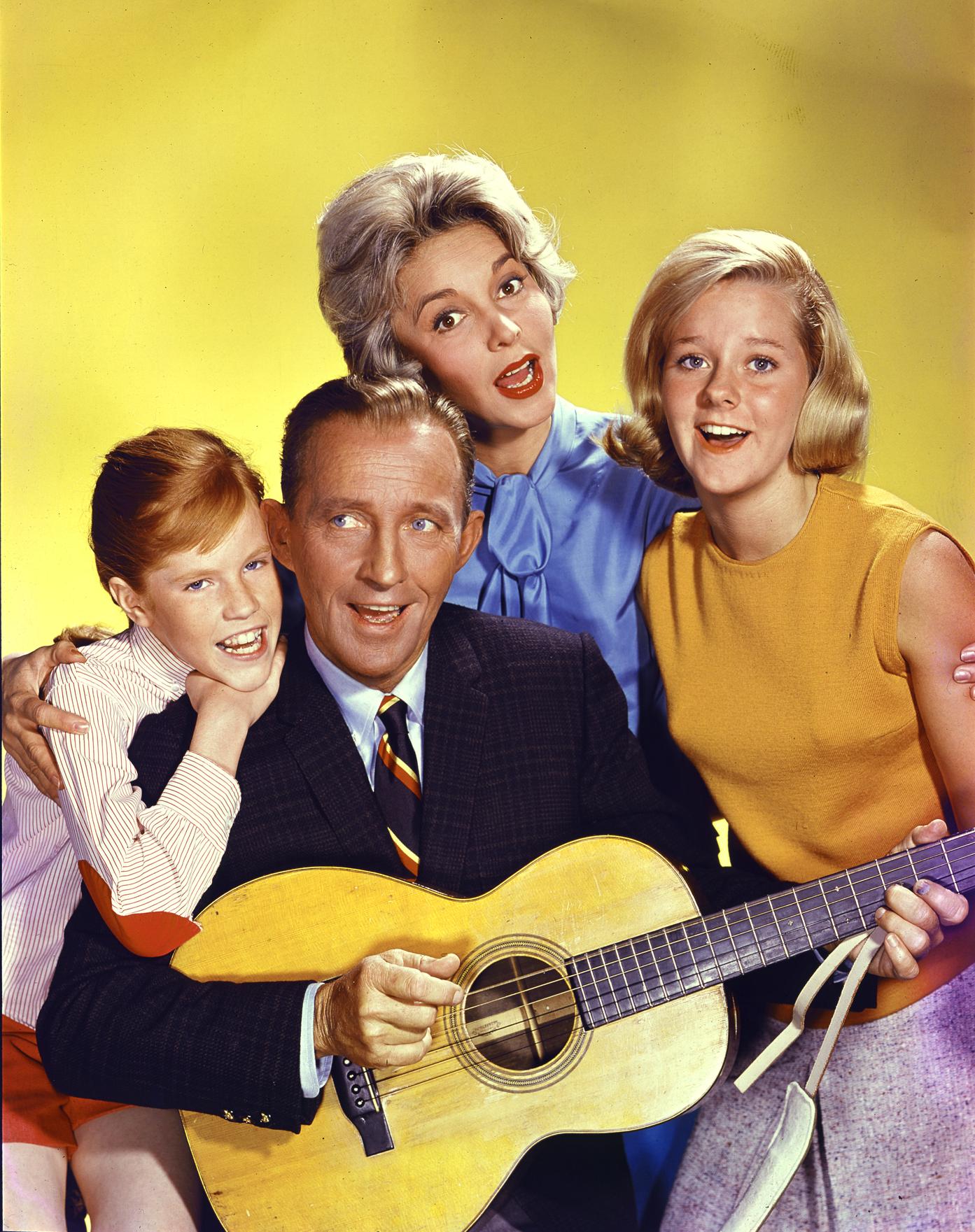
For Bing has agreed, for the first time
in his career, to a weekly TV series, a family show with lovely Beverly Garland
as Mrs. Bing Collins, his wife, Carol Faylen as their 16-year-old daughter,
Joyce, and Diane Sherry as their 11-year-old daughter Janice. Living with the
family is Bing Collins’s wartime buddy Willie (played by comedian Frank McHugh)
who dropped in for a meal and just hasn’t left.
Why face the high pressure and grind of
a weekly show, particularly when for years you have worried about the dangers
of over-exposure?
Says Bing: ‘I liked what they showed me
and thought I’d take a crack at it.’
The fact is that Bing was bored. His
holdings in the orange-juice business, real estate, oil and Bing Crosby
Productions were all in good hands, needed little attention from him. He’d had
all the golf and fishing he wanted.
Agents and friends had been trying for
years to persuade Bing to take on a weekly TV show. His answer was that he
didn’t mind an occasional appearance but that was all.
‘Suppose I made 52 movies a year? Who’d
come to watch me after the fifth or sixth? They’d get fed up with my voice, my
kisser, every aspect of me. No.’
Then one of Bing’s agents, Meta
Rosenberg, took over a proposition for Bing to make several specials. Her
viewpoint: There were already so many specials on TV that there was nothing
very special about them.
‘What would be special to if we could
ever talk Bing into doing a weekly series,’ she said.
‘After all good motion-picture roles for
Bing are hard to come by, but he’s still a fine actor in good physical
condition with an excellent mind and great stores of energy.’
So, she went to Bing and put up the
proposition again, pointing out that stars such as Lucille Ball, Red Skelton
and Donna Reed had all been appearing regularly on TV for years
Bing said he would try it, if he liked
the format of the shows they planned. The Bing Collins family was the result.
Bing, as Bing Collins, is an engineer who is also consultant to a nearby
university. As a father he is sensible and witty. It’s a family with no zany
relationships—just a group of happy people whose life can be fun. He sings in
each show, gives the youngsters sound advice. For instance, when elder daughter,
Joyce pleads for an equal-terms relationship with her parents he explains: ‘You
want to be us. And you can’t. And you force us into trying to be you And we can’t. We’re not meant to be friends,
baby. I’m your father. And you’re my kid. And if that’s an outmoded
parent-child relationship I’m all for it.’
It’s quality with a pedigree. Most
half-hour TV shows are budgeted at around 50.000 to 60,000 dollars (£22,300 to
£26,700) a program. ‘The Bing Crosby Show’ is closer to 70,000 dollars
(£31,250). Bing’s take from this package, which he owns completely, is from
15,000 to 20,000 dollars (£4700 to £8930) a week.
It hits the screen this month in the
U.S.”
(‘TV Week’ 19th September
1964)
Bing Crosby, in his first TV series rather than a special, has been assigned
the 9:30 niche and his domestic situation comedy might work out in to something
rather nice and different. At least he starts out as a sensible father, not a
wack, and he and his TV wife, Beverly Garland, live a more gentle life than is
the norm for couples on the screen,
Don Beaumont’s opening script had several warmly understanding insights
into married life in the middle years, notably the fact that conversation has a
way of always veering back to the welfare of one’s children. If James Sheldon,
the director, can withstand the normal TV pressures for fierce activity in
comedy, Mr. Crosby’s family series could evolve pleasantly.
(Jack Gould, New York Times, 15th
September 1964)
“The feeling is inescapable in watching the new Bing Crosby
situation comedy series which premiered Monday night (14th) on ABC-TV, that
it’s just about fifteen years too late in arriving. For when all is said and
done - and the saying and the doing take a long time - the new 30-minute entry
is nothing more than a variation on a dozen similar, ‘Ozzie And Harriet’, ‘Make
Room For Daddy’ themes.
Attractive people all, as were (and are)
their predecessors, each responding to the other’s cues with all proper and
warmed-over nuances to match their own stylised comedics and delivery. But,
unfortunately, its all been seen and acted and scripted before, with nary a bow
to innovation. It’s telegraphed to the viewer from the word ‘go’ and while
there is no denying that Crosby has a way with a given situation, it lacks any
inventiveness to take it out of its vintage mould.
It’s all played low key and casual
(often to the point of dragging) as Crosby and his mate, Beverly Garland (in
this initial instalment), relive their courtship, amid the more frantic
behaviourism of their teen-age daughters, Carol Faylen and Diane Sherry. Even
the old props will be recognisable - as for example, the wartime pal, (Frank
McHugh) who becomes a permanent houseguest. That’s really going back. Don
Beaumont as the scripter, James Sheldon as director and Steven Gethers as
producer are a match for Crosby and the others in perpetuating the cliché.”
(‘Variety’ 16th September
1964)
No. 79 21st
September 1964 - ‘The Bing Crosby Show’
(ABC)
‘Exactly Like Who?’ - With
Gary Crosby. Joyce can hardly wait for her new boyfriend, Don to meet her
family. She claims that he’s the living, singing image of her father.
Lavender Blue
Beverly
Garland
Come What May
Gary
Crosby
*Night And Day
Gary Crosby guests as song promoter. Bing suspects he has
cribbed his newest ‘hit’ from a popular song.
(‘Los Angeles Herald
Examiner’ 21st September 1964)
No. 80 28th
September 1964 - ‘The Bing Crosby Show’
(ABC)
‘A Bit Of Fresh Danish’ -
With Ulla Jacobsson. The Collins’ household has an unusual visitor. It’s Dr.
Olga Dannebrog, an outspoken, freethinking blonde who Bing met at an
engineering convention in Copenhagen.
*L'Amour,
Toujours, L'Amour (Love Everlasting)
(a cappella)
*Annie Laurie (in Danish)
with
Ulla Jacobsson
*The Campbell’s Are Coming(in
Danish)
with
Ulla Jacobsson
*Karoline
with
Ulla Jacobsson & Frank McHugh
“Excellent episode. At last, Bing’s series hits on all
cylinders and shows some promise. The plot concerns a scientist Bing met in
Copenhagen who has come to town on a visit. The scientist happens to be a tasty
bit of Danish pastry, complete with Danish ideas of love and courtship. There
are not real belly laughs as we go through the standard jealousy routines but
the characters gel, the pace is perfect and it’s a smile from start to finish.”
(‘Los Angeles Herald
Examiner’ 28th September 1964)
No. 81 5th October
1964 - ‘The Bing Crosby Show’ (ABC)
‘The Green Couch’ - With
The Wellingtons. Ellie’s worried about the teen-age dive that Joyce frequents
but Bing doesn’t share her concern.
*Saturday Night
(a) with Carol Faylen & The
Wellingtons
Note:
(a) A ‘blow-up’ version of this song was included
in a selection of outtakes from the series issued on a video ‘Bing Crosby’s
Cavalcade’ (unnumbered) by Festival Films.
“Bing continues to come out on top in his role as one
of TV’s most sensible husband/fathers. Tonight wife, Beverly Garland and
friend, Frank McHugh wind up in the clink after a small misunderstanding with
the police and Bing has to bail them out.”
(‘Los Angeles Herald
Examiner’ 5th October 1964)
No. 82 6th
October 1964 – ‘The Bell Telephone Hour’ (NBC) (Colour)
Guest appearance. With the
Donald Voorhees Orchestra, the Buddy Cole Trio, Grant Johannesen, The McGuire
Sisters and Burl Ives.
*Great Day
*Avalon
(a)
*Chinatown, My Chinatown
(a)
*Alabamy Bound
(a)
*I’m Confessin’
(b)
*When I Take My Sugar To
Tea
*Never Be Afraid
Notes:
(a) Audio versions of these items were issued on Longines SYS
5114 (LWS 384) - ‘The Best of the Telephone Hour’
(b) An audio version of this item was
issued on Longines SYS 5117 (LWS 387) - ‘Command Performance’
“. . . The series came out for the seventh TV season
bell with a stellar marquee of Burl Ives, the McGuire Sisters, concert pianist
Grant Johannesen and a wham plus in the person of Bing Crosby. . . Der Bingle,
backed by Buddy Cole’s combo, was likewise retrospective but let it be said
that his evergreen nostalgia was, indeed, a capper to this latest Bell seminar
in musical democracy. It was notably, Bing’s first stint on the show, which
beamed live from NBC’s Burbank plant.”
(‘Variety’ 7th October 1964)
"This doesn’t seem to be Bing Crosby’s year
on TV. Bing’s so-so ABC series hasn’t got off the ground yet. And last
night, as the final act of an otherwise sparkling Bell Telephone Hour, the
groaner seemed to saunter through a medley of his favorite tunes in an undistinguished
fashion. His usual feel of excellence wasn’t evident in the performance."
(Kay Gardella, Daily News, 7th October, 1964)
‘Hoop Shots’ - With Jimmy
Boyd. Joyce disrupts the family’s tranquillity by becoming engaged to a lanky
basketball player with a chronic case of the shakes.
*Sally, Let Your Bangs Hang
Down
with
‘the family’
*Skillet Good And Greasy
with
‘the family’
Bing and Ellie try
to break up romance between teen-age daughter and basketball star with the
shakes.
(Democrat
and Chronicle, 12th October, 1964)
No. 84 19th October 1964 - ‘The Bing Crosby Show’ (ABC)
‘Flashback’ - The Collinses
indulge in a bit of nostalgia. They watch home movies of the day when Bing met
Ellie and Willie.
*Can’t We Talk It Over?
(a)
*Sweet Georgia Brown
Notes:
(a) A few bars only.
“A delightful half-hour. Fans are treated to a little
bit of background on Bing Collins’ Army career, his courtship of Ellie and their
early marriage years in effectively handled flashbacks. Beverly Garland (Ellie)
is a standout in these sequences.”
(‘Los Angeles Herald
Examiner’ 19th October 1964)
No. 85 26th
October 1964 - ‘The Bing Crosby Show’
(ABC)
‘The Education Of Bing Collins’
- With Macdonald Carey. Joyce is not happy about the prospect of her cultivated
history teacher meeting her ‘lowbrow’ parents.
*Gaudeamus Igitur
(a)
*Shuffle Off To Buffalo
(b) with Beverly Garland and MacDonald
Carey
Notes:
(a) A few bars only.
(b) A ‘blow-up’ version of this song was included
in a selection of outtakes from the series issued on a video ‘Bing Crosby’s
Cavalcade’ (unnumbered) by Festival Films.
“There’s an abundance of charm and ease in this
pleasant entry. Debonair Macdonald Carey guest stars as Bing’s daughter’s
history professor, and it follows that she (Joyce) develops an unusually strong
interest in history.”
(‘Los Angeles Herald
Examiner’ 26th October 1964)
No. 86 9th
November 1964 - ‘The Bing Crosby Show’
(ABC)
‘The Dominant Male’ - With
Gary Crosby. Joyce’s boyfriend, Don, maintains that ‘the hand that rocks the
cradle rules the world’ and he challenges Bing to prove otherwise.
*How Deep Is The Ocean?
(a)
*Hallelujah, I Love Her So
with
Gary Crosby
Note:
(a) Also reprised.
The Bing Crosby
Show won’t win any prizes tonight but admirers of the series should enjoy its
relaxed pace, and the efforts again of Bing’s eldest son, Gary.
(Fort
Lauderdale News, 9th November, 1964)
No. 87 16th November 1964 - ‘The Bing
Crosby Show’ (ABC)
‘The Importance Of Bea ‘n’
Willie’ - With Elizabeth Fraser. Willie is smitten with the daughter of the local
lumberman but Willie’s so shy that the Collinses feel obliged to do some
coaching from the side-lines.
*My Wild Days Are Over
*Cutie, Who Ties Your Tie?
with
Diane Sherry
*You Can’t Get Along With
‘Em Or Without ‘Em
“Cute show with plenty of laughs. Willie (Frank
McHugh) gets stung by one of Cupid’s biggest arrows and doesn’t know how to
cope with it.”
(‘Los Angeles Herald
Examiner’ 16th November 1964)
No. 88 23rd
November 1964 - ‘The Bing Crosby Show’
(ABC)
‘The Liberated Woman’ -
With Glenda Farrell. After reading a book on woman’s need for self-expression,
visiting Aunt Lulu begins coaching the Collins in dramatics.
You’re An Old Smoothie
Beverly
Garland
*You’d Be So Nice To Come
Home To
No. 89 30th
November 1964 - ‘The Bing Crosby Show’
(ABC)
‘Genius At Work’ - With
Thomas Gomez. Bing and Ellie order their brilliant but chronically messy
daughter, Janice, to shape up - a world famous mathematician is coming for a
stay.
*I Gotta Right To Sing The
Blues
*D’Ye Ken John Peel
with
Beverly Garland, Frank McHugh & Carol Faylen
*D’Ye Ken John Peel (Parody
- a cappella)
Note:
(a) Recorded 3rd August 1964.
Bing and Ellie take in a temporary house guest against
their better judgement simply because he’s a genius who needs a quiet place to
work. But, when the professor sets up shop at Bing’s home he creates havoc in
the household and in the family. Thomas Gomez is pretty funny as a true eccentric,
in fact a real nut, though the show as a whole is much more of a cartoon than
usual.
(Press and Sun-Bulletin, November 30,
1964)
No. 90 7th
December 1964 - ‘The Bing Crosby Show’
(ABC)
‘The Yadwin Report’ - With Don
Penny. The Collinses seem so happy that Joyce’s boyfriend can come to only one
conclusion - their marriage is doomed.
*You’re Just In Love
with
Beverly Garland
“Funny and breezy episode. The Collins’ marriage is
rated by a junior size psychologist who happens to be daughter Joyce’s latest
boyfriend.”
(‘Los Angeles Herald
Examiner’ 7th December 1964)
No. 91 14th
December 1964 - ‘The Bing Crosby Show’
(ABC) (a)
‘Janice And Me On A
Saturday Spent With Random Inputs No. 1’ - With David Wayne. Janice and a
leading exponent of electronic music, combine efforts to prove that Bing’s
notions of music are antiquated.
*The Birth Of The Blues
Note:
(a) Recorded 11th
June 1964
“This charming series takes a humorous poke at
electronic music. Daughter Janice helps a kookie composer with his latest
way-out work. David Wayne plays the composer as though he were Burgess Meredith
playing a mad scientist.”
(‘Los Angeles Herald
Examiner’ 14th December 1964)
No. 93 21st
December 1964 - ‘The Bing Crosby Show’ (ABC) (Colour)
‘The Christmas Show’ - With
The Wellingtons. The Collinses, their singing guests, The Wellingtons and
assorted carolers celebrate the holiday season in song. John Scott Trotter and his Orchestra provide the musical backing.
*Christmas Candles
God Rest Ye Merry Gentlemen
Carolers
*We Wish You The Merriest
with
Carolers and Cast
*La Pinãta
with
Carolers and Cast
*Do You Hear What I Hear?
with
Carolers
*Argyll The Christmas
Stocking
with
Carol Faylen and Diane Sherry
White Christmas
Beverly
Garland
*White Christmas
“Good holiday entertainment for the family. Short on
plot but long on song as Bing and company gather round the piano and offer a
program of some new Christmas songs, as well as his holiday trademark, ‘White
Christmas’.”
(‘Los Angeles Herald
Examiner’ 21st December 1964)
Monday’s (21) seg of this fresh-man situationer did
what it figured to do with Crosby as
star – tossed out the plot and settled down to a pleasant holiday songfest with
Bing, his TV household – Beverly Garland, Frank McHugh, et al – plus an
augmentation from the Wellington trio of lads and a group called The Carolers
(who were doing just that outside when the family flagged them in). The
tree-trimming, gift-giving seg delivered ‘seasonal songs’, capped inevitably
with a Crosby-Garland rendition of “White Christmas”. Miss Garland, of course,
being the show's hausfrau. The two, by the way, make a fine couple, and Crosby
is convincingly his own age in this series.
(‘Variety’, 23rd December 1964)
No. 94 11th
January 1965 - ‘The Bing Crosby Show’
(ABC)
‘The Soft Life’ - The
Collinses take a vacation but have differing ideas regarding their
accommodation.
*Lazy Bones
(a)
*Mountain Greenery
Note:
(a) A few bars only
“Entertaining episode. Bing and his wife have differing
ideas about vacations and each tries to prove that their way is best. Bing
chooses a well-equipped cabin while the rest of the Collins clan, rough it, by
camping out in clear sight of Bing’s relaxed luxury.”
(‘Los Angeles Herald
Examiner’ 11th January 1965)
“Bing Crosby, who started his first weekly television
show last fall, expressed doubt yesterday that the series would continue next
season.... “It’s been fun and it hasn’t been too hard a chore,” the singer and
actor said. “But according to the rating, we haven’t been doing so well. I
think I’d have to get on a glass bottom boat to find the rating. It’s a rat
race. If you don’t get a rating they dump you.” Mr. Crosby said he was not
depressed by the show’s rating and that usually a show required “a couple of
years to get a good rating.””
(‘New York Times’ 13th January 1965)
No. 95 16th
January 1965 - ‘The Hollywood Palace’ (ABC)
Produced by
William O.
Harbach. Directed by Grey Lockwood. With Mitchell Ayres and the
Hollywood
Palace Orchestra, The Three Rebertes, Jacques D’Amboise & Catherine
Mazzo,
Leonardo, Corbett Monica, The King Family, Frank McHugh and Beverly
Garland. In addition, Gene Barry, George Burns, Cyd Charisse, Buddy
Ebsen, Phil Harris,
Liberace, Tony Martin, and Ed Wynn make brief guest appearances.
*There’s More To Life Than
Just Living
(a)
The Three Rebertes (acrobats)
*She Can Carry A Gun
with
George Burns & Ed Wynn
Jacques D’Amboise & Catherine Mazzo (ballet)
Frank McHugh spot with Bing
Corbett Monica spot
Medley:
The King Family
Lollipops And Roses
There Is Nothing Like A Dame
A Lot Of Livin' To Do
Too Young
I’m Old Fashioned
*Dream (When You're Feeling Blue)
with
The King Family
Leonardo (juggler)
Beverly Garland spot with Bing
*Top Banana
(b) with Frank McHugh
*Happy Birthday To You
(c) with entire company
Notes:
(a) An
audio version of this item was issued on Broadway Intermission BR-135 -
‘Crosbyana - Volume 5 from Bing’s Collection’ (Source shown as ‘Hollywood Place
(sic), 1959’)
(b) Also reprised
with Frank McHugh and Beverly Garland.
(c) On this first anniversary of the Hollywood Palace, the last eight personalities shown in the cast list, all former hosts for the series, joined Bing in a ‘Birthday’ sketch as well as having separate walk-on spots.
(d) The show was taped on January 9.
“The Hollywood Palace has done right well for itself
in the first year of its existence. Originally set as a replacement for the
‘Jerry Lewis Show’, this variety layout has established itself firmly in the
entertainment scheme and is vying for the top spot in the variety field. The
first birthday party show was emceed by Bing Crosby who also emceed its
premiere on January 4th, a year ago. As guests, the producers gathered many of
the emcees that had appeared during the year, for extremely brief bits. . .
Crosby, in addition to conferenciering, reparteed with Frank McHugh, Beverly
Garland and the raft of guests, to give this show a great big, agreeable and
ingratiating effect.”
(‘Variety’ 20th January
1965)
"A rousing anniversary show with host Bing Crosby. Old
vaudeville lines are exchanged between Bing and his guests, Phil Harris, George
Burns, Ed Wynn, Tony Martin, Cyd Charisse and Liberace. Beverly Garland of the
Crosby series sings, and all the King Sisters do a medley. In addition, there’s
the talented ballet dance Jacques d’Amboise, a husband and wife monologue by
Corbett Monica, a plate spinner and an Italian tumbling act."
(Quad-City Times, 16th January, 1965)
No. 96 18th January
1965 - ‘The Bing Crosby Show’ (ABC)
‘Bugged By The Love Bugs’ -
With The Standells. Bing becomes a virtual pariah in his own home - just
because he turned down two free tickets to a rock ‘n’ roll concert.
*Kansas City
with
The Standells
“Cute, timely show. A rock ‘n’ roll group known as
‘The Love Bugs’ comes to town and the Collins’ house is thrown into a dither.
The girls are heartbroken when they miss the big concert but the group’s
manager turns out to be an old friend of Bing’s so everything ends up
swinging.”
(‘Los Angeles Herald
Examiner’ 18th January 1965)
No. 96a 23rd January 1965 - The King Family Show (ABC)
Bing makes a filmed introduction to the first episode of this popular variety series.
Bing's contribution appears to have been filmed at Desilu on
the set of
his weekly sit-com series.
No. 97 25th
January 1965 - ‘The Bing Crosby Show’
(ABC) (a)
‘Are Parents People?’ -
with Ken Murray and Pam Austin. Joyce and her friend, Clarissa, upset Bing and
Ellie with their Easter vacation plans - they’ve decided to tour Mexico all by
themselves.
*Cuanto Le Gusta
with
Carol Faylen
The Wiggle Ball
Carol
Faylen and Pam Austin
*South Of The Border
Note:
(a) A video version of the programme was issued on Festival Films ‘Bing Crosby and Friends Volume 7’
The show contains
a profoundly great line: “Never be fair with teenagers, they’ll rack you up
every time.” Joyce wants to go to Mexico with an equally young friend and Bing’s
natural instinct is to refuse to let her. There’s an amusing scene as the girls
try to get jobs in a chorus for spite. Then they fail as car-hops. Sanity
finally prevails. Cute show.
(Press and Sun-Bulletin, January 25, 1965)
No. 98 1st
February 1965 - ‘The Bing Crosby Show’
(ABC)
‘That’s The Way The Suki
Yaki’s’ - With James Shigeta. Bing really goes for the way Japanese wives
pamper their husbands which provokes Ellie into wagering that he couldn’t take
even one week of it.
*The Japanese Sandman
“Pleasant show. Bing and Ellie declare war when Bing
decides the ‘old tradition’ is more desirable than the new, after spending an
evening at a Japanese couple’s home. Plenty of sight gags here.”
(‘Los Angeles Herald
Examiner’ 1st February 1965)
No. 99 8th
February 1965 - ‘The Bing Crosby Show’
(ABC) (a)
‘The Gifted Child’ - With
Arthur Franz. Ellie is beside herself with worry when precocious Janice informs
her parents that the school has sent her to see a psychiatrist.
*Sometimes I’m Happy
with
Diane Sherry
Note:
(a) Recorded 25th August 1964.
“A cute show with a built-in message. Janice (Diane
Sherry) discovers she’s under consideration to skip a grade and her reaction is
anything but joyous. Her family goes along with her as she tries to make a
decision.”
(‘Los Angeles Herald
Examiner’ 8th February 1965)
No. 100 15th
February 1965 - ‘The Bing Crosby Show’
(ABC) (a)
‘The Image’ - With Kathryn
Crosby, Pat Harrington Jr. and George Gobel. Ellie goes along with a scheme to
upgrade Bing’s public image, which involves her with an effervescent interior
decorator.
*In A Shanty In Old Shanty
Town
with
‘the family’
Note:
(a) Recorded 1st February 1965.
“Publicity
expert (Pat Harrington Jr.) and a decorator (Kathryn Crosby) try to jazz up
Bing’s personality. George Gobel plays a motel manager.”
(‘Los Angeles Herald
Examiner’ 15th February 1965)
No. 101 22nd
February 1965 - ‘The Bing Crosby Show’ (ABC)
‘The Keefers Come Calling’
- With Frankie Avalon and Vikki Carr. Bing and Ellie help their new neighbours,
a pair of teen-age newly weds, adjust to married life.
*You’re Getting To Be A Habit With Me with Beverly Garland
You’re Getting To Be A
Habit With Me
Frankie Avalon & Vikki Carr.
“A good show which places its focus on a pair of newly
weds, charmingly played by Frankie Avalon and Vikki Carr, who move into the
neighbourhood. When their marital problems become too much for them, Bing and
his wife step in and mediate.”
(‘Los Angeles Herald
Examiner’ 22nd February 1965)
No. 102 1st
March 1965 - ‘The Bing Crosby Show’
(ABC) (a)
‘Operation Man Save’ - With
Joan Fontaine and Dennis Day. Ellie takes a cue from Bing’s highly efficient
secretary and tries to introduce a little organisation at home.
*Exactly Like You
Exactly Like You (a cappella)
Beverly
Garland, Frank McHugh, Carol Faylen & Diane Sherry
Note:
(a) A
video version of the show was included in the Festival Films video ‘Bing Crosby
& Friends - Vol. 8 - ‘All-Star Show’.
“Guest star, Joan Fontaine lends her chic style to
this one in the role of Bing’s efficient secretary. Her ‘helpful’ suggestions
almost cause a domestic crisis in the Collins’ household. Dennis Day plays her
down-trodden husband.”
(‘Los Angeles Herald
Examiner’ 1st March 1965)
No. 103 8th
March 1965 - ‘The Bing Crosby Show’
(ABC)
‘One For The Birds’ - With
Phil Harris. Bing’s former vaudeville partner, Barney Jenks, shows up for a few
day’s visit with a new partner - a trained crow named Blackie, in tow. During
their stay, a number of burglaries are reported in the locality.
*Baby Face
with
Phil Harris
*The Prisoner’s Song (a
cappella)
with
Phil Harris
*Bye, Bye, Blackbird
(a) with Phil Harris
Note:
(a) A ‘blow-up’ version of this song was included in a selection of outtakes from the series issued on a video ‘Bing Crosby’s Cavalcade’ (unnumbered) by Festival Films.
Phil Harris guests as a vaudevillian who resembles a
Phil Harris type of character, which gives Bing a chance to join him in some
corny old-fashioned songs and patter. There’s a plot too, something about an
untrustworthy talking crow, but the main reason for watching is to observe a
couple of old pros like Bing and Phil go through their paces.
(Press and Sun-Bulletin, March 8, 1965)
No. 104 10th
March 1965 - ‘The Grand Award Of Sports’ (ABC)
Produced and directed by Charles
Dubin. With Jim McKay, Chris Schenkel, Colonel John Glenn and others.
Co-host with Kathryn
Crosby. Autolite Institute Of Life statues were awarded to top names in 20
categories of sport in a live telecast from New York World’s Fair.
“Grand Award of Sports on ABC-TV was an obvious
attempt to imitate the glamor and excitement of the annual Academy Awards. But
the 90-minute show was spectacular only in its failure to generate any real
interest. Emcee Bing Crosby was his of the Church of one by its lead- usual hip
and casual self, a parlay that couldn’t offset the boredom as athletes in just
about everything from pro football to beanbag plodded to the podium to collect
hardware.”
(‘Variety’ 17th March 1965)
No. 105 22nd
March 1965 - ‘The Bing Crosby Show’
(ABC)
‘The Test’ - Bing insists
that Joyce learn the rule book before taking her driver’s examination but he’s
not doing much for his own renewal test.
Ac-Cent-Tchu-Ate The Positive
Carol
Faylen & The Wellingtons
*The Little Things In Life
A good show to catch if you’re about to take your
driver’s test. Joyce is taking the test and you can study the rules with her.
The gag in this one is that Bing has let his licence expire and has to take a
test himself – but he’s forgotten all the rules. Bing gets to sing “The Little
Things in Life” which this show is one of.
(Press and Sun-Bulletin, March 22, 1965)
No. 106 29th
March 1965 - ‘The Bing Crosby Show’ (ABC) (a)
‘Moonlighting Becomes You’
- With Mel Tormé.
*Them There Eyes
*Smack Dab In The Middle
with
Mel Tormé
Note:
(a) A video version of the programme was issued on Festival Films
-’Bing Crosby and Friends Volume 6’
“Professor (Mel Tormé) moonlights as a jazz pianist in
a cellar café.”
(‘Los Angeles Herald
Examiner’ 29th March 1965)
No. 107 5th
April 1965 - ‘The Bing Crosby Show’
(ABC)
‘What’s A Buddy For’ - With
Lloyd Nolan and The Bob Mitchell Boy’s Choir.
*A Smile Looks Good On Any Face
with
The Bob Mitchell Boy’s Choir
“Insurance broker (Lloyd Nolan) talks Bing into
umpiring a Little League game.”
(‘Los Angeles Herald
Examiner’ 5th April 1965)
No. 108 12th
April 1965 - ‘The Bing Crosby Show’ (ABC) (a)
‘Conform, Conform, Whoever
You Are’
*When I Was A Lad (from
‘H.M.S. Pinafore’- a cappella)
*Auld Lang Syne
with
‘the family’
Note:
(a) Recorded
23rd September 1964. This was no doubt originally intended to be shown on 28th
December 1964 (See press quote).
“In a revolt against conformity, Bing and Ellie plan
to celebrate New Year’s Eve in a cosy mountain cabin.”
(‘Los Angeles Herald
Examiner’ 12th April 1965)
No. 109 12th
April 1965 - ‘The Lucy Show’ (CBS) (Colour)
In this episode entitled
‘Lucy, the Disk Jockey’, Lucille Ball played a radio station DJ. Although Bing did not appear on camera, he
did contribute a vocal. Lucy introduced Bing by saying ‘here’s a recording of Bing
Crosby singing Stephen Foster’. She played the ‘record’ and Bing’s voice, a
cappella, sang (to the tune of ‘De Camptown Races’)
‘dum-dum-dum-dum-dee-dee-dee, Ste-phen Fos-ter’.
No. 110 19th
April 1965 - ‘The Bing Crosby Show’
(ABC) (a)
‘Real Estate Venture’ -
With Ruth Roman. Energetic realtor, Amanda Rankin, convinces Ellie that, she
too, is a born real estate saleswoman.
*My Heart Belongs To Daddy
(Parody)
(b)
*Home, Sweet, Home
(c)
*My Blue Heaven
Notes:
(a) The entire show was included in the Festival Films video
‘Bing Crosby & Friends - Vol. 9 - Christmas Show’.
(b) A fragment only.
(c) Bing hums and whistles only to a
piano accompaniment.
“Dynamic realtor (Ruth Roman) convinces Ellie that she
should sell the house and join her staff.”
(‘Los Angeles Herald
Examiner’ 19th April 1965)
No.111 27th
June 1965 (BBC1)
Richard Allison briefly
interviews Bing on his arrival in London and this is shown on a news bulletin.
No. 112 27th
June 1965 - ‘The Eamonn Andrews Show’ (ABC in UK)
Guest appearance. With
Spike Milligan, Cilla Black, Patrick Campbell and Harry H. Corbett.
Ol’ Man River
Cilla
Black
*The Thrill Is Gone
(a)
Note:
(a) Fragment only.
No. 113 30th
June 1965 - Wimbledon Lawn Tennis Championships (BBC)
Short interview.
No. 114 6th
July 1965 - ‘Late Night Line-Up’ (BBC2)
Interviewed by Joan
Bakewell. This was probably filmed at the Wimbledon Lawn Tennis Championships.
No.115 7th September 1965 – ‘Hollywood Talent Scouts’ (CBS)
Interviewed by Art
Linkletter on the set of ‘Stagecoach’
Directed by Grey Lockwood. Produced by William O.
Harbach. With the Mitchell Ayres Orchestra, the Tibor Rudas Dancers, the Black
Theatre of Prague, The Nitwits, Burns and Schreiber, Bertha & Tina
(elephants), Tim Conway and Caterina Valente.
*On The Hollywood Palace
This Coming Year
Tibor Rudas Dancers
Burns and Schreiber (comedy sketch in taxi)
Black
Theatre of Prague (black light show)
Goody Goody
Caterina
Valente
Meditation
Caterina
Valente
Bertha & Tina
(elephants)
Tim Conway spot with Bing (jockey skit)
Medley:
with Caterina Valente
*Fancy Meeting You Here
*On A Slow Boat To China
*It Happened In Monterey
*Hindustan
*On A Slow Boat To China
(Reprise)
“Hollywood
Palace starting its third year on the vaudeo spectrum, seems to continue in
affable and agreeable ways. At this point the format continues to be
serviceable and there’s no cause to re-write this hit. The formula of a name
emcee and name talent is sufficiently potent to make this one of the better
variety displays on the medium.
Bing Crosby making his third appearance
on this soiree gave the season’s premiere a flavor unique to him. He mixes
affability and entertainment in equally potent doses and gets involved in the
proceedings to give the show an entertaining tone. For example, he ‘straighted’
for Tim Conway of ‘McHale’s Navy’, who needed a straight of Crosby’s calibre to
look good. He sang with Caterina Valente and each endowed the other with an
added ingredient. On her own, Miss Valente delivered with her accustomed
top-rated product.”
(‘Variety’ 22nd September
1965)
Note
(a) Recorded 5th September 1965. The entire show was issued on video by
Nostalgia Family Video.
No. 117 25th
September 1965 - ‘The Hollywood Palace’ (ABC) (Colour) (a)
Produced by William O.
Harbach. Directed by Grey Lockwood. With
the Mitchell Ayres Orchestra, the Young Americans, La Norma, Fred Roby, Sims’
Performing Ponies, Carl Ballantine, Pat Woodell, Louis Armstrong and Phil
Harris.
*My Blue Heaven
Sims’ Performing Ponies,
Carl Ballantine (magician)
It Might As Well Be Spring
Pat
Woodell
Waiting For The Robert E. Lee
The
Young Americans
Swanee
The
Young Americans
*Happiness Is
with
The Young Americans
La Norma (trapeze artist)
Way Down Yonder In New Orleans
Louis
Armstrong
*Dardanella
with
Louis Armstrong
Fred Roby (ventriloquist)
King Of The Road
Phil
Harris
*South Rampart Street
Parade
with
Phil Harris, Louis Armstrong and The Young Americans
Note
(a) Recorded 14th September 1965
“No matter how many times you experience it, there is
no ‘high’ in life quite like the adrenaline-surge in your body as you stand waiting
behind a curtain to open upon the stage of a TV variety show. The orchestra
goes into the intro for your song. You hear the long, sustaining roll on the
timpani drums. The string section is coming in on a single-note trill. Then you
hear the brass building in pitch and volume when suddenly the curtain opens to
reveal a truly awesome sight. At least it was an awesome sight for me to see
late that Friday afternoon, September 3, 1965, when the curtain opened on the
stage of the ABC TV variety show, Hollywood Palace.
Standing about 15 feet to my left is
big-bandleader Phil Harris. Standing about 12 feet to my right is show business
legend Louis Armstrong. And standing center-stage about eight feet in front of
me to my left is the entertainer I most admire in life - Bing Crosby. . . This particular Palace is going to be
publicized in the TV viewing guides as ‘Bing Crosby hosts Louis Armstrong’s
fiftieth year in show business.’
. . . Amid lingering uneasiness
throughout the city, an extremely large crowd is lined up out front of the ABC
Palace Theater on Vine about one-half block north of Hollywood Blvd. Making my
way down an iron fire escape on the south side of the theater where the second
and third-story dressing rooms are located, I’m amazed to see so many people
waiting to get in to the late-afternoon taping of the dress rehearsal. . . Less
than an hour later the full-dress rehearsal is being taped. I don’t remember
now all of the songs performed. But I do remember that after two or three, I am
performing with Mr. Crosby a moderately obscure song of the time called
‘Happiness Is’. He had had a special arrangement made, complete with key
changes that move one-half step upwards after every chorus. And the original
lacklustre verses are rewritten into clever new lyrics about various
celebrities. I always liked the up-beat melody, so I still remember some
phrases, like this one:
‘To a waiter, it’s a tip, tip, tip,
To Phil Harris, it’s a nip, nip, nip.
To a jockey, it’s a nag, nag, nag,
And to a G. I., it’s a Bob Hope
gag’.
When the Bob Hope line comes up in the
dress rehearsal and the final performance, both audiences emit a sustained
‘Aaaaaaaw’ that everyone up on stage can clearly hear above the ongoing music.
Through part of this song, Mr. Crosby is seated on a stool. On the floor around
him are several young female singers with their arms around the bottoms of his
legs. One day at rehearsal, Lisa, one of the girls, had found a hole in one of
his pant cuffs. She put her finger through it and wiggled it around while
laughing out loud for all to see. He just smiled and paid no attention.
While standing behind him for part of
this number I often think he has a poor tailor. Even his performance clothes
look - in a word - ‘baggy.’ When I tell my folks about this one night, my
mother says he always had a reputation over the years for being a bad dresser.
And yet his loose-fitting garments may be the result of nothing more than him
being on a diet at the time - something my current age has much experience with.
Back then, however, that thought never occurs to the 17-year-old mind in my
145-pound body. . . . At 62, his voice is deep, full and every bit as resonant
as it was for any performance at any time in his career. Watching him whenever
possible, it seems to me as though it is just so effortless on his part. His
head tilts back slightly, the jaw drops and out comes this incredible sound
unlike any voice before or since.
On Monday, the first day of rehearsal,
everyone takes turns on stage recording all the numbers with the full
orchestra. For the remainder of the week the daily rehearsing is performed to
the pre-recorded sound which is constantly stopped and rewound while the
Director and the TV camera people work the show out visually from various
angles. The orchestra will not reappear until the dress rehearsal late the
following Friday afternoon.
On variety programs of this time there
is a short break on the day before dress rehearsals. This allows newcomers to
briefly kibitz with the stars. Like me, everyone in that show could hardly wait
to return from their dressing rooms with some memento for these stars to
autograph. In my case, I had brought along the record jacket from ‘Robin and
the Seven Hoods’ on which Mr. Crosby is centered between Sinatra, Martin, Davis
and Peter Falk. When he reaches out to sign it for me, I just cannot resist
telling him the many number of times I had gone to see the film.
‘Myyyyyy,’ he says in that familiar
low-baritone voice as he drops his head and looks at me from out of the top of
his eyes, ‘but you are a brave soul.’ On the soundtrack recording of ‘Style’,
his voice can be clearly heard speaking after the song concludes: ‘Come on,
let’s get some clothes on or we’ll be late for breakfast.’ A passing comment
from me about this remark only brings a bewildered expression from him.
Standing there, less than four feet from
him as he signs the album and hands it back to me, I am thinking how authentic
his hairpiece appears. No one unaware of the truth would ever have suspected it
is not his real hair. But overall, the one aspect I find truly remarkable about
his appearance is that he has the most youthful-looking eyes I have ever seen
in any person. Either before or since, I have never seen such bright blue
irises surrounded by such large, pure white sclera. They are totally devoid of
any red blood vessels, which is probably why Phil Harris comments at one point
that Bing should not worry his ‘baby-blues.’
Misters Crosby and Harris have some
comic patter they perform together at one point. And I am so happy that on
Thursday, the last day before dress rehearsal, there seems to be endless
equipment problems. Over and over again the Director’s voice bellows out from
the control room speaker: ‘One more time from the top, please.’ The two seasoned
veterans then redo all the punchlines, complete with feigned laughter and
totally rehearsed ‘ad lib’s.’ And every time they make it sound as
though they are just having a casual, impromptu conversation in someone’s
living room. It is quite an on-the-job education for those of us present from
the younger set. . .
This Friday is also the first day that
Louis Armstrong appears at rehearsal, primarily for camera placement and sound
levels. Mr. Armstrong was age 65 at the time. A number of the younger performers
think the network is especially insensitive to his physical condition, for he
had been given a dressing room on the second floor. To reach it, he has to
slowly labor up two floors of thin metal steps.
I remember on the day of kibitz, my
request for Mr. Armstrong’s autograph turns an expression of pain upon his face
into that wonderful smile. His smile could cause the sun to shine, even
indoors. After he graciously signs my album, I watch him take very short and
slow steps towards the dressing room stairs. His head is bowed forward, and it
seems to take him forever to reach the second floor. But as far as I know, he
never once complains to a soul about not having a first-floor dressing room. I
shall always remember him as the quintessential gentleman of charm, grace,
personality, humor and - most of all - talent.
He and Mr. Crosby perform something
together, which I have since forgotten. But what I will never forget is the
closing finale, in which everyone on the show takes part. Talk about a show-stopper,
the closing number is South Rampart Street Parade. A wonderful series of
interlaced melodies and counterpoints composed by Ray Bauduc and Bob Haggart
with lyrics by Steve Allen, the entire composition conveys the feeling of an
oncoming parade building in volume and rhythm. Only this arrangement has
something no street parade ever has - a studio orchestra with a string section.
Added to this layered complexity are the jazz ‘fills’ of Mr. Armstrong’s horn
and numerous sections of syncopated rhythm.
Wow, what an experience!
There are many unforgettable musical
moments I can look back on. But if I had to select one that approaches a
spiritual level of magic, it would be this one.”
(Richard Zimmerman, one of
the Young Americans, writing in ‘BING’ magazine, winter 2001)
No.
118 16th November 1965 - CBS News
Special - Sinatra
Bing is briefly interviewed in this hour-long special and warmly praises Sinatra.
No. 119 20th
November 1965 - ‘The Hollywood Palace’ (ABC) (Colour)
With the Mitchell Ayres
Orchestra, Desmond & Marx (comedy act), Charlie Manna, Willie
Mays, Michael The Waiter, The Kessler Twins, John W. Bubbles, Diahann Carroll
and Bob Hope.
*Them There Eyes
Bob Hope spot promoting an LP about Hope's trip to Vietnam
Willie Mays spot
Falling And Fooling For You Desmond & Marx
Got To Keep Moving Blues Desmond & Marx
Married I Can Always Get
The
Kessler Twins
*Identical
(a) with The Kessler Twins
Charlie Manna spot (comedian)
When My Baby Smiles At Me
John
W. Bubbles
Medley:
*You Can Dramatise The Feeling With A Hat
with
John W. Bubbles
*A Couple Of Song And Dance
Men
with
John W. Bubbles
*Red Sails In The Sunset
*In A Little Spanish Town
with
John W. Bubbles
I Don’t Want To Set The World On Fire
John
W. Bubbles
*Prisoner Of Love
M.I.C.K.E.Y.M.O.U.S.E.
John
W. Bubbles
*London Bridge Is Falling Down
with
John W. Bubbles
Stranger In Paradise
John
W. Bubbles
*Old Devil Moon
Get Me To The Church On Time
John
W. Bubbles
*You Go To My Head
*Me And My Shadow
with
John W. Bubbles
*You Can Dramatise The Feeling With A Hat (Reprise)
with John W. Bubbles
Michael The Waiter spot (juggler)
You Go To My Head
Diahann
Carroll
Going Out Of My Head
Diahann
Carroll
If I Ruled The World
Diahann
Carroll
Bob Hope spot with Bing
*Count Your Blessings (Instead Of Sheep)
with
Chorus
Note:
(a) Bing’s contribution consists of two lines.
"Bing Crosby will make his third appearance of the
season as host of The Hollywood Palace, at 9:30 p.m. today to sing familiar melodies
and present other musicians and a wide variety of acts, in color. Veteran
vaudeville dance and singer John Bubbles, formerly of the team of Buck and
Bubbles and the creator of the “Sportin; Life” role in the Broadway production of
“Porgy and Bess” is slated to present a new routine, Song stylist Diahann
Carroll is high in the billing for the show as are the blonde Kessler singing
twins – Alice and Ellen – from West Germany. Another performer from West
Germany is Michael, the waiter, who does amazing feats with trays and cutlery.
From England comes the singing and dancing team of Desmond and Marks, and from
America’s night club circuit comes comedian Charlie Manna."
(The Times Herald,
November 20, 1965)
“Then there
was the great team of Buck and Bubbles, particularly the dancing member of the
team, Bubbles. He was considered by Fred Astaire (and many others) to be the
greatest soft shoe, buck and wing, or tap dancer who ever lived. At every
performance we had visiting dancers in the wings who had dropped in from other
vaudeville circuits or motion picture presentation houses, who came over to
watch and learn. People like Eleanor Powell and Hal Le Roy. Five times a day,
seven days a week, Bubbles never danced the same routine twice, but always an
inspired improvisation. Later he went on to play ‘Sportin’ Life’ in ‘Porgy and
Bess’.”
(Bing Crosby, writing in ‘Call Me Lucky’)
No. 120 15th
December 1965 - ‘The Bob Hope Comedy Special’ (NBC) (Colour) (a)
Guest appearance. With
Nancy Wilson, Janet Leigh and Jack Benny. Directed by Jack Shea.
I’ll Only Miss HimWhen
I Think Of
Him
Nancy
Wilson
This Dream
Nancy
Wilson
*‘The Tenant’ Sketch
(b) with Bob Hope
*Do You Hear What I Hear?
(c)
Notes:
(a) The
entire show was issued on DVD by Bobontv.com in 2010, their reference number 121565. An edited version was included in the Time Life DVD
set "The Best of the Bing Crosby Specials" (Disc 10) issued in 2018.
(b) A video version of
this item in which Bob Hope becomes Bing’s tenant at his Palm Springs home was
included in the NBC-TV programme ‘On the Road with Bing: A Special Tribute to
Bing Crosby’ shown on 28th October 1977.
(c) Bing
lip-synched to his 1963 recording with the Ralph Carmichael Orchestra &
Chorus (See also Programme No. 71).
“Last week’s TV outing was a fair variety show that
didn’t quite live up to its super stellar cast. . .The comedy sketches were
uneven, the best, possibly because it was the broadest, involving Jack Benny as
an escaped convict hiding out at the North Pole and Hope as Santa. Less
effective was the skit in which Bing tried to get rid of his Palm Springs
tenant (Hope), so that he could sell his mansion. Crosby nicely warbled his way
through a Yule tune but basically, the show seemed to be hung up on the audio
personalities of Hope, Crosby and Benny.”
(‘Variety’ 22nd December
1965)
No. 121 25th
December 1965 - ‘The Hollywood Palace’ (ABC) (Colour) (a)
With the Mitchell Ayres
Orchestra, Bob Williams & Louie, Fred Waring and his Pennsylvanians, Landon's Midgets and Blinko the Clown, Harry L. Crosby III, Dorothy Collins, Bob Crane and the cast of ‘Hogan’s
Heroes’ (Werner Klemperer, John Banner, Robert Clary, Richard Dawson, Larry
Hovis and Ivan Dixon). (b)
*The White World Of Winter
with
Chorus
Landon's Midgets and Blinko the Clown
The Nutcracker Suite (Tchaikovsky)
(c) Fred Waring and his Pennsylvanians
*The Whiffenpoof Song
with
Fred Waring and his Pennsylvanians
Hogan's Heroes spot
It Might As Well Be Spring
Dorothy
Collins
*The Glow Worm (Parody)
with
Dorothy Collins
Bob Williams & Louie (dog act)
Medley:
*It’s Christmas Time Again
with
Fred Waring and his Pennsylvanians
*Go Tell It On The Mountain
with
Fred Waring and his Pennsylvanians
Twelve Days Of Christmas
Fred
Waring and his Pennsylvanians
Stille Nacht (Silent Night)
Werner
Klemperer & John Banner
French Carol
Robert
Clary
Deck The Halls
Dorothy
Collins
*We Wish You The Merriest
with
Dorothy Collins, Bob Crane & Cast
O Come Little Children (Humperdinck)
(d) Harry L. Crosby III
*White Christmas
(e)
Notes:
(a) Recorded 29th
November 1965. A video version of the programme was issued on Festival Films –
‘Bing Crosby and Friends Volume 4’.
(b) ‘Hogan's Heroes’
was a TV series from Bing Crosby Productions that ran for 168 episodes. The
plot involved shrewd, smooth-talking, ‘Col. Robert Hogan’ (Bob Crane) leading a
ragtag band of POW's held in the mythical ‘Stalag 13’. The Germans, in the
shape of ‘Col. Wilhelm Klink’ (Werner Klemperer) with ‘Sgt. Hans Schultz’ (John
Banner), as his bumbling sidekick, gave Hogan and his gang plenty of
opportunities to sabotage their war efforts. Four of the other cast members (in
the order shown above), played respectively, ‘Cpl. Louis LeBeau’, ‘Cpl. Peter
Newkirk’, ‘Sgt. Andrew Carter’ and ‘Cpl. James Kinchloe’.
Bob
Crane had enjoyed a successful career in radio with KNX in Los Angeles. His television break came in
1963, when he played 'Dr. Dave Kelsey’ on the popular ‘Donna Reed Show’ but he
was dropped after two years. In 1965, he landed the starring role in ‘Hogan's
Heroes’. The show gained a place in the
top 10 by the end of its first season and Crane was nominated for an Emmy
twice, in 1966 and 1967. In 1971, the new president of CBS abruptly cancelled ‘Hogan's
Heroes’. In the aftermath, he continued to act. However, the roles were few and
unfulfilling. On 29th June1978, Bob Crane was murdered in his rented
apartment/hotel room in Scottsdale. He was 49 years old. His murder remains unsolved.
(c) A vocal
arrangement of themes from the well-known Christmas ballet including, ‘Dance Of
The Sugar Plum Fairy’, ‘Waltz Of The Flowers’ and ‘Arabian Dance’.
(d) Harry L. Crosby
III (aged 7) makes his first television appearance. A video version was
included in Christmas at the Hollywood
Palace, a program shown on PBS-TV in December 2004 and made available on
DVD and video.
(e) A fragment was
included in Christmas at the Hollywood
Palace, a program shown on PBS-TV in December 2004 and made available on
DVD and video.
“…When the “Hollywood Palace”
chips are down, Harbach, or his executive producer, Nick Vanoff, or his
director, Grey Lockwood, can always take advantage of two or more options. The
final show is totally taped, the dress rehearsal is totally taped (at the El
Capitan Theater) and musical sounds involving movement or large groups are
pre-taped in a recording studio.
Mix them all together, select the
best bits from each, and Harbach has got himself a show to suit his
fancy…Sometimes he lets the final show go as is; sometimes he dips into the
“dress” tape and lifts anywhere from a little to a lot.
It is common practice for most
variety shows these days. Ed Sullivan is an exception. Ed is the last of the
live wires. When a “live” Sullivan show is in progress, the whole Eastern seaboard
is watching. Nothing can be retracted…
Bing’s “Hollywood Palace” show
tomorrow night is highlighted by soaring Christmas music from Fred Waring and
his Pennsylvanians, and by the first TV appearance of Bing’s boy, Harry…
Young Harry premieres as a
soloist rendering eight lines from “Oh, Come Little Children.” Everybody is
supposed to strictly follow the cue cards but at the dress rehearsal Harry
winged an ad lib, his first. When Bing introduced him as “a classy singer…he’s
going to do “Oh Come Little Children” from “Hansel and Gretel” by Humperdinck,”
Harry suddenly looked up with surprise and said, “I am?”
It wasn’t in the script. I don’t
know if it will be in the final show. Later, when Bing was singing “White
Christmas” there was a rustle of amusement from the audience. It happened after
Harry noticed that his father was sitting with knees crossed. Harry abruptly
decided to imitate him.”
(Dwight
Newton, The San Francisco Examiner (page 15), December 24, 1965)
“Bing Crosby makes the fourth of eight planned
appearances this season (he returns next week for anniversary show) hosting
Fred Waring and His Pennsylvanians, Dorothy Collins., stars of “Hogan's
Heroes,” Blinko the clown, Landon's Midgets, puppeteer Andre Tahon and 7-year
old Harry Lillis Crosby III in his professional singing debut.
(Independent
Press-Telegram, December 25, 1965)
With the Mitchell Ayres
Orchestra, Donna Butterworth, Bob Newhart, Sonny & Cher, David Nelson and
the Flying Artons, Marilyn Maye, Ben Blue and Danny Thomas.
*This Could Be The Start Of
Something Big
Danny Thomas spot with Bing
The Flying Artons (trapeze artists including David Nelson)
Victor Borge clip
Misty
Marilyn
Maye
Bob Newhart spot
Swanee
Donna
Butterworth
Waiting For The Robert E. Lee
Donna
Butterworth
*My Little Grass Shack In
Kealakekua, Hawaii
with
Donna Butterworth
Ben Blue (pantominist)
What Now My Love
Sonny
& Cher
*Have You Made Your
Resolutions?
with
Sonny & Cher
Clips from earlier shows when things went wrong
Sam Yorty, Mayor of Los Angeles presents a citation
*High Hopes
Note:
(a) Recorded December 20, 1965.
“Holiday man Bing Crosby hosts the show again. Listening
with awe and wonder as Sonny and Cher drive the kids crazy with their
renditions of songs. Plainly, Bing feels more at home with monologist Bob
Newhart, who shares comedy honors with Oldster Ben Blue’s familiar pantomime bit
and French pantomimist Yonal. Eight year old singer Donna Butterworth completes
the variety bill.
(Quad-City Times, January 1, 1966)
No. 123 13th
January 1966 - ‘Telescope - Call Him Lucky’ (CBC Canada) (a)
Profile. Includes interview
with Fletcher Markle.
Note:
(a) Recorded October 1965.
"Canada likes
Bing Crosby, Fletcher Markle likes Bing Crosby and Bing Crosby likes Fletcher
Markle and Canada, so it was a cheery half hour with Bing and Fletcher chatting
companionably about nothing in particular. With no one out to rock the boat, it
was certainly no Mike Wallace interview, but it was a remarkably agreeable way
I found, to get from 9:30 to 10.00."
No. 124 6th
February 1966 - ‘The American Sportsman’ (ABC) (Colour)
Fishing for marlin in
Mexico with Joe Brooks.
In
the Bay of California, between the Baja California Peninsular and the mainland
of Mexico, Crosby and Brooks will fish for striped Marlin, a spectacular fish
that can weigh up to 500 pounds and take leaps across the water at speeds approaching
15 knots.
The
fishing adventure from Crosby’s 26ft. boat, the Maria Francesca, will take
place in waters known as the Bay of Cortez. The remote bay is surrounded by
barren, forbidding country and all modern conveniences and equipment must be
flown in from hundreds of miles.
ABC
color cameras will record the singer’s battle with the powerful marlin and also
capture in slow motion the Marlin’s bursting leaps as it runs the line of the
fisherman’s 12 pound test leader.
(Longville News-Journal,
February 6, 1966)
No. 125 19th
February 1966 - ‘The Hollywood Palace’ (ABC) (Colour)
With The Hugh Lambert
Dancers, Roger Ray, The Fiji Island Band, Henny Youngman, Gary Crosby, Edgar
Bergen and Rosemary Clooney.
*Just The Way You Are
(a)
Hugh Lambert Dancers
Henny Youngman spot
Who Can I Turn To?
Gary
Crosby
Find
the Lemon skit
Gary
Ctosby & Henny Youngman
Senikau-ni Bula
The
Fiji Island Band
Krisimasi The Fiji Island Band
Roger Ray (comedy xylophonist)
Edgar
Bergen & Charlie McCarthy act
Blues Medley: (b) Rosemary Clooney
I Gotta Right To Sing The Blues
You Don’t Know About Misery
Mood Indigo
Medley:
with Rosemary Clooney
*Hear That Band
*The Daughter Of Molly
Malone
*Poor People Of Paris
*New Vienna Woods
*Hear That Band
(Reprise)
with entire cast
Notes:
(a) Arrangement
includes a snatch of ‘Stay As Sweet As You Are’.
(b) The medley is
introduced and closed with a few lines on the subject of ‘torch songs’ – perhaps
parodied or possibly especially written for the occasion.
“A good night for the middle-aged set with host Bing
Crosby, Rosemary Clooney, Edgar Bergen and Henny Youngman on tap. Rounding out
the bill are the Hugh Lambert Dancers, Roger Ray who practically destroys the
xylophone and the Fiji Island Band.”
(‘Los Angeles Herald
Examiner’ 19th February 1966)
No. 126 26th
March 1966 - ‘The Hollywood Palace’ (ABC) (Colour)
With Cully Richards,
The Harris Nelson Family, David Frost, Nanette
Fabray, Jackie Mason and Tammy Grimes.
*When The Red, Red Robin
Comes Bob, Bob, Bobbin’ Along
American Patrol Nanette Fabray
David Frost spot
Cully Richards (comedy sorcery act)
Feelin' Good
Tammy
Grimes
*Typically English
with
Tammy Grimes
Medley of
various tunes
The Harris
Nelson Family (comedy band)
*The Men In My Little Girl’s Life
Jackie Mason spot
Medley:
with Nanette Fabray
*If You Wanna Learn Your
History
*B-U-Ug
*Greensleeves
*English Country Garden
*Quartet from ‘Rigoletto’
(Parody)
*Tell Me Pretty Maiden
*Indian Love Call
*Baby, It’s Cold Outside
*B-U-Ug (Reprise)
“Host, Bing Crosby and guests, Tammy Grimes and
Nanette Fabray spend most of the hour, singing tunes. In addition Miss Fabray
is tap-dancing again: Britain’s David Frost and Jackie Mason deliver soft
quiet-type comedy monologues and the vaudeville acts feature a tumbling group
and pantomimist Cully Richards.”
(‘Los Angeles Herald
Examiner’ 26th March 1966)
“If ‘Batman’ succeeds by being very bad, ‘Hollywood
Palace’ scores by being very good. Last Saturday (26th), with Bing Crosby as
emcee, viewers were treated to another potpourri of talent, with Jackie Mason,
Tammy Grimes, Nanette Fabray and David Frost among the ingredients of this
sumptuous video dish. . . Miss Fabray closed the session as Crosby joined in a
humorous duet tracing the development of music from the cave man of prehistoric
times to the ‘cave man’ of today. . . Host, Crosby, offered his rendition of
the current hit, ‘The Men In My Little Girl’s Life’ which is part soliloquy.
But singing rather than saying songs is his forte, as he demonstrated in the
opener, ‘When The Red, Red Robin Comes Bob, Bob, Bobbin’ Along’.”
(‘Variety’ 30th March 1966)
No. 127 27th
March 1966 -’Timmy’s Easter Parade Of Stars’ (Canada) (aka ‘The
Easter Seal Show’) (a)
Guest appearance. With
Orchestra conducted by Lucio Agostini, The Art Hallman Singers, Robbie Lane and
the Disciples, Juliette and Kathryn Crosby.
*When The Red, Red Robin
Comes Bob, Bob, Bobbin’ Along
More
Juliette
*Easter Parade (Parody)
with
Juliette
*Swinging On A Star
with "Timmy" & chorus
*The Men In My Little
Girl’s Life
Note:
(a) Recorded 7th March 1966 before an audience of 1,200 at the
Queen Elizabeth Theatre, Toronto, Canada. The show is one of Canada’s biggest
show business charity shows and it aids Canada’s handicapped children.
“… The television show was taped on the following evening
and what a wonderful experience it was. My daughter, Diane, who also admires
Bing very much, accompanied me to the show and we were delighted to find that
our seats were in the twelfth row, on the side of the theatre from which Bing
was working. What a wonderful thrill as the curtain went up to the strains of
the Lucio Agostini orchestra playing the ever-beautiful “Blue of the Night”—and
Bing appeared on stage. It seemed just incredible that we were actually sitting
there watching the great Mr. Crosby in person!
As the show was being taped, it was a start and stop
affair. This made it all the more
interesting for, between numbers when the tape was stopped, Bing was on stage,
talking casually to the audience, the technicians, the performers, and lending
a hand whenever he saw the need. We were particularly impressed by his
never-failing patience, friendliness and good humour throughout the entire
show.
We had been told that it was Bing’s friend, Mr. Max Bell,
who had invited and “coaxed” Bing to come to Toronto to do this show. But it
was obvious from Bing’s own remarks that he had been very happy to come as he
said he wanted to express to Canada his gratitude for many good times he has
spent in various parts of the country hunting and fishing and making good
friends. What nicer way than to give so freely of his time and talents for such
a worthy cause.
Bing opened the show with his own terrific version of
“Red Red Robin”, and the show was off to a happy start, most of the performers
on the show were Canadian, which, Bing said, was “as it should be,” but besides
emceeing the show, Bing managed to get in four songs, each of which had its own
specia1appeal, and all were well-chosen to fit the occasion.
At one point in the show, Bing
had a chat with “Timmy” who asked Bing if he would have time to meet some of
his little crippled friends. Bing said he most certainly would and then did a
very appealing version of “Swinging on a Star” with Timmy and his friends. Bing
is always so good with children. You can just imagine the scene as Bing looked
round at each of the children and smiled saying: “Well, this is the biggest
group I’ve worked with since I sang with the Fred Waring Pennsylvanians.”
Just about the happiest moment
in the show came when Bing introduced “A young lady who’s very special to
me—because she keeps my sons out of my golfing equipment, fishing tackle and
shot guns—my wife Kathryn” It had been Bing’s idea to bring Kathryn along to
appear on the show and her appearance just made it complete. The audience was
clearly delighted to see her. Kathryn came on stage smiling. She is very sweet
and friendly, and looked so beautiful in a pink fur-trimmed gown, with a short
full skirt, and very stylish white lace hose.
Kathryn talked to Bing and the
audience about the Easter Seal campaign and the excellent work which is done
through donations received. But after a few short minutes, Bing said: “That was
very well said, Kathryn,—and now I am going to excuse you.” “Already?” she
exclaimed, smiling—“I was just going to sing!” “Well,” said Bing, “I’m about to
introduce a lovely lady and I don’t want to see my wife crying in public.” “I
never cry darling,” said Kathryn “but I’ll be in the wings, waiting— and
watching,” and kissed him on the cheek. As she left the stage, Bing called out:
“Where’d you get the socks?” “From when I was a nurse,” Kathryn called back.
Bing then introduced Toronto’s own Juliette—my favourite female vocalist if I
may say so here. Glamorous Juliette has been charming her fellow Canadians with
her lovely songs and warm personality on her own weekly show for many years and
it was a real treat to see my
two favourites together. Juliette expressed her genuine pleasure at
meeting Bing. “You know,” she said, “Like every other female vocalist, I’ve
often wondered if I would ever have a chance to stand right beside you and sing
a duet with you.” “I thought you’d never ask me,” said Bing, as the orchestra
struck up “Easter Parade”. This produced one of the most delightful moments in
the show. The words of the song had been changed slightly to fit the
occasion—and this must have been somewhat confusing, though Bing wasn’t using
the cue card. But in the second chorus, when he was supposed to sing “I’ll be all
in clover”, the words eluded Bing and unable to pick up the place on the cue
card, he came in, like the pro that he is, in perfect tune and time, with the
surprising words—“I can ‘t see the next line.” Juliette, quite a pro herself,
quickly filled him in and not a note was missed. A most delightful duet, with a
special added dash of true Crosbyanna.
Something very amusing happened
as Bing was about to do his closing song. The orchestra went into the
introduction too soon and Bing didn’t quite make it to centre stage on time.
“You’d better give me that intro again, Lucio,” called Bing. The orchestra,
hidden behind the curtains for this number, must have been completely thrown.
All was silent for so long that Bing finally walked over and put his ear to the
curtain, calling out “Hello-o-o there. Is anybody there?” And then to the
audience: “I think they’ve all gone home.”
But soon the orchestra started the song again and Bing, seated on a stool, alone in the spotlight at
centre stage, closed the show with his own unforgettable version of “The Men in
My little Girl’s Life”. /Bing does this
song so well that it is really regrettable that he has not made a recording of
it for general release.
At the end of the show, all the
performers came on stage. Timmy presented Kathryn with a huge bouquet of red
roses and it was a very touching moment as she bent down to kiss him on the
cheek.
When the curtain went down,
Bing came out front and thanked the audience for “helping us to put this show
together,” said once again how happy he was to have been able to do it and with
a smile and a wave, a “Goodnight and God Bless you”, was gone.”
(Lillian Potter, writing in BINGANG magazine, December 1966)
“Bing was in Toronto last week for the
video-taping of the Timmy Easter Seal Show. The cast and crew at the Queen
Elizabeth Theatre, Canadian National Exhibition, were captivated by the Crosby
personality. Despite his genuine modest manner, it was evident to everyone that
we were in the presence of an incomparable performer.
During the rehearsals for the CTV
program he sang with the ease that others have emulated through the
years; his voice was never more mellow. His opening selection, “When the Red, Red, Robin Comes Bobbin’
Along”, he handled in his delightful breezy manner. “Easter Parade” offered
Juliette the opportunity to duet with Mr. C. The crippled children joined the
Oscar winning star to recall from ‘Going
My Way’, the Academy Award winner, “Swinging On A Star.” But, his most
impressive performance was a tender interpretation of the current hit, “The Men
In My Little Girl’s Life.”
The
ease with which he emcecd the show was infectious. The variety bill included:
Jackie Vernon (who was appearing at the RoyalYork), Gord Lightfoot, The Brian
Brown Trio, Robbie Laine and Juliette. Alex Barris, the popular Toronto
columnist and TV personality, wrote a solid script—with Crosby jargon much in
evidence.
When
I first heard that Bing would host the big Easter show, I sent him a note
telling him where I could be reached in Toronto. It was a real treat to receive
a phone call from him, shortly after his arrival—I doubt if my mother-in-law
will use her phone for a long time. We had several opportunities to talk to
Bing throughout the day and early evening. During the breaks in the rehearsal
he sat in the near - empty theatre with Alex, my wife and I. In the
mid-afternoon we were joined by his wife Kathy, who also made an appearance on
the program. Mrs. Crosby is not only very pretty, but also a very pleasant
person.”
(Gord Atkinson, The
Ottawa Citizen, 19th March 1966)
No. 128 20th
April 1966 - ‘The Road To Lebanon’ (A Danny Thomas Special) (NBC) (Colour) (a)
Guest appearance. Directed
by Alan Handley. With Harper MacKay and his Orchestra, Hugh Downs, Claudine
Auger, Sheldon Leonard and Bob
Hope.
*The Road To Lebanon
*White Christmas
(b)
Oh, Moon
Danny
Thomas
*Together Wherever We Go
with
Danny Thomas
Cool Water
(c) Danny Thomas
*I Enjoy Being A Girl
(Parody)
with
Claudine Auger
*The Road To Lebanon
(Reprise)
with
Danny Thomas & Claudine Auger
Notes:
(a) A video version of the programme was
issued on Video Yesteryear No. 230 -‘The Road To Lebanon’
A poor quality black & white
version was also issued on Elstree Hill Entertainment 730009-3 as part of the
3-DVD box set ‘The Bob Hope Collection’
(b) Brief snatches only.
(c) A snatch only, a cappella.
“Danny, Bing Crosby and Claudine Auger (of
‘Thunderball’ fame) star in this spoof of Crosby and Hope’s ‘Road’
pictures. In an interview on the
‘Today Show’, Bing tells host, Hugh Downs, that he doesn’t want Hope as his
co-star in ‘The Road To Lebanon’. ‘Danny Thomas would be perfect’, says Crosby.
‘He’s younger, fresher and Lebanese’. So, Crosby heads for Lebanon to sign
Danny.”
(‘TV Guide’ 20th April
1966)
“Fashioned on
the old ‘Road’ features that Bob Hope and Bing Crosby used to make, and aping
the style as it parodied the situations, this Garry Marshall – Jerry Belson script
had Thomas visiting his ancestral homeland to judge the Miss Lebanon beauty
contest and being pursued first by Crosby who wanted to team up with him and
slough off Hope as a partner, and second by the son of a Lebanese sheik who was
to exact punishment for a tribal sin committed by one of Thomas’ forebears –
getting a nose job. The wellspring of much of the hour’s comedy was that the
‘son’ was really a daughter, played by Claudine Auger who was everything her
role demanded – sexy. . . .The scripters managed to pave some openings along
the way for a couple of songs by Crosby and a singleton by Thomas. . . .
Producers Alan Handley and Bob Wynn kept production values high throughout, and
Handley’s direction was slick and strictly big time.”
(‘Variety’ 27th April 1966)
No. 129 1st May
1966 - ’The Magic Of Broadcasting’ (CBS) (Colour) (a)
Directed by Ben Hill. With
John Scott Trotter, Sheldon Leonard, Diane Sherry, Kerry McLane, Rod Serling,
Arthur Godfrey and Lucille Ball.
*Love Is Just Around The Corner
*Pennies From Heaven
*I’ve Got A Pocketful Of
Dreams
*Wait Till The Sun Shines,
Nellie
with
Diane Sherry & Kerry McLane
*Blue Skies
*Swinging On A Star
with
Diane Sherry & Kerry McLane
Note:
(a) Bing
was co-host for the show with Arthur Godfrey and Lucille Ball introducing film
clips. His contribution to the programme
was taped on 17th February 1966 at the Desilu Studios.
“Arthur Godfrey is host for a nostalgic review of the
great stars and favourite programs of radio and television history. Joining
him are Bing Crosby, who uses an ancient Atwater Kent radio to acquaint two
youngsters with musical stars of the past, including Al Jolson, Ben Bernie,
Helen Morgan and Arthur Tracy; Lucille Ball, seen at rehearsals for her TV show
with series co-star Gale Gordon (radio’s first Flash Gordon); Sheldon Leonard,
TV producer of such series as ‘I Spy’ and ‘The Dick Van Dyke Show’; writer Rod
Serling, who discusses the live dramas of television’s ‘Golden Age’ and
bandleader, John Scott Trotter, who reviews the big bands of yesteryear. Films,
stills and transcripts include ‘Amos ‘n’ Andy’; Fanny Brice; Rudy Vallee;
Milton Berle; ‘Fibber McGee and Molly’ and Fred Allen.”
(‘TV Guide’ 20th April
1966)
“If there was anything this star-studded
botch lacked, it was any kind of ‘magic’. In the scan of broadcasting from
early radio days to TV present, the show fell into almost total disarray in
striving to cover too much. The historic segments, a hodge-podge of clips,
stills and sounds came off as a meaningless recitation. The viewer kept waiting
for a spark in the debris which would give the feel of the medium’s past.
Nothing happened.
It was as though reels from another
special were unspooling in a reprise of a day in the life of producer, Sheldon
Leonard and Lucille Ball at work on the set. And Bing Crosby’s inane bit at
opening with two kids in a record shop seemed more like a gimmick out of the
past than the historic footage.
The first mistake in this Lee Mendelson
production may well have been putting it in color. The switches from tint to b
& w to sepia and yellow-tinted b & w was the crowning touch to the
mishmash of the whole.”
(‘Variety’ 4th May 1966)
No. 130 21st
May 1966 - ‘The Hollywood Palace’ (ABC) (Colour)
With The King Family, The
Mecners, Pat Daly & Bill Wayne, Mac Ronay, Leslie Uggams, Shelley Berman
and Johnny Mercer.
*This Is One Of Those Songs
(a)
The
Mecners (acrobats)
Shelley Berman spot
*From Monday On
with
Johnny Mercer
Medley:
*Three Little Words
Too Marvellous For Words
Johnny
Mercer
*Witchcraft
That Old Black Magic
Johnny
Mercer
*Chattanooga Choo Choo
On The Atcheson, Topeka & The Santa Fe
Johnny
Mercer
*A Shine On Your Shoes
Come Rain Or Come Shine
Johnny
Mercer
*Three O’clock In The
Morning
One For My Baby
Johnny
Mercer
*Yes, We Have No Bananas
Tangerine
Johnny
Mercer
*Lazy River
Lazy Bones / Moon River
Johnny
Mercer
*Manãna
Blues In The Night (Parody)
Johnny
Mercer
*Winter Wonderland
In The Cool, Cool, Cool Of The Evening
Johnny
Mercer
*Take Me Out To The Ball
Game
And The Angels Sing
Johnny
Mercer
*Love Me Or Leave Me
Autumn Leaves
Johnny
Mercer
*Russian Lullaby
Fools Rush In
Johnny
Mercer
*Manhattan
I’m Old Fashioned
Johnny
Mercer
*The Night They Invented
Champagne
Days Of Wine And Roses
Johnny
Mercer
*Shoo-Fly Pie And Apple Pan
Dowdy
Dream
Johnny
Mercer
*Miss America
Goody Goody (Parody)
Johnny
Mercer
*What A Difference A Day
Made
Day In, Day Out
Johnny
Mercer
*New York, New York
Hooray For Hollywood
Johnny
Mercer
*Margie
Laura
Johnny
Mercer
*Diga Diga Doo
*Something’s Gotta Give
with
Johnny Mercer
Mac Ronay (French mime-magician)
What Did I Have That I Don't Have?
Leslie
Uggams
Red River Valley The King Cousins
Yesterday The King Sisters
What The World Needs Now The King Family
*Young At Heart with The King Family
*You Make Me Feel So Young
with
The King Family
“Except for
comic, Shelley Berman at the telephone, this is mostly a singing show with Bing
Crosby as its host. Bing joins songwriter, Johnny Mercer for a medley and
manages to merge with the huge King Family for a few tunes at the end. Leslie
Uggams rounds out the vocal list with numbers like ‘Inka Dinka Doo’ and
vaudeville acts including a trio of sway poles, two British comics and a glass
tumbler juggler round out the bill.”
(‘Los Angeles Herald
Examiner’ 21st May 1966)
“With Bing Crosby as host, Saturday’s (21st) ‘Hollywood
Palace’ was another well-blended hour of mirth and melody. Whether in a solo of ‘One Of Those Songs’
or, joined by the King Family, the crooner sang in pleasant low-key manner that
has kept his popularity constant for what seems like generations. Old buddy,
Johnny Mercer was on hand for a humorous duet with Bing which in medley fashion
ran down the list of Mercer hit favourites through the years. . .”
(‘Variety’ 25th May 1966)
Note:
(a) This item was shown on ‘The Best Of The Hollywood Palace’,
hosted by Susanne Summers, on ABC-TV in 1993.
No. 131 6th
June 1966 - ‘Kaleidoscope’ Channel 9 (KQED San Francisco)
Interviewed by Jim Day on
this local PBS station. (a)
Note:
(a) An extract from the
interview may serve to illustrate Bing’s philosophy of life in his later years.
J.D: ‘You say that more recently you've come to
think that your mother was right about her prayers. What's happened more recently
that's caused you to think that luck is a little less important?’
Bing: ‘Well mebbe I've become a little
closer to religion. And thinking it over, and the way things go, you become
convinced that there is a Divine Providence that looks after you. I don't
suppose the Good Lord was looking after me whether or not I recorded this or
recorded that. But you have to feel that some influence other than something
worldly was working. My mother was such a wonderful woman and she did so many
good things and such good work and she wanted success and happiness for me so
maybe the Lord, to make her happy, had good things happen to me.’
J.D: ‘Why have you been brought closer to
religion in recent years?’
Bing: ‘Well I can't account for it,
except as you get older, you seek the solace of religion. I always was a pretty
good Catholic. I had lots of transgressions for which I was properly sorry but
in our church, if you're penitent, you're still in the fold. But as you get
older, Jim, as you know - you're just a young fellow - but you'll come to it
later in life - you'll become sere and yellow like me, that religion is a great
solace and a great refuge and a great comfort.’
J.D.: ‘How long do you intend to continue
singing?’
Bing: ‘Not much longer!’
J.D.: ‘Why not?’
Bing: ‘Oh, it doesn't sound so good
anymore. I make a record now and the disc comes back to me a few days later. I
play it at home and I play it about half through and I take it off. It sounds
too bad.’
No. 132 9th
June 1966 - ‘Across The Seven Seas - Private Plane Paradise’ (Colour)
Guest appearance. Bing escorts viewers around his home in
Las Cruces, Baja California, Mexico.
Note:
(a) A video version was included on ‘Around the World In
Technicolor’ distributed by LS Video Inc.
No. 133 17th
September 1966 - ‘The Hollywood Palace’ (ABC) (Colour)
Produced by William O.
Harbach. Directed by Grey Lockwood. With The Mitchell Ayres Orchestra, Mac
Ronay, The Rhodins, The Mamas & the Papas, Lola Falana, Jane
Marsh, Joyce Jameson, Sid Caesar and George Burns.
*Strike Up The Band
(a)
The Rhodins (trapeze act)
Promise Me Anything
Lola
Falana
You’ll Never Have To Go To Bed At All
George
Burns
*You’re Nobody Till
Somebody Loves You
(a) with George Burns
Mimi’s Aria (Puccini)
Jane Marsh
Mac
Ronay (French mime-magician)
Dancing Bear
The
Mamas & The Papas
Dancing In The Street
The
Mamas & The Papas
Sketch (A Star Comes to Suburbia)
Sid Caesar, Mickey Deems & Joyce Jameson (and Bing)
Note:
(a) An abridged video version of these items was included in the ABC-TV programme ‘Bing Crosby: His Life and Legend’ which was shown on 25th May 1978.
(b) Recorded July 29, 1966.
“New season.
Bing Crosby returns to host the season’s premiere, sing with George Burns and
act in a comedy sketch with Sid Caesar and Joyce Jameson about a harassed
husband in a split-level house. Burns brags about his talents as a vocalist.
Crosby introduces opera soprano, Jane Marsh, recent winner of the Tchaikovsky
contest in Moscow, for an aria from ‘La Boheme’ and variety novelties like the
Mamas and the Papas, a French pantomimist, a trapeze act and dancer-singer,
Lola Falana.”
(‘Los Angeles Herald
Examiner’ 17th September 1966)
“‘Hollywood Palace’ is basking in its reputation as
one of the better produced variety shows. Nick Vanoff and Bill Harbach seem to
be able to extract a maximum from each act and a distinguished emcee gives
gloss to the show and provides the acts with an excellent setting.
In its premiere for the new season, Bing
Crosby paced the proceedings, imparting his own brand of affability and
easy-going charm. Crosby contributed as a singer, comedian and conferencier and
rated high in each sector. As far as additional name value, the show had its
share. Sid Caesar, in a slimmer package, looked like his old self. . . his skit
with Joyce Jameson, portraying suburbanites whose home Crosby visited, had the
air of exaggerated truth. It had funny moments and excellent execution.”
(‘Variety’ 21st September
1966)
No. 134 30th
October 1966 - ‘The Andy Williams Show’ (NBC) (Colour) (a)
Guest appearance. With The Young Americans, Tennessee Ernie Ford, Kate Smith and the Allyn Ferguson Orchestra.
Moon River
Andy
Williams
*Where The Blue of the Night
Sixteen Tons
Tennessee
Ernie Ford
When The Moon Comes Over The Mountain
Kate
Smith
I’ve Got
You Under My Skin
Andy
Williams
Sixteen Tons
Tennessee
Ernie Ford
(I’m A) Natural Man
Tennessee
Ernie Ford
Medley:
Tennessee
Ernie Ford & Andy Williams
May The Bird Of Paradise Fly Up Your Nose
Your Cheatin’ Heart
Medley:
The
Young Americans
Seventy-Six Trombones
A Spoonful Of Sugar
Once Upon A Time
Back In The Old Routine
I’ve Been Breakin’ Rocks On A Chain
Gang
Single Minute Waltz
A Home In The Meadow
I Fell In Love
I Wanna Be Loved By You
Five Foot Two, Eyes Of Blue
Medley:
(b) with Andy Williams
*In A Little Spanish Town
(c)
*Don’t Fence Me In
*I’m An Old Cowhand (From The
Rio Grande)
*In The Cool, Cool, Cool Of
The Evening
*Swinging On A Star
(d)
*When You And I Were Young
Maggie Blues
(e)
Who Can I Turn To?
Kate
Smith
Medley:
Back In Your Old Backyard
Andy
Williams & Kate Smith
‘Way Back Home
Andy
Williams & Kate Smith
Carolina In The Morning
Andy
Williams & Kate Smith
(Back Home Again In) Indiana
Andy
Williams & Kate Smith
*Home On The Range
(f)
I Know A Place
Kate Smith
Chicago
Andy
Williams
I Left My Heart In San Francisco
Kate Smith
Home Sweet Home
Andy
Williams & Kate Smith
Finale
Right Here In The USA
Kate
Smith, Andy Williams & The Young Americans
This Land Is Your Land
Tennessee
Ernie Ford
*Yankee Doodle
Dandy
with Tennessee Ernie Ford
Dixie
Andy Williams
*This Land Is
Your Land
with Tennessee Ernie Ford
& Andy Williams
*God Bless America
with
Kate Smith, Andy Williams, Tennessee Ernie Ford & The Young Americans
The Impossible Dream
Andy
Williams
May Each Day
Andy
Williams
Notes:
(a) Recorded July 1966.
(b) All
but the opening song of the medley was included in “Duets: The Andy Williams
Show” broadcast by BBC 4 on October 9, 2009.
(c) A
video version of this item was issued on SMV Enterprises 201/042 - ‘The Best Of
The Andy Williams Show’.
(d) The item was shown as part of the PBS presentation “The
Legendary Bing Crosby” made available to PBS stations in 2010 and subsequently
issued on DVD by Infinity Entertainment Group (No.IEG2204).
(e) Included as an extra on the Infinity Entertainment Group
DVD “The Legendary Bing Crosby” (No.IEG2204).
(f) Sung by Bing and lip synched by Andy Williams.
The
Andy Williams Show did all the right things with guest stars Bing Crosby, Kate
Smith and Tennessee Ernie Ford last night. The hour was considerably better
than "special" in the TV programming sense. Most of the TV variety
hours, of course, are suffering in the ratings because of the movie
competition.
(New York Post, October 31, 1966)
I cite
for example, “The Andy Williams Show.”
especially this week’s hour which should have been irresistible to
every “old square" in the country. Indeed, anybody who didn't enjoy
thus particular program probably should be investigated for
un-American tendencies.
Andy brought on Bing Crosby, Kate Smith, Tennessee Ernie Ford and the Young Americans
for a smooth, easy-going hour of old-fashioned musical Americana. It was one of
the most entertaining programs of any kind that I’ve seen this season.
With all the
tonsilpower available, it’s no wonder the emphasis was on music though Bing did
come through with a couple of funny anecdotes at the expense of Bob Hope – a fair
turn about since it’s usually the other way around.
Andy modestly cast
himself in the role of harmonizer and worked with each guest to excellent effect.
His medley of duets with Crosby was particularly winning.
(Jerry
Coffey, Fort Worth Star-Telegram, November 1, 1966)
Although I had
some of the biggest stars in show business as guests over the
years, one of the greatest thrills was when my childhood hero,
Bing Crosby, agreed to be on the show. I hadn’t seen Bing in almost twenty
years, not since my brothers and I had made “Swinging on a Star” with him, but
he had sent me a gracious letter when I recorded “Hawaiian Wedding Song,” telling
me how much he liked it. He loved Hawaiian music and had recorded many songs,
including “Ke Kali Nei Au,” the original lyrics for
“Hawaiian Wedding Song.” Of course, I was thrilled to get that acknowledgment.
He was a guest on
the show two or three times, including an appearance during my first
season. When he stopped by my dressing room to say hello, he was wearing his
trademark hat, smoking his pipe, and wearing an old cardigan. At one time
I’m sure it had been a very lovely cashmere sweater—it was obviously one of his
favorites—but now it had a hole in the sleeve at the elbow and looked a
little weary all over.
Bing reminded me
of my dad, who got so attached to his favorite jackets or sweaters that he
would wear them forever. I can remember my mom despairing of ever
smartening him up and once going as far as throwing his current holed and
threadbare favorite sweater away. Five minutes later, as my mom settled down in
an armchair with a magazine, my dad tiptoed out the back door, retrieved the
sweater from the trash can, and was wearing it when we all sat down to supper
that night. Mom looked up, gave an exasperated sigh, and said, “All right, Jay,
you win, but at least let me darn the holes.” He kept wearing it for a few more
years until finally it was so shabby that even Dad had to concede its days were
over.
Bing’s cardigan
wasn’t quite in that state, but it had certainly seen better days. I don’t know
whether wearing his favorite old clothes relaxed him, but he was certainly in
a mellow mood that day. Friends had warned me that Bing was quite a “buttoned-up”
sort of person, but to my surprise he really seemed to relax and open up while
we were sitting around chatting in my dressing room. He started telling me
about his early days as one of seven kids growing up in Spokane, Washington. He
had been christened Harry but was renamed after The Bingville Bugle, a
parody of a hillbilly newspaper that started appearing in his local paper. According
to Bing it was a very funny spoof, and he and his friends were forever
quoting it to one another. As a result, his friends began calling him Bing
from Bingville, and the name eventually stuck.
When he grew up,
he went to college, intending to be a lawyer, but two things changed his life.
The first was when he went to see Al Jolson perform at a local theater and was
so blown away by the experience that he never forgot it. Forty years later, as
we chatted in that Burbank studio, he was still in awe of that performance by
Jolson, calling him “the greatest entertainer I ever saw.” The other key event
was when he sent away for a set of drums on mail order, taught himself to play,
and then began playing and singing with a local band. “I made so much money
doing that,” Bing told me, “that I thought, Why would I want to be a
lawyer when I can make more money and have a lot more fun doing this?”
I really felt
I’d seen at least a glimpse of the real Bing Crosby that
day, even if only for those few minutes, before a couple of
network executives arrived, and Bing slipped back into his normal role; like
so many big stars he had developed an affable but rather
distant public manner, one that kept all but the
most persistent Bing worshipers at arm’s length.
When we recorded
the show, I was as excited as a kid in a candy store to be sitting on a
stool alongside Bing and singing a medley of duets with him. We even sang
“Swinging on a Star,” just like the Williams Brothers had done with him all
those years before. I was a reasonably well-known performer by then, but
Bing was in an entirely different league—the first and greatest singing
star of the modern era and the man who paved the way for all the singers,
like me, who followed him. I found it both humbling and hugely exciting to be
sharing a stage with him, listening to that wonderful relaxed delivery and that still
silky smooth and beautiful voice.
(Andy
Williams, writing in Moon River and
Me, pages 141-143)
No. 135 16th
November 1966 - ‘The Bob Hope Chrysler Comedy Special’ (NBC) (Colour) (a)
Guest appearance. The show
was subtitled ‘Bing & Me’. With Les Brown and his Band of Renown, Bach-Yen
(‘Miss Vietnam’) and Bob Hope.
Medley:
*Pennies From Heaven
*The Second Time Around
*In The Cool, Cool, Cool Of
The Evening
*A Pretty Girl Is Like A
Melody
(b)
*‘A Day At The Races’
Sketch
with
Bob Hope
*Typically English
with
Bob Hope
*‘Fantastic Voyage’ Sketch
with
Bob Hope
*White Christmas
(b)
(a) A video version
of the show containing everything except Bing’s songs was issued by Respond2
Entertainment (#6001) as ‘Bob Hope’s Comedy Collection 1966’. The entire show was
issued on DVD in 2010 by Bobontv.com, their reference number 111666.
(b) Snatches only of
these items.
“Time has not withered the charm of the pairing of Bob
Hope and Bing Crosby and as a result this show was an unalloyed delight. . .
There were two major sketches on the show, both of them excellent. The first
was a wacky skit with Hope as a rich Texan and Crosby as a snooty Englishman,
both of them with horses in a race. The two began by betting their vast
holdings against one another in the race and the scene ended in a comically
bizarre courtroom scene. In the other big sketch - a comic takeoff on ‘The Fantastic
Voyage’ - Hope and Crosby were miniaturized to delve into Jackie Gleason’s
stomach to remove an impacted shot glass. The gastric interior set was superb
and the pair utilized the gag potential of the situation to the hilt.
As a closer, Hope and Crosby paraded an octet of
up-and-coming film starlets across the stage with a brief stop at the
microphone. They were all pretty, but were generally at a loss as
straight-women to the stars’ razor-sharp gagology.”
(‘Variety’ 23rd November 1966)
No. 136 26th
November 1966 - ‘The Hollywood Palace’ (ABC) (Colour) (a)
With Bill Dana, Tagora, The
Gimma Brothers, Liliane Montevecchi, Vikki Carr, Sid Caesar and Dorothy Lamour.
*Mame
(b)
The
Gimma Brothers (comedy acrobat act)
Bye, Bye, Blackbird
Vikki
Carr
Cuando Caliente El Sol
Vikki
Carr
*Comedy routine
(c) with Bill Dana
All Of You
Dorothy
Lamour
Medley:
with
Dorothy Lamour
*Road To Morocco (Parody)
*Moonlight Becomes You
*You Don’t Have To Know The
Language
The Moon Of Manakoora
Dorothy
Lamour
*But Beautiful
*Apalachicola FLA.
*Sunday, Monday Or Always
*Road To Morocco
Tagora (fire-eater)
I Wanna Be Loved By You
Liliane
Montevecchi
Sid Caesar (Fools Profile sketch) (assisted by Dorothy Lamour)
*Sunrise, Sunset
(d)
Notes:
(a) Taped August 3. The entire show was issued on video by Nostalgia Family
Video.
(b) An audio version was issued on Limited Edition Club LP
JGB1007 - ‘B.C. - T.V. (Bing On The Box)’ (Shown as ‘Name’)
(c) Bing joins Bill Dana during his spot as ‘Jose Jimenez’ and
indulges in some comedy dialogue with him.
(d) An audio version was issued on Crosbyana Collector’s Library EP CCL-1 - ‘Bing And Phillip Crosby Sing Thanks and Other Hits’.
“Bing Crosby hosts “Hollywood Palace” and teams up with
singer – actress Dorothy Lamour for the first time since the old Crosby – Bob Hope
– Lamour “road” pictures. Other entertainers are comedians Sid Caesar and Bill
Dana, singer Vikki Carr, singer – dancer Liliane Montevecchi, fire-eater Tagora
and the tumbling Gimma Brothers.”
(Tulare Advance-Register,
November 26, 1966)
No. 137 24th December 1966 - ‘The Hollywood Palace’
(ABC) (Colour) (a)
Produced by William O.
Harbach. Directed by Grey Lockwood. With the Mitchell Ayres Orchestra, Murillo,
Rene and his Puppets, Excess Baggage, The Kuban Cossacks, Bob Newhart, Cyd
Charisse, Roy Fitzell, Kate Smith and Kathryn, Harry, Mary Frances and
Nathaniel Crosby.
*The Christmas Waltz
(b) with Chorus
The Kuban Cossacks
Bob Newhart spot
Christmas Eve In My Home Town
Kate
Smith
Medley:
*The Way To Get Ready For
Winter
with
Kate Smith
*Jingle Bells
with
Kate Smith
*Sleigh Ride
with
Kate Smith
*Winter Wonderland
with
Kate Smith
Excess Baggage (dog act)
Murillo (highwire act)
The Legend Of Pierrot And Pierrette danced by Cyd Charisse and Roy Fitzell
Waltz of the Flowers (Tchaikovsky)
Rene and his Puppets
Medley:
*Silver Bells
(d) with Harry, Mary Frances &
Nathaniel Crosby
Silent Night
Mary
Frances Crosby
*Do You Hear What I Hear? }
(e)
(h) with Kathryn, Harry, Mary Frances
& Nathaniel Crosby
Little Drummer
Boy }
Kathryn
Crosby
*What Do You Want For
Christmas?
(d)
(h) with Kathryn, Harry, Mary Frances
& Nathaniel Crosby
*The Twelve Days Of
Christmas
(f)
(h) with Kathryn, Harry, Mary Frances
& Nathaniel Crosby
O Come Little Children
Harry
Crosby
Never Never Land
Kathryn
Crosby
*Silver Bells (Reprise)
with
Kathryn Crosby
*White Christmas
(g) with Chorus
Notes:
(a) A
video version was issued on Amvest Video VHS-CVS-1002 -’Christmas With Bing
Crosby & Kate Smith Live at the Hollywood Palace’.
A
video version showing Bing introducing his family was included in the Goodtimes
Home Video ‘Bing Crosby - Hollywood’s Greatest Entertainer’ issued in 1991.
(b) Arrangement
includes a fragment of ‘Happy Holiday’.
An
abridged video version of this item was included in the Goodtimes Home Video
‘Bing Crosby - Hollywood’s Greatest Entertainer’ issued in 1991. A version was
also included in Christmas at the
Hollywood Palace, a program shown on PBS-TV in December 2004 and made
available on DVD and video.
(c) These two items were incidental accompaniment to dances
by, respectively, Cyd Charisse & Roy Fitzell and Rene and his Puppets.
(d) A video version of these items was included in the CBS
special ‘Bing Crosby: The Christmas Years’ which was shown on 2nd December 1978.
Video versions also appeared on VCI video VC4137 ‘A
Bing Crosby Christmas’ and on Questar DVD QD3175 with the same title.
A brief extract was also seen in the Channel 4 TV
presentation ‘Top Ten Christmas’ shown in the UK on 24th December 1999.
(e) Sung contrapuntally with Kathryn
Crosby’s version of ‘Little Drummer Boy’.
(f) A
video version of this item was included in the CBS-TV special ‘Bing Crosby: The
Christmas Years’ which was shown on 2nd December 1978.
(g) An abridged video
version appeared in the CBS-TV special ‘Bing Crosby: The Christmas Years’ which
was shown on 2nd December 1978.
A similarly abridged video version was also included
in the Goodtimes Home Video ‘Bing Crosby - Hollywood’s Greatest Entertainer’
issued in 1991.
Abridged versions also appeared on VCI video VC4137 ‘A
Bing Crosby Christmas’ and on Questar DVD QD3175 with the same title.
An extract was included in Christmas at the Hollywood Palace, a
program shown on PBS-TV in December 2004 and made available on DVD and video.
An edited version was used in Nick & Jessica’s Family Christmas
shown on ABC-TV on December 1, 2004 with Jessica Simpson and Nick
Lachey singing along with
Bing.
(h) Video versions of
these items were included in Christmas at
the Hollywood Palace, a program shown on PBS-TV in December 2004 and made
available on DVD and video.
“It wouldn’t be
a Hollywood Christmas without Bing Crosby singing his ‘Happy Holiday’ and
‘White Christmas. In fact, the whole family including the tiny ones, is on hand
for carols and holiday songs, reinforced by Kate Smith with a collection of
winter melodies. Bob Newhart’s monologue deals with a man returning a gift
toupee to a department store, lovely Cyd Charisse and her partner perform a
puppet dance and dog acts, Cossacks and puppets complete the vaudeville bill.”
(‘Los Angeles Herald
Examiner’ 24th December 1966)
No. 138 31st
December 1966 - ‘The Hollywood Palace’ (ABC) (Colour)
Produced by William O. Harbach.
With the Mitchell Ayres Orchestra, Skitch Henderson, The Mills Brothers,
Dorothy Collins, The Volentes, Johnny Puleo & Harmonica Gang, Szony and
Claire, Burns and Schreiber and Charles Aznavour.
*Cabaret
The Volentes (trick cyclists)
It’s A New Dawn, It’s A New Day
Dorothy
Collins
Medley
(a) Johnny Puleo & Harmonica Gang
Don’t Blame Me
The
Mills Brothers
*Paper Doll
(b) with The Mills Brothers
Szony and
Claire (dance team)
Le Temps
Charles
Aznavour
Yesterday, When I Was Young
Charles
Aznavour
Burns and Schreiber (comedy act)
Lover
Skitch
Henderson (piano) with Orchestra
Medley: (with Skitch Henderson on piano)
*Mame
with
The Mills Brothers, Dorothy Collins & Charles
Aznavour
*A Man And A Woman
with
Dorothy Collins
The Shadow Of Your Smile
Charles
Aznavour
*Somewhere My Love (Lara’s Theme)
A Taste Of Honey
Dorothy
Collins
*Somewhere My Love (Lara’s Theme)
with
the Mills Brothers
These Boots Are Made For Walkin'
Dorothy
Collins
Spanish Flea
The Mills
Brothers
*Winchester Cathedral
Michelle
Charles
Aznavour
*Batman Theme
(c) with Mills Brothers & Chorus
*Strangers In The Night
with
Charles Aznavour & The Mills Brothers
*That’s Life
with The Mills Brothers, Dorothy Collins & Charles
Aznavour
*Auld Lang Syne
(d)
Notes:
(a) Comedy medley (featuring ‘Tzena, Tzena, Tzena’, ‘Around
the World’ and ‘Charmaine’ amongst others)
(b) An abridged video version of this item was included in the
ABC-TV programme ‘Bing Crosby: His Life and Legend’ which was shown on 25th May
1978.
(c) ‘Batman’ chanted a few times only.
(d) A few piano chords only, ostensibly played by Bing. He does not sing.
“Bing Crosby rings in the New Year with songs ranging
from “Laura’s Theme” (sic) to “Auld Lang Syne;” France’s Charles Aznavour
offers a medley of melancholy tunes, backed by Dorothy Collins, Skitch
Henderson and the Mills Brothers. Comics Burns and Schreiber return with a new
taxicab routine, ballet stars Szony and Clair perform and Johnny Puleo’s Harmonica
Gang and the unicyclist Volentes round out the bill."
(The Sacramento
Bill, December 31, 1966)
No. 139 25th
December 1966 - ‘The Late Late Show’
(RTE Eire)
Bing makes an audio
contribution by telephone from his home.
No. 140 14th
January 1967 - ‘The Hollywood Palace’ (ABC) (Colour) (a)
Produced by William O.
Harbach. With the Mitchell Ayres Orchestra, Swordsmen of the Lido, Tim Conway, Senator Everett Dirksen,
Edie Adams, Jimmy Durante and Bob Hope.
*Put On A Happy Face (parody)
Bob Hope walks on to introduce Hank Stram (coach) & Mike Garrett of the Kansas City Chiefs
Lady Godiva skit
Edie
Adams
Tim Conway (Daredevil Dan skit)
Swordsmen of the Lido
Various fluffs from earlier shows including:
*Paper Doll
(outtake)
(b) with
The Mills Brothers
Nobody Wants My Money
Jimmy
Durante
The Eagle Rock
Jimmy
Durante
*Sing Soft, Sing Sweet, Sing Gentle
(c) with Jimmy Durante
*Happy Birthday To You
with
Jimmy Durante & Bob Hope
*Inka Dinka Doo (parody)
with
Jimmy Durante & Bob Hope
Excerpt from ‘The Gallant Men’
(Narration)
Senator
Everett Dirksen with Chorus
*This Is A Great Country
with
Chorus
Notes:
(a) Recorded
6th January 1967, apparently after a parade through the streets of
Hollywood with Bing acting as Grand Marshal although this had probably taken
place in December.
The entire show was issued on video by Nostalgia
Family Video.
A video version of the Bing/Bob Hope dialogue was
included in the Goodtimes Home Video ‘Bing Crosby - Hollywood’s Greatest
Entertainer’ issued in 1991. Also an HBO documentary shown on January 28, 2004
about the first Super Bowl in 1967, included a brief extract showing Bing and
Bob Hope joking about which team they wanted to win the Super Bowl. Bing chose
the Green Bay Packers, the eventual winners.
(b) Bing joins in the verse only.
Video outtake of a ‘fluff’ from a recording of the
programme of the 31st December 1966.
An abridged video version of this item was included in
the Goodtimes Home Video ‘Bing Crosby - Hollywood’s Greatest Entertainer’
issued in 1991.
(c) An
abridged video version of this item was included in the ABC-TV programme ‘Bing
Crosby: His Life and Legend’ which was shown on 25th May 1978 and also in the
Goodtimes Home Video ‘Bing Crosby - Hollywood’s Greatest Entertainer’ issued in
1991.
“A strong bill
tonight. From Florida Senator Dirksen recites ‘The Gallant Men’ and exchanges
humorous patter with Bing Crosby via the split screen. Jimmy Durante duets with
Crosby and sings unforgettable tunes, surrounded by pretty girls. Tim Conway
does a monologue about racing car drivers and Edie Adams appears in an
eye-popping costume as Lady Godiva. Also a collection of ‘fluffs’ by guest
stars during the past year, adds to the fun.”
(‘Los Angeles Herald
Examiner’ - 14th January 1967)
“‘The Hollywood Palace’ may not match the venerable
stature of the ‘Ed Sullivan Show’, but it has reached its fourth birthday. And
in this day of 13-week cycles, ‘ second seasons’ and maybe thirds, finishing
three years and starting strong on the fourth on TV looms as quite an
accomplishment.
So last Saturday night (14th), the Hollywood
Palace had a happy style birthday party with Bing Crosby, who did similar
chores for the debut show in 1964, emceeing and performing with his customary
or rather, legendary smoothness. He was surrounded by a solid roster of
performers, including such veteran show biz comrades as Bob Hope, who dropped
in from the other network to give his greetings, and Jimmy Durante, as bouncy
as ever. . . Show also included a couple of film bits. One clip showed the
anniversary parade organised for the ‘Palace’ by the Hollywood Chamber of
Commerce. . .”
(‘Variety’
18th January 1967)
No. 141 29th
January 1967 - ‘The American Sportsman’ (ABC) (Colour)
Fishing for salmon at
Cockermouth on the River Derwent in England with professional, Joe Brooks.
Filmed in September 1966.
Note:
(a) A very brief extract from the programme was included in
the ABC-TV programme ‘Bing Crosby: His Life and Legend’ which was shown on 25th
May 1978.
No. 142 18th
February 1967 - ‘The Hollywood Palace’ (ABC) (Colour) (a)
Produced by William O.
Harbach. With Mitchell Ayres and the Hollywood Palace Orchestra, The Medini
Brothers, The Nitwits, Dom DeLuise, Hendra and Ullett, Ella
Fitzgerald, Phil Harris and Alice Faye.
*The Good Old Days
with
Chorus
The Medini Brothers (acrobats)
So Danco Samba
(b) Ella Fitzgerald
How Long Has This Been Going On?
Ella
Fitzgerald
Medley:
*London Bridge Is Falling
Down
(c) with Ella Fitzgerald
*Row, Row, Row Your Boat
(c) with Ella Fitzgerald
*Three Blind Mice
with
Ella Fitzgerald
*Frere Jacques
with
Ella Fitzgerald
Where The Blue Of The Night
Ella
Fitzgerald (scat only)
*A-Tisket, A-Tasket
*London Bridge Is Falling
Down (Reprise)
with
Ella Fitzgerald
*Row, Row, Row Your Boat
(Reprise)
(d) with Ella Fitzgerald
*Sketch
(e) with Dom DeLuise
Mame
Alice
Faye
The Nitwits (comedy band)
Battle
of Britain skit
Hendra and Ullett (comedy
team)
It Was A Very Good Year
Phil
Harris
Medley:
with Alice Faye & Phil Harris
*K-K-K-Katy
*Hello, Frisco, Hello
(f)
*Has Anybody Here Seen
Kelly?
*The Grizzly Bear
*Alexander’s Ragtime Band
Notes:
(a) Recorded 5th November 1966.
(b) Arrangement includes ‘The Girl From Ipanema’ and ‘The
Peanut Vendor’.
(c) A
video version of this item was included in the final Hollywood Palace show
transmitted on 7th February 1970 (see show No. 184) and in the
ABC-TV programme ‘Bing Crosby: His Life and Legend’ which was shown on 25th May
1978.
(d) A
brief extract was seen included in the final Hollywood Palace show transmitted
on 7th February 1970 (see show No. 184) and in ‘Remembering Bing’, a
90-minute special produced by WTTW, Chicago and televised on the Public
Broadcasting Service on 28th November 1987.
(e) Bing
also has a brief part in Dom DeLuise’s skit. Bing plays the director of the TV
commercial, which Dom is ‘filming’ for a bank. Dom has it letter perfect - until
the cameras start to roll. Bing’s only wardrobe change is from his tuxedo
jacket to a light blue cardigan for the sketch.
(f) An
abridged video version of this item was included in the ABC-TV programme ‘Bing
Crosby: His Life and Legend’ which was shown on 25th May 1978.
“An hour for
the grown-ups with Bing Crosby, Ella Fitzgerald, Alice Faye and Phil Harris.
Crosby, Alice and Phil revive old Fox movie musical tunes. Ella sings rounds
with Bing. Alice dances to ‘Mame’. Dom DeLuise’s bank commercial. English
comedians Hendra & Ullett talk about the RAF and Danny Saylor’s
pole-climbing act round out the highlights of the show.”
(‘Los Angeles Herald
Examiner’ 18th February 1967)
“Bing Crosby played host to Ella on ‘The Hollywood
Palace’ …the show was most identified with Bing Crosby, who hosted
approximately once every four weeks and did his Christmas shows as part of the
series. Der Bingle introduced Ella as, ‘The Sandy Koufax of Song, the Brooks
Robinson of Rhythm, the All-Star of Timing – The Peerless One.’ This was their
first professional pairing since the old radio days and they were obviously
enjoying each other. Ella wore a heavily frosted wig and black, strapless
evening gown with a chiffon sheath and a bow at the back. . . The obligatory
medley had Ella and Bing discussing that the best way to get started in singing
was to do children’s songs. Bing joked that he knew every children’s song
(alluding to his late-in-life second family), leading into the medley and then
the two songsters’ theme songs, (Bing whistled as Ella scatted).”
(From ‘First Lady Of Song’ by
Geoffrey Mark Fidelman)
No. 143 14th
March 1967 - ‘A Little Bit Of Irish’ (Colour) (a)
Devised and presented by
George O’Reilly. Produced by Fred O’Donovan and Buddy Bregman. Directed by John
Robins. Script and narration by Bing Crosby and Kathryn Crosby. With The Radio
Eireann Light Orchestra, The Guinness Choir, The Little Dublin Singers, Dermot
O’Brien and his Clubmen, The Ludlows, The Rory O’Connor Dancers, Alma Carroll,
John McNally, Bernadette Greevy, Siobhan McKenna, Milo O’Shea and Kathryn
Crosby
*Molly Malone (In Dublin’s
Fair City)
(b)
(c)
*Come Back To Erin
(b)
The Bold Fenian Men
The
Ludlows
The Song Of Glen Dún
Bernadette
Greevy
Irish Dance Set
The
Rory O’Connor Dancers
Dramatic poem
Milo
O’Shea
*Galway Bay
(b)
*Molly Malone (In Dublin’s
Fair City)
(b)
*The Isle Of Innisfree
(b) with the Young Dublin Singers
Off To Philadelphia In The Morning
John
McNally
Gaelic Lament
Alma
Carroll and the Young Dublin Singers
Poems (‘The Fool’ and ‘The Mother’)
Siobhan
McKenna
Believe Me If All Those Endearing Young
Charms (b) The Guinness Choir
The Boys Of Wexford
(b) The Guinness Choir
The Devil’s Own
Dermot
O’Brien and his Clubmen
Come To The Bower
Dermot
O’Brien and his Clubmen
The Merry Ploughboy
Dermot
O’Brien and his Clubmen
A Christian Irish Boy
Dermot
O’Brien and his Clubmen
*MacNamara’s Band
(b)
(c) with Milo O’Shea and Dermot
O’Brien
*When Irish Eyes Are
Smiling
(b)
Notes:
(a) Recorded in Dublin, Ireland on 20th. and 21st September
1966 at locations including O’Connell St., Howth Castle, the Abbey Theatre and
the Guinness Brewery.
The entire show was issued on the DVD “A Little Bit
Of Irish” by Varese Saraband in 2006 and included
in the Time Life DVD
set "The Best of the Bing Crosby Specials" (Disc 5) issued in 2018..
(b) Audio
versions of these items were issued on the Golden
Olden CD GORCD 101 ‘A Little Bit of Irish: Bing Crosby & Guests’
and on
Golden Olden audio cassette.
(c) These items were featured in TJL Productions’ “When Irish
Eyes Are Smiling – An Irish Parade Of Stars” shown on PBS stations in the USA
during March 2010.
“Hosted by Bing Crosby at his most nonchalant, this
pleasing songalog was presented as an affectionate tribute to Ireland, using
local talent to give samples from its musical backlog. . . Crosby himself
strolled effortlessly though such numbers as ‘Dublin Bay’ (sic), ‘Molly
Malone’, Come Back to Erin’, and other folk standards, and wife Kathryn
occasionally acted as hostess with suitable charm. . . Crosby wandered through
the Guinness factory and other venues, like a kindly guide and dodged most of
the pitfalls of sentimentality inherent in the subject. With the U. S. bulging
with Irishmen, and with the Kennedy connection still to the fore, the show
should foster nostalgia and mild pleasure in that particular mart.”
(‘Variety’ 15th March 1967)
No. 144 1st
April 1967 - ‘The Hollywood Palace’ (ABC) (Colour) (a)
Produced by William O.
Harbach. With Mitchell Ayres and the Hollywood Palace Orchestra, The Good Time
Washboard Three, Red Buttons, The Ghezzi Brothers, Marvin Roy, The Black
Theatre of Prague, Nanette Fabray and Louis Armstrong.
*This Is The Life
The Ghezzi Brothers (knockabout comedy act)
*Oh! By Jingo! Oh! By Gee!
(b) with The Good Time Washboard Three
I’m The First Girl In The Second Row
Nanette
Fabray
Sam, You Made The Pants Too Long
Red
Buttons
*‘Joe The Bartender’ Sketch
with
Red Buttons and Nanette Fabray
*(My Girl Loves) Cheesecake
(c) with Louis Armstrong
Medley:
*Let’s Sing Like A
Dixieland Band
with
Louis Armstrong
*Muskrat Ramble
with
Louis Armstrong
*Let’s Sing Like A
Dixieland Band (Reprise)
with Louis
Armstrong
Notes:
(a) A video version of the programme was
issued on Festival Films - ‘Bing Crosby and Friends Volume 4’
(b) Bing sings a few words at the end of
the song.
(c) Bing’s contribution is limited to a
few words.
“Bing Crosby hosts another Saturday vaudeville bill,
setting the pace of the hour with pal, Louis Armstrong. Bing And Louis chatter
with ease, sing a Dixieland medley including, ‘Muskrat Ramble’, while Louis
sings ‘Cheesecake’ on his own. Crosby, Fabray and Buttons also do the classic
sketch, ‘Joe The Bartender’ and French comics the Washboard Three round out the
show.”
(‘Los Angeles Herald
Examiner’ 1st April 1967)
No. 145 13th
April 1967 - ‘The Dean Martin Show’ (NBC) (Colour) (a)
Guest appearance. Produced and directed by Greg
Garrison. With Les Brown and his Band of Renown, Rowan & Martin, Don
Cherry, Polly Bergen and Dean Martin.
Everybody Loves Somebody
Dean
Martin
Rose, Don’t Have A Second Hand Heart
Dean
Martin
Cabaret
Polly
Bergen
Something Wonderful
Polly
Bergen
‘Let’s Medley:
Dean Martin & Polly Bergen
Let’s Do It, Let’s Fall In Love
Let’s Get Away From It All
Let’s Have Another Cup O’Coffee
Let’s Fall In Love
The
Story Of My Life
Don
Cherry
Hicktown
Dean
Martin & Don Cherry
Parody
Medley:
Dean Martin with Ken Lane (Piano)
Whispering
I’ve Got Rings On My Fingers
It’s Easy To Remember
Dean
Martin with Ken Lane (Piano)
Medley:
with Dean Martin
*Learn To Croon
*Thanks
*Please
*Empty Saddles
*I’m An Old Cowhand (From
The Rio Grande)
*I’ve Got A Pocketful Of
Dreams
*Pennies From Heaven
*Swinging On A Star
*Ac-Cent-Tchu-Ate The
Positive
*In The Cool, Cool, Cool Of
The Evening
*Personality
*Love Thy
Neighbour
*True Love
*Love Is Just Around The
Corner
*But Beautiful
*The Second Time Around
*Learn To Croon (Reprise)
*Style
(b) with Dean Martin & Don Cherry
Everybody Loves Somebody
Dean
Martin
Note:
(a) The show was
repeated on NBC-TV on June 15, 1967.
(b) Bing, Dean, and
Don Cherry don their cardigans (and Bing a fedora) and hit golf balls around a
sound stage version of a golf course as they perform the song.
“Pretty fair vocal bill with guests Bing Crosby and
Polly Bergen. Mr. C and Dean run through five (sic) Crosby
hits and join golf pro, Don Cherry, for a golf (sic) song called ‘Style’.”
(‘Los Angeles Herald
Examiner’ 13th April 1967)
“Bing Crosby showed up for our last show
of the season and he and Dean seemed more relaxed and casual than ten Perry
Como’s. It was often reported that Dean had copied Bing’s style when he was
getting started (perhaps it was more Bing’s attitude). . . .
For Bing, I suggested a medley of his
hits, He said he’d rather do that with Dean and not do a solo himself. Greg
agreed that since we had two REALLY big stars the medley could be nice and
long. Since they were all Bing’s songs, we didn’t have to rehearse much, and
Bing didn’t ask for any changes. He was the ultimate professional—memorized
everything he had to, didn’t complain about anything, and disappeared as soon
as possible. . . .
The most impressive thing about Bing was
the volume he had out of those mellow low tones. They were downright loud!”
(From ‘Backstage at the Dean Martin Show’ by Lee Hale)
No. 146 13th
May 1967 - ‘The Hollywood Palace’ (ABC) (Colour)
With Barbara McNair, Louis
Nye, The Polack Brothers' Elephants, Yonely, The King Family, Frances Langford and Don Ameche.
*A Cockeyed Optimist
The Polack Brothers' Elephants
You’re Gonna Hear From Me
Barbara
McNair
Louis Nye (bank sketch with Bing)
Watch What Happens
The
King Sisters
Tradition
The King Family
*Bill Bailey Won’t You Please Come Home with the King Family
Yonely (Hungarian music hall star)
"The
Bickersons" sketch
Don
Amech & Frances Langford
Medley:
*You Brought Us The Phone
with
Don Ameche & Frances Langford
*Alexander’s Ragtime Band
(parody)
with
Frances Langford
*Darling Je Vous Aime
Beaucoup
with
Frances Langford
*Hello, Frisco, Hello
with
Don Ameche & Frances Langford
*Frere Jacques (parody)
with
Don Ameche & Frances Langford
Call Me
Frances
Langford
*All Alone
with
Don Ameche & Frances Langford
“Last show of
Spring has host, Bing Crosby, introducing his guests, Frances Langford, Don
Ameche, The King Family and Louis Nye. On a nostalgic note, Miss Langford and
Ameche recreate radio’s bickering Bickersons and join Bing for a telephone
medley. The huge King Family sing ‘Bill Bailey’ with their host.”
(‘Los Angeles Herald Examiner’ 13th May 1967)
No. 146a 19th
May 1967 – Girl Talk (Australian TV show)
Hazel Philips interviews
Bing. The interview had been recorded earlier in the year at Bing’s home.
Note:
(a) The
interview was included on the Collectors’ Choice Music 2-DVD set “Bing Crosby:
The Television Specials – Volume 1” issued in April, 2010 and included in
the Time Life DVD set "The Best of the Bing Crosby Specials" (Disc 4)
issued in 2018.
No. 147 4th
June 1967 - ‘The Eamonn Andrews
Show’ (ABC in UK)
Walk-on spot at close of
Bob Hope appearance.
No. 148 7th
June 1967 - Derby Grandstand (BBC1)
Interviewed.
No. 149 17th
July 1967 - Conversations 1967-1968 (Educational Channel 13 New York) (a)
Interviewed by Jim Day.
Talks about family and career.
Note:
(a) Recorded May/June 1966. This was a repeat of Programme No. 131.
FROM THIS POINT ONWARDS ALL
PROGRAMMES WERE TRANSMITTED IN COLOUR
No. 150 5th
September 1967 - ‘The Hollywood Palace’ (ABC) (d)
Produced by William O.
Harbach. Directed by Grey Lockwood. With Mitchell Ayres and the Hollywood
Palace Orchestra, The Association, Ravi Shankar, Joey Heatherton, Diahann
Carroll, Milton Berle and Jimmy Durante.
*All Together In The Fall
Milton Berle & Jimmy Durante spot with Bing
Never My Love
The
Association
I Only Miss Him When I Think Of Him
Diahann
Carroll
Wood, Wood Jimmy Durante
I Love A Parade / The Stars And Stripes Forever!
Joey
Heatherton
*Girl Talk
(a) with Joey Heatherton & Diahann
Carroll
*That’s Where My Money Goes
(b)
Raga Mishra Piloo
Ravi
Shankar (Sitar)
We Are The Men Of Texaco Chorus
Milton Berle spot
So I Ups To Him
Jimmy
Durante
*Swinging On A Star
*There’s No Business Like
Show Business
(c)
with Jimmy Durante & Milton Berle
*To Be A Performer
with Jimmy Durante, Milton Berle & Cast
Notes:
(a) Audio
versions were issued on Crosbyana Collector’s Library EP CCL-1 - ‘Bing And
Phillip Crosby Sing Thanks and Other Hits’ and Limited Edition Club LP
JGB1007 - ‘B.C. - T.V. (Bing On The Box)’.
(b) A snatch. A cappella.
(c) Verse only
(d) Taped August 3.
“The ‘Palace’ season debut has traditionally been a
red hot show and this one was no exception. Bing Crosby, as he has for the past
five years, headlined the show, this time flanked by Jimmy Durante and Milton
Berle. The trio was in great form and their interplay was sheer delight. Crosby
was a smooth-as-silk host. . . In a
‘lest we forget’ finale, Crosby warbled ‘Swinging On A Star’, Durante did his
class ‘So I Ups To Him’ and Berle came out in Stone Age drag to do one of his
old tv-burly bits. It was an exciting half-hour of video vaudeville.”
(‘Variety’ 6th September 1967)
“(Season premiere). Old timers Bing Crosby, Jimmy
Durante and Milton Berle ride herd on the gaudy stage. Berle plays “man in the
Box”, Durante reviews an ancient vaudeville sketch called “Wood, and the three
stars reminisce about the better days singing “Going My Way”, “The Texaco Song”,
and Durante’s “So I Ups to Him”. India’s Ravi Shankar plays the sitar for 8
minutes, Joey Heatherton gyrates to “The Stars and Stripes Forever,” Diahann
Carroll sings a medley, and The Association group fills out a strong bill in
this variety series’ new time plot.”
(The Record, September 5,
1967)
No. 151 9th
October 1967 - ‘The Danny Thomas Hour’ - ‘The Demon Under The Bed’ (NBC) (a)
Directed by Peter
Tewkesbury. With George Maharis, Joan Collins and Mary Frances Crosby.
*When You And I Were Young
Maggie Blues
(b)
*They Had To Carry Carrie
To The Ferry
(b)
*The Band Played On
(b)
*Moonlight Bay
(b)
*As Time Goes By
(b)
*Let Me Dream Again
(b)
*Life Is Just A Bowl Of
Cherries
Notes:
(a) Recorded 24th July 1967.
(b) Snatches only of these items.
“Bing Crosby made one of his rare tv
dramatic appearances on Danny Thomas’ Monday night show. Nothing rare, however,
for the vet crooner-actor as he sidled through a characterisation of an ageing
performer, packing a load of juice, seeking self. (‘Country Girl’ etc., etc.).
This time he was followed by a
photographer (George Maharis) who hopes to peel off the many masks and find the
real Charlie Castle in a still shot or two. The gambit affords director Peter
Tewkesbury opportunity to utilize a lot of still photo gimmickry throughout,
but it finally seemed a sort of poor man’s ‘Blow Up.’
Joan Collins was attractive as the wife
and Mary Frances Crosby, Crosby’s eight year-old daughter preemed in a role
that consisted mainly of effusively greeting her old man.”
(‘Variety’ 11th October 1967)
Bing Crosby
last night gave a splendid performance in a terrible melodrama, “The Demon
Under the Bed,” on the “Danny Thomas Show.” Danny made it worse with
sickeningly saccharine entr’acte comments. Danny doesn’t help stories with
these intrusions. He murders them. This story, however, died of its own
leukemia.
Bing
played a movie star reeling from a smashed marriage and threatened throat
cancer. “Anything worth doing is worth overdoing,” mourned Bing, hoisting
another drink. A photographer, George Maharis, pursued him through his deliria
hoping to catch a picture of the real Bing. The pay-off was one of Bing with
his daughter (played impressively and feelingly by his 8 year old, Mary
Frances). “How’d I ever get through life without you?” Bing weepingly asks Maharis.
Hah!
It wasn’t
even good soap opera. But it was a marvelous showcase for Bing to emote
in—to be serious, heavy, kindly, curt, hurt, tipsy, distressed and happy. The
custom-built plot enabled him to sing. Mary Frances radiated charm, sincerity
and sophistication
(Dwight
Newton, The San Francisco Examiner, 10th October, 1967)
No. 152 19th
October 1967 - ‘The Dean Martin Show’ (NBC)
Guest appearance. Produced
and directed by Greg Garrison. With Les Brown and his Band of Renown, The
Golddiggers, Lena Horne, Dom DeLuise and Dean Martin.
On A Slow Boat To China
Dean
Martin
You’d Better Love Me
Lena
Horne
Softly, As I Leave You
Lena
Horne
I Concentrate On You
Lena
Horne
Bumming Around
Dean
Martin and Lena Horne
The Sheikh of Araby
The
Golddiggers
Parody Medley:
Dean Martin with Ken Lane (Piano)
A Fellow Needs A Girl
Mona Lisa
Medley:
with
Dean Martin
*Waiting For The Robert E.
Lee
*Alexander’s Ragtime Band
*Back In Your Own Backyard
*Avalon
*Carolina In The Morning
*Is It True What They Say
About Dixie?
*Toot, Toot, Tootsie
*Alabamy Bound
*Swanee
*April Showers
*‘Golf’ Sketch
with
Dean Martin & Dom DeLuise
*Give Me The Simple Life
with
Dean Martin
Medley:
A Lovely Way To Spend An Evening
Chorus
*There Will Never Be
Another You
with
Dean Martin and Lena Horne
*I Get A Kick Out Of You
with
Dean Martin and Lena Horne
You Do Something To Me
Dean
Martin and Lena Horne
*Life is Just A Bowl Of
Cherries
with
Dean Martin and Lena Horne
*They Can’t Take That Away
From Me
with
Dean Martin and Lena Horne
The Surrey With The Fringe On Top
Lena
Horne
*Exactly Like You
with
Dean Martin and Lena Horne
*Wrap Your Troubles In
Dreams
with
Dean Martin and Lena Horne
*I Want To Be Happy
with
Dean Martin and Lena Horne
*Why Don’t We Do This More
Often?
with
Dean Martin and Lena Horne
*Together
with
Dean Martin and Lena Horne
Everybody Loves Somebody Dean Martin
Bing
Crosby clearly wasn’t amused by his encounter with Horne on her next Martin
appearance, aired that November (sic).
Horne was no fan. It mystified her why so many musicians—including his early
conductor Hayton—thought so highly of the legendary crooner, whose unflappably
casual singing was the opposite of her fire-spitting approach. And as a
die-hard Republican, Crosby repelled her politically. The Martin episode
featured a long medley shared by Horne and the two men. They all sat elbow to
elbow, but Horne snubbed Crosby on camera turning her shoulder to him and
focusing her attention on Martin. Crosby glared ahead, glum and pouting.
(Stormy Weather: The Life of Lena Horne,
by James Gavin, page 367)
Dean Martin’s TV Show is an American Institution in a country where
programmes run until they melt. BBC1 imported it last night—and it took only minutes to discover
that there is nothing much to distinguish it from any another Hollywood
product. Martin, himself, has all the charm of the high professional, but the
indestructible mateyness of these US programmes curls me up at the edges.
When the guests come on
there are so many kisses and phoney punches in the chest that the whole thing
has the air of a regimental reunion at which everybody arrives rather tight. It
is always this carefully fostered bonhomie which spoils these American shows,
which are worth watching usually simply because of the quality of their guest
stars. Last night Martin produced Bing Crosby and Lena Horne—and how can you
miss with them? Well, they did not miss with Lena, for her performance was, as
ever, impeccable. But how could Bing Crosby be wasted on such a succession of
corny situations? It was almost embarrassing to see the Old Master pushed into
a corner of the screen, stretching every effort to be as agile as his juniors.
What do the British networks have to learn even from a highly rated show like
this’? Not much! Our light entertainment misses out in only one way—in
the stature of the stars which are available in Hollywood. But if as little
value is extracted from them as Dean Martin achieved last night, do we need to
mourn? I think not.
(James Thomas, Daily
Express (UK newspaper), October 10, 1968)
No. 153 25th
October 1967 - ‘The Joey Bishop Show’ (ABC)
Guest appearance. With Dorothy Lamour, Matt Monro, Regis
Philbin and Kathryn Crosby.
*Too-Ra-Loo-Ra-Loo-Ral
(a)
Note:
(a) Joey Bishop persuades
Bing to sing part of this song to Regis Philbin. In reply, Regis sings “Pennies
From Heaven” to Bing. The item was shown as part of the PBS presentation “The
Legendary Bing Crosby” made available to PBS stations in 2010 and subsequently
issued on DVD by Infinity Entertainment Group (No.IEG2204).
And
so I confessed my dream: I told him that, at the age of six, I decided I wanted
to be Bing Crosby—that I knew every lyric of every song Bing had ever sung,
that nothing made me happier than singing along with Bing on the radio.
So it had to happen: three months later, Bing was booked to
be a guest on our show. I remember spotting him backstage—this easygoing but
towering legend wandering our hallways—and I truly couldn’t take my eyes off
him. Unfortunately, there were no plans for him to sing that night; he’d simply
agreed to come on the show as a panel guest, along with his beautiful wife,
Kathy, and share some of his great old stories, then leave. But it was all
still terribly exciting. Especially for me. Especially when he walked out and
sat right next to me. My
whole life flashed before me—thirty years prior to all of this I was just a
dream-filled kid, freezing on those cold Bronx nights, listening to Bing sing
on my little radio. How did all this happen? Who could have imagined that now,
so many years later, I would be
sitting next to Bing Crosby on a big network TV show in Hollywood? It’s
one of those times when you have to pinch yourself in order to believe it.
The show’s producers, of course, would have loved for Bing
to sing anything that night, but they were afraid to ask him. Then, as the
interview progressed, Joey had an idea. He would try to talk him into it by
using me as his pawn, right on the air! “Bing, see this kid,” Joey said,
nodding toward me. “He’s the biggest fan you ever had. It would be the biggest
thrill of his life if you would sing a song for him. How about ‘Too Ra Loo Ra
Loo Ral? I was getting nervous. How would Bing react? Well, he turned, looked
directly at me, and simply sang the song a capella. He sounded great. It was so
exciting, my head was spinning. How could I tell him what he had meant to me
all these years? I should have, but I couldn’t.
(Regis Philbin,
writing in How I Got This Way, pages 5-6)
Produced by William O.
Harbach. Directed by Grey Lockwood. With Mitchell Ayres and the Hollywood
Palace Orchestra, The United Nations Children’s Choir, Fred & Mickie Finn,
Gail Martin, Paul Lynde, Roger Miller, and Victor Borge.
*It’s A Small World
with
The United Nations Children’s Choir
Paul Lynde chat with Bing
Down Yonder
Fred
& Mickie Finn
Noodlin’ Rag
Fred
& Mickie Finn
You Can’t Roller Skate In A Buffalo Herd
Roger
Miller
The Code Of The West
Roger
Miller
Medley:
*My Heart Is A Hobo
with
Roger Miller
*Second Hand Rose (Parody)
with
Roger Miller
*King Of The Road
with
Roger Miller
*Ain’t Got A Dime To My
Name
with
Roger Miller
*Brother, Can You Spare A
Dime?
I Wanna Be Free
Roger
Miller
*Engine, Engine Number Nine
with
Roger Miller
*My Heart Is A Hobo
(Reprise)
with
Roger Miller
*Comedy Dialogue
(a)
with Victor Borge
Phonetic
Punctuation
Victor Borge
Sunny
Gail
Martin
Medley:
*You Make Me Feel So Young
with
Gail Martin
My Old Flame
Gail
Martin
*My Favourite Things
with
Gail Martin
Sweet Violets
Gail
Martin
*Lollipops And Roses
with
Gail Martin
My Kind Of Town (Parody)
Gail
Martin
*Mutual Admiration Society
with
Gail Martin
*That’s Amore (Parody)
with
Gail Martin
*You Make Me Feel So Young
(Reprise)
with
Gail Martin
*My Old Flame (Reprise)
with
Gail Martin
*Lollipops And Roses
(Reprise)
with
Gail Martin
*‘Meditation’ Sketch (‘What Is Happiness?’)
(a) with Paul Lynde (as Kalta Kasha the Great)
*My Cup Runneth Over
(b) with Chorus
Notes:
(a) Bing had a scene
with Victor Borge, with both seated at the piano, reminiscing about their days
on the Kraft Music Hall. Later, Victor recreated the ‘Phonetic Punctuation’
routine he made famous on KMH twenty-six years earlier. Bing remarked ‘it
sounds just as good as it did 26 years ago!’ Bing also takes part in the
‘Meditation’ sketch with Paul Lynde near the end of the programme.
(b) An
audio version was issued on Crosbyana Collector’s Library EP CCL-1 - ‘Bing And
Phillip Crosby Sing Thanks and Other Hits’.
“Bing Crosby welcomes Victor Borge, Roger Miller,
Mickey Finn, and Dean Martin’s daughter, Gail, to the vaudeville hour. Bing and
Roger Miller run through a medley of road tunes, then add Victor Borge and Paul
Lynde to a number called “I Like Rock ‘n’ Roll Music.” Borge talks and plays
his piano. Gail Martin joins Bing for three songs, Paul Lynde appears as an
Indian mystic, and Bing joins the U. N. Children’s Choir for “Small World” in
the finale.”
(Pittsburgh
Post-Gazette, October 31, 1967)
No. 155 21st
November 1967 - ‘One Night Stands’ (ABC)
Bing narrates this documentary
about the live entertainment circuit as seen by three groups of performers,
Woody Herman and his Orchestra, Johnny Rivers, and the Bartok-Hunt Circus.
No. 156 25th
November 1967 - ‘The Jackie Gleason Show’ (CBS) (a)
Guest appearance.
With
Jackie Gleason, Alan King, Liberace, June Taylor Dancers and Stan Ross.
Musical Director Sammy Spear, the Director is Frank Bunetta.
Medley:
with
Jackie Gleason
*Valentine
*Ramona
*K-K-K-Katie
*Sweet Leilani
*Tangerine
*Marie
*I Wonder What’s Become Of
Sally?
*My Gal Sal
*Chloe
*Frances
*Mona Lisa
*The Girl From Ipanema
*Miss America
*Girls, Girls, Girls
*Dear Hearts And Gentle
People
*San Fernando Valley
*Don’t Fence Me In
*Thanks A Million
with
Jackie Gleason, Alan King & Liberace
(a) An
edited version of the show was included in the DVD Box Set "The Jackie
Gleason Show in Color", released by Time Life in 2017. Bing's song
"Don't Fence Me In" was inclided as well as the final "Thanks A
Million" but Bing's other songs were omitted.
“Comedian Jackie Gleason’s CBS show was something for
the older folks at home, last Saturday night. There was the august piping of
Bing Crosby and dance, yet from Liberace (Nureyev he ain’t!). Gleason and
Crosby kicked around a parody medley in good style and Crosby later returned
with tunes that set a nostalgic tone to the hour — ‘Dear Hearts and Gentle
People,’ ‘San Fernando Valley,’ and ‘Don’t Fence Me In’. . .”
(‘Variety’ 29th November
1967)
No. 157 29th
November 1967 - ‘Today’ (NBC)
Guest appearance.
Interviewed by Hugh Downs, Bing pays tribute to Bob Hope on his 30th anniversary on NBC.
No. 158 20th
December 1967 - ‘The Hollywood Palace’ (ABC)
Produced by William O.
Harbach. With Mitchell Ayres and the Hollywood Palace Orchestra, Louis Nye,
Adam West, The King Family, Marquis Chimps, Joyce Cuoco, Kathryn Crosby and the
Crosby children.
It’s Beginning To Look Like Christmas
Chorus
Louis Nye spot with Bing and the Crosby family
*Talk To The Animals
(a) with Kathryn Crosby & the Crosby
children
Consider Yourself
The
King Family (as Dickensian characters)
Try To Remember
Kathryn
Crosby
Marquis Chimps
Little Drummer Boy
The
King Family
*The Violin Song
with
The King Family, Kathryn Crosby & the Crosby children
*The Little Match Girl
(Narration)
(b)
Where Is Love?
(c) Mary Frances Crosby
Be Our Santa Claus
The
King Family
The Children’s Marching Song (aka ‘This Old
Man’)
Adam
West & the Crosby children
*White Christmas
(d)
*Make Believe Song
(e) with Kathryn Crosby, The King Family & the
children
*Beautiful Things (f)
Bing and Louis Nye draw out the four winning amateurs to play in
the Crosby Pro-Am.
Notes:
(a) A video version of this item
appeared on VCI video VC4137 ‘A Bing Crosby Christmas’ and on Questar
DVD QD3175 with the same title.
A video version of this item was included in Christmas at the Hollywood Palace, a
program shown on PBS-TV in December 2004 and made available on DVD and video.
(b) A video version of this item was
included in Christmas at the Hollywood
Palace, a program shown on PBS-TV in December 2004 and made
available on DVD and video. An audio version of this item also appeared on
the LP ‘Moments to Remember Vol. 5’.
(c) A video version of this item was
included in Christmas at the Hollywood
Palace, a program shown on PBS-TV in December 2004 and made available on
DVD and video.
(d) A video extract from this item was
included in Christmas at the Hollywood
Palace, a program shown on PBS-TV in December 2004 and made
available on DVD and video.
(e) A vocal adaptation of Tchaikovsky’s
‘Dance Of The Sugar Plum Fairy’.
(f) An audio version was issued on issued on Limited Edition Club LP JGB1007 - ‘B.C. - T.V. (Bing On The Box)’.
(g)
The show was supposed to be transmitted on December 19 but
had to be moved at the last minute because of a broadcast by President
Johnson.
…Like Mitzi’s show, the Hollywood Palace, which was
pre-empted Tuesday night by President Johnson’s conversation with three network
correspondents, came over Wednesday evening as a Christmas special (ABC).
And no wonder, considering the fact that its host
was Bing Crosby, “Mr. Christmas Himself.” And on hand to assist him in
enkindling the jollity of the season were, among others: his wife and some of
his children, the King Family, Adam (Batman) West, and Louis Nye, one of the
truly funny comics.
These pleasant personalities merged their talents
into a combination of fun and songs, ideal viewing for every member of the
family, especially the young ones. And what about “White Christmas,” the song
forever associated with Bing? Oh yes, he still sings it as only he can.
(Ben
Gross, Daily News [New York], December 22, 1967)
No. 159 13th January 1968 - ‘The Hollywood Palace’
(ABC) (a)
Produced by William O.
Harbach. With Mitchell Ayres and the Hollywood Palace Orchestra, Roosevelt
Grier, Peggy Lee, Milton Berle, Phil Harris, Lawrence Welk, The Fearsome
Foursome, The Solokhins and Jimmy Durante.
*Step To The Rear
(b)
Jimmy Durante is wheeled on with glamour girls for a talk with Bing about the birthday cake he is making
The Solokhins (acrobats of the Moscow Circus)
Phil Harris pedals on to the stage for a short interchange with Bing.
What Is A Woman?
Peggy
Lee
Seems Like Old Times
Peggy
Lee
Spanish Harlem
(c) Roosevelt Grier
Under The Boardwalk
Roosevelt
Grier & The Fearsome Foursome
Mock presentation to Bing the football player, led by Milton Berle
*Go, Go, Gonzaga with male cast
Lawrence Welk walk on.
Medley:
(d)
*Gee! It’s Good To See You
When He Makes Music
Peggy
Lee
*Do I Hear A Waltz?
with
Peggy Lee
*Something Stupid
with
Peggy Lee
*A Doodlin' Song
with
Peggy Lee
*I Can Sing A Rainbow
with
Peggy Lee
*Where The Blue Of The
Night
*Yellow Bird
with
Peggy Lee
*Gee! It’s Good To See You (reprise) (a) with Peggy Lee
Compilation reel from earlier Hollywood Palace shows
*Step To The Rear (reprise)
(b) with cast
Notes:
(a) Recorded
21st December 1967. Towards the close, the programme is ‘padded’
with ten minutes of excerpts from previous ‘Hollywood Palace’ programmes. In
the context of this directory, the most significant of these will be a clip from
Programme No. 142, featuring that portion of the medley with Ella Fitzgerald
which includes, ‘Frere Jacques’, ‘Where The Blue Of The Night’ and ‘A-Tisket,
A-Tasket’.
The
entire show was issued on video by Nostalgia Family Video.
(b) The
song includes parodied lyrics in accordance with its position as the opening
and closing number.
(c) Roosevelt Grier
was a large New York Giants’ football player with pretensions to being a
reasonable singer. The ‘Fearsome
Foursome’ were an equally, heftily-built quartet of fellow footballers who, in
this instance, provided vocal accompaniment.
(d) An
audio version of the medley was issued on Limited Edition Club LP JGB1007 -
‘B.C. - T.V. (Bing On The Box)’.
The Hollywood Palace returns to the spot it should never
have left, and it also returns to a format that was best suited to the show,
straight vaudeville instead of “theme” shows. Bing Crosby, the king of HP
hosts, celebrates the time change and also the show’s fifth anniversary with a
fine lineup: Jimmy Durante, Peggy Lee, Phil Harris, Milton Berle, the Solokhins
from the Moscow Circus, Rosie Grier and the Fearless Foursome of the Los
Angeles Rams, Roger Brown, Deacon Jones, Lamar Lundy and Merlin Olsen. But
undoubtedly the show’s highspot is a l5-minute segment looking back on past
shows with stars like Nat Cole, Ed Wynn, Bert Lahr and Buster Keaton.
(The Edwardsville Intelligencer,
January 13, 1968)
No. 160 28th
January 1968 - ‘The American Sportsman’ (ABC) (a)
Hunting sand grouse with
Phil Harris in Tanzania. Produced by Lorne Hassan.
*Mr. Gallagher & Mr.
Shean
(b) with Phil Harris & Harry Crosby
*Come To Tanzania
(c) with Phil Harris
Notes:
(a) A
video excerpt from the show was issued on Worldvision Home Video 2022 - ‘The
American Sportsman: Bird Hunting’.
(b) This
parodied device was invariably used when Bing and Phil Harris appeared together
in this series. (See ‘Variety’ quote).
(c) An extract was included in the Barbara Walters tribute
to Bing shown on 14th October 1977 on ABC-TV.
“This fine show for the hunting and
fishing crowd is back and had an all-star cast for the sendoff seg. . . Second
part of the hour featured Bing Crosby and Phil Harris hunting sand grouse in
Africa. [First part featured actor, Van Heflin, fishing for marlin]. If you
have to spend viewing time in a shooting blind, it couldn’t have been in more
entertaining company. The Harris-Crosby banter was like a nostalgic visit to
one of those old Hope-Crosby road musicals. And, indeed, the seg even had music
as Harris and Crosby dueted a seemingly offhand ditty on the whole affair to
close it out. Both, incidentally, are excellent shots, proving it by bagging a
score of birds.”
(‘Variety’ 31st January
1968)
No. 161 12th
February 1968 - ‘The Night Of The Century’ (NBC) (a)
Guest appearance. ‘A Salute
To The USO’ at the New Madison Square Garden. With Les Brown and his Band of
Renown, The West Point Cadet Glee Club, Barbara Eden, Pearl Bailey and Bob
Hope.
Medley:
West
Point Cadet Glee Club
The Army Air Corps Song
Anchors Aweigh
The Marines’ Hymn
The US Field Artillery March (The Caissons Go
Rolling Along)
That’s Life
Pearl
Bailey
*My Cup Runneth Over
Medley:
*Buttons And Bows
Please
Bob
Hope
*Two Sleepy People
Swinging On A Star
Bob
Hope
*Thanks For The Memory
White Christmas
Bob
Hope
*Road To Morocco
with
Bob Hope
*Put It There Pal
with
Bob Hope
Medley:
Barbara Eden
The Circus Is Coming To Town
The Skater’s Waltz
When You’re At The Dog Show
A Man And Woman
One Of Those Songs (Parody)
*‘Boxing Match’ Sketch
(b)
Notes:
(a) Recorded
11th February 1968. Bing sang other songs during the show that were not
included in the television presentation. The entire show was issued on
DVD in 2010 by Bobontv.com, their reference number 021268.
A
brief extract from the opening dialogue between Bing and Bob Hope was included
in the NBC-TV programme ‘On the Road with Bing: A Special Tribute to Bing
Crosby’ which was shown on 28th October 1977.
A video version of the boxing match was included in the NBC-TV programme ‘On the Road with Bing: A Special Tribute to Bing Crosby’ which was shown on 28th October 1977 and in ‘100 Years of Hope & Humor’, an NBC-TV special shown on 20th April 2003. It was also included in the Time Life DVD set "The Best of the Bing Crosby Specials" (Disc 10) issued in 2018.
...Crosby,
looking less buoyant than Hope, none the less reeled off a medley of his
standards and their double routine comprised singing one another’s trademark
song. When Hope essayed “White Christmas,” Bing ad libbed “Forgive him Irving”
(Berlin). They wound up with a medley from their “Road” pictures. There were a
flock of asides such as “I just got back from Cape Town and all my parts are
new” and “Hope was invited to the White House; they couldn’t get Eartha Kitt.”
(Variety, February 14, 1968)
The new Madison Square Garden had a historic
and glittering premiere last night as 19,832 persons paid $10 to $250 a seat to
attend a “Salute to the USO” and be entertained by the antics of such
performers as Bob Hope and Bing Crosby. It was a gay and responsive crowd,
liberally sprinkled with men in military uniforms, which turned out for a fun
night in Fun City but with a noble underlying motive. The proceeds are
scheduled for the benefit of the United Service Organizations…Scores of celebrities were on hand, including Mayor
Lindsay, who showed up in a tuxedo after taping his weekly TV show. …The
show was supposed to get under way at 8:30 p.m., but it was 8:50 before the
mayor showed up. It was 9 p.m. when Les Brown and his orchestra struck up the
National Anthem, accompanied by the cadet glee club of the United States
Military Academy at West Point….Hope and his guests, many of them ad-libbing
with the help of “idiot cards” -- much of the big show being taped for a
telecast tonight -- were light of heart. Pearl Bailey started her songs with
“Poor Butterfly” and ended with “Mame.” Bing Crosby, Hope’s co-star of the
evening, began with “Cockeyed Optimist” and later joined his partner in a
medley of songs…
(Nathan Kanter and Arthur Mulligan, New York Daily News, February 12, 1968)
No. 162 9th March 1968 – ‘Bing Crosby At Gonzaga’
(KREM-TV)
Television
coverage of Bing’s dedication of the Microfilm Research Centre at his alma
mater.
No. 163 17th March 1968 – ‘Bing Crosby’s Washington
State’ (a)
Bing
narrates a promotional film, designed to encourage people to visit Washington
State.
Note:
(a) Believed to have
been recorded circa September 1967
No. 164 20th
April 1968 - ‘The Hollywood Palace’ (ABC)
Produced by William O.
Harbach. Directed by Grey Lockwood. With the Mitchell Ayres Orchestra, Gene
Baylos, Every Mother’s Son, The King Sisters, Bunraku (Japanese puppeteers),
Florence Henderson, Joe Bushkin and Sid Caesar.
*Simon Says
with
Children’s Chorus
Medley:
The King Sisters
You’re Nobody Till Somebody Loves You
If I Had You
All By Myself
You’re Nobody Till Somebody Loves You
(reprise)
(Theme from) Valley Of The Dolls
The
King Sisters
*Playlet
(puppets)
(a) with Bunraku
Dr. Dolittle
Joe
Bushkin (Piano)
‘Animals’ Medley:
with
Joe Bushkin (Vocal & Piano)
*Talk To The Animals
*The Aba Daba Honeymoon
*The Donkey Serenade
*Mairzy Doats
*Three Little Fishes
*(How Much Is That) Doggy
In The Window?
*Talk To The Animals
(Reprise)
Put Your Mind At Ease
Every
Mother’s Son
When I Look In Your Eyes Florence Henderson
‘Strings’ Medley:
with Florence Henderson
*There Are All Kinds Of
Strings
*I’ve Got The World On A
String
*I’ll String Along With You
*Holiday For Strings
*Zing! Went The Strings Of
My Heart
*No Strings
*‘Restaurant’ Sketch with Sid Caesar and Florence Henderson.
*Where The Rainbow Ends
with
Chorus
Note:
(a) Narration only for this puppet item themed on the exploits
of a Japanese warlord.
“Bing Crosby helps pull down the curtain for the
season. Surrounded by a raft of kids, Crosby begins with “Simon Says,” and
joins Florence Henderson for a medley of oldies. Sid Caesar plays a waiter
having trouble with a chef; The King Sisters come on for a medley of tunes;
jazz pianist Joey Bishop introduces his new group, Every Mother’s Son; and
Japanese puppets and comic Gene Baylos round out the bill. (Color)”
(The Indianapolis
Star, April 20, 1968)
On April 20th 1968, that jaunty,
eternally youthful leprechaun from Washington State ambled on to the now well
worn ABC TV stage at the Hollywood Palace, to offer his special blend of songs
and fancy patter. The Groaner glided through “Where the Rainbow Ends” in good
style and in doing this song, billed as NEW from France, it was a marked
association with the release of his Pickwick International Products single of
the same name. Incidentally, the reverse side is “What’s More American”
distilled from Crosby’s “Thoroughly Modern Bing” album. Also on the bill at the
Palace, I found the singing King Sisters, a team in which Bing likes to
exercise his pipes. Crosby worked with sixteen children of the Palace
productions crew, but the best segment found Florence Henderson and Bing trying
to order hamburgers from a snobbish waiter, portrayed by Sid Caesar.
(Fred Romary, writing in BING
magazine, August 1968 [#11])
No. 165 5th May 1968 - ‘The Ed Sullivan Show’ - ‘A
Tribute to Irving Berlin’ (CBS) (a)
Guest appearance. With the
Harry James Orchestra, The Fred Waring Glee Club, Robert Goulet, Diana Ross
& The Supremes, Ethel Merman, Peter Gennaro and Bob Hope.
Give Me
Your Tired, Your Poor
The
Fred Waring Glee Club
*Marie From Sunny Italy
*Call Me Up Some Rainy
Afternoon
*The International Rag
*Alexander’s Ragtime Band
(b)
Marie
Robert
Goulet
I Used To Play It By Ear
Robert
Goulet & The Fred Waring Glee Club
The Song Is Ended
Robert
Goulet
All By Myself
Robert
Goulet
Medley:
Ethel
Merman
Sunshine
I Got Lost In His Arms
Anything You Can Do
They Say It’s Wonderful
Always
Diana
Ross & The Supremes
Medley:
Ethel
Merman with Diana Ross & The Supremes
Say It With Music
It’s A Lovely Day Today
Heat Wave
Say It Isn’t So
Puttin’ On The Ritz
Morecambe &
Wise
*White Christmas
(c)
God Bless America
Irving
Berlin & Chorus
Notes:
(a) Recorded 11th February 1968.
The
programme included a spoken tribute to the composer on his eightieth birthday
by President Lyndon B. Johnson and also featured various film clips including
‘Easter Parade’ with Fred Astaire & Judy Garland (from ‘Easter Parade’);
‘Blue Skies’ featuring Bing (from ‘Blue Skies’); ‘Top Hat, White Tie, &
Tails’ featuring Fred Astaire (from ‘Top Hat’); ‘Cheek To Cheek’ with Fred
Astaire & Ginger Rogers (from ‘Top Hat’); ‘A Pretty Girl Is Like A Melody’
featuring Dennis Morgan (from ‘The Great Ziegfeld’); ‘Oh! How I Hate To Get Up
In The Morning’ featuring Irving Berlin (from ‘This Is The Army’).
(b) An audio version was issued on a 5 record set Columbia
XLP157989/93 ‘Ed Sullivan Presents The Sullivan Years’.
(c) In
addition, a clip from ‘Holiday Inn’ with Bing singing ‘White Christmas’ was
shown, which segued into a ‘live’ performance. (See press quote). Bing said of
the song and of Berlin: ‘It’s been a
great influence on my career and I’m forever grateful to Irving for giving it
to me to sing. Probably the greatest break I ever had and I love him for it’
A
video version of this item was issued on Buena Vista Home Video 1533 - ‘A
Classic Christmas From The Ed Sullivan Show’.
“Crosby’s
‘White Christmas’, biggest disc seller of all time, was one of the show’s
centrepieces in a nifty bit of film editing. Crosby was first shown singing the
number in a b & w clip from the film ‘Holiday Inn’ and then segued smoothly
into Crosby rendering the song in color on videotape. . . Crosby also was in excellent form on several
early Berlin songs, including his first one, ‘Marie from Sunny Italy,’
‘International Rag,’ and ‘Alexander’s Ragtime Band’.”
(‘Variety’ 8th May 1968)
“Crosby began at the beginning, with ‘Marie From Sunny
Italy’ and so, was directly responsible for cracking one record that Berlin had
always been proud to talk about – that the song had never earned him more than
37 cents in royalties.”
(From ‘A Salute To Irving
Berlin’ by Michael Freedland)
No. 166 28th
September 1968 - ‘The Hollywood Palace’ (ABC)
Produced by
William O.
Harbach. Directed by Grey Lockwood. With the Mitchell Ayres Orchestra, The Four Robertis, The Iriston Horsemen, Bob
Gibson (baseball player), Abbey Lincoln, Jeannie C. Riley, Bobby Goldsboro and Sid Caesar.
*If You’re Looking For A
Man
with
Chorus
Milton Berle walk-on
The Four Robertis (acrobats)
Africa Abbey Lincoln
Sid Caesar spot (Professor Ludwig Know-it-all)
The Now
Generation
"Your Own Thing" cast
Don Adams walk-on
Honey
Bobby
Goldsboro
The Straight Life
Bobby
Goldsboro
Don Knotts walk-on
The Iriston Horsemen
Bob Gibson walk-on
Harper Valley PTA
Jeannie
C. Riley
Medley:
with
Jeannie C. Riley & Bobby Goldsboro
*Nashville Cats
*Gentle On My Mind
*Little Green Apples
*Hold Me Tight
“The Hollywood Palace is in for its sixth seasonal
go-round, thanks in part to Ed Sullivan’s vaudeo spadework but mostly to a
crackerjack production and creative staff that makes the hour flow smoothly.
Another plus is in the rotating emcees of star value, with Bing Crosby as the
inaugural host in his twenty-fifth appearance on the show. . . . Sid Caesar
took a turn as Prof. Ludwig, coach of an Olympic karate team and Crosby helped
along on the tomfoolery. . . Crosby had a quickie interview with Bob Gibson,
ace pitcher of the St. Louis Cardinals who start in the baseball annual today
(Wednesday). Der Bingle announced it as Tuesday. Must be the Pittsburgh Pirate
blues!”
(‘Variety’ 2nd October
1968)
No. 167 23rd
October 1968 - ‘The Bing Crosby Special’ (NBC)
Produced by Ray Charles.
Directed by Marc Breaux. With the Mitchell Ayres Orchestra, Diana Ross &
The Supremes, Jose Feliciano, Stella Stevens, Dorothy Lamour and Bob Hope.
*Making Movies
with
Bob Hope, Diana Ross & The Supremes, Jose Feliciano and Stella Stevens
*Believe Me
When I Say You're Looking Great
with
Bob Hope
High Noon (Do Not Forsake Me)
Diana
Ross & The Supremes
"Paint Your Wagon" Medley:
(a)
with
Diana Ross & The Supremes
*I’m On My Way
*I Talk To The Trees
*They Call The Wind ‘Maria’
California Dreamin’
Jose
Feliciano (Vocal & Guitar)
*Mama Don’t Allow It
(b) with Jose Feliciano (Vocal &
Guitar)
*When A Girl Comes To
Hollywood
(c) with Stella Stevens
*That Face/Funny Face
(d) with Chorus
*What The World Needs Now
Is Love
(e)
Hits Medley:
*Do You Know The Way To San
Jose?
with
Diana Ross & The Supremes
Don’t Give Up
Jose
Feliciano
I Say A Little Prayer
Diana
Ross & The Supremes
*Eleanor Rigby
Little Green Apples
Diana
Ross & The Supremes
*By The Time I Get To
Phoenix
That Kind Of Woman
Diana
Ross
Love Is Blue
Jose
Feliciano (Guitar only)
*The Fool On The Hill
with
Diana Ross & The Supremes
Hi-Heel Sneakers
Jose
Feliciano
*Gentle On My Mind
Harper Valley PTA
Diana
Ross
*Hey, Jude
with
Diana Ross & The Supremes & Jose Feliciano
This Guy’s In Love With You
Diana
Ross & The Supremes
*And I Love Her
*Hold Me Tight
with
Diana Ross & The Supremes & Jose Feliciano
*Those Were The Days
with
Diana Ross & The Supremes & Jose Feliciano
*Believe Me (Reprise)
with
Bob Hope
Notes:
(a) An audio version was
issued on Universal CD B0027588-02 "Among
My Souvenirs - More Treasures from the Crosby Archive". Bing and Diana Ross
& The Supremes sang ‘I Still See Elisa’ after ‘I Talk To The Trees’ on the
original soundtrack but this was cut during the final edit and was not aired.
(b) The item was shown as part of the PBS presentation “The
Legendary Bing Crosby” made available to PBS stations in 2010 and subsequently
issued on DVD by Infinity Entertainment Group (No.IEG2204).
(c) Bing’s contribution is limited to a couple of lines at the
beginning of this production number for Stella Stevens, which also includes ‘The
Charleston’, ‘I Say Amen Ev’ry Time I Say My Prayers’, and ‘Be Yourself’.
(d) An audio version was issued on Limited Edition Club LP
JGB1007 - ‘B.C. - T.V. (Bing On The Box)’.
(e) A few bars only during a ‘flower power’ Western sketch
with Bob Hope and Dorothy Lamour.
“The ‘ole boys’, Crosby and Hope, wander through their
hunting grounds, Paramount Studios, checking the action and newcomers like
Stella Stevens, The Supremes and blind guitarist, Jose Feliciano. Their
repartee has zing on the studio’s western set with Bing playing a ‘flower
sheriff’ advocating love to villain Hope. Musical high spot is an updated
version of ‘High Noon’ by Miss Ross and The Supremes. The ‘Paint Your Wagon’
medley by Bing, Diana Ross and the Supremes comes a close second. Jose
Feliciano duets with Bing and Hope and Crosby join Stella Stevens in a corny
screen test sketch.”
(‘Los Angeles Herald
Examiner’ 23rd October 1968)
“This hour-long Bing Crosby special had its bright
moments, but its format—a lightly-plotted variety show—worked against it
catching fire for any sustained period despite strong contributions by Crosby,
Bob Hope and an excellent guest star roster. . .
The storyline had Hope & Crosby coming back to
Paramount for what they hoped would be another ‘Road’ pic, a Par plug repeated
in a ‘Paint Your Wagon’ medley. . . Crosby and Hope were charming in their
traditional comedic horseplay but some of the material was not exactly appropriate
for their years. Whatever their private vigour may be, a necking contest skit
with Miss Stevens had about it a definitely uneasy air.”
(‘Variety’ 30th October
1968)
“…Crosby, in
excellent voice and obviously enjoying himself, performed in several production
numbers, the highlight being his number with the brilliant singer-guitarist,
Feliciano. Their number “Mama Don’t Allow” was a near-classic. Bing’s closing
number with the Supremes and Feliciano was nearly as good. They spun through a
medley of today’s hits and Bing matched them stride for stride, note for note.
Charisma, man, charisma.
(Don Page, The
Los Angeles Times, October 24, 1968)
No. 167A 18th November 1968 – ‘Here Come The Stars’ (a)
From the Ambassador Hotel
in Los Angeles. Bing is ‘roasted’ by (in order) George Jessel, Jan Daley,
Curtis & Tracey, Pat Buttram, Rich Little, Pat & Cash, Morey Amsterdam,
Dorothy Lamour, Phil Harris and Dorothy Kirsten.
I Enjoy Being A Girl
Jan
Daley
The Impossible Dream
Pat
& Cash
You Are Love
Dorothy
Kirsten
You Go To My Head
Dorothy
Kirsten
Note:
(a) The
first half of this hour-long show was released by Classic TV entitled ‘The
Missing Halves Special’. This series ‘roasted’ (i. e. mocked in a humorous and
warm way) various celebrities using speeches from friends and colleagues.
“The program
with George Jessel and Rich Little was a lot of fun to do. Jessel has always
been a great friend of mine, and I find him very funny. I know to a lot of
people, he doesn’t come off that way, but he’s such a character, everything he
does makes me laugh. Rich Little is tremendously gifted, it seemed to me.”
No. 168 23rd
November 1968 - ‘The Hollywood Palace’ (ABC)
Press releases were issued
for this programme, indicating that Bing was to be host with guests, Gene
Barry, Larry Cantrell, Shelley Berman, George Carl and Greco & Willard. In
fact, it seems that the Hollywood Palace Show of that date was hosted by Sid
Caesar and Imogene Coca. This entry must therefore be considered doubtful.
No. 169 21st
December 1968 - ‘The Hollywood Palace’ (ABC) (a)
Produced by William O.
Harbach. Directed by Grey Lockwood. With the Mitchell Ayres Orchestra, John
Byner, Nicolai Olkovikov, The Lennon Sisters, Glen Campbell, Kathryn
Crosby and the Crosby children.
*This Is That Time Of The
Year
with
Kathryn Crosby & the children
*Cast presents Bing with
Christmas gifts
(b)
The Christmas Waltz
The
Lennon Sisters
The Christmas Song The Lennon Sisters
John
Byner spot
*When The Kids Get Married
(c) with Kathryn Crosby
John Byner reading telegrams to Bing
Nicolai Olkovikov (juggler on horseback)
Ann
Glen
Campbell
Wichita Lineman
Glen
Campbell
*1432 Franklin Pike Circle
Hero
with
Glen Campbell
Medley:
*White Christmas
(d)
*Christmas Bells Are Ringing
with
Lennon Sisters, John Byner & Glen Campbell
*Do You Hear What I Hear?
(e) with Kathryn Crosby & the
children
Christmas Eve
Glen
Campbell & Lennon Sisters
O Come Little Children
Harry
Crosby
Christmas Is A Birthday
Kathryn
Crosby with Lennon Sisters
*Christmas Is A-Comin’
with
John Byner & Cast
*Silent Night
(f)
*We Wish You A Merry
Christmas
with
Cast
Notes:
(a) Recorded 12th
December 1968. The entire show was issued on video by Nostalgia Family Video.
(b) John Byner (as
‘George Jessel’) keeps forgetting to give his present to Bing.
Glen
Campbell gives Bing a Beatles album; ‘A real rarity’, Glen comments, ‘John
Lennon is fully clothed on the cover’. The Lennon Sisters gift to their host,
is a sweater with four arms!
Later, the Crosby kids offer their father, a copy of
Glen Campbell’s ‘Wichita Lineman’ album.
Bing remarks ‘I thought we had an understanding that we only play ONE
singer’s records at our house’. To which Nathaniel replies, ‘We tried, Daddy,
but our machine doesn’t play 78’s.’
In a near-mishap, young Harry Crosby almost drives a
golf cart (a supposed gift from Jack Benny) off the stage and into the
audience! He stops just short of having the front wheels leave the stage and
Bing quips ‘We purty near lost the whole cast right there!’ (This, because
Kathryn, Mary Frances, and Nathaniel were also riding in the cart).
Video extracts from this item were included in Christmas at the Hollywood Palace, a
program shown on PBS-TV in December 2004 and made available on DVD and video.
(c) A video version of this item was
included in Christmas at the Hollywood
Palace, a program shown on PBS-TV in December 2004 and made available on DVD and video.
(d) Rendition includes the rarely heard
verse. A video extract from this item was included in Christmas at the Hollywood Palace, a program shown on PBS-TV in December 2004 and made available on DVD
and video.
Part of this item also appeared
on VCI video VC4137 ‘A Bing Crosby Christmas’ and on Questar DVD QD3175
with the same title.
(e) A video version of this item was
included in Christmas at the Hollywood
Palace, a program shown on PBS-TV in December 2004 and made available on
DVD and video.
(f) A video version of this item was included in Christmas at the Hollywood Palace, a program shown on PBS-TV in December 2004 and made available on DVD and video.
“Bing Crosby plays his traditional role as guest-host
on the annual Christmas show of ABC-TV’s “The Hollywood Palace” tonight at
9:30. Also on the holiday program will be Bing’s wife Kathryn and the Crosby
children, Harry Lillis, Mary Frances and Nathaniel. Featured on the Christmas show
will be the Lennon Sisters offering a selection of Yuletide favorites; pop
singer Glen Campbell; comedian John Byner and juggler Nicolai Olkovikov from
the Moscow State Circus, who performs while riding a horse.”
(The Daily Record,
December 21, 1968)
No. 170 4th January 1969 - ‘The Hollywood Palace’
(ABC) (a)
With the Mitchell Ayres
Orchestra, Bob Hope, Stu Gilliam, Earl Wilson, Judy Carne, Dovyeko Acrobatic Troupe (of the Moscow State Circus), Bobbie Gentry and Tiny Tim.
*Once-A-Year Day!
*Happy Birthday (parody)
Earl Wilson presents Bing and Bob Hope with Show Business Hall of Fame awards.
Ring-A-Round-Rosy Rag
Judy Carne
Stu Gilliam (comedian)
Mornin’ Glory
Bobbie
Gentry
*Okolona River Bottom Band
(c)
with
Bobbie Gentry
Dovyeko Acrobatic Troupe
Come To The Ball
Tiny Tim
My Dreams Are Getting Better All the Time
Tiny Tim
Great Balls of Fire
Tiny Tim
Crosby Films Medley:
(b)
Happy Feet
Tiny
Tim
*Down The Old Ox Road
Learn To Croon
Tiny
Tim
*Please
Where The Blue Of The Night
Tiny
Tim
*Love Is Just Around The
Corner
June In January
Tiny
Tim
*I Love You Samantha
*True Love
with
Bobbie Gentry
*In The Cool, Cool, Cool Of
The Evening
with
Tiny Tim & Bobbie Gentry
*The Straight Life
*Little Green Apples
Notes:
(a) Bing
and Bob Hope were presented with the first Annual Show Business Hall of Fame
awards during the show by Earl Wilson (columnist).
(This entry has appeared in earlier listings of Bing’s
TV appearances as ‘The Hall Of Fame Awards’ but it was not, in fact, a separate
programme.)
(b) All titles in the
medley were delivered a cappella. Some of the introductory dialogue between
Bing and Tiny Tim was included in the final Hollywood Palace show transmitted
on 7th February 1970 (see show No. 184).
"Bing
really gets into the groove on this performance. As a 65 year old man, Bing is
confronted with the challenge of singing with a modern and ultra-hip singer of
the calibre of Bobbie and on her territory too ... not only is he to sing one
of her compositions but he's to do it in a modern deep funky vibe sort of rock
style.
With the opening
bars of the driving bass and punching trumpets you know that Bing is far
removed from the comfort zone of his 20 greatest hits. Bobbie takes the lead
with her so perfectly crafted super sultry singing voice ... and one wonders
how Bing will raise to the challenges presented. We aren't left waiting
long. Before Bobbie finishes her solo, Bing looking as jaunty as ever slides in
some hummed notes and we know that the master is on his game and this is going
to be something special. Bing opens his solo and what's immediately noticeable
is that this is not his laid back and relaxing voice. This is a voice with
drive and edge. It has sharpness and texture, range and resonance. It’s a voice
that has been crafted through the ages.
Bing easily assails
the solo. He is confident and swinging hard. His complete mastery is on full
display. The challenge will be the duet. Bing and Bobbie had never sung
together before and Bing had no prior knowledge of this song and probably
wasn't all that familiar with even the style of music. Bing rises to the
challenge. Imperceptibly, he lets Bobbie take the lead and gives her full
room to sing her song in her style. It's his job to fit in around her. He does
this effortlessly by instinctively taking the harmony line in this driving rock
song. It was a masterstroke because it allowed the richness and complexity of
the two singers' voices to complement and blend with each other so beautifully.
Bobbie is the driving backbone of the song but the melding and dovetailing is
all Bing. That's Bing's genius and that's what makes this song such a winner.
Bing was able to
bridge musical genres and the nearly 40-year age difference to make it work.
Master singing! The interpolation of Bing's 1927 hit 'Mississippi Mud' could
easily have been the ruin of the song but Bing handles the transition
masterfully. 'Okolona' presents us with a magnificent performance by both
singers and ranks as a triumph of Bing's later years. We are fortunate that
this hidden treasure has been preserved."
(John-yk5vv, YouTube)
“Bing
Crosby runs the show and, with the help of Earl Wilson, accepts his first Show
Business Hall of Fame Award along with Bob Hope. Bing, Tiny Tim and Bobbie
Gentry match up for “Cool Cool Cool of the Evening”; Tiny Tim croons a medley;
“Laugh-In’s” Judy Carne sings and dances, and the team of Gentry and Crosby
warm up. Also, there is Stu Gilliam and Moscow State Circus acrobats to round
out the hour. Color.”
(The
Sacramento Bee, January
4, 1969)
As for
Crosby, the opportunity for Tiny to meet this idol of his came when he was
invited to perform on the television program the Hollywood Palace. Tiny had said he would do the show with either
Elvis Presley or Crosby. Ultimately, Crosby was selected and the episode was
taped in late 1968 and aired in early January of 1969.
“We’re
very proud to have here a young fella who represents one of the most phenomenal
success stories in show business,” Crosby told the crowd as he introduced Tiny.
“For the first time on the Hollywood
Palace, the man who made tulips the national flower...Tiny Tim!” When
Tiny took to the stage and performed a few songs from the then-recently
released Tiny Tim’s Second Album,
“Come to the Ball,” My Dreams Are Getting Better All the Time,” and “Great
Balls of Fire,” he received a lively reaction from a clearly amused live
audience. “Verrrry interesting,” said Crosby as he approached Tiny, inciting
laughter from the audience. “You have quite a style there. I don’t know how to
characterize it. Well, it’s spirited!”
What
followed was later described by Tiny as one of the best moments in show
business. Though not devoid of humorous moments, such as Crosby addressing Tiny
as “TT” and Tiny, despite Crosby’s insistence, refusing to call him Bing, but
rather, “Mr. Bing,” it was made clear in the segment that Crosby genuinely
appreciated what Tiny had to offer as an entertainer. Playing on Tiny’s
encyclopedic knowledge of vintage music, Crosby quizzed Tiny by singing songs
from films he had starred in and then asked Tiny to name the film and then sing
another song from the same movie. Tiny, true to form, nailed all of Crosby’s
trivia questions and the segment closed with Tiny, Crosby, and, oddly, Bobbie
Gentry singing a rendition of “In the Cool, Cool, Cool of the Evening.”
(Justin
Martell, as seen in an interview in Amoeblog, January 11, 2011)
No. 172 15th
February 1969 - ‘Feelin’ Groovy at Marine World’ (ABC) (a)
Directed by John Urie. With
Anissa (‘Buffy’) Jones (b), The Rascals and Kathryn Crosby.
*Feelin' Good
*The 59th Street Bridge
Song (aka ‘Feelin’ Groovy’)
*A Beautiful Morning
*Groovin’
Medley:
*Three Little Fishes
(Parody)
*All Of You
with
Anissa Jones
*Smiles
Can’t Take My Eyes Off You
Anissa
Jones
*You Couldn’t Be Cuter
with
Anissa Jones
*The Way You Look Tonight
The
Look Of Love
Anissa
Jones
*Three Little Fishes
(Reprise)
with
Anissa Jones
Notes:
(a) Recorded 14th September 1968.
(b) Mary Anissa Jones, who was aged 10 when this programme was recorded,
spent most of her childhood portraying the role of ‘Buffy’ in the long-running
sitcom, ‘Family Affair’ starring Brian Keith and Sebastian Cabot. She died from combined drug
intoxication when she was 18.
“ABC plugged its own corporation’s 40-acre amusement
park in Redwood City, south of San Francisco. The park’s performing dolphins
and seals and water-skiing elephants were on view as Bing Crosby toured round
with Anissa Jones. . . Crosby was right in the groove with such snappy Adland
banter as ‘large economy size’ to describe a big turtle, and ‘brushes after
every meal’ to highlight the whale’s display of her imposing choppers. . .”
(‘Variety’ 19th February
1969)
No. 173 17th
February 1969 - Chrysler Presents ‘The Bob Hope Special’ (NBC)
Directed by Dick McDonough.
With Lisa Miller, Diana Ross and The Supremes, Martha Raye, George Burns and
Bob Hope.
Cornet Man
Diana
Ross & The Supremes
Sam, You Made The Pants Too Long
Diana
Ross & The Supremes
*When The Red, Red Robin
Comes Bob, Bob, Bobbin’ Along
Gee, I Wish I Had A Girl Like Mother
George
Burns
(If You Can’t Sing It) You’ll Have To Swing
It
Martha
Raye
*We Like Working With Each
Other
(a) with
Bob Hope
My Man
Diana
Ross
Medley:
Wonderful You
Diana
Ross
Ordinary People
Bob
Hope
I Believe In You
Diana
Ross
Younger Than Springtime
Bob
Hope
Mad About The Boy
Diana
Ross
I Don’t Know Why
Bob
Hope
I Could Write A Book
Diana
Ross
I Feel Pretty
Bob
Hope
Mr. Wonderful
Diana
Ross
Ain’t We Got Fun
Bob
Hope & Diana Ross
Note:
(a) Includes Bing and Bob Hope re-working
old vaudeville routines. (See press report)
These items were included in the NBC-TV programme ‘On
the Road with Bing: A Special Tribute to Bing Crosby’ which was shown on 28th
October 1977. Black and white versions were included in ‘100 Years of Hope
& Humor’, an NBC-TV special shown on 20th April 2003. The entire show was
issued on DVD by bobontv.com in 2010, reference No. 021769.
“This was a slapdash conglomeration of song, dance and
joke but the circuit-vaudeville frame was particularly suited to the vet
talents on hand and the proper end purpose of high entertainment was well
served. . . This troupe was bursting with millionaire (literally) talent and
host Bob Hope and Bing Crosby, in a bright and easygoing re-creation of a
comedy team, seemed to be having a great time.”
(‘Variety’ 19th February
1969)
“Hope comes up with an hour of old vaudeville
routines. Hope, Crosby and Burns resurrect ‘Goldie, Fields & Glide’, one of
the worst acts ever dreamed up. Bob and Bing revive their 1932 routine called
‘Crossovers’ in which two men meet in the street. Bing is slated for a list of
‘bird’ songs like ‘Red, Red Robin’.”
(‘Los Angeles Herald
Examiner’ 23rd October 1968)
No. 174 1st
March 1969 - ‘The Hollywood Palace’ (ABC)
With the Mitchell Ayres
Orchestra, Guy Marks, Nicolai Olkovikov, The Temptations, Frank Sinatra Jr, Gary Crosby and Victor
Borge.
*Ob-La-Di, Ob-La-Da
Runaway Child, Running Wild
The
Temptations
*My Girl
with
The Temptations
Guy Marks (comedian)
Gentle On My Mind
Gary
Crosby
*Row, Row, Row Your Boat
with
Frank Sinatra Jr & Gary Crosby
*Three Blind Mice
with
Frank Sinatra Jr & Gary Crosby
*Fugue For Tinhorns
with
Frank Sinatra Jr & Gary Crosby
Victor Borge spot with Bing
Nicolai Olkovikov (juggler on horseback)
Love Was Here Before The Stars
Frank
Sinatra Jr
We’ll Be Together Again
Frank
Sinatra Jr
Victor Borge spot
*Hey, Jude
with
Gary Crosby & Chorus
Note:
(a) Recorded 18th February 1969.
“Bing Crosby hosts a men’s club show. Old pals Bing
and Victor Borge reminisce a bit, and then Victor wanders on describing an Oriental
poem and tries to teach Bing some peculiarities in arithmetic. Son Gary Crosby
and Frank Sinatra Jr. demonstrate their inheritance in solos before harmonizing
with Bing; The Temptations sing alone and with Bing; and a juggler from the
Moscow State Circus rounds out the bill.”
(Pittsburgh
Post-Gazette, March 1, 1969)
No. 175 9th
March 1969 - ‘The American Sportsman’ (ABC)
Bing and Gaylord Perry
(pitcher for San Francisco Giants) are after quail in the countryside near
Pinehurst, North Carolina.
*Downtown (Parody)
*Lazy River (Parody)
*Carolina In The Morning
(Parody)
No. 176 5th
April 1969 - ‘The Hollywood Palace’ (ABC) (a)
With the Mitchell Ayres
Orchestra, The Four Tops, George Carl, The Dagestan Tightrope Walkers, Phillip
Crosby, Shelley Berman and Sally Ann Howes.
*Chitty Chitty Bang Bang
with
Sally Ann Howes & Chorus
In The Still Of The Night
The
Four Tops
Eleanor Rigby
The
Four Tops
Shelley Berman (comedian)
The Dagestan Tightrope Walkers
For Once In My Life
Phillip
Crosby
Medley:
with
Phillip Crosby
*Sam’s Song
*When You And I Were Young
Maggie Blues
*Play A Simple Melody
George Carl (pantomime artist)
Just One Of Those Things
Sally
Ann Howes
Free Again
Sally
Ann Howes
Medley:
*Let’s All Go Down The
Strand
with
Sally Ann Howes & Chorus
*I’ve Got A Lovely Bunch Of
Coconuts
with
Sally Ann Howes
*Any Old Iron
with
Sally Ann Howes
We Are Little Wayside Flowers
Sally
Ann Howes
*I’m Henery The Eighth, I Am
*Underneath The Arches
with
Sally Ann Howes
*With A Little Bit Of Luck
with
Sally Ann Howes & Chorus
*Both Sides Now
with
Chorus
Note:
(a) Recorded 19th March 1969.
“Hollywood Palace. The head man, Bing Crosby, brings
down the curtain for the variety hall’s sixth season. With help from son Phil,
father Bing croons “Chitty Chitty Bang Bang” as well as some melodies he
recorded with son Gary. Sally Ann Howes and Bing trot out English music hall
tunes; Shelley Berman phones his doctor after business hours; The Four Tops
sing about “Eleanor Rigby”; and pantomimist George Carl and Moscow tightrope
walkers round out the acts of the hour.”
(Wisconsin State Journal, April 5, 1969)
No. 177 4th October 1969 - ‘The Jackie Gleason Show’
- ‘The Honeymooners In Hollywood’ (CBS) (a)
Guest appearance. With
orchestra conducted by Sammy Spear.
*There’s Nothing That I
Haven’t Sung About
*You Gotta Be You
with
Jackie Gleason and Art Carney
Note:
(a) Recorded 15th-19th September 1969.
Bing
Crosby, Maureen O’Hara and Bert Parks are on hand, bearing most of the brunt of
the four lucky Brooklynites’ impact on Tinseltown. The Kramdens and the
Nortons, arriving in Hollywood to collect the prize for the song-writing
contest, bed down in Miss O’Hara’s mansion and proceed to make hay on an
unlimited expense account. Crosby, literally following a golf ball into their
lives, becomes the object of composer Kramden’s campaign to get a name crooner
to plug his tunes. But just when the vacationing bus driver thinks he’s got Der
Bingle all sewed up, the contest press agent (Parks) scotches everything by
cutting off the couples’ funds. The usual noisy, slap-stick fun, with a couple
of easy-going numbers from Crosby.
(The
Morning Call, October 4, 1969)
No. 178 11th
October 1969 - ‘The Hollywood Palace’ (ABC) (a)
Produced by William O. Harbach. Directed by Marc
Breaux. With Orchestra directed by Nick Perito, The Rodrigues Brothers,
Sweetwater, Gwen Verdon, Dick Shawn, Bobbie Gentry and Engelbert Humperdinck.
*Here We Go Again
with
Chorus
Sammy Davis Jr. walk-on
Psychedelic Stomp
Gwen
Verdon
Sometimes I Feel Like A Motherless Child
Sweetwater
Steve Lawrence & Eydie Gorme "walk-on"
Dick Shawn (comedian)
You've Made Me So Very Happy
Bobbie
Gentry
*Put A Little Love In Your
Heart
with
Bobbie Gentry & Chorus
Roy Rogers & Dale Evans "walk-on"
Flip Wilson "walk-on"
(Tom Jones seen in audience)
The Rodrigues Brothers (highwire act)
I Could Have Danced All Night
Engelbert
Humperdinck
I’m A Better Man
Engelbert
Humperdinck
Beatles
Medley:
*Yellow Submarine
with
Engelbert Humperdinck
*Can’t Buy Me Love
with
Engelbert Humperdinck & Gwen Verdon
The Fool On The Hill
Bobbie
Gentry
Yesterday
Engelbert
Humperdinck
With A Little Help From My Friends
Dick
Shawn, Bobbie Gentry & Gwen Verdon
*And I Love Her
*Ob-La-Di, Ob-La-Da
with
Engelbert Humperdinck, Gwen Verdon, Bobbie Gentry & Dick Shawn
*Love’s Been Good To Me
Note:
(a)
Recorded 30th September 1969. There were also short guest appearances by Sammy
Davis Jr., Tom Jones, Flip Wilson, Roy Rogers & Dale Evans, Steve Lawrence
& Eydie Gorme, all of whom were scheduled to host forthcoming Hollywood
Palace shows.
“Hollywood
Palace has long impressed as a slickly produced vaudeo, and the preem of the
seventh season was no exception. Bing Crosby teed off the 69-70 term, as he has
the six previous. This time, Crosby’s bit included clips from his previous
intros and Der Bingle performed an original song about the Palace and its guest
celebs through the years. The song was hardly chart material but served its
purpose of setting the proper motif for the new season. . . . Also on hand was
Engelbert Humperdinck, whose presence accentuated the star caliber of the guest
line-up. All hands joined in a medley of Beatle hits, which among other things
demonstrated that the Liverpool four have assembled a first-class repertoire of
‘unhard rock’ music. . . . Crosby closed the proceedings with a sentimental
number.”
(‘Variety’ 15th October 1969)
"I started singing my ballad of
the time, which was probably the Burt Bacharach song I’m a Better Man, and
Bing was standing there, 10ft away, with his arms folded, watching me. He had
his pipe in his mouth and his trademark trilby. I was pretty nervous because
I’d grown up seeing him in those Road to
… films with Bob Hope, and, of course, listening to all those great records
such as White Christmas. So to see
him in person was quite incredible. When I finished singing, he took his pipe
out of his mouth and said, ‘That’s some set of pipes you got there, boy.’ That
was all he said. Quite a compliment though, coming from Bing Crosby. After I
finished rehearsing, I went backstage and met his sons, then Bing. It was the
first and only time we ever met. I’d heard that he wasn’t very sociable, but I
found him to be just like his screen image: the relaxed man next door. We sat
down. I asked if we could have this picture taken together."
(Engelbert
Humperdinck, as quoted in the Telegraph
Magazine, 2009)
Guest appearance. With Les
Brown and his Band of Renown, Jack Gilford, Eva Gabor, Dom DeLuise and Dean
Martin.
Somebody Stole My Gal
Dean
Martin
It’s So Nice To Have A Man Around The House
Eva Gabor
Makin’ Whoopee (Parody)
Dean
Martin and Eva Gabor
Up, Up And Away
Dean
Martin
I’m Looking Over A Four Leaf Clover (Parody)
Dean
Martin (with Ken Lane - Vocal and Piano)
It Might As Well Be Spring (Parody)
Dean
Martin (with Ken Lane - Piano)
It’s The Talk Of The Town
Dean
Martin (with Ken Lane - Piano)
*The Straight Life
*Hi, Neighbour
with
Dean Martin
Medley:
(b) with Dean Martin
*Then I’ll Be Happy
*Mississippi Mud
*I’m A Ding Dong Daddy From
Dumas
*Little Old Lady
*Got A Date With An Angel
*Dig You Later (A Hubba,
Hubba, Hubba!)
*Let Me Sing And I’m Happy
Everybody Loves Somebody
Dean
Martin
Notes:
(a) The programme
included a walk-on appearance by Julie Andrews to plug a forthcoming show.
(b) The medley with
Dean was recorded on 28th September 1969.
“Bing Crosby is everywhere on the tube these days. He
strolls on with our host to engage in a spoof on the old radio chatter shows
and the sketch allows the men to play the ‘happiness boys’, crooning a medley
of songs with ‘happy’ (?) in the titles.”
(‘Los Angeles Herald
Examiner’ 6th November 1969)
No. 180 10th
November 1969 - ‘The Carol Burnett Show’ (CBS) (a)
Guest appearance. Orchestra
directed by Harry Zimmermann. With Dan Rowan, Dick Martin, Ella Fitzgerald and
Carol Burnett.
*Flattery (Will Get You
Somewhere)
(b) with Carol Burnett
I’ll Never Fall In Love Again
Carol
Burnett & Ella Fitzgerald
Paramount Medley:
with
Ella Fitzgerald
*Moon River
*Buttons And Bows
*In The Cool, Cool, Cool Of
The Evening
*Swinging On A Star
*Call Me Irresponsible
*Thanks For The Memory
*We’re Funny Men
Notes:
(a) Recorded 22nd - 28th November 1969. The
programme included a cameo appearance by Bob Hope.
(b) A video version of this item was issued on Fox Home Video
8139 - ‘The Carol Burnett Show - A Reunion’.
An audio version was issued on Limited Edition Club
LP JGB-1007 - ‘BC-TV Bing on the Box’.
“Postponed from last week, this is a big night with
named guests. Bing is the big cheese, singing with Ella and Carol and fawned
over by the latter in a restaurant skit and Bing seems to enjoy himself being
pushed around by Carol in this routine. The final portion pays tribute to
Paramount Studios, Bing’s old Alma Mater.”
(‘Los Angeles Herald
Examiner’ 10th November 1969)
What can I say about
Bing? Wow! My grandmother and I were usually first in line whenever a Bing
Crosby movie (with or without Bob Hope) was showing at our neighborhood
theater. He had a cool demeanor that was very attractive to me, even as a kid,
and he was a natural- born actor. I got to know him when we swapped appearances
on our television shows. He was on my show twice, and I did a couple of his
specials.
In one of the sketches
on our show I played a starstruck waitress, and when Bing and his manager
(Harvey Korman) sit at one of her tables, she goes ape. Totally obnoxious, she
badgers Bing into giving her his autograph, forcing Harvey to take a picture of
her with Bing, wrapping Bing’s arms around her, etc., etc., and finally
ignoring Bing when she spots “a bigger star” coming into the restaurant! Enter
Bob Hope!
We had been hiding Bob
backstage in a dressing room during the show until it was time for his walk-on.
The audience went wild, and Bing’s jaw dropped. It was a complete surprise and
he was delighted.
After the sketch, Bing
and Bob kidded around for the audience, trading insults, with the cameras still
rolling.
Bob: “I’ve just been
looking around for work, and I’m glad you found some. It’s nice to see you on
your feet. You look wonderful, you really do.” (Caressing Bing’s cheek) “You
just come right from the plasterers?” (Referring to Bing’s jacket) “Very nice…these
are coming back, y’know. Do you like my suit? I had this made for me in
Glendale.”
Bing: Where were you at the time?
As I said before. I
couldn’t read music, so I would listen to our special material writers sing the
medleys and original numbers on tape every week in order to learn the vocals.
Both times he was on, we sent a tape to Bing, who also didn’t read music, and
he would show up for rehearsals “note perfect.” He only had to hear it once. And some of the medleys we
did were pretty complicated! What you saw on the screen was exactly what he
was. Mellow, laid-back, and a real class act.”
(Carol Burnett, In Such Good Company: Eleven Years of Laughter, Mayhem,
and Fun in the Sandbox)
“Ella was
reunited with Bing Crosby, the last time the two would sing together in public.
. . .The camera found Crosby and Ella sitting on stools, Carol noticeably
missing as she gave these two superstars the room they needed to work together.
The theme of the medley this time was songs from films made by Paramount, which
included ‘Moon River,’ ‘Buttons and Bows,’ ‘In The Cool, Cool, Cool of the
Evening,’ ‘Swinging on a Star,’ ‘Call Me Irresponsible,’ and ‘Thanks for the
Memory.’ Both were in excellent voice, obviously enjoying working with one another.
This segment was preceded by a skit in which Bob Hope made a surprise
appearance, and Hope and Crosby bounced extemporaneous jibes at one another to
everyone’s delight. Bing was energized for his tuning with Ella, a highlight of
any television season.”
(From ‘First Lady of Song’ by Geoffrey Mark Fidelman)
No. 181
17th December 1969 -‘The Bing Crosby Special’ -‘Bing & Carol -Together
Again For The First Time’ (NBC)
(a)
Produced by Nick Vanoff and
William O. Harbach. Directed by Grey Lockwood. Musical Arrangements by Nick
Perito & Joe Lipman. With Roy
Clark, Juliet Prowse and Carol Burnett with orchestra directed by John Scott Trotter, .
*Together Again
(b) (j) with cast
Strangers
In The Night
Roy
Clark
Where
Or When
Juliet
Prowse
*I’ve Grown Accustomed To Her Face (Parody)
On The
Street Where You Live (Parody)
Carol
Burnett
*Remember
Dearie
Roy
Clark
We Have Nothing In Common
Carol
Burnett
*Jingle Bells
(c) & (d) with Roy Clark, Carol Burnett & Juliet Prowse
The
Pretty Little Dolly
(j)
Carol
Burnett
*One Little Word - Married
(i) (j) with Carol Burnett
*Nashville Cats
with
Roy Clark
*Try A Little Kindness
with
Roy Clark
*Pickin’ And Grinnin’
(c) (j) with Roy Clark
Malaguena
(e) (j) Roy Clark (guitar)
Tip Toe Through The Tulips With Me
(f)
*One Step Further
Down You
Can Go
(j)
*If My Friends Could See Me Now (j) with Juliet Prowse
*Here’s To Us (Forever And Always) with Juliet Prowse
*Have Yourself A Merry
Little Christmas
(g) with Carol Burnett
*Try To Remember
(h) (j)
1960s Medley:
*Never On Sunday (j) with Roy Clark, Carol Burnett & Juliet Prowse
*Moon River
(j)
with
Roy Clark
Days of Wine and Roses
Carol
Burnett & Juliet Prowse
Blowing In The Wind
Roy
Clark
*Sunrise, Sunset
with
Juliet Prowse
Downtown
Roy
Clark & Juliet Prowse
A Hard Day’s Night
Roy
Clark & Juliet Prowse
*Girl From Ipanema
Alfie
(j)
Carol
Burnett
*Up, Up And Away
with
Juliet Prowse
*Little Green Apples
with
Roy Clark, Carol Burnett & Juliet Prowse
*Aquarius
with
Roy Clark, Carol Burnett & Juliet Prowse
*White Christmas
(c) (j) with cast
*Together Again (Reprise) (b) (j) with cast
Strangers
In The Night
Roy
Clark
Where
Or When
Juliet
Prowse
*I’ve Grown Accustomed To Her Face
On The
Street Where You Live
Carol
Burnett
*Remember
Dearie Roy Clark
Notes:
(b) The arrangement included snatches of
the titles shown in italics.
(c) Abridged
video versions of these items were issued on VCI video VC4137 ‘A Bing Crosby
Christmas’ and on Questar DVD QD3175 with the same title.
(d) The
traditional Christmas number is parodied first by Roy Clark in Country &
Western style. Then by Carol Burnett & Juliet Prowse in the style of
composer, Jerry Herman and finally all three join Bing in a ‘send-up’ of the
style of Meredith Willson’s ‘The Music Man’ with ‘Give Me The Jing, Jing, Jing
Of The Jingle Bells’. A brief fragment
of the latter was seen in the BBC2-TV presentation ‘Bing On Bing’ transmitted
in the UK on December 25, 2002.
(e) As accompaniment to dance routine by
Juliet Prowse.
(f) Bing lip synch’s
to a few bars of Tiny Tim’s recording
(g) This
song closes a sketch featuring Carol, as a department store charwoman, and Bing
as a janitor.
An abridged video version of the song was issued on
VCI video VC4137 ‘A Bing Crosby Christmas’ and on Questar DVD QD3175
with the same title.
(h) A few bars only of this item.
(i) This item was shown as part of the PBS presentation “The Legendary Bing Crosby” made available to PBS stations in 2010 and subsequently issued on DVD by Infinity Entertainment Group (No.IEG2204).
(j) Included in the Time Life DVD set "The Best of the Bing Crosby Specials" (Disc 6) issued in 2018.
“[This] was an
average holiday network video special—over produced and under-written. Whatever
strengths Bing Crosby may have as a tv host were lost in this elaborately
hollow televaude special. The show was, on occasion, appealing but its
patchwork structure worked against any sort of sustained risibility. . . Roy
Clark tried to pull off one of his ‘Hee-Haw’ grinning and picking sessions with
Crosby but the latter’s languid style slowed it to a walk. One segment, in which
‘Jingle Bells’ was presented as written by three different current composers,
was intermittently amusing. Basically the concept was funnier than its
execution.”
(‘Variety’ 24th December
1969)
"The
Bing Crosby-Carol Burnett hour, “Together Again for the first Time,” was one of
the most enjoyable offerings in which either of those stars has participated in
a long time.
This,
because it substituted an element of freshness for the stale formats of so many
Christmas shows. First of all, it had no
one theme, being a mixture of song, comedy, music, nostalgia and whimsy…The
program had several novel highlights. One of these had the stars singing “Jingle
Bells” as it might have been written by the lyricists and composers of “Gentle
on My Mind,” “Hello Dolly,” and “The Music Man.” Another gave us a pantomime with
Carol as a charwoman in a department store and Bing as a janitor on Christmas Eve…a
lovely conceit.
The
hour also include Bing and Clark in a joint session of country tunes. But the topper of the proceedings was the
medley of songs – the great oldies of the 1960s. And - if you were inclined to
bet that the list would include “White Christmas,” the Irving Berlin ditty forever
associated with Crosby---well you’d have been the winner.
All
in all, a completely enjoyable, a highly entertaining variety program."
(Ben Gross, Daily News (New York), December 19, 1969)
“However, my biggest thrill on TV was the time I got
to work with my total idol, Bing Crosby, on one of his Christmas specials. I
flew from Maryland into Los Angeles for the taping. I couldn’t get a direct
flight and as a result was running late. I got off the airplane and went right
to the rehearsal studio on Sunset Blvd. Les Brown [sic, it was John Scott
Trotter], Bing’s orchestra leader, was there, along with some members of the
band. I walked in with my clothes bag over one arm, my guitar under the other,
and saw Bing lying on a bench. Mind you, we’d never met. He was just stretched
out, resting, while the orchestra rehearsed his charts. He had a ball cap
pulled down over his eyes, and when he heard me come in he raised it to see who
it was. ‘Hey, Roy, how you doin’?’ he said in that familiar drawl. My idol! Of
all the people I ever wanted to be like, to emulate, Bing Crosby was at the top
of the list! He was everything I ever wanted to be, with one of the truly great
voices. In my estimation he could sing a song better than anyone who ever
lived. When he sang, he made it look so easy. Like that was the only thing he
did. Or when he was acting, it was the same thing, as if that was the only thing he did.
I’ll never forget, we were also supposed to do
a duet of ‘Moon River’. Bing and I would get there early, or stay late, to
rehearse our parts. This one time we were sitting by the piano, working on the
harmonies, when his lovely wife, Kathryn, came into the room. Understand, all
of my life I worked with trios of tenor singers, which allowed me to do a lot
of switching of parts. If I got too high for one guy, he could drop down and
another could take over. The upside of that type of singing is the production
of beautiful harmonies. The downside for me was that I didn’t know a legitimate
part from Adam. Well, Bing was trying his best to teach me my part, but the
harmony I sang wasn’t the harmony written. He sat there, played block chords on
the piano, and finally looked up to me after I hit another note I wasn’t
supposed to, stopped, turned to Kathryn and said, ‘You know what his problem
is? He was raised on that Presbyterian harmony!’”
(From ‘My Life in Spite of Myself’ by Roy Clark)
No. 182 18th
December 1969 - Chrysler Presents ‘The Bob Hope Special’ (NBC) (a)
Unbilled guest appearance.
With Les Brown and his Band of Renown, Andy Williams, Anthony Newley and Elke
Sommer.
*Imagination
(b)
I Believe
Andy
Williams
Everybody’s Talking
(c) Bob Hope & Anthony Newley
There’s No Such Thing As Love
Anthony
Newley
Notes:
(a) The
entire show was issued on DVD by bobontv.com in 2010, reference No. 121869.
(b) Bing’s
only contribution consists of a few bars of the song at the close of a Santa
Claus skit featuring Bob Hope and Elke Sommer.
(c) Interpolated into a sketch.
"…Elke also appears
as Mrs. Santa Claus, unhappy at being left alone on Christmas. Bing Crosby
returns Hope’s earlier favour by appearing in this skit."
(The Evening News,
Sault Ste. Marie, Michigan, December 18, 1969)
No. 183 3rd January 1970 - ‘The
Hollywood Palace’ (ABC) (a)
With the Nick Perito
Orchestra, The Establishment, Patchett & Tarses, The Kuban Cossacks, Mac
Ronay, Leland Palmer, Sergio Franchi and Mary Costa.
*This Is The Life
The Kuban Cossacks
Stay
Sergio
Franchi
To Give
(The Reason I
Live)
Sergio
Franchi
Patchett & Tarses (comedians)
I’m In Love With Vienna
Mary
Costa
*Pollution
with
Mary Costa
Little Orphan Annie
Leland
Palmer
‘Hair’ Medley
The Establishment
Aquarius
Where Do I Go?
Let The Sunshine In
Mac
Ronay (French magician)
Crosby Medley:
Love In Bloom
Sergio
Franchi
June In January
Mary
Costa
*Love Is Just Around The
Corner
with
Leland Palmer
*Please
*Learn To Croon
*Down The Old Ox Road
with
Mary Costa
Temptation
Sergio
Franchi
Happy Feet
Leland Palmer
*The Waiter And The Porter
And The Upstairs Maid
with Mary Costa & Sergio Franchi
*Pennies From Heaven
True Love
Mary
Costa & Sergio Franchi
*Swinging On A Star
with
Leland Palmer, Mary Costa & Sergio Franchi
Note
(a) Recorded 11th December 1969. The entire show
was issued on video by Nostalgia Family Video.
“Bing Crosby hosts “Hollywood Palace” and presents
Metropolitan Opera soprano Mary Costa, Sergio Franchi, the Establishment,
singer-dancer Leland Palmer, comics Patchett and Tarses, pantomimist Mac Ronay,
and the Kuban Cossacks, folk dancers.”
(Tulare Advance-Register,
January 3, 1970)
Guest appearance.
No. 184 7th
February 1970 - ‘The Hollywood Palace’ (ABC) (a)
*Until You’ve Played The
Palace
(b)
Notes:
(a) A video version of the programme
was issued by Video Yesteryear (Catalogue No. unknown). The programme was
composed of clips from previous shows. Bing narrated and sang the one ‘new’
song.
(b) Used
to open and close the programme. Brief extracts were seen in ‘Remembering Bing’,
a 90-minute special produced by WTTW, Chicago and televised by the Public
Broadcasting Service on 28th November 1987.
This
item was also shown on ‘The Best Of The Hollywood Palace’, hosted by Susanne
Summers, on ABC-TV in 1993.
“Bing Crosby, who hosted opening night at the Palace
on 4th January 1964, rings down the curtain with a large sampling of highlights
from the past six years. Music. . . 1964 - Nat King Cole (‘Unforgettable’); Ed
Wynn & Eydie Gorme (‘Tea For Two’): 1965 - Herb Alpert and the Tijuana
Brass (‘Lonely Bull’): 1966 - Fred Astaire & Ethel Merman (‘Anything
Goes’); Martha Raye (‘Little Girl Blue’); Ray Bolger (‘Once In Love With Amy’);
Jimmy Durante & Mrs. Miller (‘Inka Dinka Doo’): 1967 - Sammy Davis Jr.
(‘Birth Of The Blues’); Bing Crosby & Ella Fitzgerald (‘Row, Row, Row Your
Boat’): 1969 - James Brown (‘Say It Loud, I’m Black And I’m Proud’).”
(‘TV Guide’ 7th February
1970)
No. 185 8th
February 1970 - ‘The American Sportsman’ (ABC)
Fishing for salmon with
outdoors editor, Bud Boyd, on the Laxamaryi River, in Iceland.
*The Land Of The Midnight
Sun
Note:
(a) An extract was included in the film “The World of Sport
Fishing” released in 1972.
No. 186 16th
February 1970 – ‘The Bob Hope Chrysler Special’ (NBC) (a)
With Les Brown and his Band
of Renown, The West Point Glee Club, Oleg Cassini, Johnny Carson, Johnny Cash, Raquel Welch and Ray
Bolger.
*Love’s Been Good To Me
Medley:
(b)
*Buttons And Bows
Please
Bob
Hope
*Two Sleepy People
Swinging On A Star
Bob
Hope
*Thanks For The
Memory
(c)
White Christmas
(c)
Bob
Hope
*Road To Morocco
with
Bob Hope
*Put It There Pal
(c)
with
Bob Hope
Medley:
(Parodies)
with
Bob Hope, Ray Bolger & Raquel Welch
*You’re The Top
*The Girl That I Marry
*Mame
*Once In Love With Amy
(Parody)
Notes:
(a) The
programme included video excerpts from the Eisenhower Medical Centre Benefit
held at the Waldorf Astoria on 27th January 1970. The entire show was issued on
DVD by bobontv.com in 2010, reference No. 021670.
(b) Extracts from the medley were included in the NBC-TV programme ‘On the Road with Bing: A Special Tribute to Bing Crosby’ which was shown on 28th October 1977.
(c) Included in the Time Life DVD set "The Best of the Bing Crosby Specials" (Disc 10) issued in 2018.
“The Special’s strong point was nostalgia,
particularly fitting for the occasion. Carson introduced Crosby and Hope for a
reprise of the ‘Road Boys’ and the twosome clowned their way through an
appealing turn of doing each other’s songs and heckling asides. Warmest bit
came when Bolger, Miss Welch, Crosby and Hope saluted Mamie Eisenhower in song;
camera stayed on the former First Lady during ‘Mame’ and ‘Once In Love With
Mamie’ while quartet sang away off-camera.”
(‘Variety’ 18th February
1970)
No. 187 26th
& 27th February 1970 - ‘The Movie
Game’ (a)
Hosted by Sonny Fox. With Raymond St. Jacques, Rosemary Forsyth
and Margaret O’Brien.
Guest appearance.
Note:
(a) “The
Movie Game” was a syndicated series originating from the studios of KTLA in Los
Angeles. The game focused on the world of motion pictures. The format had two teams
of three players, each with two celebrity guests and a contestant, competing to
see which team knew more about movies.
“One of filmdom’s all-time greats, Bing Crosby, makes
a rare appearance to play the game with Margaret O’Brien, Raymond St. Jacques
and Rosemary Forsyth. Viewers have as much fun as the guests as they try to
answer questions based on clips from movies, old and new. A feast for film fans
of all ages.”
(‘Los Angeles Times’ 26th February 1970)
No. 188 31st
March 1970 - ‘Goldilocks’ (NBC) (a)
Directed by Marc Breaux.
Orchestra directed by Doug Goodwin. With the voices of Paul Winchell and Avery
Schreiber and featuring Nathaniel Crosby, Mary Frances Crosby and Kathryn
Crosby.
*Take A Longer Look
*The Human Race
with
Kathryn Crosby
Don’t Settle For Less (Than The Best)
Mary
Frances Crosby
*Take A Longer Look
(Reprise)
with
Cast
Note:
(a) Recorded 16th June 1969. A video
version was issued by the Mirisch Video Company numbered VHS 601203 and an
audio version of the programme was issued on Disneyland ST3998 - ‘Goldilocks’.
“This update of the familiar children’s folk tale was
a puzzling network, prime time, programming anomaly. For one thing, it was
aired at 8.30 pm EST, later than would be indicated by its pre-teen approach to
both the story and its affixed message. For those grammar school scholars who
stayed up, its half-hour length and lack of new directions were not worth the
effort.
While it might take a Scrooge to fault
its tacked-on brotherhood message, it’s a fair guess that an average video-wise
tyke would find the moral appeal, simplistic in the extreme. (In this version,
a demagogue bobcat tries to run Goldie out of the forest because she is
different than the animals. Papa Bear - Bing Crosby - makes an impassioned plea
for tolerance and turns the tide). Adults might consider that in these
ecologically oriented times, the presence of humans in the forest is, at best,
a mixed blessing.
Technically, the show had considerable
gloss, including a couple of pleasant, original tunes. The mixture of animation
and live actors was well handled and the acting was passable. While the idea of
putting Bing’s daughter in as Goldilocks, is cute, Miss Crosby is no thespic
heavy weight, even by kid standards.
Finally, there was one very heavy
in-show plug for a record of the show that could be bought for $1.98 (regular
price $3.98) only at the sponsor’s carpet stores. It was narrated by Bing and
was done with no separation from the story. This is the sort of marginal
commercial pitch that raises the hackles on parent’s necks.”
(‘Variety’ 8th April 1970)
The story of Goldilocks was brought to the home
screen by NBC Tuesday night in a delightful blend of animation and live action.
In this retelling, with Bing Crosby and members of
his family, the simple fairy tale took on a new dimension. It became something
of an ecological morality play.
Mary Frances Crosby played Goldilocks in her
encounter with the three bears – who were none too happy at the prospect of a
human in the forest. A new addition to the story, a militant bobcat, warned
that “when people move in, this place won’t be worth living in.” Crosby as Papa
Bear sang a song about “The Human Race” and its rat race.
People, the bobcat warned bring pollution and cut
down trees. But as in all fairy tales – and television – all ended well.
Bing’s voice has gone a little raspy, nevertheless
he renders a song better than most singers today and is missed.
(Jerry Buck, Associated
Press, April 1, 1970)
No. 189 13th
April 1970 - ‘Bing Crosby - Cooling It’ (NBC) (a)
Directed by Marty Pasetta.
Orchestra directed by Dick Debenedictis. With Bernadette Peters, Flip Wilson
and Dean Martin.
*Cooling
It
(d)
*Leisure
Time
(d)
*Raindrops Keep Fallin’ On
My Head
(b) (d)
Self-Improvement
(d) Bernadette
Peters
*Turn Around
with
Bernadette Peters
Medley:
*Breezin’ Along With The
Breeze
with
Dean Martin
*Give Me The Simple Life
*Bidin’ My Time
with
Dean Martin
*Lazy Day
with
Dean Martin
*Gone Fishin’
*Lazy River
(c) with Dean Martin
*Enjoy Yourself (It’s Later
Than You Think)
with
Dean Martin
*Breezin’ Along With The
Breeze (Reprise)
with
Dean Martin
*There’s A New World Coming
*Cooling It
(Reprise)
(d)
Notes:
(a) The
entire show was issued on the Collectors’ Choice Music 2-DVD set “Bing Crosby:
The Television Specials – Volume 1” in April 2010.
(b) A split scene technique is employed to reveal Bing in more
formal dress, singing and also attired as a hobo in silent mime.
(c) An abridged video version of this item was included in the ABC-TV programme ‘Bing Crosby: His Life and Legend’ which was shown on 25th May 1978.
(d) Included in the Time Life DVD set "The Best of the Bing Crosby Specials" (Disc 6) issued in 2018.
“After a rather soggy start, the Bing Crosby Special,
‘Cooling It’, righted itself and built into the best Crosby tv outing in quite
a while. Using a musical comedy format to embrace the leisure time motif,
Crosby fronted the easily paced hour as glib commentator-host. Highlights were
Crosby’s ‘Raindrops Keep Falling On My Head’ done with imaginative double
screen effects and a Crosby-Peters ‘Turn Around’ segment that had some pointed
writing. . . Flip Wilson’s ‘Geraldine’ in drag character, pumped great verve
into a contrived skit that had Crosby and Dean Martin breaking up over Wilson’s
camping, after which Martin and Crosby did a showmanly lazy man’s medley for a
good climax.”
(‘Variety’ 17th April 1970)
No. 190 12th
April 1970 - ‘The American Sportsman’ (ABC)
Sportsman’s ideas for conservation
of natural resources.
No.191 13th
June 1970 - Sabados Circulares de Mancera (Channel 13, Argentina) (a)
*Where The Blue Of The
Night
(b) (c)
*Pennies
From Heaven
(b)
*Sometimes
I'm
Happy
with Kathryn Crosby
(b)
*Solamente Una Vez
*Raindrops Keep Fallin' On My Head
*La Borrachita
*Jingle
Bells
(b)
*White
Christmas
(b) (d)
*Where The Blue Of The
Night
(b)
Notes:
(b) Included in the Time Life DVD set "The Best of the Bing Crosby Specials" (Disc 8) issued in 2018.
(c) This was shown as part of the PBS presentation “The Legendary Bing Crosby” made available to PBS stations in 2010 and subsequently issued on DVD.
(d) Included as an extra on the Infinity Entertainment Group DVD “The Legendary Bing Crosby” (No. IEG2204).
No. 192 16th
July 1970 - ‘Happy Days’ (a)
Hosted by Bob Elliott and
Ray Goulding. With Louis Nye and Lionel
Hampton.
Note:
(a) Not be confused
with the top-rated, long-running, later series of the same title, starring
Henry Winkler and Ron Howard, this was described as a ‘variety’ series. A special musical guest was featured weekly
and film clips were shown. ‘The Los Angeles Times’ for this date offers,
‘Features include George Raft in a 1930’s gangster film and a rare radio spot
with Bing Crosby and Jack Benny’. As
‘radio spots’ featuring Bing and Jack are not particularly rare, it would be
fair to assume that this would have to be a filmed item.
No. 192A 10th October 1970 - The Robert K. Dornan Show (KTLA)
Guest appearance on the series premiere of this talk show.
No. 193 25th
November 1970 - ‘This Is Your Life - Bob Hope’ (BBC) (a)
Guest appearance.
Note:
(a) Recorded 17th November 1970.
As
a matter of interest, in November 2001, ‘The Daily Mail’ in London published
the following quote from Lady Caroline Townsend (Hope’s press agent at the time
and who now runs her own PR company) - “Out
of nowhere, Crosby and Hope strolled by. In real life they disliked each other
intensely – Didn’t you know that? Oh, yes, lots of bad feeling. I helped to set
up the ‘This Is Your Life’ show on Bob. Everyone was on, including two US
Presidents. Crosby refused: didn’t want anything to do with Bob.”
Bing
was seen, of course (His contribution taped as clearly as those of President Nixon,
Jack Benny and Dorothy Lamour!) and used these words, “I love and admire him – You have to, for his tireless zeal on behalf
of every worthwhile cause or project. He’s absolutely indefatigable – and at
his age.”
“Then the
familiar face with a pipe, on videotape and a voice of mock condescension: ‘I’d
be delighted to lend my stature to assist this – unknown. Exactly what is it
that this – Bob Hope – does? What is his talent.’ Crosby’s appearance was a
true audience pleaser. . .”
(From ‘Bob Hope - A Life In Comedy’ by William Robert
Faith)
No. 194 29th
November 1970 - ‘The John Wayne TV Special’ - ‘Swing Out, Sweet Land’ (NBC) (a)
Guest appearance (b). With
Ann-Margret, Lucille Ball, Jack Benny, Dan Blocker, Glen Campbell, Johnny
Cash, Roy Clark, The Doodletown Pipers,
Lorne Green, Bob Hope, Michael Landon, Dean Martin, Dick Martin, Ross Martin,
Ed McMahon, Greg Morris, Hugh O’Brian, Dan Rowan, William Shatner, Red Skelton,
Tommy Smothers and Leslie Uggams.
*Huckleberry Finn
Ribbon Of Steel
Johnny
Cash
This Is A Great Country
Glen
Campbell
Clementine
Leslie
Uggams
The Declaration
The
Doodletown Pipers
Oh! Susannah
Roy
Clark
*God Bless America
with
Cast
Notes:
(a) This
special was the most expensive single show ever produced for television at the
time, costing the sponsor, Budweiser, over $2 million. It achieved a 39.3
rating and was number one in the ratings for the week. It was estimated that 77
million people watched it.
(b) Bing,
as Mark Twain, is seen talking with Roscoe Lee Browne playing the character,
Frederick Douglass (the abolitionist editor).
An
abridged video version of this item was included in the Goodtimes Home Video
‘Bing Crosby - Hollywood’s Greatest Entertainer’ issued in 1991.
“In a $2-million dollar special, the movie hero and a
parade of stars explore our history.”
(‘TV Guide’ 28th November 1970)
Bing Crosby,
portraying Mark Twain, and Roscoe Lee Browne as Frederick Douglass seemed
ill-at-ease in contrived conversational gambit. Lucille Ball, looking lovely,
delivered a message by Paul Keyes concerning freedom and the Statue of Liberty.
Dan Rowan and Dick Martin performed as the Wright Brothers in a minor bit.
(Variety, November 30, 1970)
No. 195 14th
December 1970 - ‘Rowan & Martin’s Laugh-In’ (NBC)
Cameo appearance. Debbie Reynolds
was the featured guest. Other cameo appearances were made by Rich Little,
Phyllis Diller and Jilly Rizzo.
No. 196 16th
December 1970 - Bing Crosby’s Christmas Show for the Bell System Family
Theatre (NBC) (a)
Directed by Marty Pasetta.
With Orchestra directed by Dick Debenedictis, The Doodletown Pipers, Joe Ross,
Joe Besser, Melba Moore, Jack Wild, Kathryn, Mary Frances, Nathaniel and Harry
Crosby.
*Christmas Is Here To Stay
with
cast
Love In The Large Size
Melba
Moore
*Do You Hear What I Hear?
(b)
Movin’ The Mail
The
Doodletown Pipers
*Christmas Is For Children
*The Feast Of Fools
(c)
The Lowest Of The Low
Jack
Wild
Topsy-Turvy Time
Jack
Wild
*Ho, Ho, Ho, Merry Christmas
(d)
Medley
Jingle Bells
(e)
Harry, Nathaniel & Mary
Frances Crosby
*Sleigh Ride
(e) with Kathryn Crosby
Silver Bells
Jack
Wild
*Have Yourself A Merry Little
Christmas
(f)
with Melba Moore
*We Wish You A Merry
Christmas
with
Cast
O Little Town Of Bethlehem
Jack
Wild
What Child Is This?
Melba
Moore
Away In A Manger
Kathryn
& Mary Frances Crosby
*O Holy Night
(g)
*Joy To The World
with
cast
*White Christmas
with
cast
Notes:
(a) Recorded 21st - 23rd September 1970 at NBC Studio 2,
Burbank, California.
(b) Bing lip-synched to his 1963 recording with the Ralph
Carmichael Orchestra & Chorus.
(c) Narration with a chorus or two. Jack Wild, Kathryn Crosby
and Mary Frances Crosby feature on screen.
(d) Interpolated
into a sketch with Melba Moore. An abridged video version of this item appeared
on VCI video VC4137 ‘A Bing Crosby Christmas’ and on Questar DVD QD3175
with the same title.
(e) A
brief extract was seen in the Channel 4 TV presentation ‘Top Ten Christmas’
shown in the UK on 24th December 1999.
(f) Fragment only.
(g) An abridged video version of this item appeared on VCI
video VC4137 ‘A Bing Crosby Christmas’ and on Questar DVD QD3175 with the same title.
“Bing Crosby’s ‘Christmas Show’ played
it pretty straight as standard holiday season fare, with a good bit of his own
family on view as the magnet for family viewers. It was a pleasant show without
any particular highlights, one that concentrated on the homey aspects of the Yuletide
spirit.
The show played more like a record album
than a TV show, with a mixture of traditional Christmas songs and new material
written by the scripters, Buz Kohan and Bill Angelos, with an assist from Rod
Warren. The latter’s ‘Love In The Large Size’ sung by Melba Moore as the
opener, was the best piece of material on the show.
Otherwise, Crosby and the Doodletown
Pipers moved through the musical salute in competent fashion. Special material
about a Salvation Army lass and a street corner Santa (Miss Moore and Crosby)
and a longish ‘Feast Of Fools’ episode, featuring Jack Wild and Crosby’s
daughter Mary Frances, were different without being impressive. Both segments
maintained the mood of the show, however and that mood also sustained the Crosby
family’s rather uncertain singing during the closing carols and Christmas
favorites’ medley, which included the inevitable ‘White Christmas’ - effective
as ever.
The closest thing to comedy was Crosby’s
light-hearted glibness, but the warmth and sincerity of the musical tribute was
sufficient to make the special an easy-to-take hour.”
(‘Variety’ 23rd December
1970)
No. 197 7th
January 1971 - ‘The ‘Flip Wilson Show’ (NBC) (a)
Guest appearance. With
George Wyle Orchestra, The Supremes and David Steinberg.
It's Time To Break
Down / Stoned Love
The
Supremes
*They All Laughed
(b)
*Mountain Greenery
(b)
*The Blue Room
(b)
Medley:
*Don’t Fence Me In
*I’m An Old Cowhand (From
The Rio Grande)
with
Flip Wilson
*Tumbling Tumbleweeds
with
Flip Wilson
*Jingle, Jangle, Jingle
(I’ve Got Spurs)
with
Flip Wilson
*Ragtime Cowboy Joe
with
Flip Wilson
*I Surrender Dear
We’ve Only Just Begun
The
Supremes
*Auld Lang Syne
(c)
*The Night Is Young And
You’re So Beautiful (c)
Notes:
(a) During the show,
Flip Wilson presented Bing with a platinum disc to mark record sales of more
than 300 million.
An
abridged half hour version of this show was screened in the USA on the TV Land
cable network on 31st August 1997. It omitted Bing's solo numbers, among other
items.
(b) Audio versions were issued on Limited
Edition Club LP JGB1007 - ‘B.C. - T.V. (Bing On The Box)’
(c) Snatches only, interpolated into ‘Bunny Club’ sketch.
Flip and David Steinberg pair
up as fathers comparing notes at the maternity hospital, little league games
and high school graduation, As Geraldine, Flip meets Bing Crosby, a plumber in
town for a convention; Flip and Bing ramble through a western medley; the
Supremes step out for songs, as well as a sketch…
(Honolulu Star-Bulletin, January 10, 1971)
No. 198 19th January 1971 - ‘Movie Of The Week’ -
‘Doctor Cook’s Garden’ (ABC) (a)
Made-for-television
suspense drama. Directed by Ted Post. Based on a play written by Ira Levin and
filmed on location. The cast also included Frank Converse, Blythe Danner,
Bethel Leslie, Barnard Hughes and Abby Lewis.
Note:
(a) Recorded September 1970.
“‘Doctor Cook’s Garden’ was an unusually satisfying
entry in ABC’s ‘Movie Of The Week’ series. . . For Bing Crosby, the title role
was an acting triumph. In his long list of films, ‘Garden’ was only his second
straight acting role (the other was ‘Country Girl’ in 1955’) and he has indeed
come a long way since his first ‘doctor’ film - ‘Doctor Rhythm’ in 1938.
Playing a part that could have easily been hammed up, Crosby let the fictive
character take over - no small trick for a star with a 40-year identity as a
singer and light comedy artist.”
(‘Variety’ 20th January
1971)
“Although it
was never distributed for theatrical release, this 1971 television movie must
be included because it contains one of the performer’s most memorable acting
portrayals. . . . An enormously effective horror film produced for television
by ABC and Paramount, Dr. Cook’s Garden is of particular interest because it is
the first time the performer ever portrayed a villain. There can be no doubt
that Doctor Cook was a deranged individual, but Crosby’s performance in the
role is far above most other portrayals of screen psychos.”
(From ‘The Films of Bing Crosby’ by Robert Bookbinder)
No.
199 23rd January 1971 - ‘The Pearl
Bailey Show’ (ABC)
Guest appearance. Directed
by Dean Whitmore. Script by Buz Kohan and Bill Angelos. With Louis Bellson Orchestra, The Allan Davies Singers, The
Robert Sidney Dancers, Louis Armstrong and Andy Williams.
Applause
Pearl
Bailey
*Bridge Over Troubled Water
Medley:
*Put Your Arms Around Me,
Honey
with
Pearl Bailey
*In The Summertime
That’s My Weakness Now
Pearl
Bailey
*How Could You Believe When
I Said I Loved You
with
Pearl Bailey
*Carolina In The Morning
with
Pearl Bailey
*Mississippi Mud
with
Pearl Bailey
*Bye Bye Blues
with
Pearl Bailey
*The World Is Waiting For
The Sunrise
with
Pearl Bailey
*Shortnin’ Bread
*Put Your Arms Around Me,
Honey (Reprise)
with
Pearl Bailey
Chicago
Pearl
Bailey
Blueberry Hill
Louis
Armstrong
Someone Like You
Pearl
Bailey & Louis Armstrong
Didn’t We?
Pearl
Bailey & Louis Armstrong
I (Who Have Nothing)
Andy
Williams
Give Me The Simple Life
Andy
Williams (with interruptions from Pearl Bailey)
Medley:
*I Don’t Want To Sing That
Song
(a) with
Pearl Bailey, Andy Williams & Louis Armstrong
Where The Blue Of The Night
Andy
Williams & Louis Armstrong
*Moon River
with
Louis Armstrong
*Mack The Knife
with
Andy Williams
*Hello, Dolly!
with
Andy Williams & Louis Armstrong
Bill Bailey, Won’t You Please Come Home
Pearl
Bailey
Mama, A Rainbow
Pearl
Bailey
Note:
(a) The
song (no doubt, especially written for the occasion) serves to link the numbers
in the medley, the premise being that there is one song that each vocalist is
‘tired of singing’. A contra lyric, to
the same tune, which suggests, ‘You don’t have to sing that song
- That’s what friends are for’ and ‘the friends’ oblige by taking on the
‘unwanted chore’.
. . . it was
all Miss Bailey, despite presence of guests, Bing Crosby, Andy Williams and
Louis Armstrong. . . Crosby came on for a solo of ‘Bridge Over Troubled Water’,
followed by an up-tempo, tricky medley with La Bailey. Same format approach was
followed by Armstrong and Williams in their turns - a solo bit, then shared
medley with PB. In all instances, except Crosby, the star was on camera, during
the solo and dominated the medley portions with asides, sheer dynamics or bits
of comedy business.
. . . Finale for male guests was a
clever ‘I Don’t Want To Sing That Song’ bit, with everybody doing the other
guy’s stock in trade, culminating in the trio doing ‘Hello Dolly’ when Miss
Bailey demurred.”
(‘Variety’ 27th January
1971)
No. 200 10th February 1971 - ‘The David Frost Show’ (a)
Guest appearance. With
David Frost and Louis Armstrong.
*One Fleeting Hour
(b)
*Blueberry Hill
with
Louis Armstrong
That’s My Desire
Tyree
Glenn & Louis Armstrong
The Boy From New Orleans
Louis
Armstrong
Notes:
(a) Recorded 20th January 1971.
(b) Fragment only.
“David’s guests are Bing Crosby and Louis Armstrong.
Bing introduces two of his hit recordings (‘White Christmas’ and ‘When The Blue
Of The Night Meets The Gold Of The Day’), discusses his mother’s influence on
his life, his association with Paul Whiteman and his work with a conservation
group which is trying to set controls on the fishing of Atlantic salmon. Louis
discusses his friendship with Bing and the films they made.”
(‘TV Guide’ 10th February
1971)
No. 201 15th
February 1971 - Chrysler Presents ‘The Bob Hope Special’ (NBC) (a)
Guest appearance. Directed
by Dick McDonough. With the Les Brown Orchestra, Jerry Colonna, Teresa Graves,
Jo Anne Worley and Petula Clark.
*‘Pebble Beach Hotel’ Sketch
(b) with Bob Hope
The Song Of My Life
Petula
Clark
*I Can’t Begin To Tell You
(c)
*Make Believe (You’re Glad
When You’re Sorry)
(c)
*Save Your Sorrow For
Tomorrow
(c)
Tea For Two
Bob
Hope & Petula Clark
Make Me Smile
Teresa
Graves
Notes:
(a) The entire show
was issued on DVD by bobontv.com in 2010, reference No. 021571.
(b) The scene was set
in a run-down hotel room supposedly overlooking Monterey Bay and the plot was
based on Bing providing a room for Bob’s stay when he plays in Bing’s Pro-Am
Golf Tournament. During the sketch, Jerry Colonna (in one of his final TV
appearances following a stroke) makes a cameo appearance. When Hope opens a
door, believing it to be a closet, Colonna is revealed, embracing a girl and
saying, ‘Egad, check out time already?’
(c) Audio versions
were issued on Limited Edition Club JGB1007 LP - ‘B.C. - T.V. (Bing On The
Box)’ (‘I Can’t Begin To Tell You’ is shown as ‘I Can’t Believe That You’re In
Love With Me’)
“Probably the most interesting aspect of the fifth of
six scheduled Bob Hope Specials this season, was his top guest and old ‘Road’
playmate, Bing Crosby. Both these showbiz giants are getting on. But time has
done less to diminish Crosby’s charm as a singer which is still not to say that
he still has his old vocal power or that his fabled insouciance fits as well as
it did. It’s just better that his normally relaxed style fits better with his
frankly lined face. Perhaps the chief key to how the two have changed, is the
skit during which Crosby offers less than first class accommodations to Hope,
at his Pebble Beach golf tournament. In the old days on the ‘Roads’, the two
scufflers would have settled for a sandwich and a broom closet and a chance to
vie for the affections of Dorothy Lamour but these days their squabbles revolve
around middle class status feelings. . . Altogether, the special was not
unpalatable, but did awaken nostalgia for a time when Hope and Crosby were at
or close to No. 1, and 2nd still tried harder.”
(‘Variety’ 17th February
1971)
No. 203 18th
March 1971 - ‘Ver-r-r-ry Interesting’ (NBC)
Guest appearance. Directed
by Bill Foster. Produced by Paul Ilson and Ernest Chambers. With Arte Johnson,
Peter Marshall, Nancy Kulp, Joe Flynn, Elke Sommer and Billy De Wolfe.
American Beauty Rose
Elke
Sommer
*There’s Nothing That I
Haven’t Sung About
*So The Bluebirds And The
Blackbirds Got Together
with
Arte Johnson & Peter Marshall
*Goodnight Sweetheart
(Parody)
with
Arte Johnson & Peter Marshall
I’m A Secret, Secret Man
Arte
Johnson
“’Ver-r-ry Interesting’ was far from that. ‘Laugh-In’
stalwart Arte Johnson, projecting his now familiar characterizations of German
soldier, dirty old man, square Russian and deadly dull professor, stumbled on
the traditional bugaboo that inhibits second bananas stepping into the star
role;- the mechanics of doubling as host and chief comic at the same time. . .
. Bing Crosby had a good vocal spot with a special piece of material, ‘There’s
Nothing That I Haven’t Sung About’ with lyrics that reflected most of his song
hits over the years. A later Rhythm Boys reprise (with Marshall and Johnson)
bombed out, however. . .Typical of the mishandling of Johnson’s special was a
finale that had him saying goodbye, which was followed by a poignant ballad
‘I’m a Secret, Secret Man’ which would have made a good opener as sung by the
star. It was a strange ending to an out-of-kilter show casing.”
(‘Variety’ 24th March 1971)
No. 204 28th
March 1971 - ‘The American Sportsman’ (ABC)
A Quest for Survival. Bing
explains the rehabilitation and history of migratory birds.
No. 205 21st
June 1971 - CBS News
Bing is interviewed on
CBS-TV Morning News by Belva Davis of KPIX/SF.
No. 206 12th
August 1971 ‘Today’ (BBC1)
Bing, in London promoting
Electrovision, is interviewed on Oxford Street in the rain.
No. 206a 5th October 1971 - 'The Glen Campbell GoodTime Hour' (CBS)
Brief guest appearance. The episode featured Glen presenting the 50th annual Photoplay magazine awards. Bing makes a quip about Bob Hope being there before congratulating all of the winners of the awards.
No. 207 7th
October 1971 - ‘The Dean Martin Show’ (NBC)
Guest appearance. Produced
and directed by Greg Garrison. Orchestra directed by Les Brown. With Claire
& McMahon, Rip Taylor, Richard Castellano, Lou Jacobi, Ken Lane, Kay
Medford, The Ding-A-Lings and Dean Martin.
A Whole Lot Of Lovin’
The
Ding-A-Lings
*Put Your Hand In The Hand
with
Dean Martin
*Lay Some Happiness On Me
with
Dean Martin
‘Cow Milking’ Sketch
with
Dean Martin
*Ballin’ The Jack
I’ll Be Seeing You (Parody)
Dean
Martin
*Beautiful Brown Eyes
with
Dean Martin
*One, Two Three, Waltz
*Beautiful Brown Eyes (Reprise)
with
Dean Martin
An Evening In Roma
Dean
Martin
We Can Work It Out
The
Ding-A-Lings
When Dean Sings
The
Ding-A-Lings
I Don’t Know Enough About You
Dean
Martin & The Ding-A-Lings
How About You?
Dean
Martin & The Ding-A-Lings
Our Love Affair (Parody)
Dean
Martin with Ken Lane (Piano)
This Can’t Be Love (Parody)
Dean
Martin with Ken Lane (Piano)
Medley:
*Learn To Croon
* I’m An Old Cowhand (From
The Rio Grande)
with
Dean Martin
*I’ve Got A Pocketful Of
Dreams
with
Dean Martin
*Swinging On A Star
with
Dean Martin
*Ac-Cent-Tchu-Ate The
Positive
with
Dean Martin
*In The Cool, Cool, Cool Of
The Evening
with
Dean Martin
*Personality
with
Dean Martin
*Love Thy Neighbour
with
Dean Martin
*True Love
with
Dean Martin & Chorus
*Love Is Just Around The
Corner
with
Dean Martin
*But Beautiful
with
Dean Martin
*The Second Time Around
with
Dean Martin
*Learn To Croon (Reprise)
with
Dean Martin & Chorus
*‘Gonzaga
Reunion’ Sketch
with
Dean Martin, Claire & McMahon, Kay Medford & Lou Jacobi
It’s A Most Unusual Day (Parody)
(a) Ed Sullivan
*‘Dino Vino Show’ Sketch
(b)
Notes:
(a) A
‘surprise’ cameo appearance by Ed Sullivan in an imposture of Dean Martin who,
in turn, is seen seated at the piano (in a white wig), lampooning his own
regular accompanist, Ken Lane.
(b) The show includes a lip-synch salute featuring the cast miming to various records. Bing, wearing a wig, mimes to ‘Tip-Toe Through The Tulips’ by Tiny Tim, ‘Rudolph the Red Nosed Reindeer’ by the Chipmunks and ‘Apple Blossom Time’ by the Andrews Sisters.
Dean Martin’s
fourth show of the new 1971-72 TV season had something special. That something
was the appearance of the old groaner himself - Bing Crosby. Bing worked five
segments of the program, which amounted to approximately half of the full hour show. He was boffo all the way.
Bing and Dean
opened the show with a rousing rendition of “Put Your Hand in the Hand” (done
twice) and “Lay Some Happiness on Me”. From there these two engaged in some comedy
patter and then went into a Cow Milking Sketch that brought the audience to howls
of approval. Bing seemed to get a bigger kick out of it than anyone. Songs as well
as seemingly wild ad libs were sprinkled throughout.
Midway in the proceedings
Bing and Dino again teamed up for what was undoubtedly the high spot of the
show. This was a medley of some of Der Bingle’s top hit songs and it was a
delight. There is a great camaraderie between these two - very, similar to the groaner’s teamwork with Bob Hope…
One
of the
highlights of the weekly Dean Martin outing is the Lane Family Sketch.
This is one of the best written comedy spots in TV today. Bing was
prominently featured
in this sketch also and brought his part off with charm. The central
figure in
this sequence is Kay Medford who is truly “beautiful”…
Bing wasn’t through
though. He still had one more appearance and this was in a lip sync segment in
which he burlesqued various singing stars of the past and present. One, of all people,
was that of Tiny Tim…
The real standout
of this bright and well paced program, however, was Bing. The old master brought
class to every portion in which he appeared.
(Bill
Osborn, writing in BINGANG magazine, November 1971)
The lights went dim again on
Thursday just in time for channel 3’s Dean Martin Show. And there was my old
friend Bing Crosby nourishing those low notes a little more, looking a little
fatter in the face I thought. Crosby got in the requisite number of shots about
Dean’s drinking prowess. Kay Medford scored a Bulls-eye in preferring the old
groaner as a singer because he has “a-ba-ba-boo for a trademark instead of “Dean’s
hic-cup.”
(Keith Ashwell, Edmonton Journal, October 8, 1971)
No. 208
2nd November 1971 – ‘Swinging With The Stars’ (a)
Bing is filmed golfing at
the Road Runner Golf & Country Club, Scottsdale, Arizona as part of a
syndicated series for ABC-TV, hosted by Dale Robertson, featuring golf pro Jim
Chenoweth. Bing, with a handicap of
seven, plays golf with actor David Wayne.
Note:
No. 208a 3rd November 1971 - 'The Carol Burnett Show' (CBS) (a)
Guest appearance. With the
Peter Matz Orchestra, The Ernest Flatt Dancers, Paul Lynde, Harvey Korman,
Vicki Lawrence and Lyle Waggoner. Directed by Dave Powers.
*Put A Little Love In Your
Heart
*Love Thy
Neighbour
*‘As the Stomach Turns’
Sketch
(b)
*Sing
with
Carol Burnett
*Get Happy
with
Carol Burnett
*‘The Drunkard’s Daughter’
Sketch
(c) with Carol Burnett, Paul Lynde &
Harvey Korman
I’m So
Glad We Had This Time Together
Carol
Burnett
Notes:
(a) The programme is included in the Time Life DVD set "The Best of the Bing Crosby Specials" (Disc 9) issued in 2018.
(b) Bing plays ‘Father Sarge’.
(c) The sketch includes Carol Burnett singing ‘We’re Lifting Our Spirits’ and Bing, who plays the drunken father, joins in with a few words.
Ole
Groaner Bing Crosby visits Carol and helps her pay tribute to noteworthy forms
of drama: the old-fashioned meanie picture, and the daytime TV dramas. Otherwise
known as soap operas. Paul Lynde also makes a guest appearance, teams with
Harvey Korman as Meanie and Moe about to toss poor Carol and her drunken father
(Bing Crosby) into the streets until handsome Lyle Waggoner comes to their
rescue. On the music side, Bing sings “Put a Little Love in Your Heart” and
duets with Carol on “Get Happy” and “Sing.”
(Hartford
Courant, November
3, 1971)
No. 209 29th
November 1971 - ‘Monsanto Presents Mancini’
Guest appearance. With
Henry Mancini, Michael Landon, Sergio Mendes & Brasil ‘66, Carla Thomas and
Hoagy Carmichael.
(Where Do I Begin) Love Story
Henry
Mancini (Piano) & Orchestra
Old Buttermilk Sky
Hoagy
Carmichael
*Ol’ Rockin’ Chair
with
Henry Mancini (Piano)
*Lazy River
with
Hoagy Carmichael
Didn’t We?
Henry
Mancini (Piano)
By The Time I Get To Phoenix
Michael
Landon
Unidentified song
Sergio
Mendes & Brasil ‘66
Two For the Road
Carla
Thomas
Stardust
Hoagy
Carmichael (Piano)
In The Cool, Cool, Cool Of The Evening
Hoagy
Carmichael
Gone Forever
Sergio
Mendes & Brasil ‘66
Stillness
Sergio
Mendes & Brasil ‘66
What Is Love?
Carla
Thomas
Baby Elephant Walk
John
Muir Junior High School Band
Peter Gunn Theme
John
Muir Junior High School Band
Charade (closing theme)
Henry
Mancini (Piano) & Orchestra
Michael
Landon (Little Joe Cartwright) makes his television singing debut, Hoagy Carmichael
makes a rare TV appearance and Bing Crosby joins Henry Mancini in an hour-long special,
the third program starring the three-time Oscar winner.
(The Greenville News, November 29, 1971)
Bing Crosby and Hoagy Carmichael did a low-key rundown
on some of Hoagy’s songs (“Ol’ Buttermilk Sky,” “Skylark,” “Lazy River”) backed
by Ellis Larkin-ish solo piano of Mancini.
(Variety, December 6, 1971)
No. 210 13th
December 1971 - ‘Rowan & Martin’s Laugh-In’ (NBC)
Brief cameo appearance.
Carroll O’Connor was the main guest and Janet Leigh made a cameo
appearance.
No. 211 14th
December 1971 - ‘Bing Crosby And The Sounds Of Christmas’ (NBC) (a)
Directed by Marty Pasetta. Orchestra
directed by Nick Perito. With The Alan Copeland Singers, The Mitchell Singing
Boys Choir, Mary Costa, Robert Goulet and
Kathryn, Mary Frances, Nathaniel and Harry Crosby.
*A Time To Be Jolly
(b) (h)
Deck The Halls
(h)
Kathryn
Crosby & the Crosby children
Do You Hear What I Hear?
Robert
Goulet
*The Cop And The Anthem
(c) (h) with Robert Goulet
Carol Of The Bells
Mary
Costa
Bells Medley:
*Jingle Bells
(h)
with
Mary Costa
*Sleigh Ride
(h)
with
Mary Costa
*Jingle, Jangle,
Jingle
(I’ve Got Spurs)
(h)
Rings On My Fingers
Mary
Costa
*The Bells Of St.
Mary’s
with
Mary Costa
*For Me And My Gal
If I Were A Bell
Mary
Costa
*Jingle Bells (Reprise)
with
Mary Costa
*(There’s No Place Like)
Home For The Holidays
with
the family
*The Christmas Song
(d) (h) with Harry Crosby (guitar)
Dance Of The Sugar Plum Fairy
(e) (h) Orchestra
*Christmas Island
(i)
with
Kathryn Crosby
*(There’s No Place Like)
Home For The Holidays (Reprise)
with
the family
*Christmas Alphabet
(h)
with
Robert Goulet & Mary Costa
Medley:
God Rest Ye Merry Gentlemen
The
Mitchell Singing Boys Choir
O Little Town of Bethlehem
Kathryn
Crosby & the family
*O Come All Ye Faithful
Hark! The Herald Angels Sing
The
Mitchell Singing Boys Choir
O Holy Night
Mary
Costa & Robert Goulet
We Three Kings of Orient Are
Kathryn
Crosby & the family
*The First Nowell
(f)
*Joy To The World
with
cast
*White Christmas
(g) (h) with the family, Mary Costa &
Robert Goulet
A Time To Be Jolly
(h)
Orchestra
Notes:
(a) Recorded
September 24th - 28th, 1971 at NBC Studio 2, Burbank, California. The entire show was included in the Infinity
Entertainment 2-DVD set “Bing Crosby: The Television Specials – Volume 2 – The
Christmas Specials” released in November 2010.
An edited
version of the show was broadcast on November 29, 2019 on get TV.
(b) With
contrapuntal accompaniment from the cast singing, ‘The Sounds Of Christmas’. An
abridged video version of this item was shown on the CBS special ‘Bing Crosby:
The Christmas Years’ which was shown on 2nd December 1978. A similar version
also appeared on VCI video VC4137 ‘A Bing Crosby Christmas’ and on
Questar DVD QD3175 with the same title.
(c) A
musical playlet based on a typically sentimental fable by O. Henry in which
Bing portrays a hobo, who has a hard time getting arrested with a view to
spending Christmas in a cosy cell. A video version of this item was included in
the CBS special ‘Bing Crosby: The Christmas Years’ which was shown on 2nd
December 1978.
(d) A
video version of this item was included in the CBS special ‘Bing Crosby: The
Christmas Years’ which was shown on 2nd December 1978. Video versions also
appeared on Warner Music Video 8536 50294 3 - ‘The Magic Of Bing Crosby’ and
VCI video VC4137 ‘A Bing Crosby Christmas’ and on Questar DVD QD3175
with the same title.
A
brief extract was seen in the BBC2-TV presentation ‘Bing On Bing’ transmitted
in the UK on December 25, 2002.
(e) Accompaniment to dance by Mary Frances Crosby.
A
video version of this item was included in the CBS special ‘Bing Crosby: The
Christmas Years’ which was shown on 2nd December 1978.
(f) A
video version of this item appeared on Warner Music Video 8536 50294 3 - ‘The
Magic Of Bing Crosby’ also on VCI video VC4137 ‘A Bing Crosby Christmas’ and
on Questar DVD QD3175 with the same title.
(g) A video version of this item appeared on Warner Music Video 8536 50294 3 - ‘The Magic Of Bing Crosby’. A very brief video extract of this item was included in the CBS-TV special ‘Bing Crosby: The Christmas Years’ which was shown on 2nd December 1978. Abridged video versions also appeared on VCI video VC4137 ‘A Bing Crosby Christmas’ and on Questar DVD QD3175 with the same title. The clip from this item was also shown as part of the PBS presentation “The Legendary Bing Crosby” made available to PBS stations in 2010 and subsequently issued on DVD by Infinity Entertainment Group (No.IEG2204).
(h) Included in the Time Life DVD
set "The Best of the Bing Crosby Specials" (Disc 6) issued in 2018.
(i) An audio version was
included in the Primary Wave Music CD "Bing Crosby's Christmas Gems"
issued in 2023.
Bing Crosby with gaily arranged Christmas
numbers beautifully produced, with Costa duoing with Crosby on everything from
“Jingle Bells” to “One Horse Sleigh.”
(Variety, December 15, 1971)
Crosby’s show, for the most part, wasn’t a
prize winner. His guests were Robert Goulet, opera star Mary Costa, a boys’
choir, Kathryn Crosby and three young Crosby offspring. An opera star was a bit
much for what was supposed to be a free and easy outing, and Goulet, who for
the record is a pretty easy-going sort in person, always seems to have trouble loosening
up when they point a camera at him. As for the Crosby kids, if they’ve got any
talent it’s well disguised. Actually, the best performer was old Bing himself. He
was in fine form in a vintage role as a tramp trying to get arrested and he had
a cute turn with Kathryn impersonating dancing dolls. It looked like the kind
of show where the host might have fared better without guests.
(Bob Shiels, Calgary Herald, December
16, 1971)
...Crosby’s “The Sound of Christmas” came
along first, looking a lot like a sparkly family Christmas card. Robert Goulet
and Mary Costa were along as singing guests. But what Bing called “The House
Band of Casa Crosby” were the real stars of the show – wife Kathryn and
children Mary Frances, Nathaniel and Harry. There were ornate settings with a
decorated Christmas tree, frosted window panes and other traditional trimmings,
but the hour had a pleasant amateur quality about it.
(Cynthia Lowry (AP), December 15,
1971)
No. 212 3rd
January 1972 - ‘The Merv Griffin Show - A Salute to Director David Butler’
Guest Appearance. With Bob
Hope, Dorothy Lamour and David Butler.
*The Pessimistic Character
(With The Crab-Apple Face)
with
David Butler
No.
213 9th January 1972 - ‘The American
Sportsman’ (ABC)
With Phil Harris. Hunting
white-winged doves in Northern Mexico.
“Deep in Mexico we'd wrapped up a dove hunt segment
for “The American Sportsman.” Bing Crosby, Phil Harris and our producer were
cleaning up the last of the birds I'd cooked.
“Best thing I ever ate. Let's cook another batch,”
Bing noted. I explained the lengthy process of cleaning more birds and cooking
them over our open grill, but Bing countered with, “I've got the time.”
By the time I'd bowed to that persuasive line two
more times, it was black dark, the crew had long been gone and I'd learned a
lesson: “I've got the time” is a very useful line that most of us should use
more often. We reached our motel at midnight, facing an early flight the next
morning. Word that Bing and Harris would be taking the plane brought out a
crowd. None of us was in particularly spry condition, but Harris was really
dragging as we walked along the fence toward the plane.
My wife, Mary, edged over, nudged him and
stage-whispered, “Hey, Phil, walk pretty for the people!”
He did that, racking his shoulders back, with high
fives and handshakes and "Howdy y'alls" the rest of the way. During
the years following, I heard “Walk pretty for the people” from Mary a few other
times, usually directed at me.”
(Grits Gresham, writing in Guns & Ammo magazine, as reproduced on
the web site, www.gunsandammomag.com/gun_columns/grits_0212/)
No.
214 27th February 1972 - ‘Bing Crosby
and His Friends’ (NBC) (a)
Directed by Marty Pasetta.
Produced by Bob Finkel. Orchestra directed by Nick Perito. With Bob Hope, Pearl
Bailey and Carol Burnett.
*You’ve Got Good Friends
(c)
with
Cast
*Where The Blue Of The Night (fragment) (c)
*You’ve Got Good Friends
(Reprise)
(c)
with
Cast
*Desiderata (You
Are A
Child Of The Universe)
(c)
The Little Things We Do Together
Pearl
Bailey & Carol Burnett
*You’ve Got Good Friends
(Reprise)
(c)
with
Cast
Road Film Medley:
*Put it There Pal
(c)
with
Bob Hope
*Apalachicola FLA.
with
Bob Hope
*Road To Morocco (Parody)
(c)
with
Bob Hope
Here’s That Rainy Day
Pearl
Bailey
*Saturday Morning Confusion
with
Carol Burnett
*Side By-Side By-Side
with
Cast
*What Would We Do Without
You?
(b) with Cast
Tired Pearl
Bailey
Thanks
For The Memory (c) Bob
Hope
I’m So
Glad We Had This Time Together
(c) Carol
Burnett
*Side By-Side By-Side
(Reprise)
with
Cast
*In My Own Lifetime
Notes:
(a) Recorded 26th - 28th January 1972.
(b) Arrangement includes snatches of the items shown in italics.
(c) Included in the Time Life DVD
set "The Best of the Bing Crosby Specials" (Disc 8) issued in 2018.
“The Crosby brand of amiable showmanship
got a nice workout in ‘Bing Crosby & His Friends’, an hour-long special
that made good use of its guest stars within a ‘friendship’ continuity that was
a noticeable departure from the vaudeville format of too many celebrity
specials.
With Bob Hope, Carol Burnett and Pearl
Bailey on top, Crosby got them all on camera during the theme setting opening
song, ‘You’ve Got Good Friends’ and segued from that into a couple of skits
that kept all four stars up front in derivations of the same theme. The
sketches were pegged on the stars playing themselves in good-natured pre-show
camaraderie, which they maintained in later musical specialities with Crosby.
Under Bob Finkel’s direction, the show flowed naturally from one segment to
another, coming over as a group effort of friends enjoying themselves in an
aura of informality and it all worked, disarmingly, well.
Hope and Crosby traded banter as they
reprised some of their ‘Road’ songs.
Miss Burnett and Crosby did ‘Saturday Morning Confusion’ with homey
connotations, and Miss Bailey did, ‘Here’s That Rainy Day’ solo before all four
were again united for a medley that again stressed the chumminess aspects in
humorous fashion. Crosby cannily used two songs with young record buyer appeal
for his solos, coming over well on ‘Desiderata’ and the closing, ‘In My Own
Lifetime’.
Much has been said in the past year
about musical-variety being a worn out format on the tube; this pleasant hour
illustrated that star-studded specials can still cut the mustard when a little
thought is expended on how to use big names in an ingratiating way.”
(‘Variety’ 1st March 1972)
No.
216 16th March 1972 - ‘The Flip Wilson
Show’ (NBC) (a)
Guest appearance. Directed
by Tim Kiley. With the George Wyle Orchestra, Tim Conway and Melba Moore.
*Rover
*A Perfect Day
*Huckleberry Finn
Never Can Say Goodbye
Melba
Moore
Medley:
*Swinging On A Star
with
Flip Wilson
*But Beautiful,
*Personality
with
Flip Wilson
Moonlight Becomes You
Flip
Wilson
*Swinging On A Star
(Reprise)
with
Flip Wilson
Note:
(a) An abridged half-hour version of this show was screened in the USA on the TV Land cable network on 24th September 1997. It omitted Bing's solo numbers, among other items. Bing also takes part in a sketch with Flip Wilson and Tim Conway in which he plays a plumber visiting a burger bar.
Bing Crosby, Tim
Conway and Melba Moore rally round to help The Flip Wilson Show wind up its
second season. Bing sings a medley of the three songs he sang when he was 12—back
in 1916—the first time he ever performed in front of an audience.
(The
Lowell Sun, March 16, 1972)
No. 217 22nd
March 1972 - ‘This Is Your Life’ (BBC)
This edition of ‘This Is Your Life’ shown in the UK
features ‘flying doctor’ Micky Wood.
Bing sends a tribute, which has been filmed outside his Hillsborough
home.
No.
218 26th March 1972 - ‘The American
Sportsman’ (ABC)
Commentary.
“Something different on American Sportsman. Bing
narrates a touching feature on the Guide Dogs for the Blind School in San
Rafael, Cal. The focus is on a class whose blind youngsters learn to work with
- and trust, the dogs that will serve as their eyes.”
(‘TV Guide’ 26th March
1972)
No.
219 4th October 1972 - ‘The Dick Cavett
Show’ (ABC)
Bob Hope guests on the taped Dick Cavett show and Bing
makes a special guest appearance.
No. 220 18th
November 1972 - ‘The Lee Trevino Show’
Guest appearance.
No. 221 10th
December 1972 – ‘Christmas With The Bing Crosby’s’ (NBC) (a)
Directed by Marty
Pasetta and produced by Buz Kohan and Bill Angelos. Bob Finkel is
executive producer. The Allyn Ferguson Orchestra is directed by Nick
Perito. With Sally
Struthers, David Hartman, Edward Villella and Kathryn, Mary Frances, Nathaniel and Harry Crosby.
*(There’s No Place Like)
Home For The Holidays
(b) with Harry Crosby (Guitar)
*Jingle Bells
with
Cast
*Here We Come A-Carolling
with
Cast
‘Scrooge’
Sketch:
I Hate People
David
Hartman
*I’m The Ghost Of Christmas
Past
with
David Hartman
*Put A Little Love In Your
Heart
with
David Hartman
*Here We Come A-Carolling
(Reprise)
with
Cast
*Some Children See Him
with
Cast
*At The Manger
‘The Gift Of The Magi’ Sketch
(c) David Hartman, Sally Struthers &
Kathryn Crosby
*At The Manger (Reprise)
*Up On The Housetop
with
the Crosby family
*(That’s How It Is) When
You’re Living With Santa Claus (d) with Kathryn Crosby & the Crosby
children
*Lo, How Our Rose Is
Blooming
with
the Crosby family
*The Juggler Of Notre Dame
(e)
Christmas Medley
*God Rest Ye Merry
Gentlemen
with
David Hartman
O Little Town Of Bethlehem
Sally
Struthers
*O Come All Ye Faithful
Hark! The Herald Angels Sing
Kathryn
Crosby & the Crosby children
The First Nowell
David
Hartman
*Joy To The World
with
cast
*White Christmas
with
cast
Notes:
(a) Recorded 24th -
27th November. An edited version of the show was broadcast on November 29, 2019 on get TV.
(b) Bing sings a
second chorus, contrapuntally, of ‘Come On And Join Us Now’.
(c) All dialogue is sung.
(d) Bing’s contribution is limited to a few lines at the end
of a lengthy song.
(e) Narration by Bing whilst Edward Villella dances.
“This year’s Crosby clan Christmas show
tried for a number of ambitious sequences, only one of which was worth the
effort. The misfires took a considerable edge off the homey hour, aimed at the
family trade.
After establishing the Crosby’s at home,
with Bing singing, ‘There’s No Place Like Home for the Holidays’, the remainder
of the hour was dovetailed into the carolling trek by the family and its
guests. A sequence involving David Hartman as Scrooge and Crosby as the ghosts
of Christmas past, present and future, using super-imposed images, did not work
pictorially. . .the show righted itself with a pleasant song with rudimentary
terps about, ‘When You’re Living With Santa Claus’, done by Mrs. Crosby and the
three kids. Ballet star Edward Villella then stole the show with a moving dance
version of Anatole France’s ‘The Juggler of Notre Dame’, voice-over narrated by
Crosby. This led to a finale of traditional carols and Crosby’s patented ‘White
Christmas’.
Sets were plush and effective, except
for the obvious fakeness of the snow. The feeling persisted that the adult
target was being missed, except for Villella’s stint, the hour concentrated on
young - perhaps too young – viewers.”
(‘Variety’ 13th December
1972)
No. 222 23rd
December 1972 - ‘The Parkinson Show’ (BBC)
(a)
Guest appearance.
*Ben Bolt
(b)
*One Fleeting Hour
(b)
*Rover
(c)
*White Christmas
(d) with the Harry Stoneham Five.
Notes:
(a) Recorded 18th
September 1972. Bing is the sole guest.
A brief extract was used in the Independent TV
presentation ‘The South Bank Show’ shown in the UK on 26th December 1999 and in
the USA on 24th December 2000 on the Bravo channel as ‘Bravo Profiles Legendary
Crooner Bing Crosby’.
Several extracts were also used in the BBC2-TV
programme ‘Living Famously – Bing Crosby’ shown in the UK on 23rd January 2003.
(b) Fragments only of
these items.
(c) An extract was
included in the BBC2-TV programme ‘Living Famously – Bing Crosby’ shown in the
UK on 23rd January 2003.
(d) An abridged video
version of this item was included in the ABC-TV programme ‘Bing Crosby: His
Life and Legend’ which was shown on 25th May 1978.
A brief extract was also seen in the Channel 4 TV
presentation ‘Top Ten Christmas’ shown in the UK on 24th December 1999.
No. 223 4th
February 1973 - ‘The American Sportsman’ (ABC)
With Phil Harris. Shooting
ring-necked pheasant in Iowa.
*Mr. Gallagher & Mr.
Shean
(a) with Phil Harris
Note:
(a) Three
different parodies were used. An extract was included in the Barbara Walters
tribute to Bing shown on 14th October 1977 on ABC-TV.
NEXT SCENE
Crooner and orange
juice king Bing Crosby bubbles soothingly through pleasant covers with Phil
Harris at his elbow, also crooning while dog staunches on point. Dog trainer
remains stone faced in the background, a stoic in the face of adversity. This
is his first recording session. In between songs Crosby and Harris alternately
shoot and miss and pop and hit pheasants but all of this seems incidental to
the carefully planned, casual twitter and soon they flee from the field anyway.
It was near zero degrees out there, too staunch for singing—or pheasant hunting
for that matter.
(John Randolph, Bennington Banner, February 6, 1973)
No. 224 9th
December 1973 - ‘Bing Crosby’s Sun Valley Christmas Show’ (NBC) (a)
Directed by Art Fisher and produced by Buz Kohan and Bill Angelos. Bob Finkel is executive producer.
Orchestra directed by Peter Matz. With John Mischa Petkevitch, John Byner,
Michael Landon, Connie Stevens and Kathryn,
Mary Frances, Nathaniel and Harry Crosby.
*Christmas In Sun Valley
with
the family
We Need A Little Christmas
(b) The Crosby family
Balling The Jack (Parody)
The
Crosby family & John Byner
There’s A Fire In The Corner Slowly Dying
Michael
Landon
We Need A Little Christmas (Reprise)
The
Crosby family
Remember, Life Is Never As It Seems
Connie
Stevens
*Sketch
with
Kathryn Crosby & John Byner
*Style
(b)
*The Twelve Days Of
Christmas
with
Mary Frances Crosby
We Need A Little Christmas (Final Reprise)
The
Crosby family
*The Ballad Of The
Christmas Star
(c) with Connie Stevens, John Byner,
Michael Landon & Kathryn Crosby
*Sleigh Ride
(b) with cast
Medley:
It Came Upon A Midnight Clear
The
Crosby family & Chorus
*God Rest Ye Merry
Gentlemen
with
Harry & Nathaniel Crosby
O Little Town Of Bethlehem
Kathryn
& Mary Frances Crosby
Hark! The Herald Angels Sing
(d) Kathryn, Harry, Nathaniel
& Mary Frances Crosby
*We Three Kings Of Orient
Are
(d) with Harry & Nathaniel Crosby
*Joy To The World
(d) with cast
O Come All Ye Faithful
Chorus
*White Christmas
(e) with cast
Notes:
(a) Recorded in Sun Valley, Idaho in February 1973. An edited version of the show was broadcast on November 29, 2019 on get TV.
(b) An
abridged video version of this item appeared on VCI video VC4137 ‘A Bing Crosby
Christmas’ and on Questar DVD QD3175 with the same title. A brief
extract was also seen in the Channel 4 TV presentation ‘Top Ten Christmas’
shown in the UK on 24th December 1999.
(c) A
video version of this item was included in the CBS-TV special ‘Bing Crosby: The
Christmas Years’ which was shown on 2nd December 1978.
(d) A
video version of this item was included in the CBS-TV special ‘Bing Crosby: The
Christmas Years’ which was shown on 2nd December 1978.
(e) An
abridged video version appeared in the CBS-TV special ‘Bing Crosby: The
Christmas Years’ which was shown on 2nd December 1978. Abridged video versions
were also included on VCI video VC4137 ‘A Bing Crosby Christmas’ and on
Questar DVD QD3175 with the same title.
“The latest Bing Crosby TV essay into
celebrating a holiday was hardly a Christmas present. This year his entire
(second) family was on camera and, attractive as they may be, they can’t even
begin to match the old man’s talent.
Apart from that, the rest of the show
was lacklustre. Set in ski resort Sun Valley, it came as no surprise that the
whole thing was downhill. It had about as much of the spirit of Christmas as a
soggy snowball.
Michael Landon proved his voice is
pleasant enough but not of professional quality. Connie Stevens is at least a
pro, but not good enough to overcome the sloppy and pointless situations the
writers put the cast into.
Crosby
is undoubtedly one of the great
entertainers America has produced in this century, but he should avoid
holidays. His otherwise impeccable musicianship and good taste seem to
disappear on such occasions. And all that fine mountain scenery - snow and ice
- failed to put enough substance into the show to make it worth the
hour.”
(‘Variety’ 12th December 1973)
No.
225 10th February 1974 - ‘The American
Sportsman’ (ABC)
Commentary.
“Bing observes the cheetah, one of the world’s fastest
land animals, on Kenya’s Serengheti Plains.”
(‘TV Guide’ 10th February
1974)
No. 226 24th
February 1974 - ‘The American Sportsman’ (ABC)
With Phil Harris, shooting
grouse in Southern Alberta.
*Mr. Gallagher & Mr.
Shean
(a) with Phil
Harris
Note:
(a) Two
different parodies are used. An extract was included in the Barbara Walters
tribute to Bing shown on 14th October 1977 on ABC-TV.
No. 227 9th October 1974 - ‘Bing Crosby And His
Friends’ (CBS) (a)
Produced by Bob Finkel.
Directed by Marty Pasetta. With Bob Hope, Pearl Bailey and Sandy Duncan.
*Feels Good, Feels Right
with
Bob Hope, Pearl Bailey & Sandy Duncan
*It’s Your Delivery
with
Sandy Duncan & Pearl Bailey
After You’ve Gone
Pearl
Bailey
I’m A Brass Band
Sandy
Duncan
*No Time At All
*No Time At All (reprise)
with
Bob Hope & Pearl Bailey
Thanks For The Memory
Sandy
Duncan
*You’ll Never Get Away From
Me
with
Bob Hope
Harry Lillis Crosby Medley:
(b)
*Where The Blue Of The
Night
with
Bob Hope, Pearl Bailey & Sandy Duncan
*Love Is Just Around The
Corner
with
Pearl Bailey
With Every Breath I Take
Sandy
Duncan
Moonlight Becomes You
Bob
Hope
*From The Top Of Your Head
(To The Tip Of Your Toes)
Out Of This World
Sandy
Duncan
*Sweet Leilani
*Blue Hawaii
with
Sandy Duncan
But Beautiful
Pearl
Bailey
Road To Morocco
Bob
Hope & Pearl Bailey
*Swinging On A Star
with
Bob Hope, Pearl Bailey & Sandy Duncan
*Small Fry
*I Surrender Dear
(c) with Bob Hope
*Sunshine Cake
with
Bob Hope, Pearl Bailey & Sandy Duncan
*Mississippi Mud
with
Bob Hope
*In The Cool, Cool, Cool Of
The Evening
with
Bob Hope, Pearl Bailey & Sandy Duncan
*Down The Old Ox Road
with
Bob Hope, Pearl Bailey & Sandy Duncan
*Going My Way
You Keep Coming Back Like a Song
(d) Bob Hope, Pearl Bailey & Sandy
Duncan
*Wrap Your Troubles In
Dreams
*Pennies From Heaven
*White Christmas.
*Where The Blue Of The
Night
*Feels Good, Feels Right
(Reprise)
(e)
Notes:
(a) Recorded 10/11th August 1974 at the
Hollywood Palace.
(b) The
entire medley was framed by an original Bach-like fugue called (apparently)
‘Harry Lillis Crosby’ - sung in the opening and closing of the medley by Pearl
Bailey, Sandy Duncan and Bob Hope.
(c) Hope
‘fluffed’ this song as Bing tried to cue him on the lyrics, offering ‘I may act
gay. . . I’m not that way. . .’ to which Hope responded, ‘You KNOW I’m not that
way!’
(d) This song is reprised to link the
last four songs from Bing.
(e) Fragment only.
“Bing Crosby, resurfacing after a
serious illness earlier this year, was in fine and typical fettle on ‘Bing
Crosby & His Friends’ special on CBS-TV. Shot with a mixture of informality
and proscenium stage glitter at the Hollywood Palace, the show got good mileage
out of old friends Bob Hope and Pearl Bailey and new friends Sandy Duncan and
writers Ken & Mitzie Welch.
The Welches, whose specialty is special
musical material, including collages of myriad song hits into a cohesive
capsulized whole, contributed most of the material that gave the special a
workable format - and the performers responded winningly, within that basic
framework. Crosby opened with ‘Feels Good, Feels Right’, setting the show’s
mood, and from there on in, the headliners moved freely in and out of camera
range with natural ease.
Highspots were a self-descriptive
‘Delivery’ with Crosby, Bailey and Duncan explaining their styles musically, a
wel1-staged song-and-dance audition sequence by Duncan, and Bailey’s reprise of
her big band singing days with terps as well as vocal on ‘After You’ve Gone’. Hope
and Crosby did their usual friendly insult patter, and all the stars combined
for a medley of Crosby song hits, packaged in fragmentary form by the
resourceful Welches. The hour evolved into effortless entertainment as well as
a showmanly reminder of Crosby’s class throughout his career.”
(‘Variety’ 16th October
1974)
No.
228 25th October 1974 - ‘The Kathryn
Crosby Show’
Guest appearance. A daily
chat show from San Francisco. Kathryn interviews Bing and Phil Harris.
No. 229 15th
December 1974 - ‘Christmas With The Bing Crosby’s’ (NBC) (a)
*‘Tis The Week Before
Christmas
*The State Versus Santa
Claus
(b)
‘The Worst Christmas Story Ever’ playlet
There Go Those Two American Artists
Mac
Davis & Karen Valentine
Home Sweet Home
Mac
Davis
‘Christmas By Injunction’ playlet
(c)
Christmas By Injunction
Mac
Davis
It Just Don’t Feel Like Christmas
Karen
Valentine
*We’d Like To Borrow Your
Kids
with
Mac Davis
*How Would You Like To Go,
Kid?
with
Mac Davis & Kathryn Crosby
*What A Christmas Day
with
cast
‘Hobo’ Sketch
Deck The Halls
The
Crosby family
*Camaraderie
(d) with the Crosby family
*The Pleasure Of Your
Company
with Kathryn Crosby, Karen Valentine & Mac Davis
Christmas Carols Medley:
(e)
O Little Town Of Bethlehem
Karen
Valentine
Away In A Manger
Kathryn
& Mary Frances Crosby
Silent Night
Mac
Davis
*We Three Kings Of Orient
Are
with
Harry & Nathaniel Crosby
*Joy To The World
with
cast
*White Christmas
with
cast
Notes:
(a) Recorded
November 1974. Pre-show publicity indicates that ‘The First Noel’ was sung by
Karen Valentine and Kathryn Crosby, but this item was missing from the copies
viewed by the compilers.
An edited version of the show was broadcast on November 29, 2019 on get TV.
(b) A
musical playlet in which Bing plays all the parts. A video version was included
in the CBS special ‘Bing Crosby: The Christmas Years’ shown on 2nd December
1978.
(c) A musical version of an O. Henry
story ‘Christmas by Injunction’.
(d) A
video version of this item appeared on VCI video VC4137 ‘A Bing Crosby
Christmas’ and on Questar DVD QD3175 with the same title.
(e) Bing sings a narrative of the
Christmas story woven around the various carols.
“Bing Crosby presented his 39th. annual
Christmas show on Sunday night (15), featuring the whole Crosby clan and a
couple of guest stars. Best word to describe this ‘Bell System Family Theatre’
special is ‘cute’. With a big living room set as Xmas central (with tree,
fireplace, etc.), the Crosby’s and guests Karen Valentine and Mac Davis broke
away to musical versions of traditional Christmas stories by O. Henry and
others. The special music was pleasant and sometimes clever and not the sort of
stuff to put a strain on the talents involved. Needless to say, next-to-closing
was a medley of Christmas songs, - with Bing heading the whole cast, capped by
‘White Christmas’.”
(‘Variety’ 18th December
1974)
No. 230 25th
December 1974 - ‘The Kathryn Crosby Show’
Guest appearance, with
piano accompaniment by Bob Moonan.
*The Pleasure Of Your
Company (Parody)
with
Kathryn Crosby
*Swinging On A Star
with
Golden Gate Boys’ Choir
*White Christmas
(a)
Note:
(a) Also reprised with Kathryn Crosby.
No. 231 19th
January 1975 - ‘The American Sportsman’ (ABC)
Bing, Phil Harris and host Curt Gowdy hunt for geese in Maryland marshes.
No. 232 28th
January 1975 – ‘The Merv Griffin Show’ (a)
Walk on.
Note:
(a) Recorded in Las Vegas.
Transmission details unknown.
No. 233 22nd
February 1975 - ‘Grandstand’ (BBC1) (a)
Guest appearance. A ‘live’
Saturday afternoon programme. Over a period of one hour (between sporting
events), Bing is interviewed, informally, by Frank Bough and during this he
places a bet on a horse called ‘Uncle Bing’ which duly wins.
Note:
(a) A fragment was seen in the BBC2-TV programme ‘Living Famously – Bing Crosby’ shown in the UK on 23rd January 2003.
…I had met the maestro before. He’d been
delightfully accommodating, talking to me and the viewers on Grandstand in
the intervals between our various events. On and off for a couple of hours he
had talked about anything and everything: Grace Kelly, Sinatra, Hope, and his
love of sport, particularly golf. An extraordinary thing happened, too. He
loved horse racing and took particular interest in the meeting we were covering
that day. As we came to our second race, there in the list of runners was a
horse called Uncle Bing. It was pure coincidence, but if there was ever a good
reason for a bet that was it. ‘Is there someone here who can put me a few pound
notes on that one?’ he asked. Amongst the studio team on Grandstand there
is no shortage of people who like a flutter. In fact every Saturday afternoon a
little sweepstake is organized, known as The Swindle. Our out-of-vision readers
Len Martin and Tim Gudgin, are very much in charge, with the help, of course,
of our racing sub-editors. Len Martin came over to the desk, and Bing gave him
a five pound note. ‘On the nose, please. That’s most kind of you.’ Uncle Bing
romped home. The Old Groaner was delighted. Len Martin came over with his
winnings and asked Bing if he’d sign the five pound note. Len had stood the bet
out of his own pocket, and I know that Bing Crosby’s own note, signed by the
maestro himself, is one of Len’s prized possessions. He’ll need to be on very
hard times indeed before that one will be used to pay the rent!
(Frank
Bough, writing in his book Cue Frank! pages 139-141)
Guest appearance. Briefly
interviewed by Donny McCloud.
No. 235 15th
July 1975 – ‘The Day War Broke Out’ (Thames TV) (a)
In a filmed segment, Bing
recollects entertaining during World War II.
Note:
(a) Bing’s
contribution was recorded on 28th February 1975.
No. 236 24th
July 1975 - ‘Top Of The Pops’ (BBC1)
(a)
*That’s What Life Is All
About
(b)
Notes:
(a) Recorded 23rd July 1975.
(b) A
brief extract was seen in the BBC2-TV programme ‘Living Famously – Bing Crosby’
shown in the UK on 23rd January 2003.
No. 237 25th
July 1975 - ‘Today’ (Thames TV, London)
Bing is interviewed by Llew
Gardiner.
No. 238 25th
July 1975 – ‘The Merv Griffin Show’ (CBS) (a)
Guest appearance. With Rich
Little.
*Where The Morning Glories
Grow
*That’s What Life Is All
About
Swinging On A Star
Rich
Little (mimicking Bing’s voice)
Note:
(a) Recorded
26th June 1975 at Caesar’s Palace. Bing came out to thunderous applause as the
introduction to “Where The Morning Glories Grow” began. It was intended that
Bing should lip synch to his recording of the song, but the applause went on
for so long and was so loud that he missed his cue and the recording started
while he was still saying thanks for the ovation. Merv Griffin came out, the
song stopped and they chatted briefly before Bing started singing again.
No. 239 5th
August 1975 (ITN in the UK)
Bing is interviewed at
Sunningdale Golf Course.
No. 240 7th
August 1975 (AVRD)
Bing interviewed in Holland
and sings snatches of the following:
*It’s Tulip
Time In Holland
*Zing A Little Zong
*True Love
*Pennies From Heaven
*White Christmas
…At the end of the
game he did another interview for Dutch TV and one of the TV men asked him if
he would sing something - which he did! Bing walked to the mike and everyone
was closing in around him in a circle and joining him. Happily, I was right
beside him, joining in as he sang “It’s Tulip Time in Holland”, “Zing a Little
Zong”, “True Love”, “Pennies from Heaven”…every time it rains it rains…” then
he looked at his watch: “Don’t you know my plane is leaving for Heaven” all to
the melody! Wonderful. And then he was about to go, after he’d sung
“White Christmas” on a day when everyone was wiping their forehead it was so
hot.
(Noor
Van Heel, writing in BING magazine, June 1977 [#46])
No. 241 30th
August 1975 - ‘Parkinson’ (BBC1) (a)
Guest appearance. Produced
by Richard Drewett and directed by Stanley Appel. With the Pete Moore Orchestra. Interviewed by Michael
Parkinson.
*Hello, Dolly! (Parody)
*Breezin’ Along With The
Breeze
*Send In The Clowns
*I Love To Dance
*Play A Simple Melody
with
Harry Crosby
*The Pleasure Of Your
Company
with
Michael Parkinson (Vocal)
*That’s What Life Is All
About
(b)
Notes:
(a) Recorded 18th July 1975. Edited
version repeated 15th October 1977 on BBC1.
(b) A
brief extract was used in the Independent TV presentation ‘The South Bank Show’
shown in the UK on 26th December 1999 and in the USA on 24th December 2000 on
the Bravo channel as ‘Bravo Profiles Legendary Crooner Bing Crosby’.
“This opening
edition, directed by Stanley Appel, produced by Richard Drewett and pegged to
Bing Crosby’s half-century in show business, was obviously pre-planned,
tailored and manicured, even by chat show standards. Questions had a habit of
emerging as cues for songs. Despite all the Hollywood musical brainwashing,
with those ‘Let’s Do the Show Right Here’ bits attempting to prove that
near-perfection can be attained off the cuff, there was no doubt that
Parkinson, Crosby and the team had arranged a pleasant mixture of concert and
interview.
Bing sang
uncannily well for a man of his years, and was as engaging a talker as ever.
(Somebody’s extreme poverty was indicated by ‘He hadn’t change for a match’)
And for all the transatlantic colour, he cares about language. Complimenting
Fred Astaire on unctuousness; he quickly changed it - after a verbal nudge from
Parkinson - to urbanity, realising that it is kinder to accuse a friend of
being suave than oily.”
(Shaun Usher, ‘Daily Mail’ 1st September 1975)
No.
242 4th September 1975 - ‘The Mike Douglas
Show’
Guest appearance.
Interviewed together with Kathryn Crosby, David Brenner, Joe Williams, Jack
Nicklaus, Mike Preminger and Frank Gifford.
*Where The Morning Glories
Grow
No.
243 14th September 1975 - ‘Stars on
Sunday’ (ITV in the UK) (a)
*That’s What Life Is All
About
Note:
(a) Recorded July 1975.
“I have
mentioned, earlier in this book, how long it can sometimes take between the
first approaches being made to an artist and their appearance on the program.
The first programme of the winter series on September 14 saw the debut of Bing
Crosby in Stars on Sunday. In early August I had heard that Bing Crosby was
over here to make a record. I contacted his record producer and it was left
that if Mr. Crosby was willing and able to appear on the programme he would
give me a ring at the Leeds office.
A few days
later I was sitting in the canteen at Leeds when one of the secretaries from
the office came in looking slightly flushed and walked across to where I was
sitting. ‘I’m sorry to disturb you,’ she said, ‘but I’ve got a fellow on the
telephone who won’t leave a message and insists on talking to you personally.’
‘Who is it?’ I asked. She gave a little disbelieving laugh. ‘Well he says he’s
Bing Crosby,’ she replied. With that I leaped to my feet and broke the world
record for the 100 yard sprint back to my office. I regained my breath, picked
up the phone and said in as calm a voice as I could manage, ‘Good afternoon Mr.
Crosby, can I do anything for you?’ The reply was brief but very pleasant to hear
‘Yes, when can we get together and sort out something for this program of
yours?’ And that was it.
The recording
session was being done in studio 2 and from the moment he came on to the set it
was packed with studio personnel who had all found a legitimate excuse for
being there. We went through the songs and readings without any problems and
finished the session close on 12. We went for a pre-lunch drink in the club
bar. While we there I mentioned that he had many fans amongst the members of
the canteen staff and that they would love to see him for a few moments. ‘Well
let’s go and see them,’ he said. So off we went into the canteen where he shook
hands with everyone who came up to him. He went along the serving counter
meeting all staff from the manager and head chef down to the most junior
washer-up and signed many autographs.”
(From ‘Stars on Sunday’ by Peter Max-Wilson)
No. 244 24th
September 1975 - ‘The Vera Lynn Show’ (BBC2) (a)
Guest appearance. With The
Young Generation, Trini Lopez and the Alyn Ainsworth Orchestra.
There Is Nothing Like A Dame
The
Young Generation
The White Cliffs Of Dover
Vera
Lynn
*Sing
with
Vera Lynn
*That’s What Life Is All
About
Note:
(a) Recorded 27th July 1975
“. . . he looks a little thinner but his voice has
lost none of its charm. He still sings with impeccable timing. He, too, knows
more than a bit about sentiment. He sang about ups and downs that he said
looking us straight in the eye is what life is all about. I am not keen on
entertainers who pretend to be philosophers with a message. But the great ones
get away with it - and Bing did. As for their voices, Bing cleverly attempts no
more than he knows he can achieve. . .”
(‘Evening News’, unknown date)
…However, it
was well into the latter part of the show before the actual
introduction and appearance of Bing occurred with these words: “Over the
years there have been many singing highlights in my career, but
however great the memory of those times nothing can equal
the thrill that I now feel in introducing to you someone that we all
love and admire so much. Ladies and gentlemen: Bing Crosby!”
And Bing strolled
on to cheers and. applause which certainly equalled, if not excelled,
that of the Parkinson reception. He wore a lounge suit and joined the beaming Vera—the
Alyn Ainsworth orchestra was playing “Where the Blue of
the Night” in almost two-step time which, after Vera’s reminder,
Bing noted that he remembered “very well”. Vera thanked Bing for
coming and he responded by saying how much he had been looking forward to it.
It was at this juncture that Vera expressed the fulfillment of
her life’s ambition by singing with Bing—it invited the almost
inevitable Crosby rejoinder: “Oooh, Vera! You must elevate your goals
a little!” But Vera would have none of it and as the music
struck up they went into that presumed first-ever duet, “Sing a Song”. The
opening lines were backed by piano only and the orchestra
and chorus (Young Generation) gradually came in to good effect. Both sang out
“good and strong” and gave the likeable Joe Raposo composition
the straight and tuneful treatment it deserves. Bing faded a little
on a word or two—maybe he leaned back out of mike range—but he
carried the melody while Vera harmonised, reversing their roles towards
the conclusion. It was delightfully executed and with both renowned
for their rich, clear tones and perfect diction that much was to be expected.
The disappointment came in that they sang only the one duet. A lost opportunity! With
all respect to the other guests one felt that after such a musical amalgam
the producer might have at least treated us to more than this. It was
not to be. Still, we did have another “live” version of “That’s
What Life Is All About” —a pleasant variation from the
issued version both in words and music that included a little whistle
from Bing. We have quite a collection of these “live” versions
now—nearly enough for a complete LP! Bing took a full 40 seconds
applause after his solo, and was seeming to just settle in
comfortably when it was all over (he had appeared just a bit
“wooden” and less buoyant than usual on his entrance).
What a pity
they couldn’t have really made a night of it; but at least posterity has
one Bing/Vera duet to relish - something of which I had long given
up hope.
(Bert
Bishop, writing in BING magazine, December 1975 [#40])
No. 245 12th
October 1975 - ‘Stars on Sunday’
(ITV in the UK)
*Reading from St. Mark,
Chapter 10: Verses 1-16
No. 246 15th
October 1975 - ‘The Tonight Show’ (NBC) (a)
Don Rickles, who is
deputising for Johnny Carson, is surprised by walk-on appearances by Bing, Bob
Hope and John Wayne. The other guests are Pat Boone, Brian Oldfield and Adrienne Barbeau.
Cleveland Snow
Adrienne
Barbeau
*Road To Morocco (Parody)
with
Bob Hope
Note:
“Bing, Hope and the Duke were all taping
Hope’s ‘25 Years on Television’ TV special (See program No. 248) across the
hall at NBC in Burbank from where the ‘Tonight Show’ was being taped. First
Hope walked in, unannounced, to thunderous applause. Then Bing ambled on, to
even greater applause. Bing & Bob sing a brief parody version of ‘Road to
Morocco’ titled ‘Road to Nostalgia’. Finally, John Wayne came in and brought the house down! They all went
over to take a seat and have a little chat. Bing had brought a copy of the book
‘The Crosby: Greatest Show in Golf’ to give to host Johnny Carson who, of
course, was not present. In the course of the conversation the usually caustic
guest host Rickles is prompted to remark, ‘Bing, this is television!’ and
asides to the audience, ‘Bing is still waiting for the Kraft Music Hall to come
back’. This inspires Hope to quip, in mock disgust, ‘Aren’t we all’, drawing
from Bing the dry comment, ‘I thought Mr. Carson would be here, but I’ll have
to take what I got!’ A young lady enters, wearing a Texaco T-shirt advertising the upcoming
Hope TV special and says "come on fellas, we have to get back to work.”
Don Rickles appears very interested in the young lady, saying "come over
here my darling, what's your name?" Rickles asks "you came for the
three gentlemen?" To which she nods and the stars arise from their seats
and head back to leave through the curtain from which they entered, as Rickles
announces "Mr. Bob Hope, Duke Wayne and Bing Crosby - WOW, what a
night!” A memorable little segment.”
(Greg Van Beek, in a posting
on the Bing Crosby Internet Museum, 29th October 2001)
No. 247 23rd
October 1975 – ‘Betty Furness Consumer Affairs Show’ (NBC local TV in NewYork) (a)
Bing and Kathryn Crosby
discuss with Betty the problems involved in trying to save the ecology. Bing also plugs the Bob
Hope special, which airs the following night. Bing’s appearance is preceded by
brief review of his career.
Note:
(a) This may have been part of the ‘Today’ show.
No. 248 24th
October 1975 - Texaco Presents ‘A Quarter Century Of Bob Hope On Television’
(NBC) (a)
Guest appearance. A
television tribute to Bob Hope’s twenty-five years on television. With Frank
Sinatra and John Wayne. Extracts from earlier shows are seen including Bing
refereeing a boxing match between Bob and Rocky Marciano (See Programme No.
161) and Bing and Bob together at the Waldorf-Astoria in 1970 (See Programme
No. 187).
Notes:
(a) Also known as
‘Thanks For The Memories’.
The show was issued on video by Respond2 Entertainment (#5002) as ‘The Best of Bob Hope: 50 Years of Laughter Volume 2’. The entire show was issued on DVD by bobontv.com in 2010, reference No. 102475. An edited version was included in the Time Life DVD set "The Best of the Bing Crosby Specials" (Disc 10) issued in 2018.
(b) In addition to
Bing's newly filmed badinage with Bob and the extracts mentioned above, a rare
out-take from the Road to Bali was
screened during the special. This showed Bing, Bob, and Dorothy Lamour singing
‘Road to Bali’, with Bing and Bob dressed in top hats and battered tuxedoes
with tails bent upward, their trouser legs rolled up, and Dorothy in an almost
'mini-skirt' sarong.
“And the
other was the amazing rapport between Hope and Crosby, which provided the
special with its best moments, especially in the longest single segment in the
show, near closing, with the duo doing each other’s songs at the Waldorf-Astoria
amid the friendly badinage they always seem capable of sliding off each other
so effortlessly. It was choice stuff when they originally did it, remains
choice to this day—and strongly suggest that they should do a two-man special
in the future that could conceivably pull the top ratings either has ever
logged on the tube.”
(‘Variety’ 29th October 1975)
No.
249 28th October 1975 - ‘The Mike
Douglas Show’ - ‘Kathryn and Bing at Home’ (a)
Interviewed by Mike Douglas
at the Crosby Home in Hillsborough.
Medley:
accompanied
by Bob Moonan (Piano)
It’s Easy To Remember
Kathryn
Crosby
I’m An Old Cowhand (From The Rio Grande)
Mike
Douglas
*Pennies From Heaven
*Sweet Leilani
with
Mike Douglas
*Swinging On A Star
with
Mike Douglas & Kathryn Crosby
Too-Ra-Loo-Ra-Loo-Ral
Mike
Douglas
*The Bells Of St. Mary’s
*Deep In The Heart Of Texas
with
Kathryn Crosby & Mike Douglas
*Wait Till The Sun Shines,
Nellie
with
Kathryn Crosby
Medley:
accompanied by Bob Moonan (Piano)
*I’ll Get By
with
Mike Douglas
*Ac-cent-Tchu-ate The
Positive
*Jimmy Valentine
*Wrap Your Troubles In
Dreams
*Birth Of The Blues
with
Mike Douglas & Kathryn Crosby
Note:
(a) Recorded 16th October 1975. Bing’s recording of ‘That’s
What Life Is All About’ is played over the closing credits.
“Talk about
being comfortable with who you are. We did an entire show at Bing Crosby’s
magnificent home at Burlingame in Northern California. My first idol, Bing
Crosby. If there was a singer, a performer, and a man I aspired to be like, it
was Bing Crosby. . . .
I was as
nervous as a tenement kid at a debutante ball. It’s no secret that Bing was
almost as accomplished an investor as he was a performer. Estimates of his
wealth started in the stratosphere and moved up from there. He sang, told
stories, treated us like we were next-door neighbors over for a little visit.
I’ll tell you how unassuming Bing Crosby was. Bing was a sweater guy, remember?
Between the golf and his casual, comfortable attitude, he had gone through a
herd of alpacas in his time. He wore a sweater for the show. A few minutes
before we started taping, I looked over and noticed this one had a gaping hole
in the elbow. I leaned close and whispered, ‘Bing, that sweater has a hole in
it.’ How laid-back was Bing? He looked at me and shrugged. ‘They’ll get over
it’.”
(From ‘I’ll Be Right Back’ by Mike Douglas)
…The piece de resistance arrives when Bing, Kathryn
and Mike gather around a grand piano that Bing says Kathryn “pinched” from the “High
Society” set, making her the only piano bandit of my acquaintance.
Bing’s voice has a thrilling timbre again, fully opened
and recovered from that long siege, before and after his operation. At home, Bing
sings when the roosters crow. He sings away the mornings — but never does he sing
in party groups around a piano. Hence, the surprise when he, Kathryn and Mike
pour over sheet music, singing old favorites, The Three Rhythm Royals.
Says Mike, once: “I’ll give $5 to hear this.” Replies Bing:
“It’s a $10 song.” For the finale, Bing strolls through his grounds, while his voice
is heard singing “That’s What Life Is All About,” from his latest album. It’s great,
like old times. Vibrant.
(Dwight Newton, The San Francisco Examiner, October 24,
1975)
No. 250 12th
November 1975 – ‘Dinah!’ (CBS)
(a)
Guest Appearance. With
Dinah Shore, Phil Harris, Pat Boone and Doug Kingman.
*True Love
with
Dinah Shore
*I Love To Dance
Old Dogs, Children & Watermelon Wine
Phil
Harris with Kelly Green (Organ)
Medley
Pat Boone
Where The Blue Of The Night
In The Cool, Cool, Cool Of The Evening
Swinging On A Star
Flip Side Medley:
From Monday On
(b) Orchestra only
You Are The One
(c) Dinah Shore
*Please
(c) with Pat Boone
*The Waltz You Saved For Me
(d) with Dinah Shore & Pat Boone
Let’s Start The New Year Right
(e) Dinah Shore
*June In January
(e)
*White Christmas
(e) with Dinah Shore, Phil Harris &
Pat Boone
*I Kiss Your Hand, Madame
with
Phil Harris
*Just A Gigolo
with
Dinah Shore & Phil Harris
*Wrap Your Troubles In
Dreams
with
Dinah Shore, Phil Harris & Pat Boone
Love Letters In The Sand
Pat
Boone
*Send In The Clowns
*Well Did You Evah (Parody)
with
Dinah Shore, Phil Harris & Pat Boone
Notes:
(a) Recorded in October 1975. Dean Martin is featured in a
taped message to Bing during the show.
(b) The
object of the medley is for Bing to try to recall the flipside of his original
record and he correctly says ‘Mississippi Mud’, which leads into an extract from
his 1927 recording being played.
(c) Bing
does not recall this song at all and has to be shown the original 78, which has
‘Please’ on the reverse. The 1940 version of ‘Please’ is then played and Bing
and Pat Boone sing a snatch of the song together.
(d) The flip side was the 1940 recording of ‘Where The Blue Of
The Night’ and Bing does not identify this.
(e) Dinah Shore sings the verse only and Bing incorrectly guesses that the song is ‘June In January’ and sings a snatch. He is then informed that the flip side was his biggest selling record and the original version is played with the whole of the panel singing along.
…Eventually, Dinah
Shore devoted one of her hour programs to a tribute to Bing, and invited only
two guests to join her and the guest of honor - Phil Harris and me. I
donned a snap brim hat, carried a 9 iron and a pipe in my hand, and sang a
medley of some of his hits. I seem to remember “In the Cool of the Evening”,
“Dear Hearts and Gentle People”, and ended with “Where the Blue of the Night ...”. Singing
in front of Bing, his songs, made my throat feel like it had turned to plaster
of Paris, but I got them out anyway, and Bing smiled and nodded his approval. I
wish to goodness I had made sure to get a video tape of that program – it would
join my other Crosby mementos. Thanks to his movies and recordings, Bing will
always be one of America’s great treasures - and one of mine personally.
(Pat
Boone, in a letter to Crosby fan Ron Field, dated February 14, 2012)
No. 251 16th
November 1975 - ‘Stars on Sunday’
(ITV)
*Reading from St. Matthew,
Chapter 7: Verses 1-12 (‘Judge not’) (a)
Note:
(a) An audio version was issued on
Curzons Sound Ltd LP CLS0081 - ‘Stars On Sunday By Request’.
No. 252 3rd
December 1975 - ‘Merry Christmas Fred, From The Crosby’s’ (CBS) (a)
Produced by Gary Smith.
Directed by Dwight Hemion. Orchestra directed by Ian Fraser. With The Young
Americans, Joe Bushkin, Fred Astaire and Kathryn, Mary Frances, Nathaniel and
Harry Crosby.
*Top Billing
(k)
with
Fred Astaire
*The Week Before The Week
Before The Holiday
(k)
with
the Crosby family
*We Need A Little Christmas
(b) (k)
Putting On The Ritz
(c) Fred Astaire
*Swinging On A Star
(c)
Oh, Look At Me Now
(c) Joe Bushkin
*Sing
(j) (k) with Fred Astaire & Joe Bushkin
(piano)
Time For Living
The
Young Americans
Love Will Keep Us Together
The
Young Americans
Road Medley:
*Teamwork
(k)
with
Fred Astaire & Kathryn Crosby
*Road To Morocco
(k)
with
Fred Astaire & Kathryn Crosby
You Don’t Have To Know The Language
(k)
Kathryn
Crosby
*Apalachicola FLA.
(d) (k) with Fred Astaire, Kathryn Crosby
& Bob Hope
*A Couple Of Song And Dance
Men
(k) with
Fred Astaire & Joe Bushkin (piano)
Pick Yourself Up
(e) Fred Astaire & Mary Frances
Crosby
The Continental / Cheek To Cheek
(f) The Young Americans
*You’ve Got A Friend
with
Fred Astaire & Harry Crosby
Christmas Carols Medley:
Christmas Bells Are Ringing
The
Young Americans
Jingle Bells
The
Young Americans
*Sleigh Ride
(g) with cast
Toyland
Fred
Astaire
*Let It Snow, Let It Snow,
Let It Snow
(g) with Kathryn Crosby & Fred
Astaire
Have Yourself A Merry Little Christmas
Kathryn
Crosby
*In The Bleak Midwinter
(h) (k) with cast
*White Christmas
(i) (k) with Fred Astaire
Notes:
(a) Recorded 20th/23rd
November 1975. An edited version of the show was broadcast on November 29, 2019 on get TV.
(b) Sung
contrapuntally with ‘The Week Before The Week Before The Holiday’.
(c) Fragments only
(d) Bob Hope makes a surprise appearance and reprises a chorus
with Fred Astaire.
(e) A video version of this item was included in the CBS-TV
special ‘Bing Crosby: The Christmas Years’ which was shown on 2nd December
1978.
(f) Incidental accompaniment to dance by Mary Frances.
(g) A video version of these items appeared on VCI video
VC4137 ‘A Bing Crosby Christmas’ and on Questar DVD QD3175 with the same
title.
(h) Bing delivers a
eulogy about Jesus Christ during this item.
(i) Fred Astaire
sings the verse only. An abridged video
version appeared in the CBS-TV special ‘Bing Crosby: The Christmas Years’ which
was shown on 2nd December 1978.
(j)
The item was shown as part of the
PBS presentation “The Legendary Bing Crosby” made available to PBS stations in
2010 and subsequently issued on DVD by Infinity Entertainment Group
(No.IEG2204).
(k) Included in the Time Life DVD set "The Best of
the Bing Crosby Specials" (Disc 7) issued in 2018.
“The class and grace of Fred Astaire was
a most welcome addition to this year’s annual Bing Crosby family Christmas
special, helping to maintain the warmth and informality of the holiday mood
that has become a Crosby trademark. Astaire’s presence permitted a continuity
that had Astaire and pianist Joe Bushkin meeting at Crosby’s house, ostensibly
to discuss a future record album, which segued easily into underplayed
song-and-dance sequences featuring the stars, The Young Americans singing group
and the Crosby children.
High spots along the way were Astaire
and Crosby running through the Crosby-Hope ‘Road’ movies songs (with Bob Hope
turning up for a walk-on punchline) and an Astaire-Crosby reprise of ‘A Couple
Of Song & Dance Men’ with interspersed footage from the ‘Blue Skies’ movie
they first did it in - a device that allowed for some Astaire dance footage
from the part with steps the old master presumably can no longer risk. The
handling of the sequence was typical of the slickness of the Smith & Hemion
production gloss throughout the special, which included a sly way of sliding
into Crosby’s ‘White Christmas’ finale one more time. Pianist Bushkin,
incidentally, was an important part of the proceedings, providing musical
support to the two stars, some laugh lines and a running gag that maintained the
continuity.”
(‘Variety’ 10th December
1975)
No. 253 14th
December 1975 - ‘Stars on Sunday’
(ITV in the UK)
*The Bells Of St. Mary’s
No.
254 25th December 1975 - ‘The Kathryn
Crosby Show’
Guest appearance.
No. 255 25th
December 1975 - ‘Parkinson’ (BBC)
(a)
Bob Hope is the sole guest
and there is a short appearance by Bing, recorded in San Francisco.
*The Pleasure Of Your
Company (Parody)
Note:
(a) The
‘boxing’ match between Bob Hope and Rocky Marciano, which was refereed by Bing
(See Programme No.161) is also shown during the programme.
No. 256 26th
December 1975 - ‘Disney Time’ (BBC)
(a)
Recorded segment,
presenting excerpts from Disney films including: ‘Ichabod’.
Note:
(a) Recorded August 1975
Bing and Tom Weiskopf
versus Peter Oosterhuis and Val Doonican
Note:
(a) Recorded August 1975 on the King’s Course, Gleneagles in
Scotland
No. 259 5th
March 1976 - ‘The Tonight Show’ (NBC)
Guest appearance. With Burt
Mustin, Ray Bolger and Marvin Hamlisch. Hosted by Johnny Carson.
*Where The Morning Glories
Grow
The Old Soft Shoe
Ray
Bolger
If You Knew Susie (Like I Know Susie)
Ray
Bolger with Marvin Hamlisch (Piano)
*The Only Way To Go
with
Ray Bolger with Marvin Hamlisch (Piano)
No. 260 18th
March 1976 - ABC News
Coverage about his concert the previous day in Los Angeles.
No. 261 26th
March 1976 - ‘Bell Telephone Jubilee’ (NBC) (a)
Produced by Dwight Hemion and
Gary Smith. Directed by Dwight Hemion. Orchestra directed by Ian Fraser. With
Ben Vereen, Joel Grey, Steve Lawrence & Eydie Gorme, Roy Clark, Marvin
Hamlisch and Liza Minnelli.
*The Way We Were
(b) with Liza Minnelli & Marvin
Hamlisch (Piano)
Yesterday
(c) Liza Minnelli
*The Entertainer
with
Marvin Hamlisch (Piano)
Cabaret Medley
Wilkommen
Joel
Grey
Money, Money (Makes The World Go Round)
Joel Grey
& Liza Minnelli
Cabaret
Liza
Minnelli
*Now You Has Jazz
(b) & (d) with Ben Vereen
Yesterday, When I Was Young
(e) Roy Clark
Somewhere My Love (Lara’s Theme)
Roy
Clark (guitar)
*Let Me Sing And I’m Happy
(f)
with Liza Minnelli
Irving Berlin Medley:
Steve
Lawrence & Eydie Gorme
Let Me Sing And I’m Happy
Easter Parade
Let’s Face The Music And Dance
Change Partners
Cheek To Cheek
(g)
You’re Just In Love
They Say It’s Wonderful
Always
Blue Skies
How Deep Is The Ocean?
You Keep Coming Back Like A Song
Remember
Play A Simple Melody
Alexander’s Ragtime Band
I Love A Piano
This Is The Army, Mister Jones
Oh, How I Hate To Get Up In The Morning
It’s A Lovely Day Today
Isn’t This A Lovely Day?
I Got The Sun In the Morning
Anything You Can Do
There’s No Business Like Show Business
God Bless America
If You Could Read My Mind
Liza
Minnelli & Marvin Hamlisch (Vocal & Piano)
‘Jesus Christ Superstar’ Medley
Ben
Vereen, Joel Grey & Liza Minnelli
*Well, Did You Evah!
(b) with Liza Minnelli
Notes:
(a) Also known as ‘Tonight with Bing and Liza’, this special
celebrated the 100th anniversary of the telephone.
The
programme was peppered with video clips from previous Bell Telephone shows
introduced, variously by Bing, Liza Minnelli and Roy Clark.
Among
some of the many artistes and personalities featured were the following:
Maurice
Chevalier (‘Louise’); Harry Belafonte (‘Jamaica Farewell’); Lena Horne (‘Great
Day’); Robert Preston (‘Seventy Six Trombones’); Ethel Merman (‘I Got Rhythm’);
Fred Astaire (‘They Can’t Take That Away From Me’); Joel Grey (‘Yankee Doodle
Dandy’); Burl Ives (‘The Blue Tail Fly’); The Kingston Trio (‘Early In The
Morning’); The New Christy Minstrels (‘This Train’); Johnny Cash (‘De Camptown
Races’); Les Paul & Mary Ford (‘The World Is Waiting For the Sunrise’);
Louis Armstrong (‘Sometimes I Feel Like A Motherless Child’); Julie Andrews
(‘The Fireman’s Ride’); Joan Sutherland (Operatic aria) and Mahalia Jackson
(‘How Great Thou Art’).
Erroll
Garner (‘It’s All Right With Me’); Benny Goodman (‘I Can’t Give You Anything
But Love’); Gene Krupa (Drum solo); Andre Previn (‘I Feel Pretty’) and Andres
Segovia (Guitar solo).
(b) Audio
versions of these items were issued on Der Bingle BC104 - ‘Bing Crosby: Oslo,
Norway Concert August 27th 1977’.
(c) Sung contrapuntally to Bing’s rendition of ‘The Way We
Were’
(d) After
Bing sang the first chorus, the action segued to Ben Vereen in a white suit
dancing to the music and singing a line from ‘Is You Is Or Is You Ain’t My
Baby’ before Bing (now, also in a white suit) joins the final chorus with Ben
Vereen.
(e) First
chorus sung in Russian and the remainder in English.
(f) Verse only.
(g) Includes film of a version of the song from an earlier
Bell Telephone Hour.
“Jubilee,” tonight, 8:30 p.m., channel 4, is a 90-minute show-stopper—a
joyous song-and-dance-enhanced entertainment headlining Bing Crosby and Liza
Minnelli.
Bing glows and Liza scintillates and they have more fun than clowns
hosting rollicking performances by Joel Grey, Ben Vereen, Steve Lawrence and
Eydie Gorme, Roy Clark and Marvin Hamlisch, the Mr. Hot of contemporary
tunesmiths.
The show's producers frequently insert little bunches of refreshingly
brief and marvelously nostalgic taped vignettes selected from “Bell Telephone
Hour” programs, 1959 through 1968.
…. But the main attractions are Bing, Liza and guests. Joel again sings
and taps as George M. Cohan. Liza and Joel reprise “Cabaret” numbers, Ben and
Bing recreate Cole Porter's “Now You Has Jazz,” Roy is sensational on guitar in
a number from his Soviet tour. Steve and Eydie contribute a bang-up extended
Irving Berlin medley, Ben explodes in a “Jesus Christ, Superstar” segment (“I’m
betting on Jesus…”), and Marvin Hamlisch has a ball with both Bing and Liza.
In the end, Bing and Liza dance (Arthur Murray style), concluding: “What
a swell party this was.” Agreed. A jubilant jubilee.
(The San Francisco Examiner,
March 26, 1976)
“Jubilee” was designed as a salute to the 100th
anni of the telephone, to be celebrated by memorable performances seen on the
“Bell Telephone Hour” from 1959-’68 and the “Bell System Family Theatre” since
then—augmented by contemporary turns from hosts Bing Crosby and Liza Minnelli
and guests Joel Grey, Eydie Gorme & Steve Lawrence, Ben Vereen and Roy
Clark....On look-backs of this nature, keeping perspective is really what the
viewer has a right to expect—and that was achieved by the 90-minute production...It
was all okay for what it was.
(Variety, April 7, 1976)
“I don’t know what kind of rating the
show got, but if it wasn’t something rather large, I think the ratings are
going to be very suspect, in my thinking.
I was in San Francisco the day after the
show, and I never encountered a reaction like this in my whole career. Total
strangers came up to me, no matter where I went. Said they liked the show. Liked
the way it was done. They liked the people in it. They liked the music.
Incredible reaction;
Maybe it’s just San Francisco. I don’t
know. But these weren’t friends of mine. These were just people on the street,
people in the restaurant where I had lunch, people at the Club. Fantastic.
And I thought it was great. Everybody in
our house thought it was great. Really looked classy. Had style. But then
that’s your trademark. Thanks a lot -
Always yours,
Bing”
(Extracted from a personal
letter of appreciation to the programme’s producers.)
No. 262 5th
April 1976 - ‘The Rich Little Show’ (NBC)
Guest appearance. With Bill
Cosby and Joe Baker.
*‘Childhood Days’ Sketch
with
Rich Little
* The Whiffenpoof Song
(a)
* Count Your Blessings
(Instead Of Sheep) (Parody) (b)
Medley:
(c) with Rich Little
*A Couple Of Song And Dance
Men
*Gone Fishin’
*True Love
*Well, Did You Evah!
*Road To Morocco
*Going My Way
*Swinging On A Star
*Style
*‘Scotland Yard’ Sketch
(d) with Rich Little
Notes:
(a)
A snatch only
(b)
This leads into Rich Little and other members of the cast singing brief parodies
of ‘Prisoner of Love’, ‘You’ve Lost That Lovin’ Feelin’’, ‘The Way We Were’,
‘Love Letters In The Sand’, ‘Bye, Bye Love’, ‘Don’t Fence Me In’ and ‘A Boy
Named Sue’ in imitations of various artists.
(c)
The medley mainly involves Rich
Little impersonating the original duetists on these items, beginning as
follows, Fred Astaire, Louis Armstrong, Gene (gag) Kelly, Frank Sinatra and Bob
Hope. Then for ‘Going My Way’ the impersonation is of Bing and on ‘Swinging On
A Star’ Rich uses his own voice. Finally, on ‘Style’ the impression is of Dean
Martin.
(d) Bing makes a brief appearance only.
No. 263 18th
April 1976 - ‘The American Sportsman’ (ABC)
Bing and Phil are seen reef fishing in Walter's Cay in The Bahamas.
When Bing Crosby and
Phil Harris get together, it’s bound to be a musical experience, even if the
purpose of their meeting is to fish the waters of Walkers Cay in the Bahamas. On The
American Sportsman, airing Sunday, April 18 (3:30-4:30 p.m., EST) on the ABC
Television Network, Crosby and Harris, with Bing’s son Harry, mix singing and
fishing aboard the Sea Lion, skippered by Larry Thomas…In the Bahamas,
impromptu singing among the Crosbys and Harris gives a festive air to the trip,
as they land a couple of kingfish and a wahoo. However, their target, the blue
marlin, remains elusive. Although they manage to hook two of them, they are
unsuccessful in bringing them on board. Then with Larry Thomas, Harry Crosby
takes a break from fishing to explore the waters from the fish’s point of
view. Clad in wet suits, they descend 30 feet to explore the newly found
ruins of a sunken ship.
(Press Release, April 7, 1976)
No. 264 21st
April 1976 - ‘The Bob Hope Olympic Benefit’ (NBC) (a)
Guest appearance. With
Shirley Jones, Lynn Anderson, Rene Simard, Freddie Prinze and Les Brown and his
Band of Renown.
It’s A Miracle
Rene
Simard
I Write The Songs
Rene
Simard
He Touched Me
Shirley
Jones
Medley:
Shirley
Jones
‘Shirley’ Blues
The Surrey With The Fringe On Top
You’re Gonna Hear From Me
Darn It Baby, That’s Love
Bob
Hope & Shirley Jones
*Where The Morning Glories
Grow
*At My Time Of Life
Sweet Talkin’ Man
Lynn
Anderson
Feelings
Lynn
Anderson
Never Can Say Goodbye
Lynn
Anderson
Small Fry
Bob
Hope & Freddie Prinze
‘Mounties’ Sketch’
with
Bob Hope, Freddie Prinze & Shirley Jones
Stout Hearted Men Lynn Anderson & Shirley Jones
*Holiday For Strings
(Parody)
with
Bob Hope
*Rhythm Cymbals (‘Neither
sleet or snow....’)
with
Bob Hope & Freddie Prinze
*Patty Cake Rhythm
with
Bob Hope & Freddie Prinze
*We Lost Our Man
with
Bob Hope
All I Really Need Is A Girl
Bob
Hope & Shirley Jones
*Where The Blue Of The
Night
(b)
Medley:
with
Bob Hope
*Buttons And Bows
Please
Bob
Hope
*Two Sleepy People
Swinging On A Star
Bob
Hope
*Thanks For The Memory
White Christmas
Bob
Hope
*Road To Morocco
with
Bob Hope
*Put It There Pal
with
Bob Hope
Notes:
(a) Recorded 12th April 1976 at the
Montreal Forum, Canada, before a crowd said to number 19,000, all of whom paid
$15 each. The show was a benefit for the United States and Canadian Olympic
teams. The
entire show was issued on DVD by Bobontv.com, their reference number 042176.
(b) A few bars only as part of the Bob Hope / Shirley Jones duet ‘All I Really Need Is a Girl’.
Hope–Crosby still
draw
Montreal (CP) –
The Bob Hope–Bing Crosby Olympic benefit television spectacular played to a
full house at the Forum Monday night, amply demonstrating the two seasoned
performers could still draw audiences. Hope, who will be 72 next month, and
Crosby, 73, won lengthy ovations when they exchanged the traditional insults
and went through a medley of Road–movies songs, much to the delight of the
largely middle-aged audience.
(Brandon Sun, April 14, 1976)
No. 265 4th May
1976 - ‘Tonight’ (BBC1)
Interviewed. (No
confirmation of this interview can be found.)
No.
266 12th June 1976 - ‘Entertainment Hall
of Fame’ (NBC) (a)
With Sammy Cahn, Tony Bennett and Bob Hope.
Tribute programme.
The Second Time Around
(fragment only)
Sammy
Cahn
Medley
Tony
Bennett
Where The Blue Of The Night
Swinging On A Star
Please
But Beautiful
In The Cool, Cool, Cool Of
The Evening
Pennies From Heaven
Note:
(a) Bing makes a short ‘Thank you’ speech
at the close. This has been filmed in advance.
No. 267 16th
June 1976 - Royal Ascot (BBC1)
Interviewed at races. (a)
Note:
(a) A
brief extract was seen in the BBC2-TV programme ‘Living Famously – Bing Crosby’
shown in the UK on 23rd January 2003.
No. 268 2nd
July 1976 - ‘Tribute to Johnny Mercer’ (BBC) (a)
Narrates short
introduction.
Note:
(a) Recorded 26th June 1976 in Bing’s dressing room at the
London Palladium.
No.
269 ?/?/76 - ‘Golf Through The Ages’ (a)
Documentary charting the
early days of golf.
On screen briefly at the
beginning and then narrates the entire programme.
Note:
(a) Recorded 24th
July 1975. Made by Cygnet Films Ltd, Bushey, Hertfordshire in the
UK. Possibly shown by a Scottish TV
company? No further details.
No. 270 26th August 1976 (Fife Educational
TV Service)
Interviewed by a Scottish schoolgirl, Judy Allan, at Gleneagles. The interview is made available to all schools in the Fife educational area.
No. 270a ?? August 1976 "Bing's Britain" (a)
Interviewed as part of a documentary for the British Tourist Authority
Note:
No. 271 1st December 1976 - ‘Bing Crosby’s White
Christmas’ Special (CBS) (a)
Produced and directed by Norman Campbell. Orchestra directed by Peter Knight. With Jackie Gleason, Bernadette Peters and Kathryn, Mary Frances, Nathaniel and Harry Crosby.
*White Christmas
(b) (g)
*Let It Snow, Let It Snow,
Let It Snow
(c) (g)
*I’ve Got My Love To Keep
Me Warm
(g)
with
Kathryn Crosby & Bernadette Peters
Sleigh Ride
(c) Nathaniel & Harry Crosby
*It’s Beginning To Look
Like Christmas
(g)
with
cast
*Happy Holiday
(g)
with
cast
I Feel Pretty
Kathryn
Crosby & Bernadette Peters
One Singular Sensation
Bernadette
Peters
*A Pair Of Loafers
(d) (g) with Jackie Gleason
*Busy Doing Nothing
(d) (g) with Jackie Gleason
Jingle Bells
(g)
Harry, Nathaniel
& Mary Frances Crosby
*I Love To Dance
with
Kathryn Crosby
*Style
(g)
with
Jackie Gleason & Bernadette Peters
*Swinging On A Star
(g)
with
Schoolboy Choir
Johnny Mercer Medley:
*Ac-Cent-Tchu-Ate The
Positive
with
Bernadette Peters & the Crosby family
Jeepers Creepers
Harry
Crosby
Hooray For Hollywood
Bernadette
Peters & Mary Frances Crosby
*On The Atcheson, Topeka
& The Santa Fe
with
Bernadette Peters & the Crosby family
*Lazy Bones
*I’m An Old Cowhand (From
The Rio Grande)
with
Bernadette Peters & the Crosby family
Moon River
Kathryn
Crosby
That Old Black Magic
Mary
Frances Crosby
*Too Marvellous For Words
with
Bernadette Peters
*In The Cool, Cool, Cool Of
The Evening
with
Bernadette Peters & the Crosby family
*Ac-Cent-Tchu-Ate The
Positive (Reprise)
with
Bernadette Peters & the Crosby family
*Put It There Pal
(e) with Jackie Gleason
*(There’s No Place Like)
Home For The Holidays
(d) with the family
*Children
(d)
Medley:
(g)
Here We Come A-Carolling
Children’s
Choir
*Hark! The Herald Angels
Sing
(d) with Harry & Nathaniel Crosby
Beautiful Is The Child
Bernadette
Peters, Kathryn & Mary Frances Crosby
God Rest Ye Merry Gentlemen
Jackie
Gleason
What Child Is This?
Bernadette
Peters
*I Saw Three Ships
with
cast
*Silent Night
(d)
*Joy To The World
(d) with cast
*White Christmas
(f)
Notes:
(a) Recorded July
1976. A script was drafted on 2nd June 1976 by Herbert Baker.
A further medley by Bing and Bernadette Peters was planned, but not used, probably due to the death of Johnny Mercer, which resulted in a tribute to him. Songs to have been performed by them included: ‘Tie A Yellow Ribbon Round The Ole Oak Tree’; ‘Fifty Ways To Leave Your Lover’; ‘Love Will Keep Us Together’; ‘Ease On Down The Road’.
An edited version of the show was broadcast on November 29, 2019 on get TV.
(b) Verse only.
(c) Fragment only.
(d) A video version
of this item appeared on VCI video VC4137 ‘A Bing Crosby Christmas’ and
on Questar DVD QD3175 with the same
title. A brief extract was also seen in the Channel 4 TV presentation ‘Top Ten
Christmas’ shown in the UK on 24th December 1999.
(e) A video version
of this item was included in the CBS special ‘Bing Crosby: The Christmas Years’
which was shown on 2nd December 1978.
(f) An abridged video version appeared in the CBS-TV special ‘Bing Crosby: The Christmas Years’ which was shown on 2nd December 1978.
(g) Included in the Time Life DVD set "The
Best of the Bing Crosby Specials" (Disc 7) issued in 2018.
No. 272 3rd December 1976 - ‘Joe Franklin’s TV
Show’ (WOR-TV NYC) (a)
Guest appearance. With Joe
Franklin, Arthur Tracy, Steve Mason and Kathryn Crosby.
*Ramona
*If I Had You
*Call Me Darling
*Out Of Nowhere
*April Showers
*Ballin’ The Jack
*Where The Blue Of The
Night
*A Good Man Is Hard To Find
*Just One More Chance
*I Found A Million Dollar
Baby (In A Five & Ten Cent Store)
*You Call It Madness (But I
Call It Love)
*I Don’t Know Why
with
Kathryn Crosby
*You Call It Madness (But I
Call It Love)
with
Steve Mason & Joe Franklin
Mr. Gallagher & Mr. Shean
Steve
Mason
I Surrender Dear
Steve
Mason
*Marta (Rambling Rose Of
The Wildwood)
(b)
Here Lies Love
Arthur
Tracy
Notes:
(a) Steve
Mason, a Crosby sing-alike is in the audience and Bing is shown a copy of this
latest album inspiring Bing to sing impromptu snatches of the list of songs shown.
Steve Mason then sings snatches of several songs from the audience.
(b) Arthur
Tracy (the Street Singer) is introduced from the audience leading Bing to sing
a few words of this item. Later, Arthur Tracy sings a few words of ‘Here Lies
Love’ from the audience.
“James Reston once wrote about a certain good man that
‘he brings integrity into every room he enters.’ He was referring at the time
to Gene McCarthy, at the height of his political career. But that description
applied just as well to another off-the-cuff straight shooter, Bing Crosby.
In December 1976, Bing came to Broadway
for the only thing that got him out of the house on the San Francisco
peninsula—to help somebody. This time it was a three-week engagement for
charity at the Uris Theatre. He was due to give us a ten-minute plug, smile,
and say how great it was to be back on Broadway for the first time in forty-one
years. He ended up singing to the cameramen, joshing his wife about their
courtship, and talking a small book about his life and times. The more Harry
Lillis Crosby tried to submerge himself in others, the more he shone like the
noonday sun.
‘Everybody who hears me knows he can
sing as well as I do’ Bing began, ‘and that’s my appeal.’ In 1932, when his
‘B-B-B-Boo’ was wafting across the land, he said a college somewhere in the
South got the crazy idea of staging a ‘Singalike.’ All contestants, Crosby
included, tried to imitate the crooner. Bing came in third, which, he said,
‘Ain’t that bad.’
My favorite record happens to be ‘White
Christmas.’ That’s corny, but there must be a lot of people out there like me,
because Bing knew that’s the Irving Berlin song that put him in the
stratosphere. Between you and me, Bing sang better than most people. I once
handed him an album called ‘Steve Mason sings Bing Crosby,’ and he casually did
a lyric from each song on the cover, pitch perfect, recordable. But he talked
just as well as he sang. And seldom a word was wasted. Just witness—
On Hope: ‘Ample in the waist—the only
pot that doesn’t have a rainbow.’
On scriptwriters for Hope and Bing: ‘If
you hear a line that’s yours, holler bingo.’
On trouble: ‘Go fishin’. The seriousness
will abate.’
On aging: ‘Can’t chase the chicks
anymore.’
On Bob Burns and his bazooka (or don’t
you remember where the GI’s got the name for the antitank contraption): ‘He’s
better than Hope.’
On marital problems: ‘Usually, you kid
or you hug.’
On golf: ‘The only way to play well is
to forget everything else. Then you’ll never be tired at eighteen.’
On breaking a romance: ‘When you find
he’s a fink you haul your freight.’
On the Joe Franklin hour: ‘You’ve pumped
me up immeasurably.’
It doesn’t matter that we’ve heard all
the words before. Like little kids, we say, ‘Do it again. Dad!’ The old lines
don’t die; they just come from somebody else’s heart. At least once a month I
hear the old Hollywood line, ‘Things are great but they should pick up,’ and it
still tickles me. And I use the same old saws over and over, too. It isn’t the
words that make the thought.
So my message is, be like Bing and don’t
be on. Hug the happy side of the road.”
(From ‘Joe Franklin - A
Gift for People’ by Joe Franklin.)
No. 273 3rd
December 1976 - ‘Bing with Pat - A Look At A Legend’ (WCBS-TV, NYC)
Interviewed by Pat Collins.
*At My Time Of Life
(a)
*On A Slow Boat To
China
(a) with Rosemary Clooney
*Now You Has Jazz
(a)
Note:
(a) Video clips of songs from earlier shows.
No. 274 5th December 1976 - ‘Sunday’ (WNBC-TV, NYC)
Bing and Rise Stevens are
interviewed.
No. 275 6th
December 1976 - ‘Today’ (NBC)
Interviewed by Gene Shalit.
Short extracts of Bing talking were included in the A. & E. Biography
Channel programme ‘Bing Crosby: America’s Crooner’ which was first televised on
14th December 1993 and has been repeated on several occasions since then and
issued on video.
No. 276 6th
December 1976 - ‘An Hour with Bing & Kathryn Crosby - AM New York’
(WABC-TV, NYC) (a)
Bing and Kathryn are
interviewed by Stanley Siegel.
*Jimmy Valentine
(b)
*White Christmas (with
verse)
(c)
*Sometimes I’m Happy
with
Kathryn Crosby
Notes:
(a) Recorded 3rd December 1976.
(b) A snatch only.
(c) Including verse.
No. 277 8th December, 1976 - ‘AM New York’ (WABC-TV, NYC)
Bing and Kathryn again
guest on this show.
No. 278 10th
December 1976 - ‘Good Morning America’ (ABC)
Bing and Kathryn are
interviewed.
No. 279 10th
December 1976 - ‘Midday’ (WNEW-TV, NYC)
Bing and Kathryn are
interviewed by Bill Boggs. With Rise Stevens, Mabel Mercer and Melba Moore.
*The Best Things In Life
Are Free
No. 280 10th
December 1976 - ‘The Tonight Show’ (NBC)
Bob Hope is Johnny Carson’s
guest and it is believed that Bing made a contribution to the show.
No. 281 15th
December 1976 - City Hall Christmas
Tree lighting ceremony (local TV in New York)
*White Christmas
(a)
Note:
(a) Bing sings this briefly at the City
Hall Christmas Tree lighting ceremony in New York and it is believed that this
was captured by a local TV station.
No. 282 17th December
1976 - ‘Good Morning America’ (ABC)
Thought to have been
interviewed.
No. 283 25th
December 1976 - ‘New York, New York’ (NDR)
Interviewed
in his suite at the New York Waldorf-Astoria by Werner Baecker for the West
German network, Norddeutscher Rundfunk.
*Basin Street Blues
*White Christmas
*Silent Night
(a) with Kathryn Crosby
Note:
(a) Sung in German.
No. 284 12th
January 1977 - International Pro-Celebrity Golf (BBC2) (a)
USA versus UK for the Bing
Crosby Cup.
Bing is the USA captain and
in the first match, he and Johnny Miller play against Sean Connery and Tony
Jacklin. Bing also makes brief appearances in other programmes in the series.
Note:
(a) Recorded August 1976
No. 285 20th
March 1977 - ‘Bing - A 50th Anniversary Gala’ (CBS) (a)
Produced and directed by
Marty Pasetta. Orchestra directed by Nick Perito. With Debbie Reynolds, Sandy
Duncan, Anson Williams, Bob Hope,
Donald O’Connor, Martha Raye, Joe Bushkin, The Mills Brothers, Pearl Bailey, Rosemary Clooney, Bette
Midler, Paul Anka and Kathryn, Mary Frances, Nathaniel and Harry Crosby.
Of Bing We Sing
(h)
Bob
Hope
*Feels Good,
Feels Right
(h)
*Mary Lou
(b)
*She’s A Lady
with
Paul Anka
Anytime
Paul
Anka
*Now You Has Jazz
with
Joe Bushkin & his Jazz Quartet
Instrumental
Joe
Bushkin & his Jazz Quartet
*Ac-Cent-Tchu-Ate the
Positive
(h)
with
Bette Midler
The Glow Worm
(h)
Bette
Midler & the Mills Brothers
*Dinah
(h)
with
the Mills Brothers
*Bill Bailey, Won’t You
Please Come Home
(c) (h)
*Gone Fishin’
(d) (h) with Pearl Bailey
Medley:
with
Kathryn Crosby
*Everything Old Is New
Again
*Baby Face
*Toot-Toot-Tootsie
*I’m Looking Over A Four
Leaf Clover
*Everything Old Is New
Again (Reprise)
*Comedy dialogue
(e) with Bob Hope
*On The 10-10 From
Ten-Ten-Tennessee
with
Harry Crosby
Tenderly
(h)
Rosemary
Clooney
*Moonlight Becomes You
(d) with Mary Frances Crosby
The Crosby Medley:
with
Joe Bushkin & his Jazz Quartet
*I Surrender Dear
*Swinging On A Star
(f)
*True Love
(h) with
Mary Frances Crosby
*Don’t Fence Me
In
(h)
*Pennies From Heaven
(f)
*Blue
Hawaii
(h)
*Sweet
Leilani
(h)
*Too-Ra-Loo-Ra-Loo-Ral
*Just One More
Chance
(h)
*Them There Eyes
*Basin Street Blues
(g)
*Please
(h)
*South Of The Border
*San Fernando
Valley
(h)
*I Found A Million Dollar
Baby
(In A Five And Ten Cent Store) (f)
*San Antonio Rose
* I’m An Old Cowhand (From
The Rio Grande)
*In A Little Spanish Town
*Wait Till The Sun Shines,
Nellie
with
Kathryn Crosby
*It’s Easy To
Remember
(h)
*It’s Been A Long, Long
Time
(f)
*White Christmas
*Ol’ Man
River
(h)
Notes:
(a) Recorded
3rd March 1977. (This was a recording of the Pasadena concert when Bing
suffered a bad fall from the stage at the end of the show).
(b) As
Bing sang this song, Debbie Reynolds, Donald O’Connor, Anson Williams (from TVs
‘Happy Days’), Sandy Duncan and Martha Raye were heard singing about Bing. Each
artist was paid $500 for their services.
(c) Snatch only prior to interruption by
Pearl Bailey.
(d) This
was linked with part of the film version of the song from ‘Road to Morocco’,
which was shown on the screen. An abridged video version of this item was
included in the ABC-TV programme ‘Bing Crosby: His Life and Legend’ which was
shown on 25th May 1978.
(e) Bob
Hope presents Bing with the ‘Crummy’ Award!
(f) These
songs were recorded but not used during this transmission. They were later
reinstated in an edited memorial re-broadcast of the show shortly after Bing’s
death.
(g) Bob Hope and Bing’s children (from his second marriage) trade barbs whilst Bing sings this number.
(h) Included in the Time Life DVD set
"The Best of the Bing Crosby Specials" (Disc 8) issued in 2018.
“There is probably no one more deserving
of having his 50th showbiz anni celebrated on TV than Bing Crosby. He was a
staple during the golden age of radio and a regular ‘special’ performer through
most of the TV years. He is the last word in household words. The pity is that
CBS, for which most of his work was done over the years, couldn’t have come up
with a better show to cap his half-century. The problem wasn’t with the guests,
nor with the production (staged before an appreciative ‘invited black-tie’
audience) The trouble started after a glib but polished intro by Crosby’s old
‘Road’ mate Bob Hope and an ‘Of Bing We Sing’ rouser with Hope, Sandy Duncan,
Martha Raye, Anson Williams, Debbie Reynolds and Donald O’Connor. The producers
felt it necessary to intro Bette Midler as a singing usherette. She came up to
spread coyness and clumsy cavorting on stage with Crosby and the Mills
Brothers. Her singing was fine, but her antics hit a sour note in the proceedings.
It was difficult to find a reason for her presence. With few TV credits in her
past, she can hardly be well enough known (outside of New York and Los Angeles)
to bag much of a general audience. Certainly, she doesn’t have the major star
credentials to justify the on-stage treatment she got on the show. Pearl
Bailey, too, was introed from the audience and much time was consumed in banter
that wasn’t particularly funny before she got on stage for her Crosby duet. Far
better was the more normal intros for the Mills Brothers and Joe Bushkin, who
performed up to their high standards.
But the occasion was Crosby, and the
audience got what it tuned in for in most numbers. If the singer has lost a
little off his fast ball in repartee, and if he seemed to limit his singing
throughout, the deft touch with a tune and a lyric remained. No one has ever
had a surer grasp of popular music than Crosby and, in a second bit with Paul
Anka, he showed that he could handle today’s musical idiom if he’d a mind to.
He did one number with wife Kathryn that
went well. But he might be better advised to leave the kids home next time or
let them watch from the audience.”
(‘Variety’ 23rd March 1977)
No. 286 26th
March 1977 - ‘All You Need Is Love’ (ITV in the UK)
Interviewed regarding his
early career as part of a documentary about popular music.
No.
287 25th April 1977 - ‘Paul Anka - Music My Way’ (ABC-TV)
Bing sings a few lines from ‘My
Way’ as part of a procession of guest stars.
No. 288 31st
May 1977 - ‘Barbara Walters Special’ (ABC)
(a)
Interviews with Bing, Bob
Hope & Redd Foxx at their respective homes.
Sings a parodied snatch of
‘Singin’ In The Rain’ whilst walking around his garden and later a few lines of
‘South Of The Border’ during the interview.
Note:
(a) Short
extracts of Bing talking were included in a tribute to Bing by Barbara Walters
on ABC-TV on October 14, 1977 and in the A. & E. Biography Channel
programme ‘Bing Crosby: America’s Crooner’ which was first televised on 14th
December 1993 and has been repeated on several occasions since then and issued
on video.
“And,
recently on her ABC special, Walters conducted interviews in their respective
homes with Bob Hope, Bing Crosby and Redd Foxx. And with Bing, looking well but
still recuperating from that terrible spill he took last March, the questions
gnawed close to the bone.
After a discussion of Bing’s first
marriage and how his first four sons were reared (‘I must have left something
undone’), Barbara said: ‘You’ve got a young family, teenagers. There’s a lot
of difference in the morals today. How
do you feel about young people living together?’
‘Without being married?’ Bing said.
‘Yes.’
‘I think it’s wrong.’
‘Well,’ Barbara said, ‘suppose one of
your sons came home and said, ‘Dad, I’ve got this girl. We’ve been staying
together or living together. Would you mind if we shared a room in the house?’’
Bing was incredulous. ‘In OUR house?’ he
said. Then he emitted a wry chuckle. ‘No chance.’
‘But,’ she persisted, ‘it happens in
other families.’
‘Well, it wouldn’t happen in my family,’
Bing said, ‘I mean, if one of them did that, I wouldn’t speak to them ever
again.’
Now it was Walters’ turn to be
incredulous.”
(Don Freeman, writing in an
article headed ‘To Tell The Truth: Can Candor Make It On The Tube?’ in an unidentified
newspaper)
No. 289 27th
August 1977 - Bing in Norway (a)
With the Joe Bushkin Group
(b) and Harry Crosby.
*Feels Good, Feels Right
*Now You Has Jazz
Hallelujah!
Joe
Bushkin (Piano)
The Crosby Medley:
*I Surrender Dear
*Swinging On A Star
*Wrap Your Troubles In
Dreams
*Dear Hearts And Gentle
People
*True Love
*Don’t Fence Me In
*Pennies From Heaven
*Blue Hawaii
*Sweet Leilani
*Too-Ra-Loo-Ra-Loo-Ral
*Just One More Chance
*Them There Eyes
*Moonlight Becomes You
*You Are My Sunshine
*I’ll Be Seeing You
*Basin Street Blues
*Ac-Cent-Tchu-Ate The
Positive
*Please
*Baby Face
*South Of The Border
*Galway Bay
*Play A Simple Melody
with
Harry Crosby
*Gone Fishin’
with
Harry Crosby
*San Fernando Valley
*I Found A Million Dollar
Baby (In A Five & Ten Cent Store)
*San Antonio Rose
*I’m An Old Cowhand (From
The Rio Grande)
*In A Little Spanish Town
*Wait Till The Sun Shines,
Nellie
with
Harry Crosby
*It’s Easy To Remember
*It’s Been A Long, Long Time
*Blue Skies
*White Christmas
*Ol’ Man River
*Sail Away From Norway
*Pere Spellman
(c) with cast
*The Way We Were
(d)
*Cuando Caliente El Sol (Love Me With All Your Heart) (d)
*Dinah
(d)
Notes:
(a) Recorded 27th
August 1977. Shown only in Europe and
not in the UK.
A live open-air concert in Mysen, Norway as part of
celebrations to commemorate 100 years of recorded sound. Bing commiserated with
the audience who braved a steady downpour throughout the performance.
An
audio version of the programme was issued on the CDs Der Bingle BC104 - ‘Bing
Crosby: Oslo, Norway Concert August 27th 1977’ and on HLYCD-003 ‘Harry
Lillis - On Stage’.
(b) The
group consisted of Joe Bushkin (Piano), Jake Hanna (Drums), George Duvivier
(Bass) and Johnny Smith (Guitar).
(c) A Norwegian folk song.
(d) After television transmission had ended, Bing sang these
three songs in an effort to leave the stage as various presentations were made to him.
No. 290 21st
September 1977 - ‘Newsnight’ (BBC2)
Interviewed by Vincent
Hanna in the bar of the London Palladium.
No. 291 29th
September 1977 - ‘Nationwide’ (BBC1) (a)
Interviewed in his dressing
room at the London Palladium by Frank Bough.
Note:
(a) Recorded 28th September 1977.
No. 292 30th October
1977 - ‘60 Minutes USA’ (CBS) (a)
Interviewed at London
Palladium regarding Jack Harris, a singer who cannot obtain work because he
sounds like Bing.
Note:
(a) Recorded 8th October 1977.
No. 293 30th November 1977 - ‘Bing Crosby’s Merrie
Olde Christmas’ (CBS) (a)
Produced by Gary Smith and
Dwight Hemion. Directed by Dwight Hemion. Orchestra directed by Ian Fraser.
With Twiggy, Ron Moody, Stanley Baxter, David Bowie, the Trinity Boys Choir and
Kathryn, Mary Frances, Nathaniel and Harry Crosby.
*Where The Blue Of The
Night
(b) (g)
*Genealogy
(c) (g) with the family
*Little Drummer Boy/Peace
On Earth
(d) (g) with David Bowie
I’m Ebenezer Scrooge
(g) Ron
Moody & Twiggy
Where Would You Be Without Me?
Ron
Moody & Twiggy
*Have Yourself A Merry
Little Christmas
(e) (g) with Twiggy
*Side By-Side-By Side
(g) with
Kathryn Crosby, Ron Moody & Stanley Baxter
Heroes
David
Bowie
Christmas Carols Medley:
(g)
Ding Dong! Merrily On High
The
Trinity Boys Choir
*Jingle Bells
with
the family
Sleigh Ride
Twiggy
& the Crosby children
*Winter Wonderland
(f) with Kathryn Crosby
Jingle Bell Rock
Twiggy,
Harry & Nathaniel Crosby
*Silver Bells
with
Ron Moody & Stanley Baxter
*I Heard The Bells On
Christmas Day
with
Harry Crosby (guitar)
*Carol Of The Bells
with
Cast
*I Saw Three Ships
with
Cast
*White Christmas
(e) (g)
Notes:
(a) Recorded 6th - 9th September 1977.
Shown on the British ITV network 24th December 1977.
The
entire show was included in the Infinity Entertainment 2-DVD set “Bing Crosby:
The Television Specials – Volume 2 – The Christmas Specials” released in
November 2010.
A video version was issued on ITC Entertainment ITC4401 - ‘Bing Crosby’s Merrie Olde Christmas’
An edited version of the show was broadcast on November 29, 2019 on get TV.
(b) A
fragment only.
(c) A
brief extract was seen in the BBC2-TV programme ‘Living Famously – Bing Crosby’
shown in the UK on 23rd January 2003.
(d) Innumerable
versions of this item have been issued, commercially on single, LP, tape and
CD. A video version of this item was included in the CBS special ‘Bing Crosby:
The Christmas Years’ which was shown on 2nd December 1978.
Video versions also appeared on VCI video VC4137 ‘A
Bing Crosby Christmas’ and on Questar DVD QD3175 with the same title.
An abridged version was seen in ‘Bing! His Legendary
Years, 1931 - 1957’ first shown on the Disney Channel on 21st November 1993 and
subsequently issued on an MCA video MCAV-10846.
A
brief extract was also seen in the Channel 4 TV presentation ‘Top Ten Christmas’
shown in the UK on 24th December 1999. The item was also shown as part of the
PBS presentation “The Legendary Bing Crosby” made available to PBS stations in
2010 and subsequently issued on DVD by Infinity Entertainment Group
(No.IEG2204).
(e) An abridged
video version of this item was included in the ABC-TV programme ‘Bing Crosby:
His Life and Legend’ which was shown on 25th May 1978.
Abridged
video versions also appeared on VCI video VC4137 ‘A Bing Crosby Christmas’ and
on Questar DVD QD3175 with the same title. A clip from this item was shown as
part of the PBS presentation “The Legendary Bing Crosby” made available to PBS
stations in 2010 and subsequently issued on DVD by Infinity Entertainment Group
(No.IEG2204).
(f) An
abridged video version appeared in the CBS-TV special ‘Bing Crosby: The
Christmas Years’ which was shown on 2nd December 1978.
Abridged video versions also appeared on VCI video VC4137 ‘A Bing Crosby Christmas’ and on Questar DVD QD3175 with the same title.
(g) Included in the Time Life DVD set "The Best of the Bing Crosby Specials" (Disc 7) issued in 2018.“Legendary is a word we toss about quite
frequently in this trade. Scarcely does a slew-footed third baseman who played
briefly with the St. Louis Browns pass away but some sportswriter will refer to
him as the legendary so-and-so, though the only legends ever told about him
never got outside a locker room. Nor are entertainment writers any less guilty
of referring to some dim-witted blonde whose only talent was getting hit in the
face with custard pies, as the legendary star of yesteryear, though the legends
about her would curl your hair.
Strictly speaking, legends are accounts
of the saints and a legendary figure would be a saint. Bing Crosby was no
saint, nor was he the subject of legends, in the sense of heroic tales. He just
wanted to be known as a guy who could carry a tune. But Bing’s career,
stretching back as it did, to the early days of radio and records is probably
the stuff of which legends will be told. His final show is on the air tonight.
‘Bing Crosby’s Merrie Olde Christmas’, taped in England, five weeks before his
death on a Spanish golf course, October 14th. For the last time he sings ‘White
Christmas’.
It’s a sleek little show on Channel 2 at
9 p.m., a polished Gary Smith/Dwight Hemion production, better than most
variety specials in that there’s a bit of a story line, a reason for being.
Again, it has Bing’s widow, Kathryn Crosby and their children performing.
Also aboard are some marvellous British
performers - Twiggy, looking not at all twiggy but quite shapely, a singing a
dancing delight. Ron Moody doing Dickens and a trio of Dickens’ villains,
Quilp, Scrooge and his masterful Fagin and a superb impressionist, Stanley
Baxter who plays Hudson, the butler of a British manor house and also Mrs.
Bridges, the cook, Rose, the parlour maid and a ghost named Leslie Townes Hope
in the best Hope impersonation I can recall. Twiggy not only sings with Bing
and his children but plays the Artful Dodger, Tiny Tim and Little Nell to
Moody’s villains in a rousing production number to the Newley/Bricusse song,
‘Where Would You Be Without Me’.
There’s a strange jarring note in the
midst of this Christmas pudding - David Bowie doing a David Bowie number called
‘Heroes’, all multiple images and jangling sound, as incongruous as a hangman’s
noose dangling from a Christmas tree. I’m not knocking Bowie - he does a sweet
duet of ‘Little Drummer Boy’ with Bing earlier but the number is ill-advised in
this setting.
The story line, if you care, takes
Crosby and his family to England to spend Christmas with a distant relative,
Sir Percival Crosby, who also turns out to be Ron Moody. The show is a bit
stage-bound - I hoped for more actual British Christmas flavour - but perhaps
for a 76 year-old crooner in his final bow that was asking too much. Kathryn
Crosby introduces this final Crosby outing.”
(‘Los Angeles Times’ 30th
November 1977)
“If there was a dry eye in the house
when Bing Crosby sang ‘White Christmas’ in this Yule special - his last - it
would have had to be that of a hardhearted viewer. It is fortunate for
posterity that Crosby’s final seasonal spec was his best one, and will
undoubtedly have an annual reprise. Producers Gary Smith and Dwight Hemion and
scripter Buz Kohan deserve full credit for providing a video send-off in which
Crosby himself would have liked to be remembered.
The special Crosby mixture of warmth and
dignity was well served in the show. The storyline had to do with a trip to
England with his wife, Kathryn and their three children, Harry, Mary Frances
and Nathaniel. It was a premise that could have easily turned maudlin. But that
is not the style of either Crosby or his wife, and the producers reflected the
solid family relationship without getting sticky.
Everyone in the show appeared to be
having a good time. Ron Moody was all over the place in his quicksilver
impressions of the fictive ‘Sir Percival Crosby’ and as a crusty Charles
Dickens. This latter role led into a charming musical segment in which Moody
and Twiggy joined in song and dance portrayals of Scrooge, Tiny Tim, Fagin, the
Artful Dodger, Quilp and Little Nell - all Dickens creations. It was a stunning
sequence set handsomely among the narrow streets of an old English village.
Stanley Baxter also popped in and out
with ‘Upstairs, Downstairs impressions of Sir Percival’s household - the
butler, Hudson, house keeper, Mrs. Bridges and maid, Rose. The only odd choice
on the show was that of English rock star David Bowie who, despite his
reference to his wife and family, retains and courts an androgynous appearance
that clashed with the traditional family tone of the show. Twiggy, looking like
a little girl in grown-up clothes and eyeliner, was a perfect foil for Crosby
and a charming partner for Ron Moody in the musical centrepiece.
The program was a consummate tribute to
a man of goodwill in a season of goodwill. The closing medley with Crosby, his
family, the guest stars and the Trinity Boys Choir joining in ‘Jingle Bells’,
‘Winter Wonderland’ and ‘I Heard The Bells on Christmas Day’ was a segment to
be remembered and treasured. Although a cavil may be cavalier, it might have
been nice of CBS to schedule the show closer to Christmas and not on the last
day of November, along with two other Yule specs.”
(‘Variety’ 7th December
1977)
'Tis the season of specials, and CBS is especially
busy this week. Among the mixed lot of offerings, tonight's "The Ted
Knight Musical Comedy Variety Special Special" attempts something a little
different. Tomorrow's "Bing Crosby's White Christmas Special" sticks
to the traditional inclusion of the entire Crosby family. Both fail.
...Mr. Crosby is in exceptionally fine
voice. Bernadette Peters is fine within the limitations imposed on her.
Isolating the key problem, however, tends to place the critic in the unenviable
role of Scrooge for the holiday. It is nothing less than the Crosby family...To
keep foisting them and Kathryn Crosby, Bing’s wife, on audiences year after
year amounts to foolishness bordering on arrogance.
As a singer, Mr. Crosby happens to be a
personal favorite of mine. He still can put a lyric through the marvellous
gyrations of inimitable crooning.
(John J. O’Connor, New York Times, 30th
November 1977)
“This bizarre collaboration took place in London, where Crosby’s twenty-first (and, as it turned out, final) Christmas special was filmed that September. The two men, separated by forty-five years but both short-haired and wearing identical Yuletide blazers (sic), looked distressingly alike. Not only that: Bowie’s mannered phrasing and husky, nicotine voice joined with the Groaner’s, still full-bodied and with all its natural insouciance, in an eerie match of laid-back vocal styles. Crosby, who paid Bowie the compliment of asking his home phone number, died less than a month later. The special was shown on schedule. A single of ‘Peace on Earth’ backed by ‘Little Drummer Boy’ released by RCA in November 1982 (by which time Bowie had left the label) was a Christmas hit five years after the event.” (From ‘Bowie - Loving The Alien’)
No. 294
8th January 1978 - ‘Das Sonntagskonzert’
(ZDF)
with The Medicine Ball Band. Thought to have been taped in August 1977.
*Dear Hearts And Gentle
People
Lists, alphabetically, the songs or musical items in which Bing Crosby
participated
1432 Franklin Pike Circle Hero 169
59th Street Bridge Song, The 172
Aba Daba Honeymoon, The 45, 164
Ac-Cent-Tchu-Ate The Positive 10, 31, 145, 207, 249,
271, 285, 289
Across The Wide Missouri 69
After You’ve Gone 13
Ain’t Got A Dime To My Name 154
Alabamy Bound 82, 152
Alexander’s Ragtime Band 142, 146, 152, 165
All Alone 146
All Of You 52, 172
All Together In The Fall 150
Alouette 49
America 62
And I Love Her 167, 178
Animal Crackers 45
Annie Laurie 80
Any Old Iron 58, 176
Apalachicola FLA 136, 214, 252
April Showers 152, 272
Aquarius 181
Aren’t You Glad You’re You? 45, 47
Argyll, The Christmas Stocking 93
As Time Goes By 151
A-Tisket, A-Tasket 24, 142
At My Time Of Life
264, 273
At Sundown 45
At The Manger 221
Auld Lang Syne 108, 138, 197
Avalon 44, 82, 152
Away In A Manger 32
Baby Face 103, 285, 289
Baby, It’s Cold Outside 126
Back In The Old Routine 41
Back In Your Own Backyard 152
Ballad Of Davy Crockett, The 69
Ballad Of The Christmas Star, The 224
Ballin’ The Jack 207, 272
Band Played On, The 151
Basin Street Blues 42, 49, 283, 285, 289
Batman Theme 138
Beautiful Brown
Eyes 207
Beautiful Morning, A 172
Beautiful Things 158
Beer Barrel Polka, The 77
Bei Mir Bist Du Schön 69
Believe Me When I Say You're Looking Great 167
Bells Of St.
Mary’s, The 211, 249, 253
Ben Bolt 222
Best Things In Life Are Free, The 279
Bidin’ My Time 189
Bill Bailey, Won’t You Please Come Home 43, 49, 146,
285
Birth Of The Blues, The 91, 249
Blueberry Hill 200
Blue Hawaii 47, 227, 285, 289
Blue Room, The 197
Blue Skies 129, 289
Bob White (Whatcha Gonna Swing Tonight) 44
Both Sides Now 176
Breezin’ Along With The Breeze 189, 241
Bridge Over Troubled Water 199
Brother, Can You Spare A Dime? 154
Busy Doing Nothing 271
But Beautiful 52, 62, 136, 145, 207, 216
Buttons And Bows 161, 180, 186, 26
B-U-Ug 126
Bye, Bye, Blackbird 103
Bye Bye Blues 199
By The Time I Get To Phoenix 167
Cabaret 138
Call Me Darling 272
Call Me Irresponsible 180
Call Me Up Some
Rainy Afternoon 165
Camaraderie 229
Campbell’s Are Coming, The 80
Camp Karefree 62
Candy 49
Can’t Buy Me Love 178
Can’t We Talk It Over? 84
Carol Of The Bells 293
Carolina In The Morning 4, 152, 175, 199
Changing Partners 9
Chattanooga Choo Choo 130
Cheek To Cheek 43, 66
Cheesecake (My Girl Loves) 144
Chicago (That Toddlin’ Town) 44
Children 271
Chinatown, My Chinatown 82
Chiquita Banana, (I’m) 49
Chitty Chitty Bang Bang 176
Chloe 156
Christmas Alphabet 211
Christmas Bells Are Ringing 169
Christmas Candles 93
Christmas In Sun Valley 224
Christmas Is
A-Comin’ 169
Christmas Is For
Children 196
Christmas Is Here
To Stay 196
Christmas Island 211
Christmas Song, The 32, 211
Christmas Waltz, The 137
Climb Ev’ry Mountain 74
Cock-Eyed Optimist, A 146
Collegiate 31, 45
Columbia, The Gem Of The Ocean (aka ‘The Red, White
And Blue’) 31
Come A’ Running 68
Come Back To Erin 143
Come To Tanzania 160
C-O-N-S-T-A-N-T-I-N-O-P-L-E 45
Cooling It 189
Cop And The Anthem, The 211
Count Your Blessings (Instead Of Sheep) 16, 49, 119,
262
Couple Of Song And Dance Men, A 44, 119,
252, 262
Crawdad Song, The 75
Crazy Words-Crazy Tune
(Vo-Do-De-O) 45
Cuando Caliente El Sol (Love Me
With All Your Heart) 289
Cuanto Le Gusta 97
Cup Of Coffee, A Sandwich And You, A 58
Cutie, Who Ties Your Tie? 87
Danke Schöen 69
Dardanella 117
Darling Je Vous Aime Beaucoup 146
Daughter Of Molly Malone, The 125
Dear Hearts And Gentle People 13, 156, 289,
294
Dear Old Donegal 45
De Camptown Races 109
Deck The Halls With Boughs Of Holly 32
Deep In The Heart Of Texas 249
Desiderata (You Are A Child Of The Universe) 214
Dig You Later (A Hubba, Hubba, Hubba!) 179
Diga Diga Doo 130
Dinah 285, 289
Doggy In The Window? (How Much Is That) 164
Do I Hear A Waltz? 159
Doing The Bing 66
Donkey Serenade, The 164
Don’t Fence Me In 75, 134, 156, 197, 285, 289
Doodle Doo Doo 4
Doodlin' Song, A 69, 159
Down By The Old Mill Stream 43
Down In The Valley 75
Down The Old Ox Road 43, 170, 183, 227
Downtown 175
Do You Hear What I Hear? 71, 93, 120, 137,
169, 196
Do You Know The Way To San Jose? 167
Dream (When You're Feeling Blue) 75, 95
Dream Along With Me (I’m On My Way To A
Star) 45
D’Ye Ken John Peel 89
Early American 10
Easter Parade 127
Eleanor Rigby 167
Empty Saddles 145
Engine, Engine, Number Nine 154
English Country Garden 126
Enjoy Yourself (It’s Later Than You Think) 189
Entertainer, The 261
Evelina 49
Everybody Loves My Baby 42
Everything Old Is New Again 285
Exactly Like You 102, 152
Fancy Meeting You Here 40, 51, 116
Far Away Places 37
Feast Of Fools, The 196
Feelin' Good 172
Feelin’ Groovy 172
Feels Good, Feels Right 227, 285, 289
Feudin’ And Fightin’ 47
Fings Ain’t Wot They Used T’Be 58
First Nowell, The 211
Flattery (Can Charge Your Battery) 49
Flattery (Will Get You Somewhere) 180
Fool On The Hill, The 167
For Me And My Gal 211
For My Good Fortune 37
Frances 156
Frere Jacques 142,
146
Friends 67
From Monday On 130
From The Top Of Your Head (To The Tip Of Your Toes)
227
Fugue For Tinhorns 174
Funny Face 167
Galway Bay 37, 143, 289
Gaudeamus Igitur 85
Gee! It’s Good To See You 159
Genealogy 293
Gentle On My Mind 166, 167
Get Happy 44, 208a
Getting To Know You 44
Gigi 44, 49
Girl From Ipanema, The 156, 181
Girl Talk 150
Girl That I Marry, The 186
Girls, Girls, Girls 156
Give Me The Simple Life 152, 189
Give Us The Good Old Songs 43
Glow Worm, The 121
God Bless America 134, 194
God Rest Ye Merry Gentlemen 32,
93, 221, 224
Go, Go, Gonzaga 159
Going My Way 227, 262
Gone Fishin’ 44, 189, 262, 285, 289
Good Man Is Hard To Find, A 272
Goodnight Sweetheart 203
Good Old Days, The 142
Goody Goody 31
Got A Date With An Angel 179
Go Tell It On The Mountain 121
Great Day! 58
Greensleeves 126
Grizzly Bear 142
Groovin’ 172
Gypsy In My Soul, The 12, 26
Hallelujah, I Love Her So 86
Happiness Is 117
Happy Birthday To You 46, 95, 140, 170
Happy Holiday 32, 137, 271
Hark! The Herald Angels Sing 32, 271
Has Anybody Here Seen Kelly? 142
Have You Made Your Resolutions? 122
Have Yourself A Merry Little Christmas 181, 196, 293
Hear That Band 125
Hello, Dolly! 199, 241
Hello, Frisco, Hello 142, 146
Here Comes The Sun 45
Here We Come A-Carolling 221
Here We Go Again 178
Here’s To Us (Forever And Always) 181
Hey, Jude 167,
174
Hi, Neighbour 179
High Hopes 43, 52, 122
Hindustan 40, 116
Hit The Road To Dreamland 44
Ho, Ho, Ho, Merry
Christmas 196
Hold Me Tight 166,
167
Holiday For Strings 164, 264
Home For The Holidays (There’s No Place Like) 211,
221, 271
Home On The Range
134
Home, Sweet, Home 110
Honey I Will Long For You 12
Hoop-De-Doo 44
Hooray For Love 40
Hound Dog 31
How About You? 67
How Could You Believe When I Said I Loved You 199
How Deep Is The Ocean? 86
How Would You Like To Go, Kid? 229
Huckleberry Finn 194, 216
Hug Up Close To Your Baby 142
Human Race, The 188
I Believe In You 75
I Can Sing A Rainbow 159
I Can’t Begin To Tell You 65, 201
I Can’t Believe That You’re In Love With Me 63
I Can’t Get Started 40
I Can’t Give You Anything But Love 47
Ida, Sweet As Apple Cider 44, 49
I’d Climb The Highest Mountain 31
I’d Do Anything 67
Identical 119
I Don’t Know Why 272
I Don’t Want To Sing That Song 199
I Enjoy Being A Girl 128
If I Had My Druthers 47
If I Had You 272
If My Friends Could See Me Now 181
I Found A Million-Dollar Baby (In A Five
& Ten Cent Store) 4, 44, 47, 272, 285, 289
If You Knew Susie 49
If You Wanna Learn Your History 126
If You’re Irish Come Into The Parlour 58
If You’re Looking For A Man 166
I Get A Kick Out Of You 47, 152
I Got Rhythm 66
I Gotta Right To Sing The Blues 89
I Guess I’ll Get The Papers (And Go Home) 37
I Guess I’ll Have To Change My Plan 44
I Hear Music 45, 66
I Heard The Bells On Christmas Day 293
I Kiss Your Hand, Madame 250
I Left My Heart In San Francisco 66, 75
I Like Music 66
I Like The Likes Of You 66
I’ll Be Seeing You 289
I’ll Get By 249
I’ll String Along With You 164
I Love A Piano 42
I Love Paris 9, 31
I Love To Dance 241, 250, 271
I Love To Whistle 66
I Love You Samantha 170
I’m A Ding Dong Daddy From Dumas 179
Ice Cream (I Scream -You
Scream, We
All Scream For Ice
Cream) 45
Imagination 182
I’m An Old Cowhand
(From The Rio Grande) 31, 47, 75, 134, 145, 197, 207, 271, 285, 289
I’m Confessin’ 82
I’m Glad I’m Not Young Anymore 42, 49
I’m Henery The Eighth, I Am 176
I’m Looking Over A Four Leaf Clover 285
I’m On My Way 167
I’m The Ghost Of Christmas Past 221
In A Little Spanish Town 37, 67, 119, 134, 285, 289
In A Shanty In Old Shanty Town 100
Indian Love Call 126
Inka Dinka Doo 43, 140
In My Merry Oldsmobile 37
In My Own Lifetime 214
International Rag, The 165
In The Bleak Midwinter 252
In The Cool, Cool, Cool Of The Evening 45,
49, 134, 135, 145, 170, 180, 207, 227, 271
In The Summertime 69, 199
I Saw Three Ships 271, 293
Is It True What They Say About Dixie? 152
Isle Of Innisfree, The 143
I Still See Elisa 167
I Surrender Dear 197, 227, 285, 289
It Ain’t Gonna Rain No Mo’ 45
I Talk To The Trees 167
It All Adds Up 78
It Had To Be You 9, 78
It Happened In Monterey 40, 116
It’s A Good Day 49
It’s A Lovely Day, Today 45
It’s A Small World 154
It’s Been A Long, Long Time 31, 285, 289
It’s Beginning To Look Like Christmas 271
It’s Christmas Time
Again 121
It’s Easy To Remember 38, 40, 285, 289
It’s Tulip Time In Holland 240
It’s Your Delivery 227
I’ve Got A Lovely Bunch Of Coconuts 176
I’ve Got A Pocketful Of Dreams 129, 145, 207
I’ve Got My Love To Keep Me Warm 271
I’ve Got The World On A String 164
I’ve Grown Accustomed To Her Face 181
I Want To Be Happy 47, 152
I Wish I Were In Love Again 49
I Wonder What’s Become Of Sally? 156
Japanese Sandman, The 98
Jealous 31
Jimmy Valentine 249, 276
Jingle Bells 32, 137, 181, 191, 211, 221, 293
Jingle, Jangle, Jingle (I’ve Got Spurs) 197, 211
John Barleycorn 22
Jones Boy, The 40
Joshua Fit De Battle Of Jericho 44
Joy To The World 196, 211, 221, 224, 229, 271
Judge Not 251
Juggler Of Notre Dame, The 221
June In January 47, 250
Just A Gigolo 250
Just One More Chance 272, 285, 289
Just The Way You Are 67, 125
Kansas City 96
Karoline 80
King Of The Road 154
K-K-K-Katie 142, 156
Knees Up Mother Brown 58
L'Amour, Toujours, L'Amour (Love Everlasting) 80
Land Of The Midnight Sun, The 185
Language Of Love, The 69
La Borrachita 191
La Pinãta 93
Lay Some Happiness On Me 207
Lazy 44
Lazy Afternoon 44
Lazy Bones 42, 47, 94, 271
Lazy Day 189
Lazy River 130, 175, 189, 209
Learn To Croon 38, 47, 58, 145, 183, 207
Leisure Time 189
Let It Snow, Let It Snow, Let It Snow 252, 271
Let Me Dream Again 151
Let Me Sing And I’m Happy 179, 261
Let’s All Go Down The Strand 176
Let’s Be Buddies 67
Let’s Get Away From It All 45
Let’s Not Be Sensible 62
Let’s Put Out The Lights And Go To Sleep
45
Let’s Sing Like A Dixieland Band 144
Let’s Take An Old Fashioned Walk 31, 47
Let The Rest Of The World Go By 67
Life Is Just A Bowl Of Cherries 37, 151, 152
Lily Of Laguna 58
Little Drummer Boy 66, 293
Little Green Apples 166, 170, 181
Little Love, A
Little While, A 22
Little Match Girl,
The 158
Little Old Lady 179
Little Things In Life, The 105
Living One Day At A
Time 22
Lo, How Our Rose Is Blooming 221
Lollipops And Roses 154
London Bridge Is
Falling Down 119, 142
Looking At The World Through Rose-Coloured
Glasses 42
Louise 49
Love In Bloom 38
Love Is Just Around The Corner 38, 129,
145, 170, 183, 207, 227
Love Makes The World Go Round 75
Love Me Or Leave Me 130
Love Me With All Your Heart (See Cuando Caliente El
Sol)
Love Nest, The 47
Love’s Been Good To Me 178, 186
Love Thy Neighbour 38, 145, 207, 208a
Love Won’t Let You Get Away 40
Lullaby Of Broadway 47
Ma Blushin’ Rosie 31, 44, 45, 49
Mack The Knife 199
MacNamara’s Band 45, 143
Mademoiselle De Paris 69
Mairzy Doats 164
Make Believe (You’re Glad When You’re Sorry) 201
Make Believe Song 158
Making Movies 167
Mama Don’t Allow It
167
Mame 136, 138, 186
Man And A Woman, A
138
Manãna 130
Manhattan 130
Margie 130
Marie 156
Marie From Sunny
Italy 165
Marta (Rambling Rose Of The Wildwood) 272
Mary Lou 285
Me And My Shadow 119
Men In My Little Girl’s Life, The 126, 127
Mexicali Rose 31, 49
Mimi 44
Miss America 130, 156
Mississippi Moon 37
Mississippi Mud 24, 46, 47, 179, 199, 227
Molly Malone (In Dublin’s Fair City) 143
Mona Lisa 156
Moonlight Bay 45, 151
Moonlight Becomes You 52, 62, 136, 285, 289
Moon River 180, 181, 199
M-O-T-H-E-R (A Word That Means The World To Me) 12
Mountain Greenery 45, 94, 197
Mr. Gallagher & Mr. Shean 45, 47, 160, 223, 226
Mr. Meadowlark 47
Muskrat Ramble 144
Mutual Admiration Society 154
My Blue Heaven 31, 110, 117
My Cup Runneth Over
154, 161
My Fate Is In Your
Hands 58
My Favourite Things 154
My Gal Sal 156
My Girl 174
My Heart Belongs To Daddy 110
My Heart Is A Hobo 154
My Little Buckaroo 37
My Little Grass Shack In Kealakekua, Hawaii 122
My Melancholy Baby
58
My Old Flame 43
My Way 287
My Wild Days Are Over 87
My Wild Irish Rose 37
Nashville Cats 166, 181
Nature Boy 31
Never Be Afraid 82
Never On Sunday 69, 181
New Vienna Woods 125
New York, New York130
Night And Day 79
Night Is Young And You’re So Beautiful, The 197
Night They Invented Champagne, The 130
No Strings 164
No Time At All 227
Nothing In Common 34
Now You Has Jazz 31, 38, 42, 261, 273, 285, 289
Ob-La-Di, Ob-La-Da 174, 178
O Come All Ye Faithful 32, 211, 221
Oh! By Jingo! Oh! By Gee! 144
O Holy Night 196
Okolona River
Bottom Band 170
Old Devil Moon 119
Oldest Established
Permanent Floating Crap Game In New York,
The 75
O Little Town Of Bethlehem 32
Ol’ Man River 40, 43, 285, 289
Ol’ Rockin’ Chair 209
On ABC This Coming Year 77
On A Slow Boat To China 40, 116, 273
On Behalf Of The Visiting Firemen 45, 47
Once-A-Year Day! 170
Once In Love With Amy 49, 186
Once Upon A Long Ago 22
One Fleeting Hour 200, 222
One Little Candle 10
One Little Word - Married 181
One Step Further Down You Can Go 181
One, Two Three, Waltz 207
Only Forever 66
Only Way To Go, The
259
On The Atcheson, Topeka & The Santa Fe 271
On The Hollywood Palace This Coming Year 116
On The Street Where You Live 47
On The Sunny Side Of The Street 31
On The 10-10 From Ten-Ten-Tennessee 285
On Top Of Old Smokey 75
Out Of Nowhere 272
Pair Of Loafers, A 271
Paper Doll 138, 140
Paris In The Spring 31
Patty Cake Rhythm 264
Peace On Earth 293
Pennies From Heaven 47, 75, 129, 135, 145, 183, 191, 227,
240, 249, 285, 289
Pere Spellman 289
Perfect Day, A 216
Personality 62, 145, 207, 216
Pessimistic Character, The (With The Crab-Apple Face)
212
Pickin’ And Grinnin’ 181
Pigalle 49
Play A Simple Melody 47, 62, 77, 176, 241, 289
Please 31, 38, 47, 145, 170, 183, 250, 285, 289
Pleasure Of Your Company, The 229, 230, 241, 255
Pollution 183
Poor People Of Paris 125
Popeye The Sailor Man 47
Pretty Girl Is Like A Melody, A 135
Prisoner Of Love 119
Prisoner’s Song, The
103
Put A Little Love In Your Heart 178, 208a, 221
Put It There Pal 65, 161, 186, 214, 264,
271
Put On A Happy Face 140
Put Your Arms Around Me, Honey 199
Put Your Hand In The Hand 207
Quando, Quando, Quando 69
Quartet from ‘Rigoletto’ 126
Quizas, Quizas, Quizas 67, 69
Ragtime Cowboy Joe 197
Raindrops Keep Fallin’ On My Head 189, 191
Ramona 156, 272
Reading from St. Mark, Chapter 10: Verses 1-16 245
Reading from St. Matthew, Chapter 7: Verses 1-12 251
Red Sails In The
Sunset 119
Red, White And
Blue, The (See ‘Columbia Gem Of The Ocean’)
Remember 181
Rhythm Cymbals 264
Ridin’ High 49
Road To Lebanon, The 128
Road To Morocco 4, 31, 62, 136, 161, 186, 214, 246,
252, 262, 264
Rover 216, 222
Row, Row, Row Your Boat 142, 174
Rudolph, The Red-Nosed Reindeer 32
Russian Lullaby 130
Sail Away From Norway 289
Sally, Let Your Bangs Hang Down 83
Sam’s Song 176
San Antonio Rose 75, 285, 289
San Fernando Valley 156, 285, 289
Saturday Morning Confusion 214
Saturday Night 81
Save Your Sorrow For Tomorrow 201
Scarf, A Stool, A Song And Imagination, A 75
Second Hand Rose 154
Second Time Around, The 49, 135, 145, 207
Secret Love 13
Send In The Clowns 241, 250
September Song 31
She Can Carry A Gun
95
Sheikh Of Araby,
The 58
She’ll Be Comin’ Round The Mountain 75
Shenandoah (Across The Wide Missouri) 69
She’s A Lady 285
Shine On Your Shoes, A 130
Shoo-Fly Pie And Apple Pan Dowdy 130
Shortnin’ Bread 199
Shuffle Off To Buffalo 85
Side By Side 31
Side By-Side By-Side 214, 293
Silent Night 2, 169, 271, 283
Silver Bells 137, 293
Simon Says 164
Sing 208a, 244, 252
Singin’ In The Rain 66, 288
Sing, Sing, Sing 44, 45
Sing Soft, Sing
Sweet, Sing Gentle 140
Skillet Good And Greasy 83
Sleigh Ride 137, 196, 211, 252
Smack Dab In The Middle 106
Small Fry 31, 227
Smile Looks Good On Any Face, A 107
Smiles 172
Solamente Una Vez 191
So Long! Oo-long (How Long You Gonna Be Gone?) 58
Some Children See Him 66, 221
Something’s Gotta Give 130
Something Stupid 159
Something To Do 75
Sometimes I’m Happy 99, 191, 276
Somewhere My Love
(Lara’s Theme) 138
Song Is Ended, The 66
Soon 38
So The Bluebirds And The Blackbirds Got
Together 203
South Of The Border 31, 97, 285, 288, 289
South Rampart Street Parade 67, 117
State Versus Santa Claus, The
229
Stay As Sweet As You Are 47
Step To The Rear 159
Straight Down The Middle 33
Straight Life, The 170, 179
Strangers In The
Night 138
Strike Up The Band 133
Style 77, 145, 224, 262, 271
Sukiyaki 69
Sunday, Monday Or Always 31, 136
Sunrise, Sunset 136, 181
Sunshine Cake 227
Swanee 37, 47, 152
Sweet Georgia Brown 84
Sweet Leilani 31, 47, 156, 227, 249, 285, 289
Swinging On A Star 31, 37, 127, 129, 134, 145, 150,
180, 183, 207, 216, 227, 230, 249, 252, 262, 271, 285, 289
‘S Wonderful 67
Take A Longer Look 188
Take Me Out To The Ball Game 130
Talk To The Animals 158, 164
Tangerine 156
Tea For Two 47, 58
Teamwork 61, 62, 67, 74, 252
Tell Me Pretty Maiden 126
Temptation 30
Thank Heaven For Little Girls 44, 49
Thanks 38, 145
Thanks A Million 156
Thanks For The Memory 161, 180, 186, 264
That Face 167
That Old Black Magic 47
That’s Amore 154
That’s Life 138
That’s What Life Is All About 236, 241, 243, 244, 257
That’s Where My Money Goes 150
Them There Eyes 106, 119, 285, 289
Then I’ll Be Happy 179
There Are All Kinds Of Strings 164
There’s A Long, Long Trail 31
There’s A New World Coming 189
There’s More To Life Than Just Living 78, 95
There’s No Business Like Show Business 150
There’s Nothing That I Haven’t Sung About 177, 203
There Will Never Be Another You 47, 152
They All Laughed 197
They Call The Wind ‘Maria’ 167
They Can’t Take That Away From Me 152
They Had To Carry Carrie To The Ferry 151
This Could Be The Start Of Something Big 122
This Is A Grand Occasion 66
This Is A Great
Country 140
This Is A Lovely Way To Spend An Evening 66
This Is One Of Those Songs 130
This Is That Time Of The Year 169
This Is The Life 144, 183
This Land Is Your Land 134
This Ole House 16
Those Were The Days 167
Three Blind Mice 142, 174
Three Little Fishes 31, 164, 172
Three Little Words 130
Three O’Clock In The Morning 130
Thrill Is Gone, The 112
Time To Be Jolly, A 211
‘Tis The Week Before Christmas 229
To Be A Performer 150
Together 152
Together Again 181
Together Wherever We Go 43, 128
Tomorrow’s My Lucky Day 33
Too Marvellous For Words 49, 271
Too Neat To Be A Beatnik 42
Too-Ra-Loo-Ra-Loo-Ral 37, 45, 153, 285,
289
Toot, Toot, Tootsie 152, 285
Top Banana 95
Top Billing 252
True Love 27, 29, 31, 37, 145, 170, 207, 240, 250,
262, 285, 289
Try A Little Kindness 181
Try To Remember 181
Tumbling Tumbleweeds 47, 197
Turn Around 189
Twang, Twang, Twang 37
Twelve Days Of Christmas, The 137, 224
Twilight On The Trail 40
Two Sleepy People 44, 161, 186, 264
Typically English 126, 135
Underneath The Arches 176
Until You’ve Played The Palace 184
Up On The Housetop 221
Up, Up And Away 181
Valentine 44, 156
Violin Song, The 158
Volare 38
Wait Till The Sun Shines, Nellie 66, 129, 249, 285,
289
Waiter And The Porter And The Upstairs Maid, The 183
Waiting For The Robert E. Lee 152
Waltz You Saved For Me, The 250
Way To Get Ready For Winter, The 137
Way We Were, The 261, 289
Way You Look Tonight, The 172
We’d Like To Borrow Your Kids 229
Week Before The Week Before The Holiday, The 252
We Like Working With Each Other 173
Well, Did You Evah! 37, 250, 261, 262
We Lost Our Man 264
We Need A Little Christmas 252
We’re Funny Men 180
(We're Gonna Be In) High Society 42
We Three Kings Of Orient Are 224, 229
We Wish You A Merry Christmas 169, 196
We Wish You The Merriest 93, 121
What A Christmas Day 229
What A Difference A Day Made 130
What Do You Want For Christmas? 137
What’s New 66
What The World Needs Now Is Love 167
What Would We Do Without You? 214
When A Girl Comes To Hollywood 167
When I Take My Sugar To Tea 45, 58, 82
When I Was A Lad (from ‘HMS Pinafore’) 108
When Irish Eyes Are Smiling 143
When The Kids Get Married 169
When The Red, Red, Robin Comes Bob, Bob, Bobbin’ Along
44, 126, 127, 173
When The Saints Go Marching In 37
When You And I Were
Young Maggie Blues 134, 151, 176
When You’re Living With Santa Claus (That’s How It Is)
221
Where The Blue Of The Night 38, 42, 45,
47, 48, 75, 134, 159, 191, 214, 227, 264, 272, 293
Where The Morning Glories Grow 238, 242, 257, 259, 264
Where The Rainbow Ends 164
Whiffenpoof Song, The 31, 121, 262
White Christmas 14, 15, 32, 39, 58, 66, 93, 121, 128,
135, 137, 158, 165, 169, 181, 191, 196, 211, 221, 222, 224, 227, 229, 230, 240, 250,
252, 271, 276, 281, 283, 285, 289, 293
White World Of Winter,
The 121
Why Don’t We Do This More Often? 152
Winchester
Cathedral 138
Winter Wonderland 130, 137, 293
Witchcraft 130
With A Little Bit Of Luck 176
Without A Song 49
World Is Waiting For The Sunrise, The 199
Wrap Your Troubles In Dreams 44, 69, 152,
227, 249, 250, 289
Wreck Of The Hesperus, The (Longfellow) 28
Y’All Come 9
Yankee Doodle Dandy
134
Yellow Bird 159
Yellow Submarine 178
Yesterdays 49
Yes! We Have No Bananas 45, 130
You Are My Lucky Star 69
You Are My Sunshine 75, 289
You Brought Us The Phone 146
You Call It Madness (But I Call It Love) 272
You Came A Long Way From St. Louis 40
You Can Dramatise The Feeling With A Hat
119
You Can’t Get Along With ‘Em Or Without ‘Em 87
You Couldn’t Be Cuter 172
You’d Be So Nice To Come Home To 88
You Don’t Have To Know The Language 136
You Go To My Head 31, 119
You Gotta Be A Football Hero (To Get Along With The
Beautiful Girls) 47
You Gotta Be You 177
You Gotta Start Off Each Day With A Song
43
You’ll Never Get Away 67
You’ll Never Get Away From Me 227
You Lucky People You 62
You Make Me Feel So Young 130, 154
Young At Heart 13, 130
You’re Getting To Be A Habit With Me 101
You’re Just In Love 90
You’re Nobody Till Somebody Loves You 133
You’re The Top 186
You’ve Got A Friend 252
You’ve Got Good Friends 214
Zing A Little Zong 44, 62, 240
Zing! Went The Strings Of My Heart 164
Details, alphabetically, the people and
places concerned in the programmes
‘27th Academy Awards Ceremony’ 19
‘29th Academy
Awards Ceremony’ 29
‘60 Minutes USA’ 292
Abbott, Bud 4
Abbott, Norman 66
ABC 32, 37, 40, 42, 43, 44, 47, 49, 58, 62, 66, 74,
77, 78 to 81, 83 to 91, 93 to 108, 110, 116, 117, 119, 121, 122, 124, 125, 126,
130, 133, 136, 137, 138, 140 to 142, 144, 146, 150, 154, 155, 158, 159, 160,
164, 166, 168 to 170, 172, 174 to 176, 178, 183 to 185, 190, 198, 199, 204,
213, 218, 219, 223, 225, 226, 231, 263, 278, 282, 288
ABC News 260
ABC-TV 8
ABC-UK 112, 147
‘ABC’s Wide World of Entertainment’ 77
Academy of Recording Arts and Sciences, The 70
‘Across The Seven Seas’ 132
Adams, Don 166
Adams, Edie 62, 140
Agostini, Lucio 127
Ainsworth, Alyn 244
Alan Copeland Singers, The 211
Alberghetti, Anna
Maria 39
Allan Davies Singers, The 199
Allan, Judy 270
Allen, Gracie 4
Allen, Steve 59, 63
Allison, Richard 111
‘All You Need Is Love’ 286
Allyson, June 39
Ambassador Hotel 171
Ameche, Don 146
American Red Cross Fund Campaign 3
‘American Sportsman, The’ 124, 141, 160, 175, 185,
190, 204, 213, 218, 223, 225, 226, 231
Amsterdam, Morey 167A
‘AM New York’ 276, 277
Anderson, Eddie ‘Rochester’ 10, 12
Anderson, Lynn 264
Andrews, Julie 22,
24, 27, 179
‘Andy Williams
Show, The’ 134
Angelos, Bill, 196, 199, 221, 224, 229
‘An Hour with Bing
& Kathryn Crosby’ 276
Anka, Paul 285, 287
Ann-Margret 194
Appel, Stanley 241
Arlen, Harold 54
Armstrong, Louis 24, 25, 27, 31, 39, 42, 117, 144,
199, 200
Art Hallman Singers, The 127
‘Art Linkletter’ 115
Association, The 150
Astaire, Fred 20, 252
ATV 51, 52, 53
Auger, Claudine 128
Austin, Pam 97
Autry, Gene 6
Avalon, Frankie 101
AVRD 240
Ayres, Mitchell 45,
95, 116, 117, 119, 121, 122, 133, 137, 138, 140, 142, 144, 150, 154, 158, 159,
164, 166, 167, 169, 170, 174, 176
Aznavour, Charles 138
Bach-Yen (Miss Vietnam) 135
Backus, Jim 7
Baecker, Werner 283
Bailey, Pearl 66a, 161, 199, 214, 227, 285
Baker, Joe 262
Baker, La Vern 54
Bakewell, Joan 114
Ball, Lucille 1,
63, 65, 109, 129, 194
Ballantine, Carl 117
Band Of The USA,
The 39
Banner, John 121
‘Barbara Walters
Special’ 288
Barbeau, Adrienne 246
Barry, Gene 77, 95, 168
Bartok-Hunt Circus, The 155
Barton, Eileen 6,
20
Basehart, Richard 77
Bassey, Shirley 58
Baxter, Stanley 293
Baylos, Gene 164
BBC 48, 50, 61, 111, 113, 114, 148, 193, 206, 217,
222, 233, 234, 236, 241, 244, 255, 256, 258, 265, 267, 268, 284, 290, 291
Beach Boys, The 92
Bee, Molly 6
Bellson, Louis 199
‘Bell System Family
Theatre’ 196
‘Bell Telephone Hour, The’ 82
‘Bell Telephone Jubilee’ 261
Bennett, Tony 266
Benny, Jack 9, 10, 12, 39, 63, 71, 120, 192, 194
Bergen, Edgar 125
Bergen, Polly 30, 39, 145
Berle, Milton 39, 150, 159, 166
Berlin, Irving 15, 165
Berman, Shelley 130, 168, 176
Berns, Seymour 25, 31, 33
Bertha & Tina
116
Besser, Joe 196
‘Betty Furness Consumer Affairs Show’ 247
‘Big Night Out With
Peggy Lee, A’ 52
‘Bing - A 50th Anniversary Gala’ 285
‘Bing & Carol
-Together Again For The First Time’ 181
‘Bing Crosby - Cooling It’ 189
‘Bing Crosby And Friends’ 214
‘Bing Crosby And His Friends’ 33, 227
‘Bing Crosby And The Sounds Of Christmas’ 211
‘Bing Crosby At Gonzaga’ 162
Bing Crosby Cup, The 284
‘Bing Crosby Pro-Am Golf Tournament, The’ 33
‘Bing Crosby Show for Clairol, The’ 66
‘Bing Crosby Show for General Electric, The’ 9, 13
‘Bing Crosby Show for Lever Brothers, The’ 75
‘Bing Crosby Show for Oldsmobile, The’ 37,
40, 42, 44, 47, 49
‘Bing Crosby Show, The’ 58, 62, 69, 78 to 81, 83 to
91, 93, 94, 96 to 103, 105 to 108, 110
‘Bing Crosby Special, The’ 167, 181
‘Bing Crosby’s
Christmas Show’ 196
‘Bing Crosby’s Merrie Olde Christmas’ 293
‘Bing Crosby’s Sun Valley Christmas Show’ 224
‘Bing Crosby’s Washington State’ 163
‘Bing Crosby’s White Christmas’ 271
‘Bing in Norway’ 289
‘Bing with Pat -A Look At A Legend’ 273
‘Biography of a Movie’ 64
Black, Cilla 112
Black Theatre of
Prague, The 116, 144
Blocker, Dan 194
Blue, Ben 122
Blyth, Ann 10
‘Bob Hope Chrysler Comedy Special, The’ 135
‘Bob Hope Chrysler Special, The’ 186
‘Bob Hope Comedy Hour, The’ 71
‘Bob Hope Comedy Special, The’ 120
‘Bob Hope Olympic Benefit, The’ 264
‘Bob Hope Show, The’ 21, 34, 59, 65, 92
‘Bob Hope Special, The’ 173, 182, 201
‘Bob Hope Sunday Spectacular, The’ 23
Bob Mitchell Boys’
Choir, The 2, 107
Boggs, Bill, 279
Bolger, Ray 39, 186, 259
Boone, Pat 246, 250
Borge, Victor 154, 174
Botkin, Perry 9, 10
Bough, Frank 233, 291
Bowie, David 293
Boyd, Bud 185
Boyd, Jimmy 6, 83
Braden, Bernard 57
Brasil ‘66, 209
Breaux, Marc 69, 167,
178, 188
Bregman, Buddy 143
Brenner, David 242
Brewer, Teresa 63
Brooks, Joe 124, 141
Brown, Les 23, 34, 65, 71, 74, 135, 145, 152, 161,
179, 182, 186, 201, 207, 264
Brown, Roscoe Lee
194
Bubbles, John W.
119
Buchanan, Jack 5
Bud & Travis 67
Buenos Aires TV 191
Bunraku 164
Burnett, Carol 180, 181, 208a, 214
Burns and Schreiber 116, 138
Burns, George 4, 12, 39, 95, 133, 173
Bushkin, Joe 42, 164, 252, 285, 289
Butler, David 212
Butterworth, Donna 122
Buttons, Red 63, 144
Buttram, Pat 167A
Byner, John 169, 224
Caesar, Sid 133, 136, 164, 166, 168
Cahn, Sammy 43, 52, 266
Camarata, Toots 31
Campbell, Glen 169, 194, 206a
Campbell, Norman 271
Campbell, Patrick 112
Canada 123, 127, 264
Cantor, Eddie 1
Cantrell, Larry 168
Carey, MacDonald 85
Carl, George 168, 176
Carmichael, Hoagy 209
Carne, Judy 170
Carney, Art, 177
‘Carol Burnett Show, The’ 180, 208a
Caron, Leslie 20
Carr, Vikki 101, 136
Carroll, Alma 143
Carroll, Diahann
119, 150
Carson, Johnny 63, 186, 246, 259, 280
Carter, Jack 63
Cash, Johnny 186, 194
Cass County Boys, The 9
Cassini, Oleg 186
Castellano, Richard 207
Cavett, Dick 219
CBC-Canada 123
CBS 3, 4, 6, 9, 12, 13, 15 to 18, 20, 22, 24, 25, 27,
28, 30, 31, 33, 46, 55, 63, 68, 69, 75, 109, 115, 118, 129, 156, 165, 177, 205,
208a, 227, 238, 250, 252, 257, 271, 285, 292, 293
Chakiris, George 25
Chambers, Ernest 203
Champion, Marge
& Gower 39
Charisse, Cyd 39,
95, 137
Charles, Ray 167
Chenoweth, Jim 208
Cherry, Don 5, 145
Chevalier, Maurice 49
Chiles,
Linden 68
‘Christmas Carol, A’ 2
‘Christmas With The Bing Crosby’s’ 221, 229
‘Christophers,
The’ 10
Chrysler 69a, 135, 173, 182, 186, 201
‘City Hall Christmas Tree Lighting Ceremony’ 281
Claire & McMahon 207
Clairol 66
Clark, Petula 201
Clark, Roy 181, 194, 261
Clary, Robert 121
Cliben, Van 39
Clooney, Rosemary 31, 47, 51, 75, 125, 273, 285
Coca, Imogene 168
Cockermouth 141
Colbert, Claudette 20
Cole, Buddy 4, 9, 13, 31, 33, 37, 82
‘Colgate Comedy Hour, The’ 5, 11
Colleran, Bill 37, 40, 42, 43
Collins, Dorothy
121, 138
Collins, Joan 59, 151
Collins, Pat 273
Colonna, Jerry 201
‘Come A’ Running’ 68
Como, Perry 44, 45
Connery, Sean 284
Conried, Hans 22
‘Conversations 1967-1968’ 149
Converse, Frank 198
Conway, Tim 116,
140, 216
Cooper, Gary 1
Corbett, Harry H. 112
Corrigan, Lloyd 22
Cosby, Bill 262
Costa, Mary 183, 211
Costello, Lou 4
Cotton, Joseph 72
‘Country Girl, The’ 18
Crain, Jeanne 20
Crane, Bob 121
Crawford, Joan 1,
20
Croft, Peter 58
Crosby, Bob 33
Crosby, Dennis 40, 44, 47
Crosby, Gary 62, 74, 79, 86, 125, 174
Crosby, Harry 121,
137, 158, 169, 196, 211, 221, 224, 229, 252, 263, 271, 285, 289, 293
Crosby, Kathryn 33, 69a, 75, 92, 100, 104, 127, 137,
143, 153, 158, 169, 172, 188, 191, 196, 211, 221, 224, 228, 229, 230, 242, 247,
249, 252, 271, 272, 276, 277, 278, 279, 283, 285, 293
Crosby, Lindsay 31, 44, 47
Crosby, Mary Frances 137, 151, 158, 169, 188, 196,
211, 221, 224, 229, 252, 271, 285, 293
Crosby, Nathaniel 137, 158, 169, 188, 196, 211, 221,
224, 229, 252, 271, 285, 293
Crosby, Phillip 40, 44, 47, 176
Cummings, Robert 20
Cuoco, Joyce 158
Curfew Kids, The 41
Curtis & Tracey 167A
‘Daddy Long Legs’ 20
D’Amboise, Jacques 95
Dagestan Tightrope Dancers, The 176
Daley, Jan 167A
Daly, John 33
Daly, Pat 130
Damone, Vic 54
Dana, Bill 136
Dandridge, Dorothy 25
Danner, Blythe 198
‘Danny Thomas Hour, The’ 151
‘David Frost Show, The’ 200
Davis, Belva 205
Davis, Joan 7
Davis Jr, Sammy 178, 202
Davis, Mac 229
Dawson, Richard 121
Day, Dennis 10, 102
Day, Jim 131, 149
‘Day War Broke Out, The’ 235
Dean, Jimmy 77
‘Dean Martin Show for Timex, The’ 38
‘Dean Martin Show, The’ 41, 145, 152, 179, 207
Debenedictis, Dick 189, 196
De Cordova. Fred 9
DeLuise, Dom 142, 152, 179
Demaret, Jimmy, 11a
‘Demon Under The Bed, The’ 151
‘Derby Grandstand’ 148
Desmond & Marx
119
De Wolfe, Billy 203
‘Dick Cavett Show, The’ 219
Diller, Phyllis 195
‘Dinah!’ 250
‘Dinah Shore Show, The’ 67
Ding-A-Lings, The 207
Dirksen, Senator Everett 140
‘Disney Time’ 256
Disney, Walt 18
Dixon, Ivan 121
‘Doctor Cook’s Garden’ 198
Don Crichton Dancers, The 25
Donohue, Jack 38, 41
Doodletown Pipers, The 194, 196
Doonican, Val 258
Dornan, Robert K. 192A
Douglas, Mike 242, 249
Douglas, Paul 4, 10
Downs, Hugh 128, 157
Draper, Rusty 30
Drewett, Richard 241
Dubin, Charles 104
Duncan, Sandy 227, 285
Dunne, Elaine 44
Dunne, Irene 10
‘DuPont Show, The’ 54,
Durante, Jimmy 26, 43, 140, 150, 159
Dussault, Nancy 55
Duvivier, George
289
‘Eamonn Andrews Show, The’112, 147
‘Easter Seal Show, The’ 127
Ebsen, Buddy 69, 95
‘Eddie Fisher Show, The’ 36
Eden, Barbara 161
‘Edsel Show, The’ 31
‘Ed Sullivan Show, The’ 24, 27, 30, 55, 63, 165
Educational Channel 13 149
Ekberg, Anita 34
Electrovision 206
Elliott, Bob 192
‘Emperor Waltz, The’ 1
‘Entertainment Hall of Fame’ 266
Ernest Flatt Dancers, The 208a
Establishment, The 183
Evans, Dale, 178
Every Mother’s Son
164
Excess Baggage 137
Fabray, Nanette 126, 144
‘Faith, Hope and Hogan’ 10
Falana, Lola 133
Farrell, Glenda 88
Father Peyton’s Family Theater Group 73
Faye, Alice 142
Faylen, Carol 78, 81, 89, 93, 97, 102, 105
Fearsome Foursome, The 159
‘Feelin’ Groovy at Marine World’ 172
Feliciano, Jose 167
Ferguson, Allyn 134, 221
Fife Educational TV Service 270
Fiji Island Band, The 125
‘Films Of Faith’ 10
Finkel, Bob 211, 214, 227, 229
Finn, Fred & Mickie 154
Fischer, George 1
Fisher, Art 224
Fisher, Eddie 20,
36
Fitzell, Roy 137
Fitzgerald, Ella 142, 180
Fleming, Rhonda 39
‘Flip Wilson Show,
The’ 197, 216
Flynn, Joe 203
Fontaine, Joan 102
‘Ford Automobile 50th Anniversary Celebration’ 14
‘Ford Star Jubilee’ 22, 25
Ford, Tennessee Ernie 134
Forrest, Sally 25
Forsyth, Bruce 53
Forsyth, Rosemary 187
Foster, Bill 203
Fountain, Pete 62
Four Preps, The 31
Four Robertis, The 166
Four Tops, The 176
Fox, Sonny 187
Foxx, Redd 288
Franchi, Sergio 183
Franciosa, Tony 77
Franklin, Joe 272
‘Frank Sinatra Timex Show, The’ 43
Franz, Arthur 99
Fraser, Elizabeth 87
Fraser, Ian 252, 261, 293
Fred Waring and his
Pennsylvanians 121
Fred Waring Glee Club, The 165
Freeman, Mona 1
Frost, David 126, 200
Furness, Betty 247
Gable, Clark 1
Gabor, Eva 179
Gardiner, Llew 237
Garland, Beverly 78, 79, 85, 88, 89, 90, 93, 95, 101,
102, 108, 110
Garland, Judy 3
Garner, James 40, 92
Garrison, Greg 145, 152, 207
Gaynor, Mitzi 43
General Electric 9, 13
Genevieve 45
Gennaro, Peter 45, 75, 165
Gentry, Bobbie 170, 178
‘George Jessel
Show, The’ 35
Ghezzi Brothers, The 144
Gibson, Bob 166
Gifford, Frank 242
Gilbert, Joanne 13
Gilford, Jack 179
Gilliam, Stu 170
Gimma Brothers, The 136
Gleason, Jackie 156, 177, 271
Gleneagles 258, 270
Glenn, Colonel John 104
Glenn, Tyree 200
Glenville, Sean 58
Gobel, George 63, 100
Godfrey, Arthur 129
Golddiggers, The 152
Golden Gate Boys’ Choir, The 230
‘Goldilocks’ 188
Goldsboro, Bobby 166
‘Golf Through The Ages’ 269
Gomez, Thomas 89
Goodman, Benny 39
‘Good Morning America’ 278, 282
Good Time Washboard Three, The 144
Goodwin, Doug 188
Goodwins, Les 13
Gorin, Igor 10
Gorme, Eydie 39,
178, 261
Goulding, Ray 192
Goulet, Robert 165, 211
Gowdy, Curt, 231
Grable, Betty 1,
20, 23
Grammy Awards, The
70
‘Grand Award Of Sports, The 104’
‘Grandstand’ 233
Graves, Teresa 201
Gray, Dolores 25
Greco & Willard
168
Green, Kelly 250
Green, Lorne 194
Greevy, Bernadette
143
Grey, Joel 261
Grier, Roosevelt 159
Griffin, Merv 212, 232, 238
Grimes, Tammy 126
Guinness Choir, The
143
Hamlisch, Marvin 259, 261
Hampton, Lionel 66a, 192
Handley, Alan 128
Hanna, Jake 289
Hanna, Vincent 290
Hanson, Tom 37, 40
‘Happy Days’ 192
‘Happy Holidays with Bing & Frank’ 32
Happy Wanderers,
The 58
‘Happy With The
Blues’ 54
Harbach, William O. 47, 49, 95, 116, 133,
137, 138, 140, 142, 144, 150, 154, 158, 159, 166, 169, 178, 181
Harmon, Tommy 33
Harrington Jr., Pat 100
Harris Nelson Family, The 126
Harris, Jack 292
Harris, Phil 4, 10, 33, 38, 95, 103, 117, 142, 159,
160, 167A, 213, 223, 226, 228, 231, 250, 263
Harris, Stan 62
Harrison, Rex 1
Harry Stoneham Five, The 222
Hart, Derek 48
Hartman, David 221
Hartman, Don 21
Hassan, Lorne 160
Hawaii 64
Hayes, Bill 37, 40, 42
Hayes, Peter Lind 25
Healy, Mary 25
Hearne, Richard
20
Heatherton, Joey 150
Hedison, David 77
Heinkel, Susan 30
Hemion, Dwight 77, 252, 261, 293
Henderson, Florence 37, 40, 42, 164
Henderson, Skitch 138
Hendra and Ullett 142
‘Here Come The Stars’ 171
Herman, Woody 155
‘High Society’
24
‘High Tor’ 22
Hill, Ben 129
Hillsborough 217, 249
Hirt, Al 67
Hitchcock, Alfred 18
Hogan, Ben 10
‘Hogan’s Heroes’ 121
Holden, William 1,
10
Holland 240
Holloway, Joan 24
Hollywood 1, 16, 20
‘Hollywood and The
Stars -The One And Only Bing’ 72
‘Hollywood Palace,
The’ 74, 95, 116, 117, 119, 121, 122, 125, 126, 130, 133, 136, 137, 138, 140,
142, 144, 146, 150, 154, 158, 159, 164, 166, 168, 169, 170, 174, 176, 178, 183,
184
Hollywood Paramount
1
‘Honeymooners In Hollywood, The’ 177
Hope, Bob 1, 3, 4,
5, 10, 12, 19, 21, 23, 26, 31, 33, 34, 39, 53, 55, 55a, 56, 58, 59, 61, 62, 65, 69a,
71, 75, 92, 119, 120, 128, 135, 140, 147,
157, 161, 165, 167, 170, 173, 181, 182, 186, 193, 194, 201, 212, 214, 219, 227,
246, 247, 248, 252, 255, 264, 266, 280, 285, 288
Hopkins, Miriam 17
Horne, Lena 39,
152
Hovis, Larry
121
Howes, Sally Ann 176
Hugh Lambert Dancers, The 125
Hughes, Barnard 198
Humperdinck,
Engelbert 178
Hussey,
Ruth 68
Hutton, Betty 39
Iceland 185
‘Ichabod’ 256
Ilson, Paul 203
‘I Married Joan’ 7
International Pro-Celebrity Golf 258, 284
Iowa 223
Ireland 139, 143
Iriston Horsemen, The 166
ITN-UK 239
ITV-UK 243, 245,
251, 253, 286
Ives, Burl 82
‘Jack Benny Show’, The 12
‘Jackie Gleason Show, The’ 156, 177
Jacklin, Tony 284
Jackson, Mahalia 37
Jackson, Sammy 77
Jacobi, Lou 207
Jacobsson, Ulla 80
James, Harry 20, 165
Jameson, Joyce 133
Janssen, David 77
Jessel, George 35, 167A
‘Joe Franklin’s TV Show’272
‘Joey Bishop Show, The’ 153
Johannesen, Grant 82
Johnson, Arte 203
Johnson, Van 1
‘John Wayne TV
Special, The’ 194
Jones, Anissa (‘Buffy’) 172
Jones, Jennifer 20
Jones, Shirley 25, 264
Jones, Tom, 178
Jordan, Will 63
Juliette 127
‘Kaleidoscope’ 131
Karlin, Miriam 58
‘Kathryn and Bing
at Home’ 249
‘Kathryn Crosby
Show, The’ 228, 230, 254
Kaye, Danny 39
Keaton, Buster 46
Keller, Father 10
Kessler Twins, The
119
Kiley, Tim 216
King, Alan 156
King, Dave 51, 58
King Cousins 130
King Family, The 95, 96a, 130, 146, 158
King Sisters, The
130, 164
Kingman, Doug 250
Kirsten, Dorothy 167A
Klemperer, Werner
121
Knight, Peter 58,
271
Kohan, Buz, 196, 199, 221, 224, 229
Korman, Harvey 208a
Kossoff, David 52
KPIX/SF 187
KQED 131
KREM-TV 162
KTLA-TV 1
Kuban Cossacks, The 137, 183
Kulp, Nancy 203
Ladd, Alan 1
Laine, Frankie
39
Lamarr, Hedy 1
Lambert, Hugh 49
L’Amouret, Robert
20
Lamour, Dorothy 4, 23, 136, 153, 167, 167A, 212
Landon, Michael 194, 200, 224
Landon's Midgets and Blinko the Clown 121
Lane, Ken 207
Lane, Robbie and the Disciples 127
Lang, Harold 24
Langford, Frances 146
La Norma 117
Las Cruces 132
‘Late Late Show’, The 139
‘Late Night Line-Up’ 114
Lawford, Peter 26, 202
Lawrence, Carol 47, 49
Lawrence, Steve 178, 261
Lawrence, Vicki 208a
Laxa River 185
Lee, Peggy 42, 46, 52, 54, 159
‘Lee Trevino Show, The’ 220
Leigh, Janet 120, 210
Lemmon, Jack 18
Lennon Sisters, The 169
Leonard, Sheldon 128, 129
Leonardo 95
Leslie, Bethel 198
Lester, Buddy 33
Lever Brothers 75
Levin, Ira 198
Lewis, Abby 198
Lewis, Jerry 4, 8, 36, 63
Liberace 4, 15, 95, 156
Lilley, Joseph 22, 62, 66
Lincoln, Abbey 166
Linkletter, Art 115
Lipman, Joe 181
‘Little Bit Of Irish, A’ 143
Little Dublin
Singers, The 143
Little, Rich 167A, 195, 238, 262
Lockwood, Grey 116, 133, 137, 150, 154, 166, 169,
181
Logan, Barbara 9
London Palladium 53, 290, 291, 292
‘Look’ 18
Lopez, Trini 244
Los Angeles 171
‘Los Expertos Contestan’ 76
Luboff, Norman 58
‘Lucy Show, The’ 109
Ludlows, The 143
‘Lux Video Theatre,
The’ 17
Lynde, Paul 154, 208a
Lynn, Vera 244
Mack, Ted 63
MacKay, Harper 128
MacKenzie, Gisele 41
MacMurray, Fred 33
MacRae, Gordon 25
‘Magic Of Broadcasting, The’ 129
Maharis, George 151
Malleson, Miles 58
Mamas & The Papas, The 133
Manna, Charlie 119
Marceau, Marcel 27
Marciano, Rocky 161, 248, 255
Mariners, The
20
Markle, Fletcher 123
Marks, Guy 174
Marquis Chimps 158
Marsh, Jane 133
Marshall, Peter 203
Martin, Dean 4, 8, 36, 37, 38, 40, 41, 43, 66a, 75,
145, 152, 179, 189, 194, 207
Martin, Dick 145, 180, 180a, 183a, 194, 195, 210
Martin, Gail 154
Martin, Mary 66
Martin, Ross 194
Martin, Tony 39,
95
Marx, Groucho 26
Mason, Jackie 126
Mason, Steve 272
‘Maternidad Pardo Ostetrich’ 191
Mathis, Johnny 30
Mature, Victor 20
Matz, Peter 208a, 224, 229
Maxwell, Marilyn 5, 23
Maye, Marilyn 122
Mays, Willie 119
Mazzo, Catherine 95
McCarey Leo 10
McCloud, Donny 234
McDonough, Dick 173, 201
McGuire Sisters,
The 55, 82
McHugh, Frank 78, 89, 95, 102
McKay, Jim 104
McKenna, Siobhan
143
McLane, Kerry 129
McMahon, Ed 194
McNair, Barbara 146
McNally, John 143
Mecners, The 130
Medford, Kay 207
Medicine Ball Band 294
Medini Brothers, The 142
Mendes, Sergio 209
Mercer, Johnny 47, 130, 268
Mercer, Mabel 279
Merman, Ethel 165
Merrick, Mahlon 12
‘Merry Christmas Fred, From The Crosby’s’ 252
‘Merv Griffin Show, The’ 212, 232, 238, 257
Mexico 124, 132, 213
Michael The Waiter 119
‘Midday’ 279
Midler, Bette 285
‘Mike Douglas Show, The’ 242, 249
Miller, Johnny 284
Miller, Lisa 173
Miller, Roger 154
Milligan, Spike 112
Mills Brothers, The 138, 285
Minnelli, Liza 261
‘Minute Maid’ 60
‘Miss Vietnam’ 135
Mitchell Singing Boys Choir, The 211
Monaco, Aldo 49
Monica, Corbett 95
Monro, Matt 153
Monroe, Marilyn 8
‘Monsanto Presents Mancini’ 209
Montevecchi, Liliane 136
Montreal Forum 264
Moody, Ron 58, 293
Moonan, Bob 230, 249
Moore, Melba 196,
216, 279
Moore, Pete 241
Morecambe And Wise
165
Morris, Greg 194
Morrow, Bill 9, 13, 31, 32, 37, 40, 44, 69
‘Movie Game, The’ 187
‘Movie Of The Week’ 198
Mr. Conn & Mr. Mann 31
Murillo 137
Murray, Arthur & Katherine 63
Murray, Ken 97
Murrow, Edward R. 16
Muscular Dystrophy Foundation 8
Mustin, Burt 259
Mysen 289
National Pro-Am Golf Tournament 11
‘Nationwide’ 291
NBC 2, 4, 5, 7, 11, 19, 21, 22, 34, 38, 45, 54, 56,
59, 64, 65, 67, 70, 71, 72, 82, 92, 120, 128, 134, 135, 145, 151, 152, 157,
161, 167, 173, 179, 181, 182, 186, 188, 189, 194, 195, 196, 201, 202, 203, 207,
210, 211, 214, 216, 221, 224, 229, 246, 247, 248, 259, 261, 262, 264, 275, 280,
NDR 283
Neilsen, James 22
Nelson, David and the Flying Artons 122
Nero, Peter 55
Newhart, Bob 74, 122, 137
Newley, Anthony 182
New Madison Square
Garden 161
‘Newsnight’ 290
New York 16, 149,
247, 273, 274, 276, 277, 279, 281, 283
‘New York, New
York’ 283
Nichols, Red 4
Nicklaus, Jack 242
‘Night Of The Century, The’ 161
Nitwits, The 116,
142
Niven, David
39
Nolan, Kathy 77
Nolan, Lloyd 107
North, Sheree 9
Novak, Kim 39
Novello, Jay 12
Nye, Louis 146, 158, 192
O’Brian, Hugh 194
O’Brien, Dermot and
his Clubmen 143
O’Brien, Edmond 18
O’Brien, Margaret 187
O’Brien, Pat 1
O’Connor, Carroll 210
O’Connor, Donald 41, 285
O’Donovan, Fred 143
O’Hara, Maureen 20
Oldfield, Brian 246
Oldsmobile 37, 40, 42, 44, 47, 49
Olkovikov, Nicolai 169, 174
Olsen, Nancy 22
Olympic Fund Telethon 4
‘One And Only Bing, The’ 72
‘One Night Stands’ 155
Oosterhuis Peter 258
‘Opera, The’ 7
O’Reilly, George
143
O’Shea, Milo 143
Paar, Jack 59
Page & Bray 30
Page, Patti 37
Palmer, Leland 183
‘Parkinson’ 241, 255
‘Parkinson Show, The’ 222
Parkinson, Michael 222, 241, 255
Parks, Larry 1
Parnell, Jack 53
Pasetta, Marty 189,
196, 211, 214, 221, 227, 229, 285
Pat & Cash 167A
Patchett & Tarses 183
‘Paul Anka - Music My Way’ 287
‘Pearl Bailey Show, The’ 199
Pebble Beach 11, 25
‘Pebble Mill At One’ 234
Peck, Gregory
39
Penny, Don 90
Perito, Nick 178, 181, 183, 211, 214, 221, 285
‘Perry Como’s Kraft Music Hall’ 45
Perry, Gaylord 175
‘Person To Person’ 16
Peters, Bernadette 189, 271
Peters, Roberta 6
Petkevitch, Jan Mischa 224
‘Philco Playhouse’ 2
‘Phil Silvers Show, The’ 28
Philips, Hazel 146a
‘Picture Parade’ 61
Pidgeon, Walter
39
Pinehurst, N.C. 175
Pinza, Ezio 4
Polack Brothers Elephants 146
Porter, Cole 25
Post, Ted 198
Powell, Dick 39
Powell, Jane 39
Preminger, Mike 242
President
Eisenhower 39
Previn, Andre 66,
66a, 69
Prinze, Freddie 264
‘Promise, The’ 73
Prowse, Juliet 65, 66a, 71, 181
Puleo, Johnny & Harmonica Gang 138
‘Quarter Century Of Bob Hope On Television, A’ 248
Radio Eireann Light
Orchestra, The 143
Raitt, John 30
Rascals, The 172
Ray Charles Mixed Group, The 45
Ray, Roger 125
Raye, Martha 39,
92, 173, 285
Readon, John 55
‘Red Skelton Show,
The’ 18
Rene and his Puppets 137
‘Revlon Revue’ 46
Reynolds, Debbie
195, 285
Rhodins, The 133
Rhythmaires, The 9
‘Rich Little Show, The’ 262
Richards, Cully 126
Rickles, Don 246
Riddle, Nelson 32, 40, 43, 47, 49
Riley, Jeannie C. 166
River Derwent 141
Rivers, Johnny 155
Rizzo, Jilly 195
Road Runner Golf & Country Club 208
‘Road To Hong Kong,
The’ 55, 61
‘Road To Lebanon, The’ 128
Robert Sidney Dancers, The 199
Robertson, Dale 208
Robins, John 143
Robinson, Edward G.
1
Robinson,
Honeychile 6
Robinson, Robert 61
Roby, Fred 117
Rodgers, Jimmie
39
Rodrigues Brothers,
The 178
Rogers, Roy, 178
Roman, Ruth 110
Ronay, Mac 130, 133, 183
Rondo, Don 30
Rooney, Mickey 1,
74, 77
Rory O’Connor
Dancers, The 143
Rose, David 4, 25, 38, 41, 59, 62
‘Rosemary Clooney Show, The’ 51
Ross, Diana 165, 167, 173
Ross, Joe 196
‘Rowan & Martin’s Laugh-In’ 183a, 195, 210
Rowan & Martin 145, 183a, 195, 210
Rowan, Dan 145, 180, 183a, 194, 195, 210
Roy, Marvin 144
‘Royal Ascot’ 267
RTE-Eire 139
Russell, Jane 20, 21, 23, 39
Ryan, Marion 58
‘Salute To Paul Whiteman, A’ 46
‘Salute To The USO, A’ 161
Salvadori, Les 74
San Francisco 131, 228, 255
Sanders, George 23, 25
Schenkel, Chris 104
Schoen, Vic 44
Schreiber, Avery 188
Scottsdale 208
‘See You At The Polls’ 26
Serling, Rod
129
‘Sgt. Bilko Presents Bing Crosby’ 28
Shankar, Ravi 150
Sharples, Bob 52
Shatner, William 194
Shawn, Dick 39,
178
Shea, Jack 59, 65
Shearing, George 42
Sheldon, James 78
‘Shell’ Advertisement 60
Sherry, Diane 78, 87, 93, 99, 102, 129
Shigeta, James 98
Shore, Dinah 39,
67, 250
Siegel, Stanley 276
Silvan 74
Silvers, Phil 27, 28, 55, 63
Simard, Rene 264
Sims’ Performing Ponies117
Sinatra Jr., Frank 174
Sinatra, Frank 4, 31, 32, 42, 70, 75, 118, 248
Skelton, Red 18, 33, 194
Sloane, Everett 22
Smith, Gary 252, 261, 293
Smith, Johnny 289
Smith, Kate 27, 63, 134, 137
Smith, Paul 42
Smothers Brothers, The 62
Smothers, Tommy 194
Solokhins, The 159
Sommer, Elke 182,
203
Sommers, Joanie 54, 59
Sonny & Cher 122
Southern Alberta 226
Spear, Sammy 156, 177
St. Jacques, Raymond 187
St. John, Jill 69a
Stafford, Jo 40
‘Stagecoach’115
Standells, The 96
‘Stars on Sunday’
243, 245, 251, 253
Steinberg, David 197
Stevens, Connie 66a, 77, 224
Stevens, Inger 30, 77
Stevens, Rise 274, 279
Stevens, Stella 167
Stewart, James
39
Stewart, Sandy 44
Stordahl, Axel 42
Storm, Gale 39
Strauss, Robert 54
Struthers, Sally 221
Sullivan, Ed 3, 15,
20, 24, 27, 30, 55, 63, 161, 165, 207
‘Sunday’ 274
‘Sunday Night At The London Palladium’ 53
Sunningdale Golf Course 48, 239
‘Sunset Boulevard’
17
Supremes, The 165, 167, 173, 197
Sweetwater 178
‘Swing Out, Sweet Land’ 194
‘Swinging With The
Stars’ 208
Swordsmen of the Lido 140
Szony & Claire 138
Tadlock, Tad 37, 40
Tagora 136
Tahon, Andre 74
Tahon Puppets, The 74
Tanzania 160
Taylor, Rip 207
Teagarden, Jack 46
‘Telescope’ 123
Temple, Shirley 1
Temptations, The 174
Terry-Thomas 58
Tewkesbury, Peter 151
Texaco 248
Thames TV 235, 237
‘Thanks For The Memories’ 248
‘This Is Your Life’ 193, 217
Thomas, Carla 209
Thomas, Danny 8, 39, 71, 122, 128
Thomas, John Charles 10
Three Rebertes, The 95
Tibor Rudas
Dancers, The 116
Tierney, Gene 1
Tiller Girls, The 53
‘Time, The Place And The Camera, The’ 57
Timex 38, 43
‘Timmy’s Easter Parade Of Stars’ 127
Tiny Tim 170
‘Toast Of The Town’ 6, 15, 20
‘Today’ (UK) 206, 237
‘Today’ (USA) 157, 247, 275
‘Tonight Show, The’ 246, 259, 280
‘Tonight’ (UK) 48, 50, 265, 280
‘Tonight with Bing and Liza’ 261
‘Top Of The
Pops’ 236
Toppers, The 25
Tormé, Mel 106
Tracy, Arthur 272
Treniers, The 38
Trevino, Lee 220
‘Tribute to Irving Berlin, A’ 165
‘Tribute to Johnny Mercer’ 268
Trinity Boys Choir, The 293
Trotter, John Scott 4, 9, 13, 31, 75, 93, 129, 181
Tunney, Gene 161
Turner, Jayne 42
Twiggy 293
Uggams, Leslie 130, 194
Umecki, Miyoshi
39
‘Uncle Bing’ 233
United Nations
Children’s Choir, The 66, 154
Urie, John 172
USO
Christmas Show 39
Valente, Caterina 69, 116
Valentine, Karen 229
Vallee, Rudy 14
Van Heusen, Jimmy 43, 52
Van, Bobby 74
Vanoff, Nick 44, 69, 75, 181
‘Vera Lynn Show, The’ 244
Verdon, Gwen 178
Vereen, Ben 261
‘Ver-r-r-ry
Interesting’ 203
Victor Feldman Quartet, The 52
Villella, Edward 221
Volentes, The 138
Voorhees, Donald 82
WABC-TV NYC 276, 277
Waggoner, Lyle 208a
Wagner, Robert 34
Waldorf-Astoria 248, 283
Wallace, Mike 46
Walters, Barbara 288
Waring, Fred 165
Washington State 163
Wayne, Bill 130
Wayne, David 91, 208
Wayne, John 194, 246, 248
WCBS-TV NYC 273
Webb, Clifton 20
Weiskopf, Tom 258
Welch, Raquel 186
Welk, Lawrence 77, 159
Wellingtons, The 81, 93, 105
Wesson & Polk 24
West, Adam 158
West Point Cadet Glee Club, The 161, 186
Weston, Paul 54
Whiteman, Paul 46
Whitmore, Dean 67, 199
Wiere Brothers, The 13
Wild, Jack 196
Wilk, Max, 69
Williams, Andy 134, 182, 199
Williams, Anson
285
Williams, Bob & Louie 121
Williams, Esther 1
Williams, Joe 242
Wilson, Don 12
Wilson, Earl 170
Wilson, Flip 178, 189, 197, 216
Wilson, Nancy 74, 92, 120
Wimbledon Lawn Tennis Championships 113, 114
Winchell, Paul 188
WNBC-TV NYC 274
WNEW-TV NYC 279
Wonder Boy John 20
Wood, Dee Dee, 69
Wood, Micky 217
Wood, Natalie 34
Woodell, Pat 117
‘World Of Bob Hope, The’ 56
Worley, Jo Anne 201
WOR-TV 10, 272
WPIX-TV 10
Wyle, George 197, 216
Wyman, Jane 8
Wynn, Ed 95
Yagamuchi, Shirley 24
Yana 53
Yonely 146
‘You Can Change The World’ 10
Young Americans, The 69, 74, 117, 134, 252
Young Generation, The 143
Young, Loretta 10
Young, Victor 4
Youngman, Henny 125
‘You’re The Top’ 25
Zimmerman, Harry 67, 180
Lists,
alphabetically, the songs or musical items performed solely by or for other
guests during the programmes
Ac-cent-Tchu-Ate The Positive 105
Africa 166
After You’ve Gone 227
Ain’t We Got Fun 173
Alexander’s Ragtime
Band 261
Alfie 181
All Alone 38
All By Myself 38, 164, 165
All I Really Need Is A Girl 264
All Of You 136
All The Way 31, 52
Always 165, 261
Always True To You In My Fashion 25
American Beauty Rose 203
American Patrol 126
Anchors Aweigh 161
And The Angels Sing 130
Anema e Core (How Wonderful To Know) 49
An Evening In Roma 207
Angel Eyes 43
Ann 169
Anniversary Waltz 63
Another Op'nin, Another Show 25
Any Place I Hang My Hat Is Home 40
Anything Goes 25
Anything You Can Do 165, 261
Anytime 285
Applause 199
Aquarius 183
Army Air Corps Song, The 161
Around The World 39
As I Love You 58
At The Codfish Ball 69
Autumn Leaves 130
Avalon 39
Away In A Manger 196, 229
Baby Elephant Walk 209
Baby, Won’t You Please Come Home 31
Back In The Old Routine 41
Back In Your Own Backyard 45, 134
Balling The Jack 224
Barney Google 45
Basin Street Blues
24, 46
Baubles, Bangles And Beads 42
Be Our Santa Claus 158
Beautiful Is The Child 271
Before I Leave This Town 44
Begin The Beguine 25
Believe Me If All Those Endearing Young Charms 143
Big Noise From Winnetka 49
Bill Bailey, Won’t You Please Come Home 199
Birth Of The Blues, The 31
Blow, Gabriel, Blow 25
Blowing In The Wind 181
Blueberry Hill 199
Blue Skies 45, 261
Blues In The Night 31, 130
Bold Fenian Men, The 143
Boola Boola 31
Boy From New Orleans, The 200
Boys Of Wexford, The 143
Breezin’ Along With The Breeze 45
Broadway Rhythm 69
Bumming Around 152
But Beautiful 227, 266
But Not For Me 66
Bye, Bye, Blackbird 44, 136
Bye, Bye, Blues 58
By The Time I Get To Phoenix 209
Cabaret 145, 261
Caissons Go Rolling
Along, The (See US Field Artillery March)
California Dreamin’ 167
Call Me 146
Can’t Take My Eyes Off You 172
Carolina In The Morning 134
Carol Of The Bells 211
Catch A Falling Star 44
C'est Magnifique 25
Change Partners 261
Charade 209
Charmaine 49
Cheek To Cheek 252, 261
Chicago 134, 199
Chicken Fat 62
Children’s Marching Song, The 158
Chocolate 62
Chop Suey 67
Christian Irish Boy, A 143
Christmas Bells Are Ringing 252
Christmas By Injunction 229
Christmas Eve 169
Christmas Eve In My Home Town 137
Christmas Is A Birthday 169
Christmas Night In Harlem 46
Christmas Song, The
169
Christmas Waltz,
The 169
Circus Is Coming To Town, The 161
Clementine 194
Cleveland Snow
246
Climb Every Mountain 63
Code Of The West, The 154
Come Along With Me To New York 44
Come Rain Or Come
Shine 39, 130
Come To The Ball 170
Come To The Bower 143
Come What May 79
Consider Yourself 158
Continental, The 252
Cool Water 128
Cornet Man 173
Cottonfields 69
Crawdad Song, The 69
Cuando Caliente El Sol 136
Daddy 47
Dance Of The Sugar Plum Fairy (Tchaikovsky) 211
Dancing Bear 133
Dancing In The Streets 133
Darn It Baby, That’s Love 264
Day In, Day Out 43, 130
Days Of Wine And Roses 130, 181
Dearie 181
Deck The Halls 121, 211, 229
Declaration, The 194
Devil’s Own, The 143
Didn’t We? 199, 209
Dinah 44
Ding Dong! Merrily On High 293
Dixie 134
Do You Hear What I Hear? 211
Dominique 74
Don’t Blame Me
138
Don't Fence Me In 25
Don’t Give Up 167
Don’t Settle For Less (Than The Best) 188
Down Yonder 154
Downtown 181
Dr. Dolittle 164
Dream 130
Dream Along With Me (I’m On My Way To A
Star) 44, 45
Drink, Drink, Drink (The Drinking Song) 25
Eagle Rock, The 140
Easter Parade 261
Easy To Love 67, 69
Eleanor Rigby 176
Everybody Loves Somebody 145, 152, 179
Everybody’s Talking
182
Exactly Like You 102, 199
Faithful Hussar,
The 24
Falling And Fooling For You 119
Feelin' Good 126
Feelings 264
Fellow Needs A Girl, A 152
Fever 52
First Nowell, The
221
Five Foot Two, Eyes
Of Blue 134
Fly Me To The Moon 52
Foggy Day, A 47
Fool On The Hill, The 178
Fool, The 143
Fools Rush In 130
For Once In My Life 176
Free Again 176
French Carol 121
From Monday On 250
Gaelic Lament 143
‘Gallant Men, The’ 140
Gee, I Wish I Had A Girl Like Mother 173
Gentle On My Mind 174
Georgia On My Mind 46
Get Me To The
Church On Time 119
Give Me The Simple
Life 199
Give Me Your Tired,
Your Poor 165
Glow Worm, The 285
God Bless America 27, 165, 261
God Rest Ye Merry Gentleman 66, 93, 211, 271
Going Out Of My
Head 119
Gone Forever 209
Goody Goody 116, 130
Got To Keep Moving Blues 119
Grace 37
Granada 49
Great Balls O Fire 170
Great Day! 47
Green, Green 74
Guys And Dolls 38
Gypsy In My Soul, The 46
Hallelujah! 289
Happy Feet 170, 183
Hard Day’s Night, A 181
Hark! The Herald Angels Sing 211, 221, 224
Harper Valley PTA 166, 167
Have Yourself A
Merry Little Christmas 252
Heat Wave 165
Here Lies Love 272
Heroes 293
Here’s That Rainy Day 214
Here’s To My Lady 37
Here We Come A-Carolling 271
He Touched Me 264
Hicktown 145
High Hopes 43
High Noon (Do Not Forsake Me) 167
Hi-Heel Sneakers 167
Hold On 46
Home In The Meadow
134
Home Sweet Home 134, 229
Honey 166
Hooray For Hollywood 130, 271
Hot Diggity 44
How About You? 47, 207
How Deep Is The
Ocean? 261
How Long Has This
Been Going On? 142
How Wonderful To
Know (See Anema e Core)
How Ya Gonna Keep ‘Em Down On The Farm? 44
Hurricane Mitzi 43
I (Who Have Nothing) 199
I Believe 182
I Believe In You 173
I Can’t Give You Anything But Love 31
I Concentrate On You 152
I Could Have Danced All Night 24, 178
I Could Write A Book 44, 173
I’d Do Anything 39
I Don’t Know Enough About You 207
I Don’t Know Why 173
I Don’t Want To Set The World On Fire 119
I Enjoy Being A Girl 171
I Feel Pretty 173, 271
I Fell In Love 134
If I Could Be With You 42
If I Had A Hammer 74
If I Had My Druthers 47
If I Had You 164
If I Ruled The World 119
If I Were A Bell 211
If You Could Read
My Mind 261
If You Knew Susie
(Like I Know Susie) 259
I Get A Kick Out Of You 25, 31
I Got Lost In His Arms 165
I Got Rhythm 31, 62
I Gotta Right To Sing The Blues 125
I Got The Sun In
the Morning 261
I Guess I’ll Have To Change My Plan 31
I Hate Men 25
I Hate People 221
I Heard a Love Song in Paris (La Seine) 37
I Know A Place 134
I Left My Heart In
San Francisco 134
I Like The Likes Of You 47
I’ll Be Seeing You 40, 207
I’ll Follow My Secret Heart 27
I’ll Never Fall In
Love Again 180
I’ll Only Miss Him When I Think Of Him 120
I’ll Walk Alone 31
I Love A Parade 150
I Love A Piano 261
I Love Being Here With You 52
I Love You 25
I’m A Better Man 178
I’m A Brass Band 227
Imagination 75
I’m Almost In Your Arms 74
I’m Always Chasing Rainbows 31
I’m An Old Cowhand (From The Rio Grande) 249
I’m A Secret, Secret Man 203
I’m Ebenezer Scrooge 293
I’m Gonna Sit Right Down And Write Myself
A Letter 38
I’m In Love With Vienna 183
I’m Looking Over A Four Leaf Clover 179
I’m Old Fashioned
95, 130
Impossible Dream,
The 134, 171
I’m Shooting High 58
I’m So Glad We Had This Time Together 208a, 214
I’m The First Girl In The Second Row 144
I’m Walking Behind You 31
Indiana (Back Home
Again In) 134
I Need Some Night Life 62
Inka-Dinka-Doo 130
In My Merry Oldsmobile 49
In The Cool, Cool, Cool Of The
Evening 130, 209, 250, 266
In The Middle Of An Island 31
In The Shade Of The Old Apple Tree 43
In The Still Of The Night 25, 176
I Only Have Eyes For You 37
I Only Miss Him When I Think Of Him 150
Irish Dance Set 143
I Say A Little Prayer 167
Isn’t This A Lovely
Day? 261
I Surrender Dear 38, 272
It All Depends On You 31
It Came Upon A Midnight Clear 32, 224
It Just Don’t Feel Like Christmas 229
It Might As Well Be Spring 39, 117, 121, 179
It’s A Grand Night For Singing 31
It’s A Great Day For The Irish 45
It’s A Lovely Day Today 165, 261
It’s A Miracle 264
It’s A Most Unusual Day 39, 207
It’s A New Dawn,
It’s A New Day 138
It’s Beginning To Look Like Christmas 158
It’s Easy To Remember 145, 249
It’s Love 59
It’s So Nice To Have A Man Around The House 179
It’s So Peaceful In The Country 46
It’s The Talk Of The Town 179
It's Time To Break Down 197
It Was A Very Good Year 142
I Used To Play It By Ear 165
I’ve Been Breakin’
Rocks On A Chain Gang 134
I’ve Been Ramblin’ 69
I’ve Got A Feelin’ You’re Foolin’ 31
I’ve Got Rings On My Fingers 145
I’ve Got The World
On A String 39
I’ve Got You Under My Skin 31, 69, 134
Ivory Tower 39
I Wanna Be Free 154
I Wanna Be Loved By
You 134, 136
I Want To Be Happy 31, 75
I Whistle A Happy Tune 44
I Won’t Dance 47
I Write The Songs 264
Jamaica Farewell 69
Java Jive 58
Jeepers Creepers 46, 271
‘Jesus Christ
Superstar’ Medley 261
Jingle Bell Rock 293
Jingle Bells 196, 252, 271
John Henry 38
Joshua Fit De Battle Of Jericho 74
June In January 38, 170, 183
June Night 31
Just In Time 38
Just One More Chance 38
Just One Of Those Things 25, 31, 43, 176
King Of The Road 117
Krisimasi 125
La Bamba 67
Lady Godiva 140
Lady Is A Tramp, The 43
Lara’s Theme 261
La Seine 37
Laura 130
Lavender Blue 79
Lazy Bones 130
Lazy River 42, 46
Le Temps 138
Learn To Croon 170
Legend Of Pierrot And Pierrette, The 137
Let Me Sing And I’m Happy 261
Let’s Do It, Let’s Fall In Love 25, 145
Let’s Face The
Music And Dance 261
Let’s Fall In Love 145
Let’s Get Away From It All 145
Let’s Have Another Cup O’Coffee 145
Let’s Start The New Year Right 250
Let The Sunshine In 183
Let There Be Peace On Earth 66
Life Is For Livin’ 52
Life Is Just a Bowl of Cherries 49
Limehouse Blues 47
Linda 49
Little Drummer Boy 137,
158
Little Green Apples 167
Little Orphan Annie 183
Little Things We Do Together, The 214
Loads of Love 62
Lollipops And Roses
95
Long Ago And Far Away 47
Look Of Love, The 172
Lot Of Livin To Do, A 95
Louise 44
Love And Marriage 31, 52
Love In Bloom 183
Love In The Large Size 196
Love Is Blue 167
Love Is Sweeping The Country 47
Love Is The Sweetest Thing 31
Love Letters In The Sand 250
Love Thy Neighbour 31
Love Was Here Before The Stars 174
Love Will Keep Us Together 252
Lovely Way To Spend An Evening, A 152
Lover 138
Lowest Of The Low,
The 196
Lucky Day (This Is My) 58
Lullaby Of Birdland 42
Lullaby Of Broadway
39
Mack The Knife 42
Mad About The Boy 66, 173
Mademoiselle De Paris 31
Make Me Smile 201
Make Yourself At Home 58
Makin’ Whoopee 38, 179
Malaguena 181
Mama, A Rainbow 199
Mame 142
Man And Woman, A
161
Man On The Flying Trapeze, The 47
Manhattan 44
March Of The Gladiators, The 47
Margie 49
Marie 165
Marines’ Hymn, The
161
Married I Can Always Get 119
Mary Ellen 52
May Each Day 134
May I? 38
May The Bird Of
Paradise Fly Up Your Nose 134
Meditation 116
Merry Ploughboy, The 143
Michael, Row The Boat 69
Michelle 138
M.I.C.K.E.Y.
M.O.U.S.E 119
Mimi 49
Mimi’s Aria (Puccini) 133
Mistletoe And Holly 32
Misty 122
Moments Like This 52
Mona Lisa 152
Money, Money (Makes The World Go Round) 261
Mood Indigo 125
Moonlight Becomes You 216, 227
Moon Of Manakoora, The 136
Moon River 130, 134, 271
More 127
Mornin’ Glory 170
Mother, The 143
Movin’ The Mail 196
Mr. Gallagher & Mr. Shean 272
Mr. Meadowlark 44
Mr. Wonderful 173
Muskrat Ramble 24
My Blue Heaven 45
My Dreams Are Getting Better All The Time 170
My Heart Belongs To Daddy 25
My Honey, I Will
Pine For You 39
My Kind Of Town 154
My Man 173
My Old Flame 154
My Ship 75
Natural Man (I’m A) 134
Never Can Say Goodbye 216, 264
Never My Love 150
Never Never Land
137
Never Will I Marry 69
Nice Cup Of Tea, A 58
Night And Day 25
No Other Love 31
Nobody Wants My
Money 140
Noodlin’ Rag 154
Now Generation, The 166
Nutcracker Suite, The (Tchaikovsky) 121
O Come All Ye Faithful 224
O Come Little Children (Humperdinck) 121, 137, 169
Of Bing We Sing 285
Off To Philadelphia In The Morning 143
O Holy Night 211
Oh, How I Hate To Get Up In The Morning
45, 261
Oh, Look At Me Now 252
Oh, Marie 37
Oh, Moon 128
Oh! Susannah 194
Old Buttermilk Sky 209
Old Devil Moon 43, 47
Oh-Oh, I’m Falling In Love Again 39
Old Dogs, Children & Watermelon Wine 250
Old Grey Mare, The
43
Old Soft Shoe, The 259
O Little Town Of Bethlehem 196, 211, 221,
224, 229
Ol’ Man River 112
Ol’ Rockin’ Chair 43
On A Slow Boat To China 152
Once Upon A Long
Ago 22
Once Upon A Time
134
Once Upon A Time (It Happened) 37
One For My Baby 130
One I Love Belongs To Somebody Else, The 42
One Of Those Songs 161
One Singular Sensation 271
On The Atcheson, Topeka & The Santa Fe 31, 47, 130
On The Street Where You Live 181
Ordinary People 173
O Sole Mio (see There’s No Tomorrow)
Our Love Affair 207
Out Of This World 227
Over The Rainbow 47
Papa Loves Mambo 44
Pennies From Heaven 44, 266
Peter Gunn Theme 209
Phonetic Punctuation 154
Pick Yourself Up 252
Play A Simple Melody 44, 261
Please 161, 186, 264, 266
Pretty Little Dolly, The 181
Promise Me Anything 133
Psychedelic
Stomp
178
Put Your Mind At
Ease 164
Puttin’ On The Ritz 165, 252
Raga Mishra Piloo 150
Raspberries 67
Red River Valley 130
Remember 261
Remember, Life Is Never As It Seems 224
Rhapsody In Blue 46
Ribbon Of Steel 194
Right Here In The
USA 134
Ring-A-Round-Rosy Rag 170
Rings On My Fingers 211
Road To Morocco 227
R.O.C.K. 38
Rockin’ Chair 46
Rose, Don’t Have A Second Hand Heart 145
Runaway Child, Running Wild 174
Sad Is The Life Of
A Sailor’s Wife 22
Sam, You Made The Pants Too Long 144, 173
Santa Claus Is Comin' To Town 32
Saturday Night 74
Say It Isn’t So 165
Say It With Music 165
Scarlet Ribbons 44
Second Time Around, The 52, 266
Seems Like Old Times 159
Self-Improvement 189
Senikau-ni Bula 125
September Song 49
Serenade In Blue 67
Seventy-Six
Trombones 134
Shadow Of Your
Smile, The 138
Sheikh of Araby, The 152
Shirley Blues 264
Show Me 24
Show Me The Way To Go Home 44
‘Signs’ Song 66
Silent Night 39, 121, 137, 229
Silver Bells 196
Singin’ In The Rain
13
Single Minute Waltz
134
Sixteen Tons 134
Skater’s Waltz, The 161
Sleepy Time Down South 42
Sleigh Ride 271, 293
Small Fry 41, 264
Smile Medley 63
Smiles 39
So Danco Samba 142
So In Love 25
So I Ups To Him 150
Softly, As I Leave You 152
Somebody Loves Me 31
Somebody Stole My Gal 179
Some Of These Days 42
Someone To Watch Over Me 27
Something Wonderful 145
Sometimes I Feel Like A Motherless Child 37, 178
Somewhere My Love
261
Song Is Ended, The 165
Song Is You, The 66
Song Of Glen Dún, The 143
Song Of India 46
Song Of My Life,
The 201
South American Way 47
South Of The Border 31
Spanish Flea 138
Spanish Harlem 159
Spoonful Of Sugar,
A 134
Spring Will Be A Little Late This Year 67
Stardust 40, 209
Stars And Stripes Forever!, The 150
Stay 183
Stille Nacht (Silent Night) 121
Stillness 209
Stompin' At The
Savoy 24
Stoned Love 197
Story Of My Life, The 145
Stout Hearted Men 264
Straight Life, The 166
Stranger In Paradise 75, 119
Strangers In The Night 181
Summertime 37
Sunny 154
Sunshine 165
Surrey With The Fringe On Top, The 152, 264
Swanee 117, 122
Sweetheart Of Sigma Chi, The 31
Sweet Talkin’ Man 264
Sweet Violets 154
Swinging On A Star 44, 52, 161, 186, 238, 250, 257,
264, 266
‘S Wonderful 31, 67
Taking A Chance On
Love 39
Talk To Me 43
Tangerine 130
Taste Of Honey, A
138
Tea For Two 31, 201
Tears In My Ears 37
Temptation 183
Tenderly 285
Thank You So Much, Mrs. Lowsborough-Goodby 25
Thanks For The Memory 214, 227
That Kind Of Woman
167
That Old Black Magic 130, 271
That Old Feeling 43
That’s Amoré 58
That’s Life 161
That’s My Desire
39, 200
That’s My Weakness Now 199
Them There Eyes 42, 46
(Theme From) The Valley Of The Dolls 164
There Go Those Two American Artists 229
There Is Nothing
Like A Dame 31, 95, 244
There’s A Fire In The Corner Slowly Dying 224
There’s No Business
Like Show Business 261
There’s No Such Thing As Love 182
There’s No Tomorrow
(O Sole Mio) 39
There Will Never Be Another You 47
These Boots Are
Made For Walking 138
They Can’t Take
That Away From Me 39
They Didn’t Believe Me 38
They Say It’s Wonderful 165, 261
This Can’t Be Love 207
This Dream 120
This Guy’s In Love With You 167
This Is A Great Country 194
This Is The Army,
Mister Jones 261
This Land Is Your Land 69, 134
This Old Man 158
Three Coins In The Fountain 31, 52
Three Little Words 31
Three O’clock In The Morning 31
Tiger Rag 46
Till There Was You 52
Time For Living 252
Time To Be Jolly, A 211
Tip Toe Through The Tulips With Me 181
Tired 214
To Give (The Reason I Live) 183
Too Marvellous For Words 130
Too-Ra-Loo-Ra-Loo-Ral 249
Too Young 95
Topsy-Turvy Time 196
Torna A Surriento 37
Toyland 252
Tradition 146
True Love 183
Try To Remember 158
Turkey Trot 65
Twelve Days Of Christmas 121
Two For the Road 209
Two Ladies In De Shade Of De Banana Tree 75
Two Sleepy People
34
Under The Boardwalk 159
Up, Up And Away 179
US Field Artillery
March, The 161
Waiting For The Robert E. Lee 117, 122
Waltz of the Flowers (Tchaikovsky) 137
Watch What Happens 146
‘Way Back Home 134
Way Down Yonder in New Orleans 40, 117
We Are Little Wayside Flowers 176
We Are The Men Of Texaco 150
We Can Work It Out 207
We Have Nothing In Common 181
We’ll Be Together Again 174
We’ve Only Just Begun 197
Well, Did You Evah! 25, 37
We Need A Little Christmas 224
We Three Kings of Orient Are 211
What Child Is This? 196, 271
What Did I Have That I Don't Have? 130
What Is A Woman? 159
What Is Love? 209
What’ll I Do? 38
What Now My Love 122
What The World Needs Now 130
When Day Is Done 46
When Dean Sings 207
When He Makes Music 159
When I Look Into
Your Eyes 164
When I Was Very Young 47
When My Baby Smiles At Me 119
When My Sugar Walks Down The Street 45
When The Moon Comes
Over The Mountain 134
When The Saints Go
Marching In 39
When You’re At The
Dog Show 161
When You’re In Love
22
When Your Lover Has
Gone 39
Where Did You Get That Hat? 58
(Where Do I Begin) Love Story 209
Where Do I Go? 183
Where Is Love? 158
Where Or When 181
Where The Blue Of The Night 31, 44, 142,
170, 199, 250, 266
Where Would You Be
Without Me? 293
Whispering 145
White Christmas 93,
161, 186, 264
White Cliffs Of
Dover, The 244
Who Can I Turn To? 125, 13
Who Threw The Overalls In Mrs. Murphy’s Chowder? 45
Who Will Be With You When I’m Far Away? 43
Whole Lot Of Lovin’, A 207
Why Can’t You Behave? 25
Why Don’t We Do This More Often? 31
Why, Oh Why? 38
Wichita Lineman 169
Wiggle Ball, The 97
Wilkommen 261
Willow Weep For Me 42
With a Little Help From My Friends 178
With Every Breath I Take 227
Wonderful Boy 67
Wonderful Guy, A 66
Wonderful You 173
Wood, Wood 150
Wouldn’t It Be Luverly 27
Wrap Your Troubles In Dreams 43
Wunderbar 25
Yankee Doodle Dandy
69
Yesterday 130, 178, 261
Yesterday, When I
Was Young 138, 261
You Are Love 171
You Are My Lucky Star 47
You Are The One 250
You Can’t Roller Skate In A Buffalo Herd 154
You’d Better Love Me 152
You Do Something To Me 25, 152
You Don’t Have To Know The Language 252
You Don’t Know
About Misery 125
You Go To My Head
119, 171
You Keep Coming
Back Like A Song 227, 261
You’ll Have To Swing It (If You Can’t Sing It) 173
You’ll Never Have
To Go To Bed At All 133
Your Cheatin’ Heart
134
You’re An Old Smoothie 43, 88
You’re Driving Me Crazy 46
You’re Getting To Be A Habit With Me 101
You’re Gonna Hear From Me 146, 264
You’re Just In Love
261
You’re Nobody Till
Somebody Loves You 164
You’re The Top 25
You've Made Me So Very Happy 178
Young At Heart 49
Younger Than Springtime 173
Zing A Little Zong 44
Zip-A-Dee-Doo-Dah
69